A remodeling contractor in Honeoye Falls can start the week focused on framing, scheduling, and the next progress payment, then spend the afternoon responding to an injury claim involving a subcontractor. The work may be taking place in Pittsford, Rush, or another nearby community, but the insurance consequences are shaped by New York law, contract requirements, the trade being performed, and the wording buried in the policy endorsements.
That's why Honeoye contractors insurance can't be treated like a generic small-business package. The right program has to follow the actual work, from company vehicles and tools to subcontractors, completed operations, labor exposure, and the contracts your customers require.
Table of Contents
- Why Honeoye Contractors Need Specialized Insurance Protection
- Essential Coverages Every Construction Business Must Have
- Navigating New York Licensing and Certificate Requirements
- Understanding Contractor Insurance Costs in New York
- Avoiding Common Coverage Exclusions That Cost Claims
- Getting Your Honeoye Contractors Insurance Quotes
- Partnering with Mitchell-Joseph Insurance Agency
Why Honeoye Contractors Need Specialized Insurance Protection
A residential remodeler hires a subcontractor to handle part of a kitchen renovation. The subcontractor is injured while working on the property and alleges that unsafe conditions contributed to the accident. The remodeler's first assumption is often simple: “The subcontractor has insurance, so this should be covered.”
That assumption can create serious problems. The subcontractor's policy may have exclusions, inadequate limits, or wording that doesn't satisfy the contract. The remodeler's own general liability policy may also contain restrictions involving residential work, subcontractor-caused damage, or the exact area where operations were being performed. A certificate of insurance might show that a policy exists without proving that the required protection applies to this claim.

New York changes the risk calculation
New York is one of the most challenging construction insurance markets in the country. Insurer appetite is heavily influenced by New York Labor Law exposure, legal system abuse, auto liability severity, and continuing underwriting pressure, as documented in industry reporting on the construction insurance market.
Those pressures affect contractors in Honeoye Falls and the greater Rochester area even when a business has a good safety record. Carriers evaluate the trade, payroll, vehicle use, project types, subcontractor controls, loss history, contract requirements, and the jurisdictions where work takes place. A contractor may be a careful operator and still find that some standard markets won't offer enough capacity for the jobs being pursued.
Many contractors continue to depend on the excess and surplus market for critical capacity. That doesn't automatically mean the coverage is inferior. It does mean the policy must be reviewed carefully, because forms, exclusions, underwriting conditions, and available endorsements can differ substantially from one option to another.
Practical rule: A lower quote isn't a better result if it removes protection for the work that produces most of your revenue.
Local work still creates complex exposure
A contractor based in Honeoye Falls may work on older homes, additions, commercial improvements, municipal projects, or jobs spread across the Rochester region. Each project can introduce different obligations involving additional insured status, completed operations, excavation, roofing, design responsibility, or subcontractor verification.
Estimating and project documentation also influence the insurance conversation. Contractors who want a clearer picture of labor, materials, and project scope can use Exayard construction estimating software as part of their internal estimating process. Better documentation won't replace insurance, but it can help an advisor understand what the business does and where the policy needs to respond.
Generic coverage often fails because it describes a business category instead of the contractor's real operations. A customized program starts with the work itself, then matches liability, property, employee, vehicle, and contract protection to the risks that can produce a claim.
Essential Coverages Every Construction Business Must Have
A ladder falls through a client's window, a company van causes a serious collision, or a worker suffers an injury on a renovation site. Those events follow different legal and insurance paths. A construction insurance program must account for each one, especially in New York, where Labor Law claims can create severe exposure for contractors, owners, and general contractors.
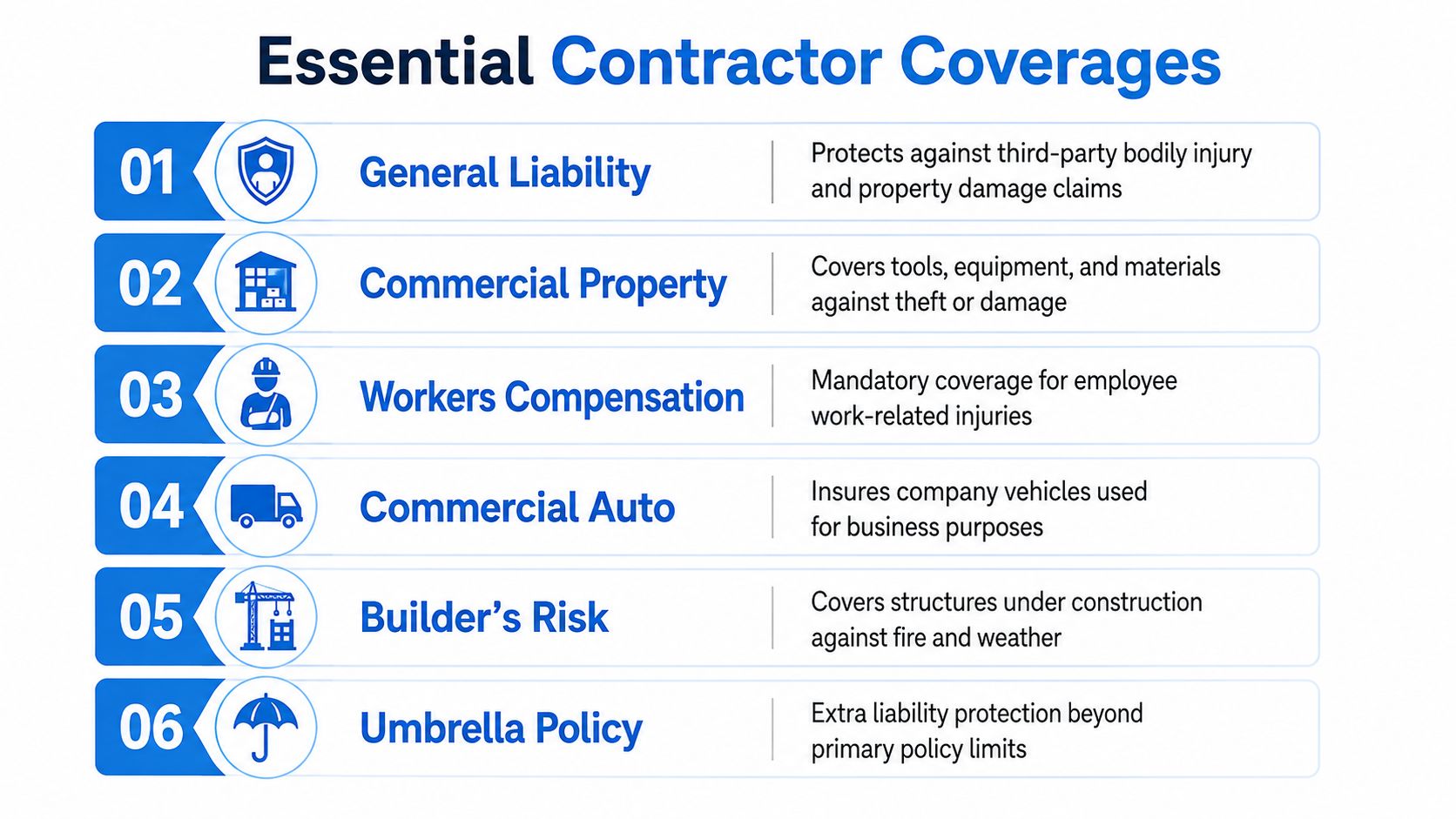
Construction insurance is a coordinated program, not a single policy. General liability may address a third-party injury, but it does not automatically cover every vehicle accident, employee injury, design error, damaged tool, or contractual obligation. Coverage should reflect the work a Honeoye Falls contractor performs, the contracts it accepts, and the carrier capacity available for that type of operation.
General liability
Commercial General Liability, or CGL, is the main protection for third-party bodily injury and property damage claims. A customer could trip at a job site, a worker could damage a client's property, or a completed installation could later cause damage. The policy may also address personal and advertising injury, subject to its form, exclusions, and endorsements.
New York public project requirements commonly call for CGL on the ISO CG 00 01 form. Procurement documents may address premises operations, independent contractors, products-completed operations, contractual liability, and explosion, collapse, and underground exposures. They may also require minimum CGL limits of $1,000,000 to $2,000,000 per occurrence, as shown in New York state insurance requirements for contractors.
The policy name tells you very little by itself. Review limits, exclusions, additional insured wording, completed-operations protection, and any conditions tied to subcontractors. New York's Labor Law can make a claim particularly expensive, so a low premium may not be a good result if the form removes protection for the work that produces the business's revenue. A broader review of general liability insurance for contractors can help identify the terms that deserve attention.
Commercial auto
A personal auto policy generally is not designed for vehicles used primarily in business operations. Commercial auto coverage can address company vans, pickup trucks, trailers, and other vehicles used to transport workers, equipment, or materials, depending on the scheduled vehicles and policy terms.
A collision involving a delivery van could injure another driver, damage property, and generate legal defense costs while materials remain undelivered. Discuss hired and non-owned auto exposure if employees use vehicles the company does not own for business errands. Confirm that every regularly used vehicle is described accurately to the carrier.
Workers' compensation
Workers' compensation addresses covered work-related injuries to employees and supports compliance with New York contract requirements. It follows a different legal and insurance pathway from a customer, visitor, or other third-party injury.
Payroll classification matters. A carpenter, office employee, driver, and occasional laborer may present different exposures. Misclassification can create problems at audit, renewal, or claim time, particularly when payroll records do not match the work performed.
Professional liability
Professional liability, also called errors and omissions coverage, matters when a contractor provides design, specifications, engineering coordination, project management, or other professional services. General liability may respond to resulting property damage in some circumstances, but it generally does not replace coverage designed for professional errors.
A design error can cause rework, delay, or financial loss without a conventional accident involving bodily injury. Contractors advertising design-build services should describe those responsibilities before requesting quotes.
Inland marine
Inland marine coverage can protect tools, mobile equipment, materials in transit, and property temporarily stored away from business premises, subject to policy terms. Equipment may be at a job site, inside a trailer, or moving between locations when theft or accidental damage occurs.
Ask whether tools remain covered at temporary locations, whether rented equipment is included, and how the policy treats unattended vehicles or trailers. This explanation of inland marine coverage offers useful context for reviewing mobile contractor property.
Bonds
Bonds are not insurance. A bond can support a contractual promise, such as completing work or paying certain obligations, while insurance transfers specified risks of loss. Public and private construction contracts may require different bonds, so review the agreement before bidding.
The practical goal is coordination. Liability, auto, workers' compensation, professional liability, mobile property coverage, and bonds should describe the same operations and project responsibilities. That consistency gives the broker and carrier a clearer basis for evaluating risk, particularly when local underwriting capacity is limited.
Navigating New York Licensing and Certificate Requirements
A Honeoye Falls contractor can have the right policy and still lose a bid because the certificate, endorsement, or workers' compensation documentation is missing. New York's Labor Law also makes certificate review more than paperwork. A serious job-site injury can produce a high-severity claim, and an owner or general contractor may scrutinize every insurance condition before allowing work to begin.
Prepare documentation before bidding
Start with the contract, bid specifications, or owner requirements. Review each requested item with your insurance advisor:
- CGL form: Confirm whether the project requires the ISO CG 00 01 form or another specific form.
- Limits: Compare the required per-occurrence and aggregate limits with the limits currently available.
- Additional insured wording: Check whether the owner, general contractor, municipality, or another party must be added. Confirm whether the requirement applies to ongoing operations, completed operations, or both.
- Completed operations period: Identify how long protection must remain available after the work ends.
- Workers' compensation proof: Prepare the required evidence before submitting the bid.
- Disability benefits proof: Include evidence of disability benefits coverage when the contract requires it.
New York state contract templates require proof of workers' compensation and disability benefits at bid, renewal, and upon request, according to the state's contractor insurance requirements. Documentation is part of project readiness. Waiting until after work begins can delay approval or leave a contractor unable to meet the contract.
Match the policy to the obligation
Send the complete insurance requirements to your advisor before signing. The advisor should verify that the policy includes the requested endorsements, that the limits apply as required, and that exclusions do not undermine the contract's protection.
A certificate cannot fix a coverage gap. If the project calls for specific additional insured wording or completed-operations protection, the endorsement must be reviewed and issued before work starts. Local contractors may also face limited carrier appetite, so an unusual trade, large limit, or demanding contract can take longer to place in the Honeoye Falls market.
Keep records current
Maintain a project file with the contract, certificate, endorsements, subcontractor certificates, workers' compensation documentation, and insurance-related correspondence. Review it when the scope changes, a subcontractor is added, or the completion date moves.
A certificate helps prove insurance exists. The policy and endorsements determine what the insurance can actually do.
Understanding Contractor Insurance Costs in New York
New York contractors need to budget for insurance as an operating expense that affects estimating, cash flow, and bid decisions. A quote that looks manageable at renewal can change when payroll, vehicle use, project types, claims, limits, or market appetite changes.
One 2025 industry analysis reported that New York contractors typically spend 7% to 10% of revenue on insurance, compared with a 3% to 5% national average. The same analysis reported 2025 rate changes of approximately 12% for general liability, 8% for commercial auto, 10% for workers' compensation, and 15% for builder's risk in New York. Those figures are discussed in the 2025 contractor insurance market analysis.
What drives the premium
The rate isn't determined by revenue alone. Underwriters usually want to understand:
- Trade mix: Roofing, excavation, foundation work, remodeling, electrical work, and other trades carry different loss patterns.
- Payroll and subcontractors: The amount of employee labor and the use of subcontractors affect workers' compensation and liability evaluation.
- Vehicle exposure: Vehicle count, driver history, radius, cargo, and usage can influence commercial auto pricing.
- Project profile: Residential, commercial, public, renovation, and new construction work may require different underwriting treatment.
- Claims history: Prior losses can affect both price and carrier availability.
- Contract requirements: Higher limits, special endorsements, and completed-operations obligations can increase the cost of a program.
- Carrier appetite: A carrier willing to write the trade and territory may offer a different structure from a carrier avoiding that exposure.
Build insurance into every estimate
A contractor who treats insurance as an afterthought can underprice a project before the first worker arrives. Include the cost of required liability limits, workers' compensation, auto, builder's risk, bonds, and any project-specific endorsements in the estimating process.
The right comparison isn't the lowest premium. Compare the total cost of risk, including deductibles, excluded operations, uninsured subcontractor exposure, limits, and the possibility that a policy won't satisfy the owner's contract.
For payroll-related planning, contractors can review workers' compensation insurance for New York small businesses and then ask how employee classifications and projected payroll will affect the program.
Use ranges carefully
There isn't one reliable price range for every Honeoye contractor. A small interior remodeler, an excavation business, and a contractor operating several commercial vehicles can have very different exposures even if their annual revenue is similar.
Request quotes using the same operations description, payroll information, vehicle schedule, limits, and contract requirements. Otherwise, the cheapest proposal may be the one that leaves out a coverage the other proposals included.
Avoiding Common Coverage Exclusions That Cost Claims
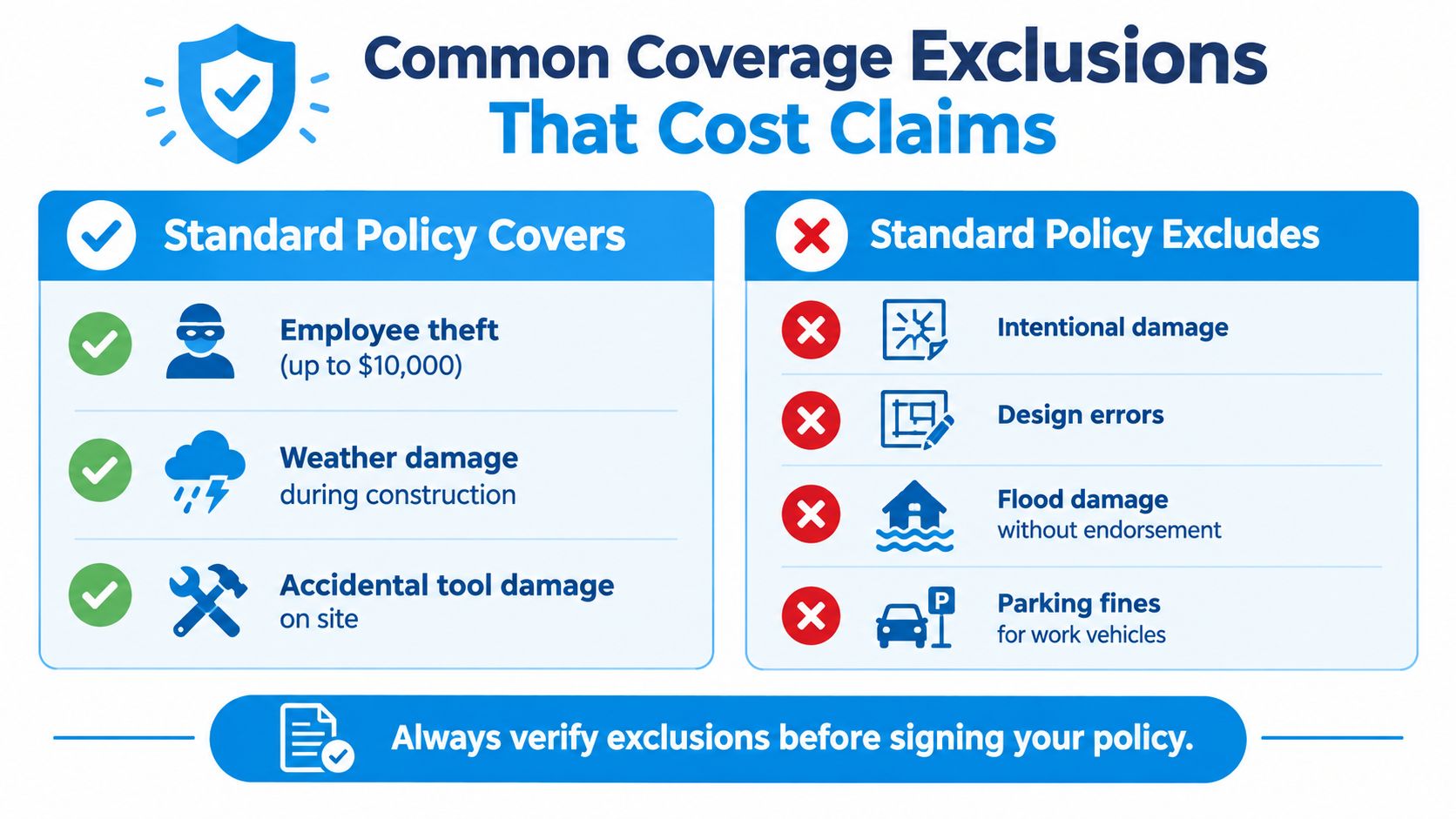
A construction-related claim isn't automatically a covered claim. The policy responds according to its wording, endorsements, definitions, and exclusions. Contractors who read only the declarations page may miss restrictions that apply directly to their most common jobs.
Excavation and underground work
An excavation or foundation contractor can face allegations involving damaged utilities, subsidence, collapse, or damage to the precise area being worked on. Standard liability language may restrict protection for some of these situations, especially when the loss falls within an exclusion for underground property or operations on the area being worked.
The solution isn't to assume that a broad policy name covers the exposure. Review the collapse, underground, subsidence, and damage-to-property wording with someone who understands the trade. This analysis of common construction liability exclusions explains why construction-related claims can still fall outside standard coverage.
Roofing and residential construction
Roofing work can involve height, water intrusion, completed operations, subcontractor use, and damage to the structure under repair. A residential contractor may also encounter a restriction that limits or excludes residential construction, especially if the policy was written around commercial work.
A contractor who occasionally accepts residential jobs should disclose that work before binding coverage. “Occasional” doesn't guarantee coverage if the policy specifically excludes the operation.
Subcontractor-caused damage
A general contractor may assume a subcontractor's mistake belongs entirely to the subcontractor. That assumption overlooks contractual obligations, additional insured requirements, indemnification provisions, and the possibility that the subcontractor's policy won't respond as expected.
Collect certificates, but don't stop there. Verify that the subcontractor's trade is accurately described, the policy remains active, and the contract requirements are reflected in the relevant endorsements. Your own policy should also be reviewed for subcontractor-related exclusions and warranties.
Pollution and professional errors
A spill, release, mold allegation, or contamination claim may not fit within standard general liability coverage. Pollution exclusions can be broad, and the response may depend on the substance, location, timing, and services performed.
Design errors present a different problem. A contractor that provides plans or professional recommendations may need professional liability rather than relying on CGL. General liability is designed primarily around certain bodily injury, property damage, and personal injury exposures, not every financial loss connected to a construction mistake.
Compare the policy to the actual work
Use a simple coverage review before renewal or a major contract:
| Actual operation | Wording to examine |
|---|---|
| Excavation or foundation work | Underground, collapse, subsidence, and utility damage |
| Roofing | Height, completed operations, water damage, and subcontractors |
| Residential remodeling | Residential construction and work area exclusions |
| Design-build services | Professional liability and design responsibility |
| Material handling | Property in transit, installation, and care custody or control |
| Environmental work | Pollution exclusions and any available specialty protection |
Policy review habit: Ask, “What is the most expensive mistake this business could make, and where does the policy address it?”
The declarations page shows the broad outline. The endorsements often determine the result.
Getting Your Honeoye Contractors Insurance Quotes
Competitive quotes start with accurate information. If one application describes the business as “general contractor” and another explains that the company performs residential remodeling, roofing, and occasional excavation, the proposals may not be comparable.
Assemble a usable submission
Prepare the information an underwriter needs before requesting quotes:
- Describe the work precisely. List the trades performed, the percentage of revenue from each, and any services involving design, supervision, excavation, roofing, or structural work.
- Separate employees from subcontractors. Provide payroll by role and explain how subcontractors are selected, contracted, and verified.
- List vehicles and equipment. Include company vehicles, trailers, mobile tools, rented equipment, and where those items are stored.
- Gather contract requirements. Include current certificates, additional insured wording, required limits, and completed-operations provisions.
- Organize claims history. Explain what happened, what changed afterward, and whether any loss involved a coverage dispute.
- Document safety practices. Written procedures, training records, site inspections, and subcontractor controls can help an advisor present the business accurately.
Ask the same questions of every quote
Price comparisons only work when the coverage is aligned. Ask each advisor to identify the form, exclusions, endorsements, limits, deductibles, and assumptions used in the proposal.
Important questions include:
- Does the policy cover every trade the business performs?
- Are residential, roofing, excavation, or underground operations restricted?
- How are subcontractors treated?
- Does the additional insured wording meet the project contract?
- Are completed operations available for the required period?
- Are tools and equipment covered away from the premises?
- Which vehicles and drivers are included?
- How will claims be reported and managed?
Online forms can be convenient for straightforward risks, but complex construction operations often need a detailed conversation. A local independent agency may also be able to approach multiple carriers and explain why one market is willing to consider a particular trade while another is not.

Don't choose on premium alone
A quote with a lower premium may carry a narrower operations description, lower limits, a restrictive endorsement, or a deductible that changes the business's real exposure. Compare the proposals line by line, then ask what happens if the claim involves the exact area being worked on, a subcontractor, a completed project, or a vehicle used for business.
The best quote is the one that fits the contract, the trade, and the business's ability to absorb an uncovered loss.
Partnering with Mitchell-Joseph Insurance Agency
Honeoye contractors need an insurance partner that can discuss both local service and difficult market conditions. Mitchell-Joseph Insurance Agency is an independent, family-owned brokerage serving Honeoye Falls, Pittsford, Rochester, and nearby New York communities. Its business insurance work includes general liability, commercial property, commercial auto, workers' compensation, professional and product liability, cyber liability, and business umbrella coverage.
A practical review should begin with the contractor's operations, not a preselected package. The advisor can then evaluate available carrier options, check contract requirements, identify exclusions, and coordinate the policies that need to work together. Responsive claims guidance also matters, because a contractor often needs help interpreting an incident and preserving records before the insurer completes its review.
The agency offers online quote requests and neighborhood office access for contractors who prefer to discuss their operations directly. That combination can help a Honeoye business prepare a clearer submission and make a more informed decision than comparing premium totals alone.
Mitchell-Joseph Insurance Agency offers contractor insurance programs that can bring together general liability, commercial property, workers' compensation, commercial auto, and other construction-related coverages. Visit Mitchell-Joseph Insurance Agency to request a quote and review whether your current protection matches your Honeoye work, contracts, and New York exposures.