You've got a storefront remodel on Main Street, a wiring crew heading to Cheshire, and a general contractor asking for certificates before anyone steps onto the site. The premium looks manageable until the contract calls for specific additional-insured wording, the workers' compensation audit asks about a 1099 electrician, and the commercial auto quote arrives higher than expected.
That's the reality behind Canandaigua contractors insurance. A policy has to satisfy New York rules, municipal contract requirements, and the actual exposures of work around Ontario County and the Finger Lakes. The right question isn't “What's the cheapest premium?” It's “Will this policy respond when a subcontractor causes damage, a worker gets hurt, a truck is involved, or a defect appears after completion?”
Table of Contents
- Why Canandaigua Contractors Need the Right Insurance Mix
- The Eight Coverages Every Contractor Should Understand
- New York and Local Rules That Shape Your Policy
- What Contractors Insurance Costs in Upstate New York
- The 2026 Market Reality for Contractors
- Smart Ways to Lower Risk and Premiums
- Comparing Quotes and Taking the Next Step
Why Canandaigua Contractors Need the Right Insurance Mix
A fire starts during a kitchen renovation, a delivery truck backs into a client's property, or a worker alleges an injury after leaving the site. The claim may involve your crew, a subcontractor, the property owner, and a general contractor at the same time. A solid Canandaigua contractors insurance program addresses New York rules, municipal contract requirements, and the actual exposures of work around Ontario County and the Finger Lakes.
Construction is a major insurance market in New York. In 2017, construction put in place in the state totaled about $129 billion, roughly 3% of gross state product. Specialty trade contractors represented about two-thirds of construction firms and produced almost half of construction value. Construction also accounted for 30% of premiums in New York's excess-and-surplus market, according to New York construction and E&S market data.
That scale shapes underwriting even for a small Canandaigua contractor. Carriers, agents, general contractors, municipalities, and project owners rely on standardized requirements because construction claims can involve several businesses, overlapping contracts, and injuries reported long after the work ends.
A general contractor has the broadest coordination burden. You control the site, hire multiple trades, accept contractual liability, and may face a claim tied to a subcontractor whose certificate appeared acceptable. A specialty trade contractor has a narrower operation, yet may work inside occupied buildings, near expensive mechanical systems, or in locations where one mistake damages property beyond the immediate work area.
A solo operator faces a different set of gaps. Even without employees, the business may need coverage for commercial vehicle use, tools stored at jobsites, contract obligations, and disputes over independent-contractor status. A low premium does not solve those problems if the policy classifies the work incorrectly or excludes the activity that produces the claim.
Seven decisions to make before renewal
Before renewing or bidding a project, answer these questions:
- General liability limits: Does the contract require a specific per-occurrence limit, aggregate structure, or completed-operations protection?
- Commercial auto: Are trucks, trailers, personal vehicles used for business, hired vehicles, and employee vehicles classified correctly?
- Workers' compensation: Who is an employee, who is a subcontractor, and what records support that distinction?
- Tools and equipment: Are mobile tools covered away from your premises, and should high-value items be scheduled?
- Builders risk: Does the owner or lender require coverage for the structure, materials, and work in progress?
- Bonds and professional liability: Does the work involve public projects, design-build services, performance, payment, licensing, or errors-and-omissions obligations?
- Umbrella liability: Does excess coverage follow the underlying policies, and are its attachment points high enough for a serious claim?
Practical rule: A certificate proves that a policy exists. It does not prove that the policy satisfies the contract.
For Canandaigua and Finger Lakes contractors, insurance supports contract acceptance, keeps projects moving, and funds a defense when an owner, tenant, employee, or injured third party alleges that the work caused harm. Judge quotes by coverage wording and attachment points, not premium alone.
The Eight Coverages Every Contractor Should Understand
A contractor can carry every standard policy and still miss the requirement that stops a job from starting. Coverage must match the contract, the work, and the point where a serious claim reaches the business. In Canandaigua and across the Finger Lakes, review wording and attachment points before comparing premium.
General liability
Commercial general liability responds to third-party bodily injury, property damage, and personal or advertising injury arising from covered operations. Remodelers, builders, and specialty trades should require an occurrence-based form, suitable completed-operations protection, and additional-insured wording that matches the contract.
Public and municipal work can require the ISO CG 00 01 form with $2,000,000 per occurrence in some settings, plus premises operations, independent contractors, products-completed operations, contractual liability, and cross-liability provisions, as shown in New York public-project insurance requirements. Read the endorsements and exclusions. A declarations page does not show how the policy will respond to the claim. This general liability insurance guide for contractors provides useful questions, but the project contract controls the final structure.
Commercial auto
A personal auto policy can leave a major gap when a vehicle is used for paid contracting work. Commercial auto should identify owned vehicles, trailers, hired vehicles, and non-owned vehicles used by employees or subcontractors.
Winter routes between Canandaigua, Geneva, and nearby job locations add severity concerns. Underwriters will examine vehicle schedules, driver records, loading practices, and the way tools or materials are transported. Classify business use accurately before a loss exposes a coverage problem.
Workers' compensation
Workers' compensation pays covered job-related injury benefits and wage-loss benefits for employees. Payroll classification drives the audit, so an inaccurate description of carpentry, masonry, roofing, excavation, or other work can create an unexpected bill.
New York coverage rules and worker status must be reviewed before relying on a subcontractor arrangement. Use the New York Workers' Compensation Board class-code resources when checking how the business and its payroll are classified. General contractors should document who performs the work, collect certificates, and keep contracts and payroll records together.
Tools and equipment
Tools, mobile equipment, and materials need protection while they move from the shop to a jobsite or remain at a temporary location. Inland marine coverage can address property in transit and equipment away from the scheduled premises.
Excavators, landscapers, concrete contractors, and carpenters should check theft, transit, rented equipment, and replacement valuation. A blanket limit may work for ordinary tools, while high-value equipment may need scheduling. Confirm whether unattended equipment, theft from vehicles, and newly acquired items are covered.
Builders risk
Builders risk protects covered property during construction. Depending on the project, that can include the structure, materials, temporary works, and certain soft costs. The owner, lender, and general contractor may assign the responsibility differently, so the construction contract must state who buys the policy and when coverage begins and ends.
Lake-region weather makes exclusions and deductibles important. Freezing conditions, water intrusion, and snow-load concerns can affect a claim even when the headline premium looks attractive. Review vacancy, theft, delay, and protective-safeguard provisions before work begins.
Bonds
License and contract bonds support financial and contractual obligations. Public work may require bid, performance, or payment bonds, and municipalities can impose project-specific requirements before completion or occupancy.
Bond underwriting considers financial records, work history, backlog, and the contractor's ability to complete the job. Start the request early. A bond is a separate financial commitment, not an endorsement added to a liability policy.
Professional liability
Professional liability, also called errors and omissions coverage, applies when a contractor designs, specifies, consults, or makes professional decisions. Design-build remodelers, HVAC designers, engineers, and contractors selecting systems for a client should not assume CGL will address a claim alleging that the design caused financial loss.
Check whether the form is claims-made, how the retroactive date operates, and whether subcontracted design work is included. The policy should match the services described in the contract and the actual work performed.
Umbrella liability
An umbrella adds limits above selected underlying policies, but it responds properly only when those policies and exclusions align. Review attachment points, auto requirements, completed operations, subcontractor provisions, and restrictions on high-hazard work.
In the 2026 market, casualty, auto, and umbrella costs are putting more pressure on contractor budgets, while property terms are improving in some accounts. That makes the umbrella's attachment point and follow-form language as important as its limit. A lower premium is poor value if the excess policy will not follow the underlying coverage required by the contract.
| Coverage | Typical Limit | Who Needs It Most | NY-Specific Note |
|---|---|---|---|
| General liability | Contract-driven | GCs, remodelers, specialty trades | Occurrence wording and completed operations often determine acceptance |
| Commercial auto | Vehicle and contract-driven | Contractors using trucks, vans, or trailers | Business use and driver classification must be accurate |
| Workers' compensation | Payroll-driven | Employers and contractors with crews | Employee status and payroll audits are central |
| Tools and equipment | Scheduled or blanket basis | Mobile trades and equipment operators | Confirm theft, transit, rented equipment, and valuation |
| Builders risk | Project value driven | Owners, GCs, and builders | Responsibility should be assigned in the construction contract |
| Bonds | Contract-driven | Public and bonded-project contractors | Financial strength and backlog affect eligibility |
| Professional liability | Service and design driven | Design-build and consulting contractors | CGL may not address pure professional-error allegations |
| Umbrella | Excess-limit driven | GCs and higher-hazard trades | Check attachment points and follow-form language |
New York and Local Rules That Shape Your Policy
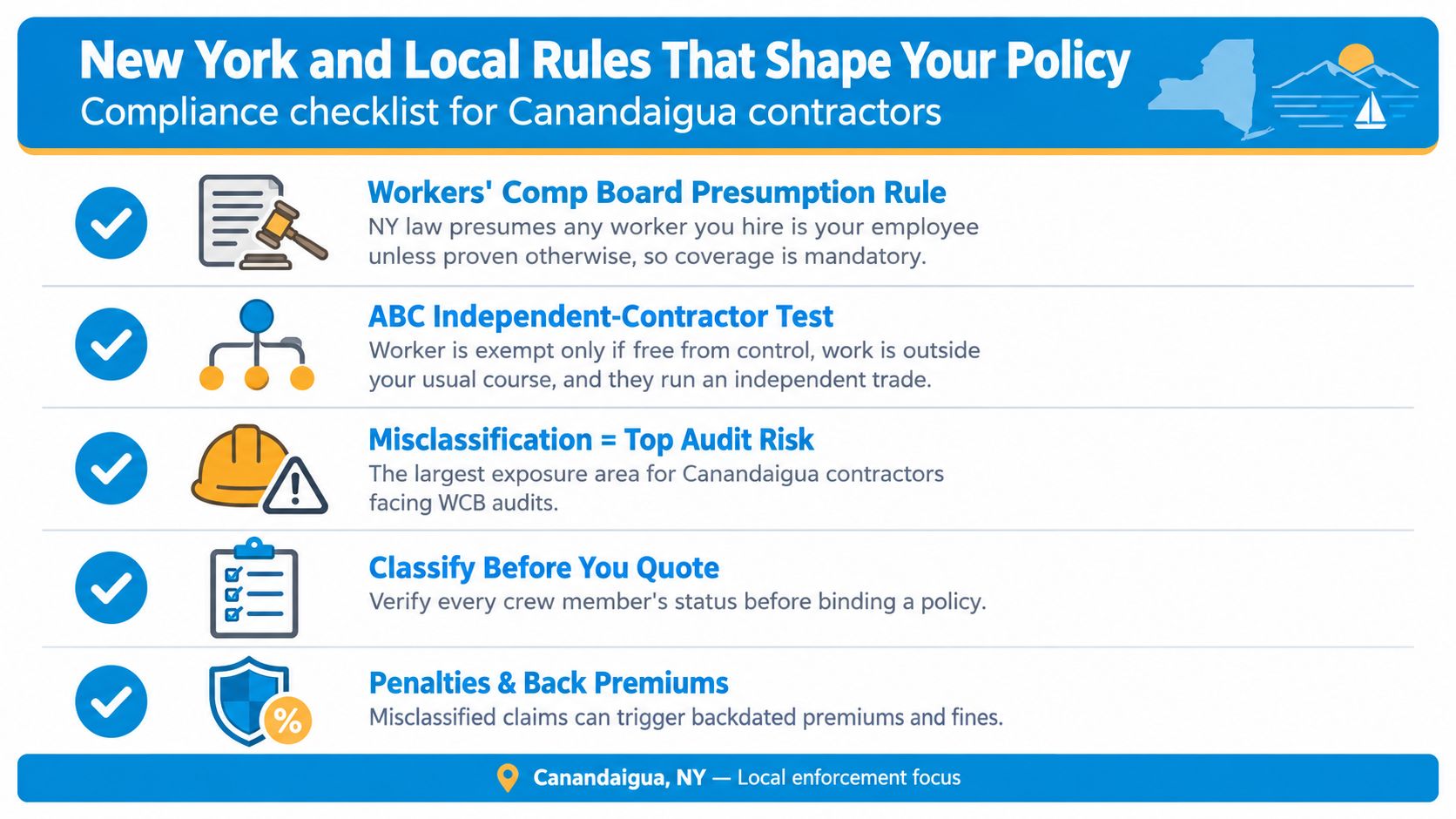
A subcontractor's invoice does not prove independent-contractor status. On a Canandaigua jobsite, the actual working relationship controls. If the contractor directs the work, provides the tools, or assigns the worker duties central to its operation, a 1099 label may not protect the business.
New York generally requires employers to carry workers' compensation coverage. The state also applies an independent-contractor test that considers control, the nature of the work, and whether the worker operates an independent trade. Misclassification can create back premiums, penalties, disputes over responsibility, and an uncovered claim.
Classification comes before the certificate
Review every 1099 arrangement against the statutory test before the worker enters a project. Do not rely on a signed waiver or invoice alone. A contractor whose operation depends on the labor may still carry responsibility for coverage, even when the worker calls the arrangement subcontracting.
General contractors should collect certificates from each subcontractor, verify effective dates and limits, and retain contracts assigning responsibility for labor and insurance. Check the subcontractor's actual operations as well as its paperwork. A certificate confirms that a policy was issued. It does not settle classification or guarantee coverage for a particular loss.
Contract language matters as much as limits
Municipal and commercial contracts commonly require occurrence-based CGL, completed-operations coverage, additional-insured status, waiver of subrogation, and primary-and-noncontributory wording. Some contracts request forms such as CG 20 10 for ongoing operations and CG 20 37 for completed operations. Read the actual agreement and endorsements. The wording, attachment point, and follow-form terms can matter more than a small premium difference, especially as casualty, auto, and umbrella costs rise while property terms improve in parts of the market.
New York disability benefits requirements also deserve review. An owner exempt from workers' compensation is not automatically exempt from every labor-related insurance obligation. Ask whether Disability Benefits Law coverage and a CE-200 filing apply to the project and business structure.
For Canandaigua work, confirm requirements from the building department, owner, lender, and general contractor before mobilization. A missing certificate, unacceptable endorsement, or required bond can delay a permit, inspection, or certificate of occupancy even when the policy is active.
Workers' compensation coverage explained for business owners provides useful background, but your classification and contract documents still require individual review.
What Contractors Insurance Costs in Upstate New York
Contractor insurance pricing depends on the work, payroll, vehicles, claims, subcontracting, and contract demands. A solo carpenter with no employees should not receive the same structure as a framing contractor running several crews. A general contractor with substantial payroll and project exposure needs still different protection.
Use these figures for planning, not as quotes. Final premiums can shift sharply when class codes, experience modification, claims, vehicle use, contract limits, or attachment points change.
| Account Profile | Annual Payroll / Revenue | Typical All-In Premium | Main Cost Drivers |
|---|---|---|---|
| Solo operator | Small or no employee payroll | $1,500 to $3,500 for $1 million CGL | Trade, vehicle use, tools, claims, contract requirements |
| Multi-trade shop | Two to ten employees | $8,000 to $40,000 | Workers' compensation class codes, payroll, auto, subcontractors, limits |
| Mid-sized general contractor | $3 million or more in payroll | $60,000 to $150,000 or more | Payroll scale, fleet, subcontracting, claims, umbrella, project hazards |
Workers' compensation class codes often create the largest pricing swing. Underwriters also review overtime payroll, subcontractor costs, certificates, experience modification, and higher-severity work such as roofing, excavation, structural construction, and snow operations.
What moves the quote
- Payroll accuracy: Misclassified payroll can produce audit bills and undermine the policy's reliability.
- Subcontractor costs: Carriers review whether subcontractors maintain their own coverage and how much of the work they represent.
- Experience modification: A mod above 1.0 generally reflects less favorable loss experience and can raise workers' compensation costs.
- Vehicle exposure: Fleet size, driver records, travel radius, vehicle type, and winter use affect commercial auto pricing.
- Liability limits: A contract requiring $2 million per occurrence will not be satisfied by a policy built around a lower limit.
- Deductibles and territory: A higher deductible can reduce premium, provided the business can fund the retained loss.
- Prior claims: Open reserves, repeated injury patterns, and late reporting affect underwriting decisions.
In the 2026 market, judge the quote by more than its total premium. Casualty, auto, and umbrella pricing remain pressured, while property terms can improve for favorable risks. A lower property premium may come with narrower casualty wording, a higher umbrella attachment, or a restrictive exclusion.
Compare the form, endorsements, exclusions, aggregates, and attachment points before accepting a cheaper proposal. Insurance that fails contract review or leaves completed operations exposed is not a bargain.
The 2026 Market Reality for Contractors
The 2026 market is split. Property and builders risk conditions are improving for strong accounts, while casualty, auto, and excess liability remain difficult. Industry reporting describes construction casualty rates as flat to up 5%, general liability as flat to up 10%, commercial auto as up 5% to 20%, and excess liability as up 5% to 30% for higher-hazard contractors, as reported by construction casualty market coverage.
A separate construction insurance market report describes construction starts as up 8.1% in the 12 months ending April 2026 and says capacity and pricing have improved for strong property risks while catastrophe-exposed and complex accounts still face underwriting discipline. Those are market observations, not a promise that a Canandaigua contractor will receive a reduction.
Why a cheaper property quote can mislead
A carrier may compete aggressively on builders risk or commercial property while tightening casualty terms. The result can be a lower property premium paired with a higher auto renewal, a narrower CGL form, a larger umbrella attachment, or a restrictive defect exclusion.
Read the policy for water damage, weather, ordinance or law, vacancy, protective safeguards, defective work, and completed operations. A rate improvement doesn't compensate for a sublimit that prevents the business from recovering enough to rebuild.
Compare the attachment, not just the umbrella limit
Umbrella limits matter only above the point where the umbrella attaches. Check which underlying policies qualify, whether the umbrella follows form, and whether it excludes work performed by subcontractors, residential construction, snow operations, design work, or specific vehicle classes.
Coverage decision: In 2026, the strongest quote is the one that preserves the required trigger, endorsements, and attachment structure while pricing the actual exposure honestly.
For owners bidding spring work, obtain the contract insurance specifications before requesting quotes. Ask every carrier to quote identical limits and forms, then compare exclusions line by line. A premium comparison without a wording comparison is incomplete.
Smart Ways to Lower Risk and Premiums
The best savings usually come from making the account easier to underwrite, not from stripping away protection. Carriers respond better when a contractor can show consistent hiring, training, vehicle, subcontractor, and claim-reporting practices.
Build an underwriting file that tells the right story
Keep a written safety program that matches the work you perform. Maintain training logs, daily vehicle inspections, driver screening records, equipment maintenance records, and documented jobsite procedures. For contractors using connected vehicle monitoring, use the information to correct speeding, harsh braking, idle time, and unsafe routes rather than collecting data without follow-through.
Subcontractor screening deserves the same discipline. Collect certificates before work starts, verify additional-insured requirements, confirm workers' compensation status, and keep signed agreements that allocate responsibility. Those records help with both claims handling and audits.
Cyber basics also matter for contractors that handle payroll, payment instructions, customer data, or project files. Use access controls, multifactor authentication, offline backups, and a process for verifying payment-change requests.
Use policy design carefully
Ask about pay-as-you-go workers' compensation when cash flow and payroll volatility make large deposits difficult. Consider a higher CGL deductible only when the company has a funded reserve and understands whether the deductible applies per claim or per occurrence.
Schedule valuable equipment instead of assuming a blanket tools limit is sufficient. For recurring jobs, blanket additional-insured arrangements may simplify administration, but contracts should still control the exact parties, operations, and duration. A stand-alone umbrella can work well when it follows the underlying policies and includes the contractor endorsements your jobs require.
A modest experience-modification improvement can affect workers' compensation cost materially, but no responsible advisor should promise a fixed savings amount without reviewing payroll and loss history.
Keep false savings out of the bid
Dropping liability limits, deleting additional-insured endorsements, underinsuring equipment, or accepting an umbrella that doesn't cover the required operations may reduce premium while increasing contract and claim risk. Those changes can also create delays when a GC rejects the certificate.
Use this bid checklist before committing to a project:
- Certificate requirements: Confirm limits, effective dates, and certificate holder.
- Additional insured: Match ongoing and completed-operations wording to the contract.
- Workers' compensation: Verify coverage or a valid exemption for every labor source.
- Disability benefits: Confirm whether New York requirements and filings apply.
- Bond line: Determine whether bid, payment, performance, or license bonds are required.
- Builders risk: Assign responsibility for the structure, materials, and work in progress.
- Indemnification: Have the agent and legal advisor review insurance obligations together.
- Umbrella: Confirm the attachment point, follow-form language, and excluded operations.
For a plain-language explanation of excess protection, review what an umbrella insurance policy does.
Comparing Quotes and Taking the Next Step
Start with one specification sheet and give it to every broker. If one quote uses a lower limit, a different aggregate, a narrower additional-insured form, or a higher umbrella attachment, you aren't comparing prices. You're comparing different products.
Give the broker a complete submission
Prepare these documents before requesting terms:
- Five years of currently valued loss runs.
- The current declarations pages and policy forms.
- Payroll separated by class and employee role.
- Vehicle schedules, usage details, and driver information.
- Existing certificates showing additional-insured wording.
- A list of general contractors, owners, and municipalities requiring specific terms.
- A description of design, excavation, roofing, snow, residential, or other higher-hazard work.
- Current backlog, subcontractor practices, and project locations.
Ask for an occurrence-based CGL using the required form and endorsements, commercial auto on the appropriate business auto form, workers' compensation on an approved New York form, contractors equipment protection, and an umbrella with contractor-specific wording. If the company performs design-build work, request contractors professional liability as a separate line rather than assuming CGL responds.
Compare fields line by line
| Coverage Line | Quote A | Quote B | Notes |
|---|---|---|---|
| CGL occurrence form | Confirm trigger, limits, aggregates, and exclusions | ||
| Completed operations | Check duration and project or aggregate restrictions | ||
| Additional insured | Compare ongoing and completed-operations endorsements | ||
| Commercial auto | Review vehicle schedule, hired and non-owned auto, and drivers | ||
| Workers' compensation | Verify class codes, payroll basis, and audit terms | ||
| Tools and equipment | Check theft, transit, rented equipment, and valuation | ||
| Builders risk | Confirm covered property, deductibles, and project responsibility | ||
| Professional liability | Review design-build and service exclusions | ||
| Umbrella | Compare attachment points, follow-form terms, and exclusions | ||
| Bonds | Confirm required bond types and underwriting capacity |
An independent agency can approach multiple markets using the same specifications. Mitchell-Joseph Insurance Agency offers contractor programs that combine general liability, commercial property, workers' compensation, and related coverages, with options for specialty contracting operations. The useful test is whether the advisor can explain why one form fits your contract better than another, not how many quotes were collected.
Once you choose terms, bind coverage before the crew mobilizes, issue certificates with accurate wording, and request endorsements early. Keep a project file containing the contract, certificate, subcontractor documents, waiver requirements, and any mid-term changes. That process prevents the common Finger Lakes jobsite problem: coverage exists, but the paperwork doesn't match the work.
If you're bidding work in Canandaigua or elsewhere in the Finger Lakes, have an advisor review your current declarations, subcontractor process, and upcoming contract specifications before renewal. Visit Mitchell-Joseph Insurance Agency to request a contractor insurance review focused on wording, limits, attachment points, and certificates that will stand up to the job.