You're halfway through a bathroom renovation in East Bloomfield when the general contractor hands you a subcontractor agreement and says the paperwork must be complete by Friday. It calls for commercial general liability, workers' compensation, commercial auto, and an additional-insured endorsement. The certificate of insurance in your truck satisfies the homeowner, but it doesn't satisfy the contract.
Then the problems multiply. The GC's risk manager rejects the basic certificate, the bank holds the final draw until coverage is updated, and the permit office flags an expired policy. Nobody is arguing about the quality of your work. The job is stalled because your insurance documents don't match the people and contracts involved.
That's the practical reality of East Bloomfield contractors insurance. A policy isn't just a premium and a certificate. New York compliance paperwork, subcontractor transfers, endorsements, limits, exclusions, and proof-of-coverage requests determine whether you can start work and whether a future claim gets paid.
Table of Contents
- The Tuesday That Changed How You Think About Coverage
- What Contractors Insurance Actually Covers
- New York Rules Every East Bloomfield Contractor Must Know
- What Drives Your Premium in New York
- Job-Site Habits That Lower Your Risk
- How to Compare Quotes the Right Way
- Why a Local Independent Broker Earns the Fee
- Your Next Steps and Quick Reference Checklist
The Tuesday That Changed How You Think About Coverage
The contractor in this situation isn't careless. He has a liability policy, pays his premium, and keeps a certificate in the truck. His mistake is assuming the certificate proves everything the contract requires.
It doesn't. A certificate is evidence that a policy exists on a particular date. It usually doesn't change the policy, grant additional-insured status, add primary and noncontributory wording, or create a waiver of subrogation. Those protections must appear in the policy endorsements or other binding documents.
Practical rule: A certificate can confirm coverage. It can't manufacture coverage that the policy doesn't contain.
The GC's agreement may also require limits that exceed the contractor's everyday residential work. Public and institutional contracts can set substantially higher benchmarks. New York State contract language may require commercial general liability of at least $2 million per occurrence, along with an insurer rated A- Class VII or better by A.M. Best. Some institutional standards also call for $2 million of automobile liability per occurrence and owners-and-contractors protective liability of $3 million per occurrence and $5 million aggregate. New York State insurance requirements show why a small contractor shouldn't assume a standard package will satisfy every project.
The paperwork problem often appears at the worst possible time. A GC wants an updated certificate before mobilization. A lender wants current proof before releasing money. A municipality or building department wants documentation before approving a permit or inspection. A subcontractor's missing workers' compensation proof can create exposure for the hiring contractor, even when the subcontractor promised to handle it.
The conversation you want happens before bidding. Review the contract, identify every required coverage and endorsement, confirm who must carry each policy, and check whether the requested limits match the work. That process costs far less than discovering a coverage gap after the crew, materials, and payment schedule are already committed.
What Contractors Insurance Actually Covers
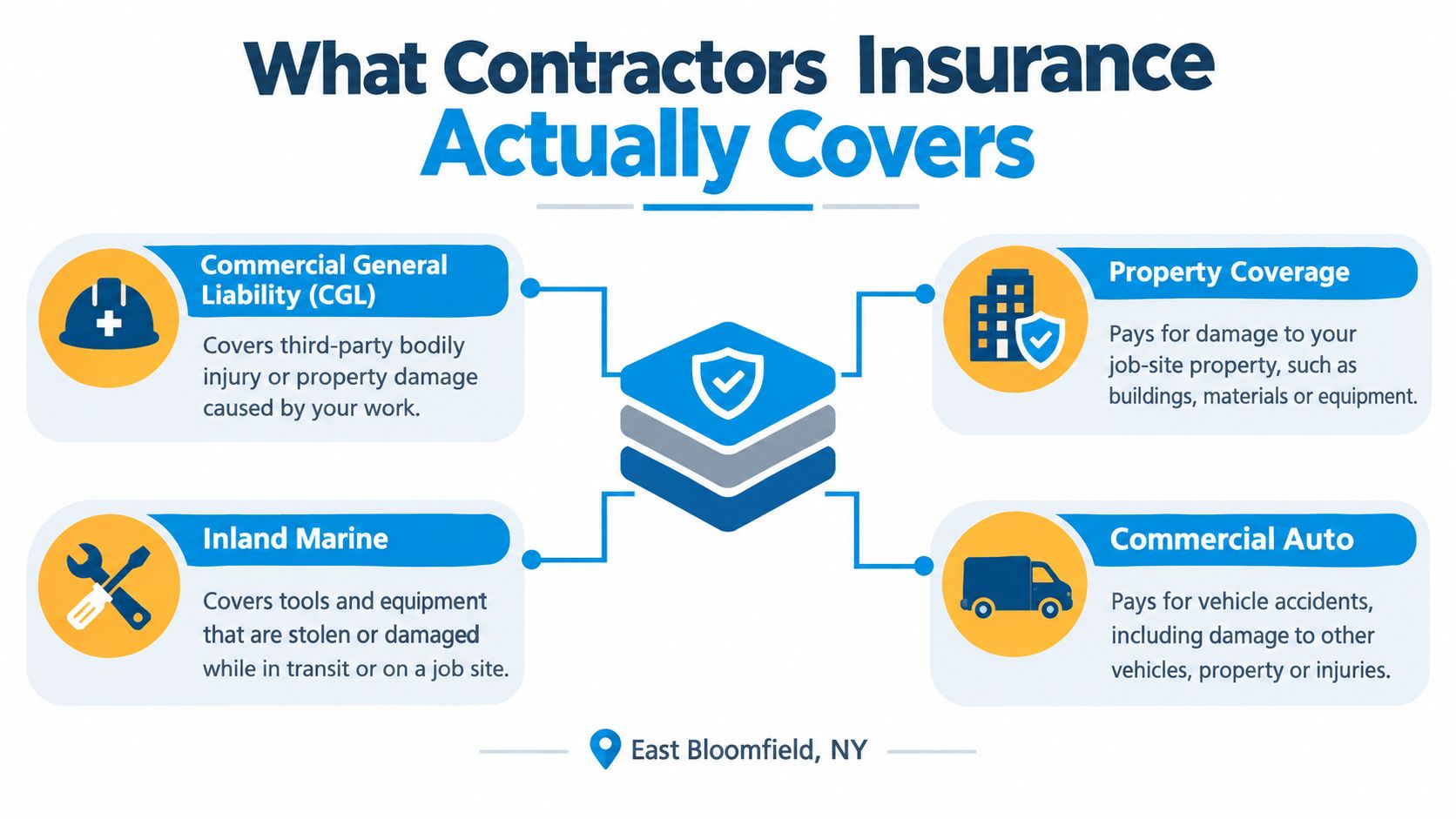
Contractors insurance is a layered package, not one policy. Each layer answers a different question: Who was injured? Whose property was damaged? Was an employee hurt? Did a vehicle cause the loss? Were tools stolen? Did the contract require a bond or special endorsement?
Liability starts with third-party damage
Commercial general liability responds to many third-party bodily-injury and property-damage claims arising from your operations. A ladder tips through a customer's bay window, a visitor trips over materials, or a plumbing mistake damages a finished room. The policy's exclusions, limits, deductible, and endorsements still matter, but this is the core protection most GCs and property owners expect.
A plumber working on a remodel may want a focused explanation of the exposures that arise from completed work and customer property. A practical resource on liability insurance for plumbers can help clarify that trade-specific perspective.
Commercial auto covers business-use vehicles according to the policy terms. That can include owned vehicles, and may include hired or non-owned vehicles when properly endorsed. If a van backs into a customer's retaining wall or a trailer-mounted mixer causes a roadway accident, personal auto coverage may not respond as the contractor expects.
Employee, equipment, and project protection
Workers' compensation handles covered workplace injuries for employees, including medical care and wage benefits under the law. If an employee injures a shoulder lifting tile or falls while carrying materials, workers' compensation is the relevant system, not general liability.
Disability benefits addresses qualifying off-work injuries and illnesses that aren't compensable under workers' compensation. Inland marine protects tools, mobile equipment, and materials while they're in transit or at a job site. A locked truck is broken into overnight and marked power tools disappear. The right equipment coverage may respond, subject to the scheduled property, deductible, security requirements, and exclusions.
A surety bond isn't the same as insurance. License, permit, payment, and performance bonds support contractual or municipal obligations. If a project requires a performance bond, the surety evaluates the contractor and the contract before issuing it.
Finally, umbrella liability adds limits above underlying liability policies when a covered judgment or settlement exceeds the primary limit. Professional liability matters when you provide design, engineering, specifications, or design-build services. A construction defect caused by a professional error can fall outside ordinary bodily-injury and property-damage coverage, so don't leave design responsibility buried in the proposal.
Before you bind, compare the actual policy language and endorsements through this guide to general liability insurance for contractors. The right question isn't “Do I have a certificate?” It's “Which policy responds to this specific loss?”
New York Rules Every East Bloomfield Contractor Must Know
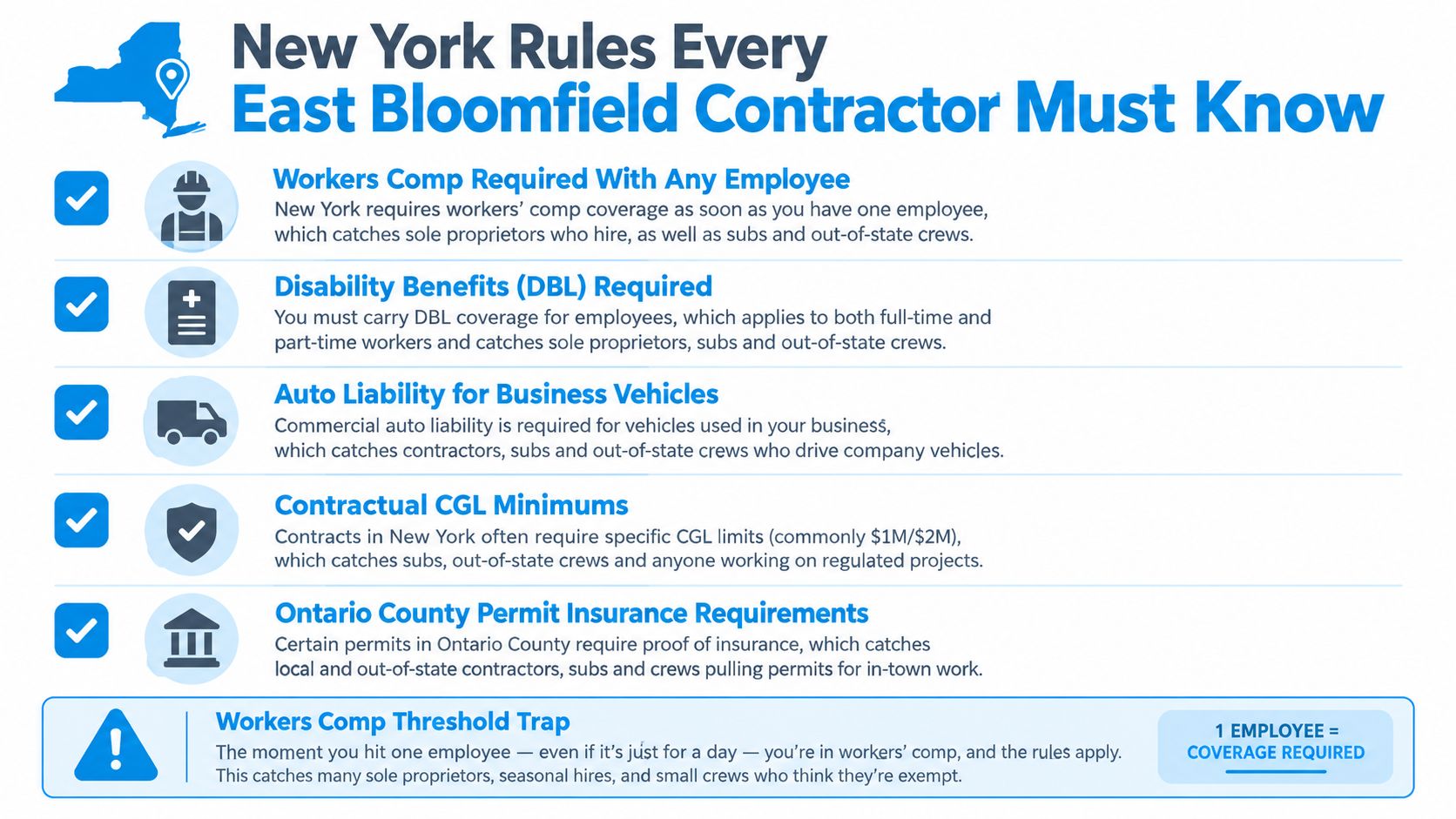
New York's compliance burden catches contractors who think insurance begins and ends with general liability. Workers' compensation is generally required when a contractor has one or more employees. New York also requires out-of-state employers with employees or subcontractors working in the state to carry a New York workers' compensation policy. Failing to maintain coverage can trigger civil penalties of up to $2,000 for each 10-day period of noncompliance, plus direct responsibility for wage, medical, and defense costs on uninsured claims. New York Workers' Compensation Board guidance explains the exposure.
The waiver is not a shortcut
A true sole proprietor or qualifying LLC member may have an exemption path, but the contractor must document it correctly. New York agencies commonly require proof of workers' compensation and disability benefits coverage, or a properly completed exemption form when the business qualifies. A homeowner's statement that “the contractor has no employees” doesn't replace the required documentation.
Disability benefits are a frequent blind spot. A quote built around general liability and workers' compensation can still omit disability benefits, even though New York compliance requests may treat the coverage separately. If you use subcontractors, verify their documentation before they arrive, not after an inspector or GC asks for it.
Proof matters at several points
New York agencies and project owners may request proof at bidding, award, renewal, or any time they need verification. New York procurement guidance also shows that proof documents, no-employee waivers, and separate workers' compensation and disability-benefit handling remain recurring administrative friction points. New York Department of Financial Services requirements are a useful reminder that coverage and documentation are separate tasks.
Keep current certificates, exemption forms, policy numbers, and endorsements in one accessible file. An expired certificate can stop a permit, delay a bid, or prevent a final inspection even when the underlying policy has renewed. Ask your broker what the town, GC, or owner specifically needs, then request the document in that exact format.
For a plain-language explanation of employee injury protection, review what workers' compensation insurance covers. New York's rule is simple enough to remember, but the paperwork needs active management.
What Drives Your Premium in New York
Premium follows exposure. A finish carpenter and a roofer may both ask for general liability, but the insurer sees different heights, injury severity, property damage potential, and completed-operations concerns. Excavation, masonry, electrical, plumbing, and HVAC work also carry trade-specific hazards that affect underwriting.
Payroll drives workers' compensation pricing. Classification matters as much as the payroll estimate. Misclassifying a field employee, office worker, or subcontractor can create an unpleasant audit adjustment. Treating every worker as an independent contractor without reviewing New York rules is especially risky.
Commercial auto pricing reflects vehicle type, use, driver history, territory, hauling, and whether the vehicle carries tools or materials. A single pickup used occasionally for local work presents a different exposure from a fleet of vans traveling to multiple sites.
Claims history, requested limits, deductibles, equipment values, and the number of certificates you need also influence the result. A contractor who supplies accurate operations details often receives a more dependable quote than one who selects a generic trade description online.
The following table is a planning framework, not a rate quote. The brief provides no verified premium ranges, so an honest broker should calculate pricing from your actual trade, payroll, vehicles, claims, limits, and contract requirements rather than promise a number.
Sample Annual Premium Ranges for NY Trades
| Coverage | Low-Trade, carpentry, painting, flooring | Mid-Trade, HVAC, plumbing, electrical | High-Trade, roofing, excavation, masonry |
|---|---|---|---|
| Commercial general liability | Obtain a trade-specific quote | Obtain a trade-specific quote | Expect underwriting to focus closely on hazard and completed operations |
| Workers' compensation | Driven by payroll and class code | Driven by payroll, class code, and field duties | Driven by payroll, class code, and severity exposure |
| Commercial auto | Driven by vehicle schedule and use | Driven by vehicle schedule, drivers, and hauling | Driven by vehicle schedule, drivers, hauling, and job-site access |
| Umbrella liability | Match to contract demands | Review with GCs and owners | Review early because higher-hazard work can require broader limits |
Don't let a low quote win before you confirm what was excluded. A cheaper policy with the wrong classification, inadequate equipment coverage, or missing endorsements can become the most expensive option after a loss.
Job-Site Habits That Lower Your Risk
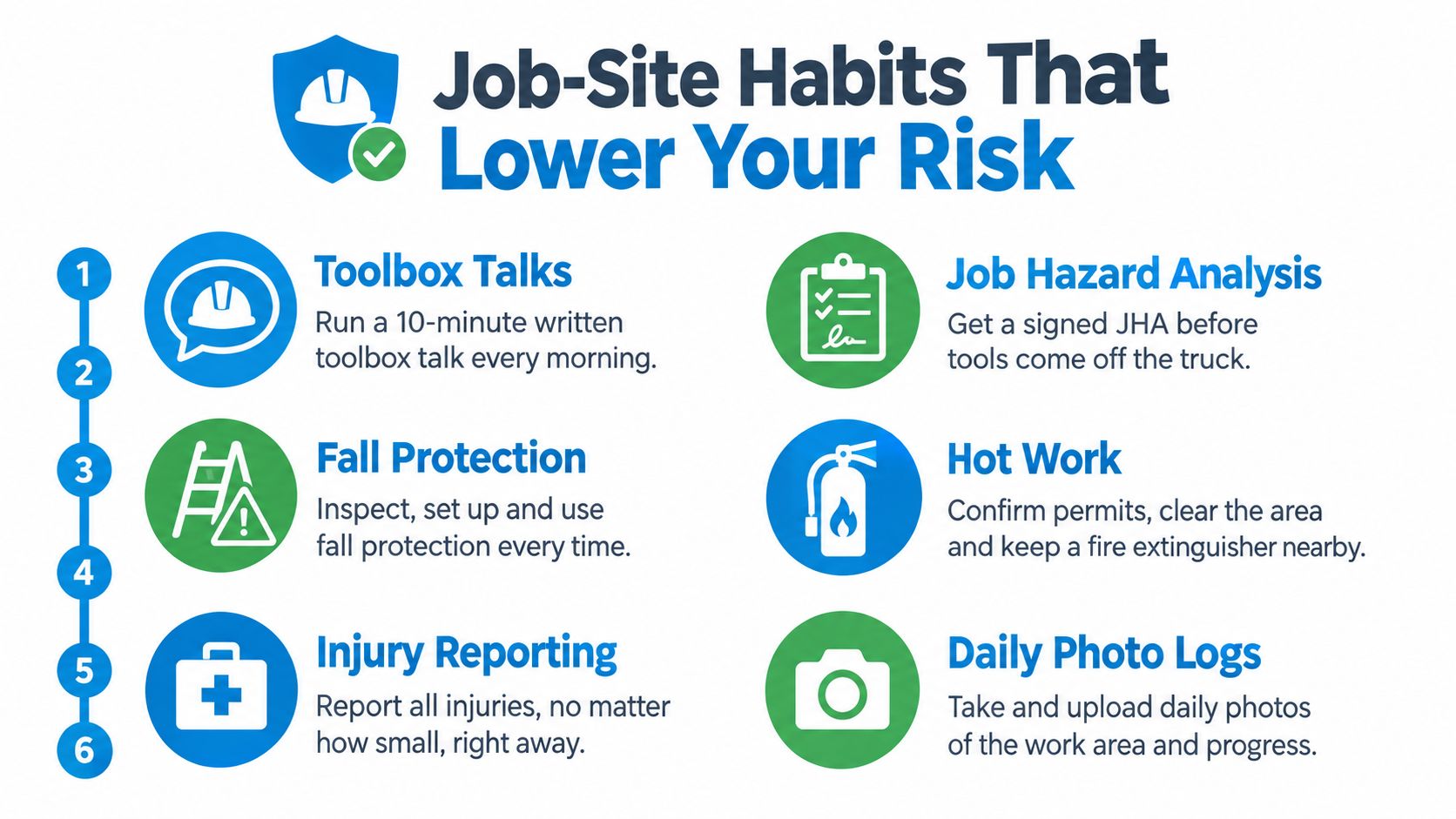
Small crews can improve their insurance profile without buying another piece of equipment. The starting point is written consistency. Run a short toolbox talk each morning, record the subject, and have attendees sign it. Complete a job hazard analysis before tools come off the truck, especially when the site changes during demolition or excavation.
Make documentation part of the work
Take photographs at the beginning, during active work, and at closeout. Photograph existing damage, utility locations, temporary protection, completed flashing, concealed work, and final cleanup. When a property owner later disputes the condition of a wall or floor, a dated photo record gives everyone something concrete to review.
Use a checklist for recurring hazards:
- Toolbox talks: Record the topic, crew, site, and follow-up action.
- Job hazard analysis: Note the hazard, control, responsible person, and completion.
- Subcontractor compliance: Collect certificates before mobilization and verify required additional-insured and waiver wording.
- Vehicle security: Lock vans and trailers, and avoid leaving loose tools visible overnight.
- Inventory control: Record serial numbers and maintain a marked equipment list.
- Injury response: Report injuries promptly and keep a written return-to-work process.
Digital workflows can make the record easier to maintain when the crew moves between sites. If you're evaluating automating site inspections for compliance, focus on whether the process captures signatures, photographs, corrective actions, and an audit trail your broker or claims representative can understand.
Subcontractor certificates deserve special attention. Require the document before work starts, confirm the policy dates, and check that the subcontractor's operations match the job. A certificate that names a company incorrectly or omits a requested endorsement creates a false sense of security.
Underwriters notice operational discipline at renewal, but the bigger benefit is practical. Good records shorten disagreements, support recovery against responsible parties, and help your crew repeat safe decisions instead of relying on memory.
How to Compare Quotes the Right Way
Two liability quotes can show the same headline limit and still protect different claims. Compare the policy forms, endorsements, classifications, and exclusions before comparing the premium.
Build one matrix for every carrier. Put the coverage categories down the left side and the quotes across the top. Then fill in the actual language, not a salesperson's shorthand.
Quote Comparison Checklist
| Line Item | Carrier A | Carrier B |
|---|---|---|
| Coverage form | Occurrence or claims-made, with reporting requirements | Occurrence or claims-made, with reporting requirements |
| Per-occurrence limit | Confirm the amount and covered operations | Confirm the amount and covered operations |
| Aggregate limit | Check whether the aggregate applies by policy, location, or project | Check whether the aggregate applies by policy, location, or project |
| Deductible or self-insured retention | Confirm what you pay before the carrier responds | Confirm what you pay before the carrier responds |
| Additional insured | Check required project, ongoing operations, and completed-operations wording | Check required project, ongoing operations, and completed-operations wording |
| Primary and noncontributory | Confirm the endorsement and contractual scope | Confirm the endorsement and contractual scope |
| Waiver of subrogation | Confirm where it applies and whether the contract permits it | Confirm where it applies and whether the contract permits it |
| Subcontractor wording | Review uninsured, underinsured, and independent-contractor provisions | Review uninsured, underinsured, and independent-contractor provisions |
| Equipment coverage | Scheduled or blanket, transit and job-site terms | Scheduled or blanket, transit and job-site terms |
| Exclusions | Review professional, pollution, earth movement, roofing, and other trade-specific exclusions | Review professional, pollution, earth movement, roofing, and other trade-specific exclusions |
| Auto | Owned, hired, and non-owned coverage, vehicle schedule, and drivers | Owned, hired, and non-owned coverage, vehicle schedule, and drivers |
| Other policies | Confirm whether cyber, pollution, or professional liability is separate | Confirm whether cyber, pollution, or professional liability is separate |
The four contractual phrases that deserve careful review are additional insured, primary and noncontributory, waiver of subrogation, and completed operations. They affect who receives protection, whose policy responds first, whether the insurer can pursue another party, and whether protection continues after the job is finished.
Check the underlying information too. Payroll, class codes, subcontractor use, vehicle details, radius, annual receipts, and project types must match across quotes. If one carrier received a fuller description of your operations, its premium may look higher because the other quote omitted exposure.
The right decision comes after alignment. Price matters, but a lower premium doesn't help if the contract endorsement is missing or a key operation is excluded.
Why a Local Independent Broker Earns the Fee
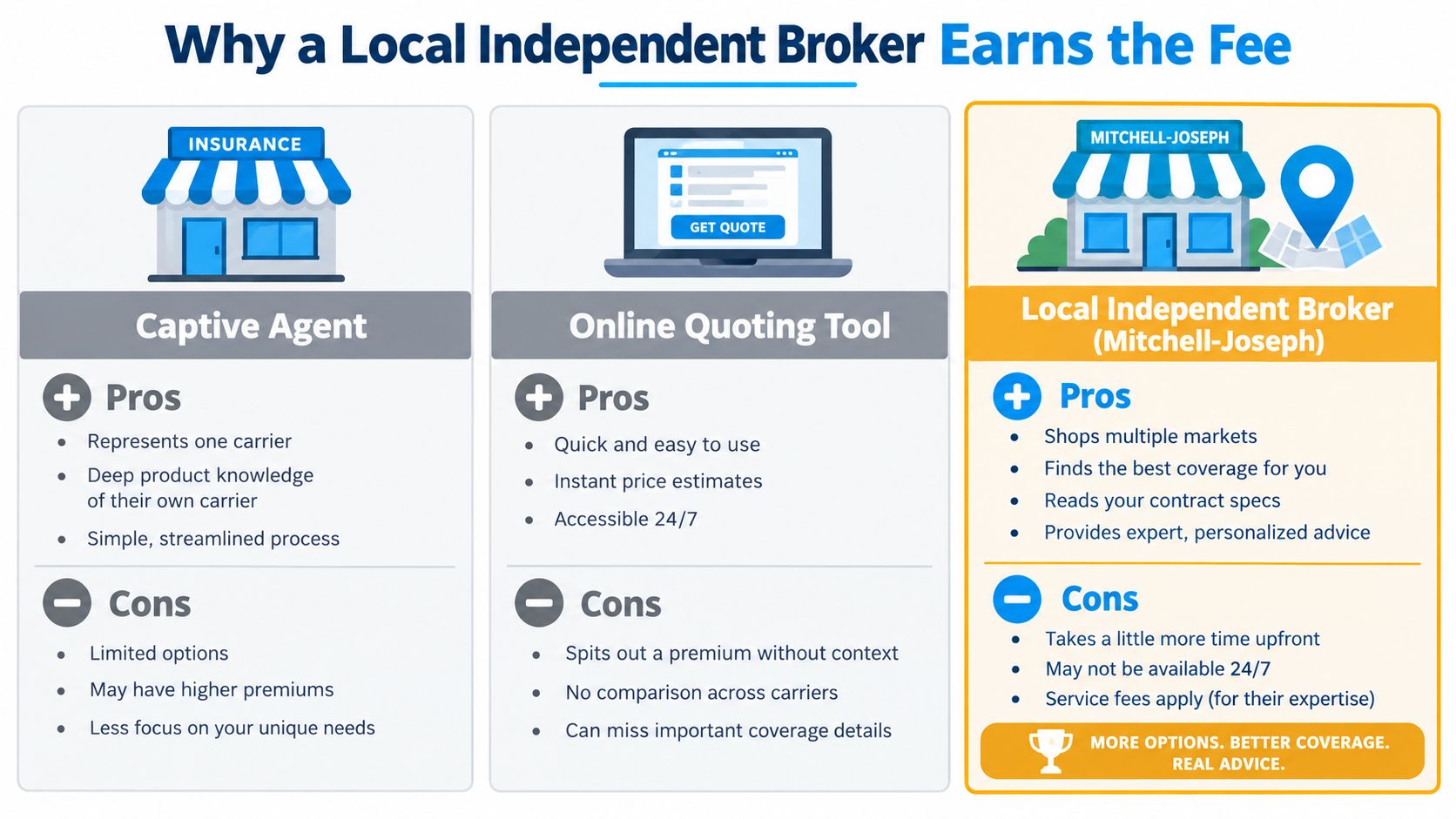
A captive agent works within one carrier's menu. An online quote tool can produce a number quickly. Neither approach necessarily reads your subcontract, questions how you classify labor, or spots an exclusion that matters to the next job.
A local independent broker can approach multiple markets and translate the contract into insurance requirements. That work has value before binding, but it matters even more afterward. Someone should review payroll classifications, update vehicle schedules, request project-specific certificates, and explain why a claim falls inside or outside the policy.
The broker's real work happens between renewals
A contractor installing smart-home systems may have a professional-services or technology-related exclusion that never appeared in a basic conversation. A foundation contractor may need to examine earth movement wording. A GC on a hospital addition may demand umbrella capacity that wasn't necessary for residential remodeling.
Those issues don't get solved by looking only at the premium. They require someone to understand the work, read the contract, and ask the carrier whether the policy responds as intended.
Mitchell-Joseph Insurance Agency is one local option that offers contractor programs combining general liability, commercial property, workers' compensation, and other construction-related coverages. The broader difference between a single-carrier representative and a market-shopping intermediary is explained in this overview of independent insurance brokers.
A useful broker should also help after a loss. If a property owner asks why a foundation crack isn't covered, the answer should come from the policy wording and endorsements, not guesswork. That same person should help assemble certificates, identify missing subcontractor documents, and prepare renewal information before the carrier asks.
Broker test: Ask what the broker will do after the policy is issued. If the answer stops at “send you the certificate,” you're buying a transaction, not ongoing coverage management.
Your Next Steps and Quick Reference Checklist
Set aside an hour this week and gather:
- Active contracts: Mark every required limit, endorsement, bond, and certificate recipient.
- Payroll records: Separate employees by class code and identify how subcontractors are documented.
- Vehicle information: Collect vehicle identification numbers, drivers, trailers, and business-use details.
- Current policy file: Include the declarations pages, endorsements, certificates, and exemption forms.
- Project details: Note residential, commercial, public, institutional, design-build, excavation, or other operations.
Send the file to a broker who can compare coverage, not just price. Before binding, confirm that general liability doesn't contain an unexpected professional-services exclusion, workers' compensation applies where your crew works, and commercial auto addresses owned, hired, and non-owned exposure as needed.
Ask for a sample certificate request and a sample claim discussion. Schedule a renewal review well before the expiration date. If a project needs a bond, start early because the surety will want financial information and contract details.
Store every policy and endorsement in one shared folder for your bookkeeper and field supervisor. The goal is simple: no stalled permit, delayed draw, rejected subcontract, or denied claim caused by paperwork nobody checked.
Mitchell-Joseph Insurance Agency offers contractor coverage reviews, including general liability, workers' compensation, commercial auto, property, and business umbrella options built for construction operations. Visit Mitchell-Joseph Insurance Agency to request a review of your current policies, contracts, and certificates before your next East Bloomfield job.