You've just won a renovation job in Avon, and the customer wants proof of insurance before you schedule the first delivery. Your general liability policy is active, but the contract also asks about completed operations, subcontractors, vehicles, and tools. A quick certificate may get you through the door, yet it won't tell you whether your policy will respond when a defect appears months after the work is finished or equipment disappears between jobs.
That's the practical challenge with Avon contractors insurance. Contractor coverage isn't one product. It's a coordinated program built around your trade, payroll, vehicles, job sites, subcontractors, tools, contracts, and the work that remains your responsibility after you leave. The right policy protects your business without paying for coverage that doesn't match how you operate.
Table of Contents
- Why Avon Contractors Face Unique Insurance Challenges
- Required and Recommended Coverages for New York Contractors
- What Drives Contractor Insurance Costs Up and Down
- Hidden Gaps in Standard Construction Policies
- Contractor Insurance Quote Checklist and Document Preparation
- Practical Strategies to Lower Your Contractor Insurance Premiums
- Next Steps Working with Mitchell-Joseph Insurance Agency
Why Avon Contractors Face Unique Insurance Challenges
A drywall contractor serving East Rochester completes a basement renovation and closes out the project. Several months later, the homeowner discovers mold behind a finished wall and alleges that the installation allowed moisture to spread. The contractor carries general liability, but his completed-operations protection lapsed during a policy change. The claim now raises a difficult question: did the policy cover damage caused by work that had already been completed, and was the relevant coverage active when the alleged damage occurred?
That scenario is more serious than a missed certificate request. A contractor can face defense expenses, remediation costs, project delays, and demands from a property owner even when the contractor believes the original work was sound. A standard business policy may address some third-party bodily injury or property damage, but it won't automatically cover every exposure created by construction work, subcontracted labor, vehicles, tools, or unfinished buildings.
A contractor policy is a bundle of decisions
General liability responds to many third-party injury and property-damage allegations arising from operations, but exclusions define where that protection stops. Workers' compensation addresses employee injuries, commercial auto handles vehicles used for business, builder's risk protects qualifying construction property, and completed operations addresses liability tied to work after you've finished it. Tools and mobile equipment may need separate property treatment, especially when they travel between jobs.
The market itself reflects this specialization. IBISWorld estimated the U.S. contractors' insurance industry at $13.7 billion in 2026, with 198 businesses operating in the segment, and tracks the category as a distinct insurance market with historical data and forecasts. Its figures also show that the number of businesses declined at a 0.9% CAGR from 2019 to 2024, while industry revenue grew 0.3% over that period. IBISWorld's contractors' insurance market profile provides useful context, but local underwriting still turns on your specific trade and operations.
Practical rule: Treat your insurance application like a job estimate. If the scope is vague, the result may be incomplete.
A cheaper policy can become the most expensive choice when it omits completed operations, restricts subcontractor work, excludes the property you're installing, or leaves business vehicles on a personal auto policy. Before comparing premiums, compare exclusions, endorsements, deductibles, and the policy's definition of covered operations.
Required and Recommended Coverages for New York Contractors
New York contractors should separate legal requirements from contract requirements and from coverage that protects the business's balance sheet. Those categories overlap, but they aren't interchangeable.
Start with the coverage that follows your work
General liability is the foundation for third-party bodily injury, property damage, and certain personal or advertising injury allegations. It may respond if a customer trips over materials, a worker damages a client's property, or an operation causes covered damage. It generally will not repair defective work just because the work is defective, and exclusions can apply to damage to your own work, employee injuries, professional advice, pollution, and other specialized exposures.
Workers' compensation is a New York compliance issue for businesses with employees, subject to applicable state rules and classifications. The premium follows payroll and the assigned class code, so a finish carpenter, roofer, electrician, and laborer won't necessarily receive the same treatment. Keep certificates and exemption documentation current, and confirm that anyone you call an independent contractor is classified appropriately.
Commercial auto matters as soon as a vehicle regularly carries tools, materials, employees, or equipment for business. A personal auto policy may not provide the protection you expect for commercial use, especially when the vehicle is titled to the business or employees drive it for job duties. List the actual vehicles and drivers, rather than assuming a pickup is automatically covered because it's also used personally.
Builder's risk protects qualifying materials, structures, and work in progress against covered property losses during construction. It isn't a substitute for general liability, and it doesn't solve every workmanship dispute. Ask who is responsible for arranging it, when coverage begins, and whether stored materials and temporary structures fit the policy.
Completed operations addresses liability allegations tied to work after the job is finished. A contractor can leave a site without an obvious problem and still face a claim later involving water intrusion, fire, electrical malfunction, or a failed installation. Confirm that the coverage remains in force for the relevant work and that the policy's wording matches your contracts.
Umbrella or excess liability adds limits above underlying liability policies. It's worth considering when a project owner requires higher limits, when you work in occupied homes, or when one severe claim could threaten business assets. Don't assume an umbrella automatically follows every exclusion in the underlying policies. The form, attachment points, and exclusions need review.
Use this decision matrix before trimming coverage
| Coverage Type | Legally Required | Typical Annual Cost | When You Need It |
|---|---|---|---|
| General liability | Often contractually required | Varies by trade and operations | Nearly every contractor serving customers or entering job sites |
| Workers' compensation | Generally required for covered employees in New York | Varies by payroll class code | When you employ covered workers |
| Commercial auto | Required for registered vehicles, with business-use needs reviewed separately | Varies by vehicle, drivers, and use | When vehicles carry tools, materials, or workers |
| Builder's risk | Usually contract-driven | Varies by project and construction value | When you own or are responsible for work in progress |
| Completed operations | Strongly recommended and often contract-related | Usually part of liability pricing or endorsements | When your work can cause damage after completion |
| Umbrella or excess liability | Usually not legally required | Varies by limits and underlying risk | When contracts or asset exposure justify higher limits |
For a plain-language review of liability fundamentals, see this guide to general liability insurance for contractors. The key decision isn't whether to buy every available policy. It's whether each major exposure has a clearly assigned coverage, limit, deductible, and responsible party.
What Drives Contractor Insurance Costs Up and Down
Two contractors with similar revenue can receive very different quotes because insurers aren't pricing revenue alone. They're evaluating what the contractor does, who performs the work, how the work is controlled, and what happened in prior years.
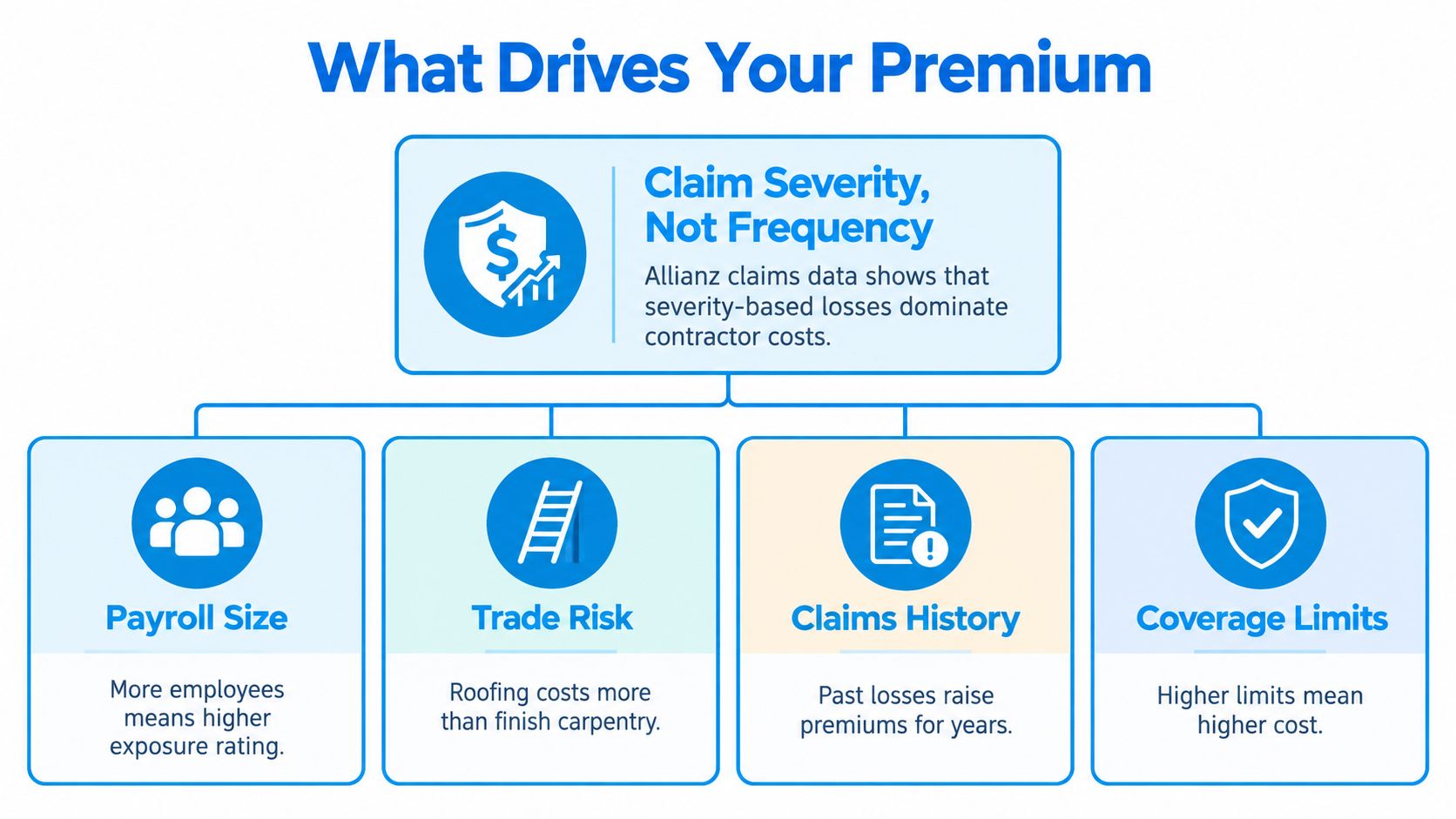
Claims severity is a central concern. An analysis of construction and engineering claims found that fires and explosions represented 27% of claim value over the prior five years, followed by natural catastrophes at 19%, defective products at 10%, faulty workmanship or maintenance at 8%, and machinery breakdown at 7%. Allianz's construction claims analysis shows why an underwriter may focus on hot-work permits, fire prevention, weather planning, equipment maintenance, and quality control rather than counting minor incidents alone.
Five variables you can influence
Payroll class code is one of the first pricing inputs for workers' compensation and can affect how the insurer views the overall account. Report the actual work performed, not the least expensive label. Misclassification can create audit problems and coverage disputes.
Trade risk changes the underlying hazard. Roofing, structural work, excavation, and work near utilities typically demand a different underwriting approach from interior finish carpentry. Accurate descriptions help the insurer price the account instead of guessing.
Years in business can strengthen an application when the contractor has documented controls and a stable loss record. NFP's construction-market guidance identifies at least five years in business, a strong five-year loss record, and evidence of safety, quality, fleet, and risk-transfer practices as favorable underwriting factors. NFP's construction insurance market guidance explains why experience alone isn't enough. The contractor must show how that experience is managed.
Claims history affects both price and eligibility. A claim involving fire, water damage, or a serious injury can matter more than several small incidents because the potential severity is higher. Provide complete loss runs and explain corrective action rather than hiding a resolved claim.
Subcontractor controls protect you from another business's mistakes. Collect certificates before work begins, verify that limits and dates are current, and use written agreements that address insurance responsibilities. An uninsured subcontractor can leave you arguing about liability after an injury or property loss.
A written fall-protection program may not guarantee a discount, but it gives an underwriter evidence that your business controls predictable hazards. The same applies to vehicle maintenance logs, hot-work procedures, toolbox talks, incident reporting, and documented quality checks.
Hidden Gaps in Standard Construction Policies
A commercial general liability policy can be broad and still fail to cover the specific loss a contractor expects. The difference usually appears in the exclusions, definitions, endorsements, and timing provisions.
Damage to your work isn't always covered
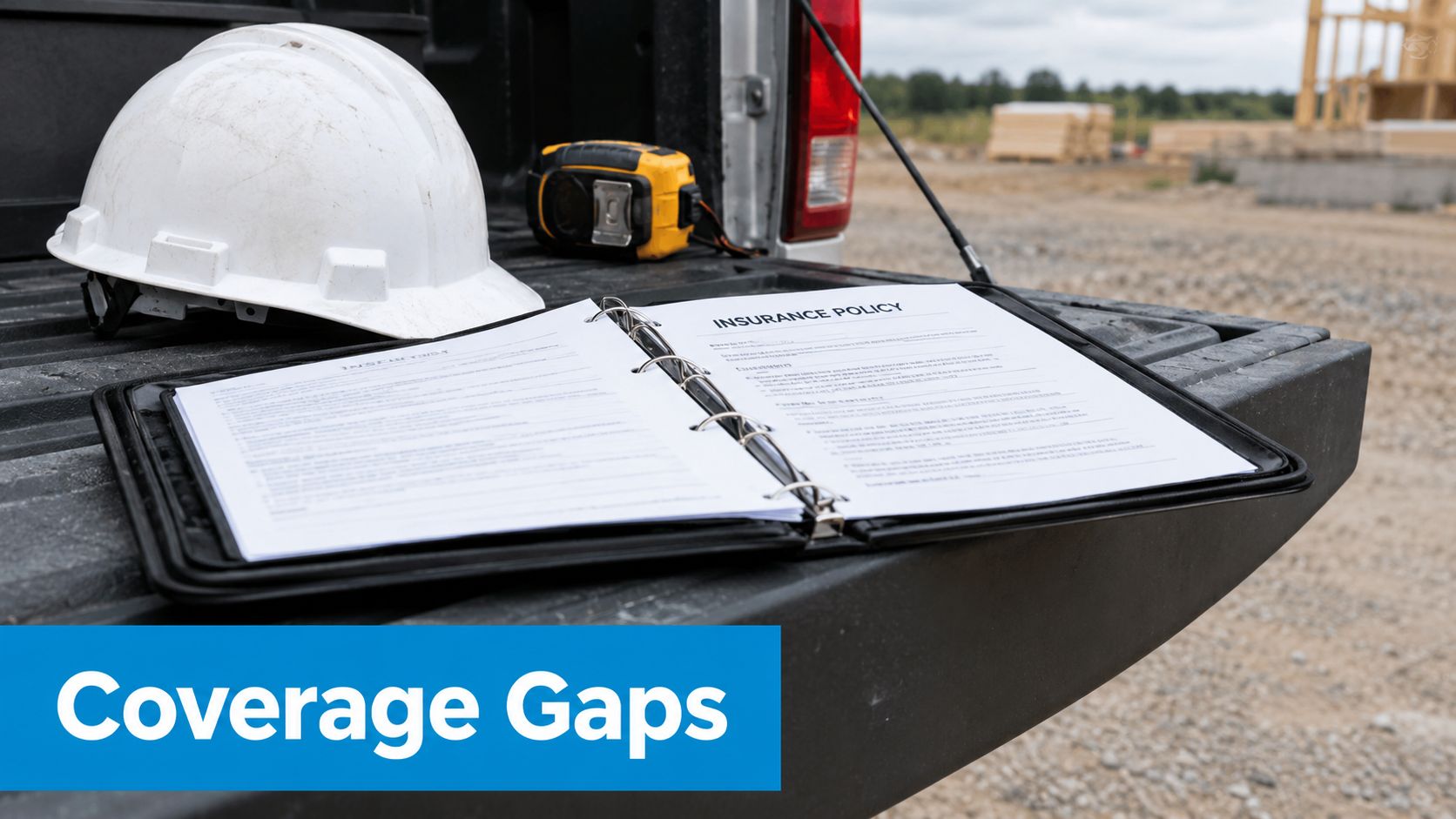
A contractor installs flooring, cabinets, or roofing materials. A defect in the installation causes damage to the completed work. Standard construction forms may exclude property damage to the contractor's own work while it's being performed, leaving the business responsible for removing and replacing defective work. Builder's risk may address qualifying property damage during construction, while completed-operations coverage addresses certain third-party claims after completion.
The policy won't turn poor workmanship into an insured maintenance program. It can, however, respond differently when defective work causes separate damage to other property. Your agent should review the contract, scope, and applicable endorsements before you assume the entire project is protected.
Subcontractor injuries can create an unexpected dispute
A small general contractor hires a subcontractor for exterior work. The subcontractor's employee is injured at the site, but the subcontractor never provided valid workers' compensation evidence. The general contractor may face demands, litigation, or questions about whether the policy excludes injury to an independent contractor or the employee of an independent contractor.
That's why certificates must be collected and checked before mobilization. A certificate is evidence of insurance, not the policy itself, so confirm the relevant limits, dates, and endorsements with the carrier or agency when the project warrants it.
Prior work can fall outside the policy period
A new policy starts after a contractor changes agencies. A customer then reports damage allegedly caused by work completed before the new policy began. A prior-work exclusion or policy wording tied to the start date may limit coverage, even though the contractor has maintained insurance continuously.
Ask specifically how the new policy treats work completed before inception, ongoing operations, and completed operations. Specialized guidance identifies exclusions involving independent-contractor injuries and work completed before the policy start date as common blind spots for small contractors. This analysis of contractor general liability limitations is a useful prompt for your policy review.
For tools, compressors, generators, and other mobile property, ask whether coverage follows the equipment in transit and at temporary job locations. An explanation of inland marine insurance for tools and equipment can help you identify property that a basic office or building policy may not address.
Contractor Insurance Quote Checklist and Document Preparation
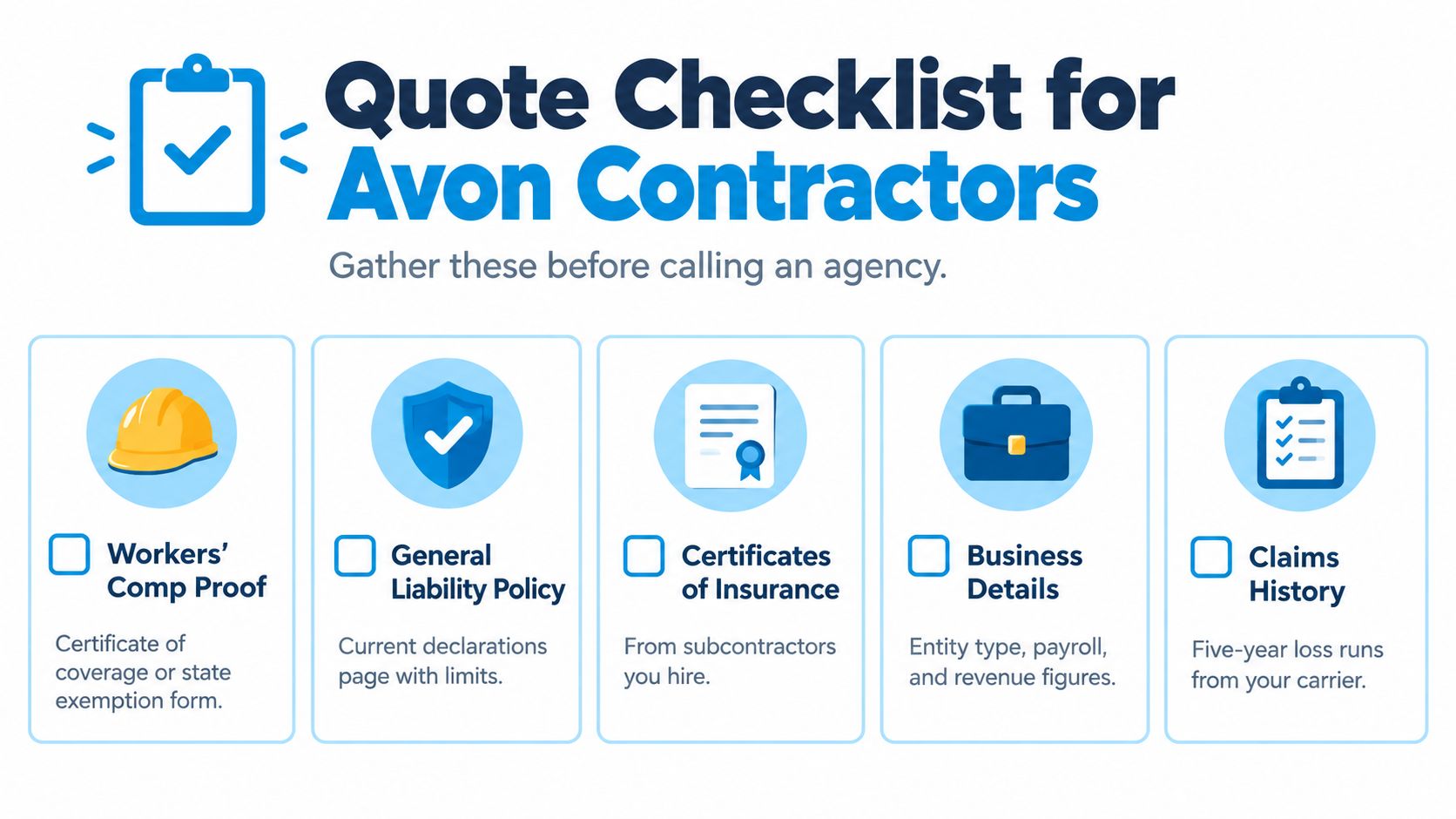
A clean submission gives an agent enough information to approach the right markets without repeated clarification. Gather the documents before you request quotes, and keep digital copies organized by policy year.
Assemble the underwriting file
- Workers' compensation proof: Provide the current certificate of coverage or applicable New York exemption documentation. Include payroll information and class descriptions that match actual duties.
- General liability declarations: Share the current declarations page, limits, deductibles, locations, and endorsements. This shows what is already insured and where the gaps may be.
- Subcontractor certificates: Collect certificates from every subcontractor you hire, then verify dates, limits, and required additional-insured language where the contract calls for it.
- Business details: Prepare the legal entity, years in business, trades performed, service territory, annual revenue, payroll, subcontracted cost, and expected project mix.
- Claims history: Request loss runs from prior carriers and include resolved claims. Add a short explanation of corrective measures for any significant loss.
- Vehicle and driver records: List vehicle identification, ownership, use, garaging, driver names, and motor-vehicle history. Include trailers and regularly transported equipment.
- Safety procedures: Keep written fall-protection, ladder, job-site, fleet, hot-work, and incident-reporting procedures in one accessible file.
- Contract requirements: Mark requested liability limits, additional-insured provisions, waiver language, completed-operations requirements, and builder's risk responsibilities.
If estimating takes up much of your administrative time, a dedicated contractor estimating software resource can help keep project scopes, revenue assumptions, and backlog information consistent. That consistency matters because an insurance application based on last year's work may not reflect the jobs you're bidding today.
Before you call: Have the next contract's insurance requirements open beside your current declarations page. The differences often reveal the questions that need answers.
Practical Strategies to Lower Your Contractor Insurance Premiums
The safest savings usually come from better information and stronger controls, not from deleting coverage. Start by correcting classifications, reviewing duplicate property coverage, and asking whether multiple commercial policies can be coordinated under one program. A higher deductible can reduce premium, but only choose it if the business can fund that amount after a slow month or a minor loss.
Fleet exposure deserves separate attention. Recent market commentary reported fleet rate increases of 5% to 20% in many cases, while workers' compensation remained relatively stable and general liability and excess liability continued to face pressure for higher-hazard contractors. Baldwin's construction industry report supports a line-by-line review rather than a blanket assumption that every part of the account is becoming cheaper.
Make the savings operational
- Document safety every year: Keep signed training records, inspection logs, incident reports, and corrective actions. A written program carries more weight when employees follow it.
- Control subcontractor transfer: Require certificates before work starts, use written contracts, and maintain a renewal calendar. This can reduce uncertainty during underwriting and claims handling.
- Protect the loss record: Report incidents appropriately, investigate near misses, and fix recurring causes. Don't delay reporting solely to avoid a claim on the record.
- Review equipment and vehicles: Remove sold assets, insure newly acquired equipment promptly, and check whether tools are protected while stored, loaded, and transported.
- Choose limits deliberately: Cutting completed operations or umbrella limits may save premium while exposing the business to a loss it cannot absorb. Trim duplication before trimming essential protection.
The best quote is the one that balances premium, exclusions, deductible, limits, and claims support. Ask the agent to show what changes when you raise a deductible or adjust a limit, then compare the added exposure in dollars your business could survive.
Next Steps Working with Mitchell-Joseph Insurance Agency
Avon contractors often need an agency that can compare more than one underwriting approach. Mitchell-Joseph Insurance Agency is an independent, family-owned brokerage serving Honeoye Falls, Pittsford, Naples, Rushville, Rochester, and surrounding Finger Lakes communities for over 50 years, with more than 200 years of combined agent experience and relationships with 24 carriers.
An independent broker can review your trade, subcontractor controls, vehicle exposure, completed operations, and equipment needs across available markets. Learn more about how an independent insurance broker works before you request quotes. If your office is busy handling calls from customers and crews, a resource on how to capture leads with answering services may also help prevent new opportunities from reaching voicemail.
Call for a consultation, bring the completed quote checklist, and ask whether coordinating commercial and personal lines makes sense for your household. Review the policy before signing the next contract, not after a claim exposes a gap.
Mitchell-Joseph Insurance Agency can help Avon contractors build coverage around completed operations, subcontractor certificates, commercial vehicles, and equipment in transit instead of treating insurance as a one-size-fits-all purchase. Bring your current declarations page and upcoming contract requirements, then visit Mitchell-Joseph Insurance Agency to request a practical policy review.