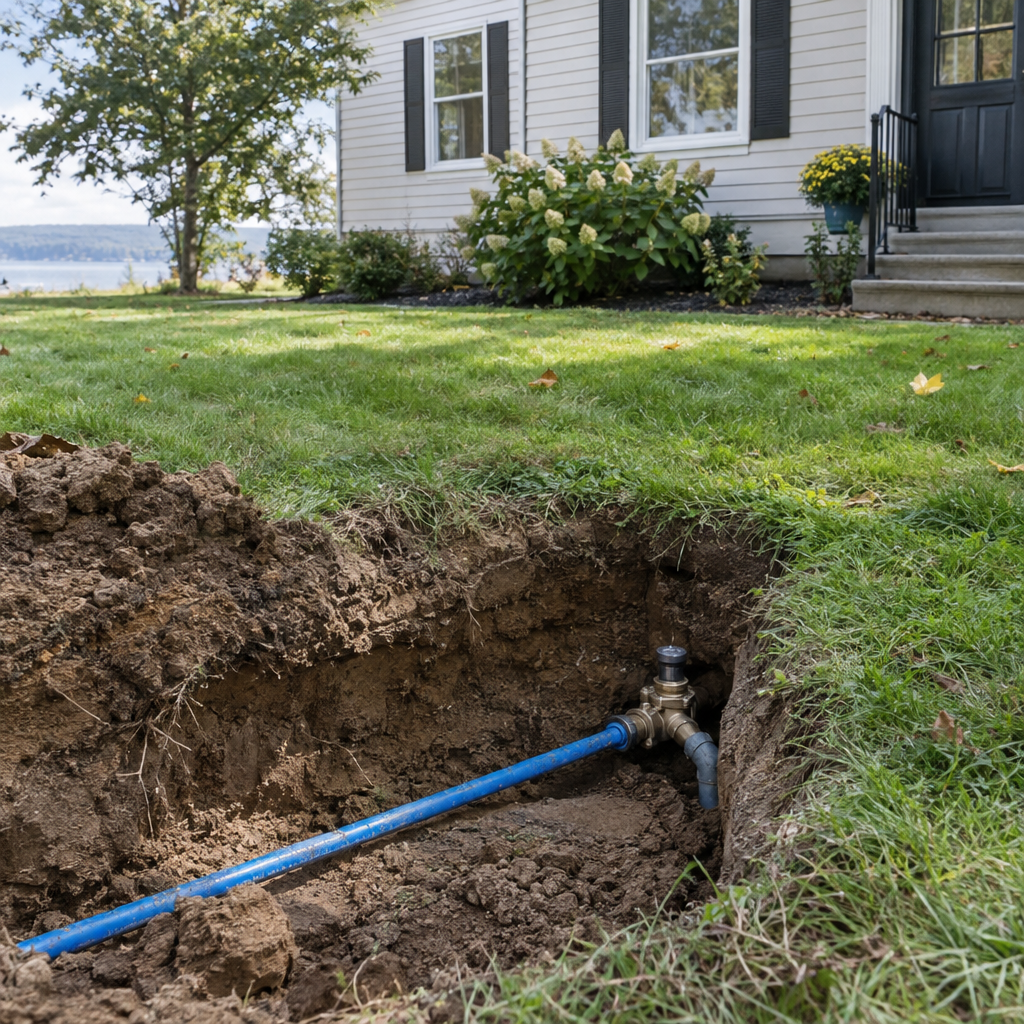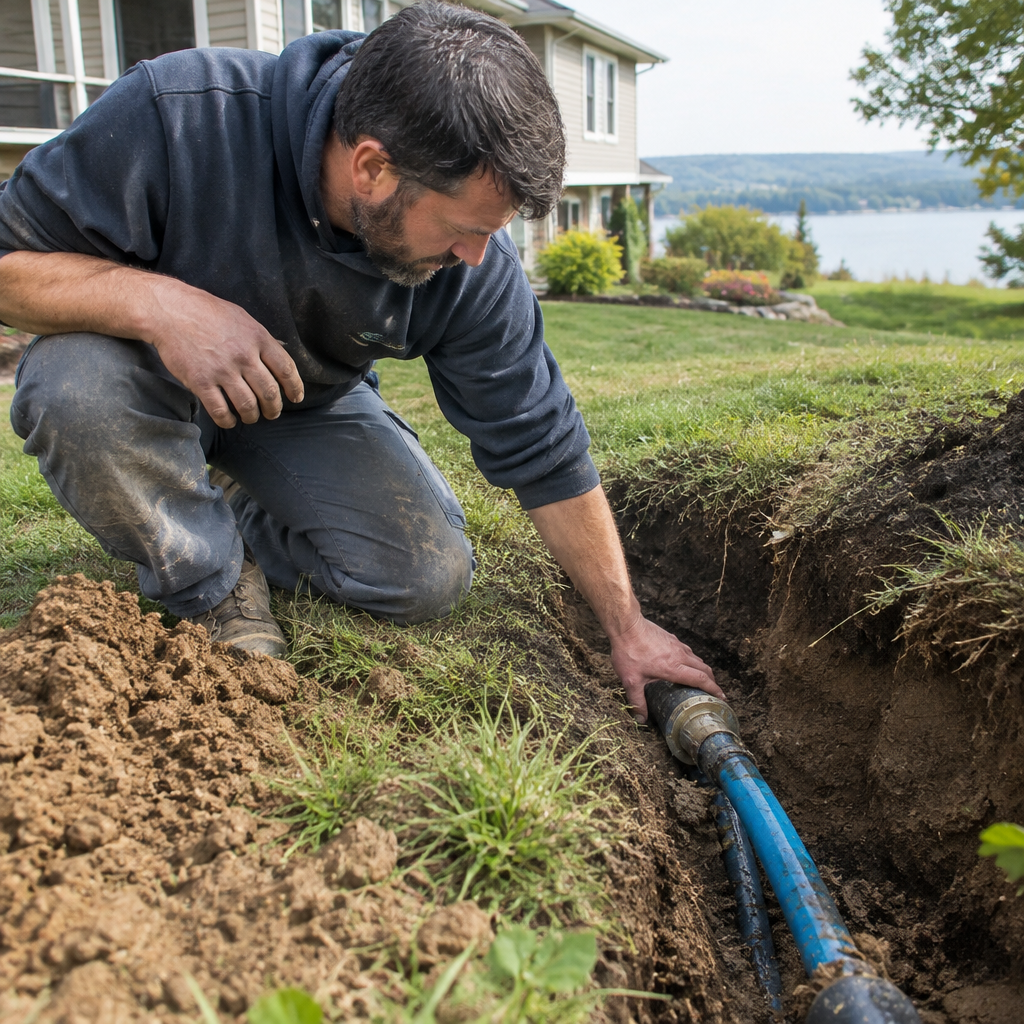
A damp patch in the yard, an unexplained drop in water pressure, or a higher-than-usual water bill may point to a problem with the buried pipe supplying your home. If that pipe needs repair, the bill can involve more than plumbing: someone may need to locate the break, excavate, repair the line, and restore the disturbed ground.
Is exterior water line insurance worth it? The answer depends on which part of the line you are responsible for, what your homeowners policy already covers, the terms of any optional protection, and how much of a repair bill you could comfortably pay yourself. Exterior water line protection is often offered as part of broader service-line coverage, but the name alone does not tell you what a particular policy will pay. Here is how to evaluate it without confusing a buried-pipe repair with other water-damage claims.
What is an exterior water line?
An exterior water service line is the buried pipe connecting a home’s plumbing to a public water system or another water source. It may cross a yard and run near trees, landscaping, a walkway, or a driveway. Where it runs—and where the homeowner’s responsibility begins—depends on the property and the water provider’s rules.
Do not assume that a municipality pays for every section of a pipe connected to its system. Before comparing insurance options, ask your water provider or municipality which portions it maintains and which portions are your responsibility. Available property records or records of prior line work may help you identify the route. That distinction matters: coverage for a homeowner’s service line is only useful if it applies to the section and type of line involved in a loss.
Some service-line endorsements address several kinds of underground utilities, potentially including sewer, gas, electrical, or communications lines. Others differ. Check the endorsement’s definition of a covered line rather than assuming that protection for one utility includes the others.
Does homeowners insurance cover a broken exterior water line?
A standard homeowners policy may cover certain resulting damage when water escapes suddenly and accidentally from a covered source. That is a different question from whether the policy pays to excavate and repair the buried pipe that failed. As Travelers explains in its discussion of burst pipes, sudden water damage may be covered, while an exterior line that breaks because of age, wear, shifting soil, or tree roots is not likely to be covered under ordinary homeowners coverage. Your policy’s wording and the facts of the loss control.
This distinction is easy to miss when a broken line causes more than one expense. A homeowner might need to address the pipe itself, damage to the yard or paved surfaces needed to reach it, and water damage inside the house. Those costs may be evaluated under different coverage provisions, with different conditions, deductibles, and limits. Coverage for one part of the loss does not establish coverage for every part.
The New York State Department of Financial Services recommends reviewing homeowners coverage and additional riders because policy forms differ. If you are unsure whether your current policy includes a service-line endorsement, start with your declarations page, then request the full endorsement and ask your agent to explain how it applies to your property.
What might service-line coverage pay for?
An optional service-line endorsement may provide coverage for eligible physical damage to specified underground utility lines. Depending on its terms, covered expenses might include locating the damaged section, accessing and excavating the line, repairing or replacing an eligible portion, and restoring certain outdoor property disturbed by the work. Some forms may address related expenses, while others may not.
Erie’s explanation of service-line protection illustrates the kinds of line damage and related costs such coverage may address. It is an example, not a description of every insurer’s product: availability, covered causes, limits, and exclusions depend on the policy and state.
When reviewing an offer, separate the promise to repair a pipe from the cost of reaching it. Ask whether the endorsement pays for excavation and access, and whether it addresses restoration of landscaping, a walkway, or a driveway. If losing water service could make the home temporarily unusable, ask whether any related living expense is covered. A stated maximum benefit is not a guarantee that every expense associated with a failure qualifies.
What may be excluded or limited?
Service-line coverage is not a maintenance plan for every underground plumbing concern. An endorsement may require direct physical damage to a defined, covered line. Low water pressure or a blockage, for example, may not qualify if the policy’s damage requirement has not been met. Coverage may also depend on the cause of the failure and whether the line is connected, in service, and located within the area described by the contract.
Review possible restrictions on lines serving detached structures, sections beneath buildings, or particular causes of damage. Ask about exclusions, a separate deductible, a maximum payment limit, and any lower limits for specific expenses. If a sales description mentions repairs caused by wear or deterioration, check how the actual endorsement treats those causes; do not assume the base homeowners policy and the endorsement apply the same way. Also ask whether any waiting period or claim condition applies.
If a line has already failed, contact your insurer promptly and follow its claim instructions. Take reasonable steps to prevent further damage and keep photographs, invoices, and records of conversations and repairs. You may need to act quickly to protect the property or restore essential service, but communicating with the insurer as soon as practicable can help you understand what documentation it needs.
Is exterior water line insurance worth it? Four factors to weigh
First, establish responsibility. Find out where your water provider’s responsibility ends and yours begins. A coverage decision based on the entire route from the street to the house may be misleading if only part of that route is your responsibility—or if the proposed endorsement defines the covered section differently.
Second, consider the likely work involved. The line’s known condition, material, length, and accessibility can all affect the repair scenario you are trying to insure against. Trees, landscaping, or hardscaping may make access more complicated. Age alone does not predict when a line will fail, and a visible symptom does not establish the cause. A qualified plumbing or utility professional can help assess concerns about the line’s condition; an insurance agent can explain how the policy treats an eligible failure.
Third, compare the financial terms. Look at the annual premium, the deductible you would pay after a covered loss, and the maximum benefit available. Then consider what you could comfortably pay without coverage. A high stated limit may be less useful if important parts of a likely repair are excluded; a lower limit may still have value if it addresses the costs that concern you most. Compare the actual policy terms, not a presumed average repair bill.
Fourth, check for overlap. A utility protection plan, warranty, or existing endorsement may address some of the same work, but the contracts may define eligibility and payment differently. Compare where each plan applies, which causes it covers, whether it pays for excavation and restoration, and how claims are arranged. Avoid paying for two products based on the assumption that they offer identical protection.
There is no universal yes-or-no answer. A household facing a long, difficult-to-access private line may view the risk differently from one with a short, accessible line and funds set aside for repairs. The worthwhile choice is the one that fits your property, the contract offered, and your tolerance for an unexpected expense.
Compare a hypothetical claim, not just the coverage limit
Suppose you are offered a service-line endorsement with a stated maximum benefit. To understand its practical value, ask your agent to walk through a hypothetical break on your property using the actual form. Would the damaged section meet the definition of a covered line? Would the assumed cause qualify? Does the endorsement require physical damage, and what evidence would the insurer need?
Next, divide the potential bill into three categories: repairing the line, accessing and restoring the site, and repairing any resulting damage inside the home. Ask which coverage provision would address each category, if any. Then apply the relevant deductible, maximum limit, and any expense-specific sublimits. This exercise will not predict a future claim decision, but it can reveal a significant gap before you buy—or show where the endorsement offers useful protection.
Water-line coverage is not flood or water-backup coverage
Water-related insurance terms often sound interchangeable when they are not. Service-line coverage concerns eligible damage to specified underground lines. Water-backup coverage generally concerns certain losses from a sewer or drain backup and, depending on the policy, may address sump-pump failure. New York DFS notes that some insurers offer a water-backup endorsement; its terms and limits vary. Standard homeowners policies do not cover flood losses, according to the department.
A broken supply line, backed-up sewer, failed sump pump, and floodwater entering from outside can therefore present different coverage questions. Buying protection for one does not mean you have protection for the others. If water entering a basement is your principal concern, discuss that exposure directly rather than assuming a water service-line endorsement resolves it. Our guide to sump pump failure and homeowners insurance explains another coverage question worth reviewing separately.
Does home insurance cover gas leaks?
A gas leak raises a related but distinct question. A leaking gas line that needs to be located and repaired is not the same loss as property damage from a resulting fire or explosion. The National Association of Insurance Commissioners says standard homeowners and renters policies generally cover damage caused by explosions due to causes such as a gas leak, subject to policy provisions and exclusions. That does not establish that the policy pays to find or replace a leaking line.
If you are comparing a service-line endorsement because it mentions gas lines, ask whether it covers your gas line, where the covered section begins and ends, and which causes of physical damage qualify. Ask separately how your homeowners policy would treat resulting property damage. If you suspect an active gas leak, leave the area and contact emergency services or the gas utility from a safe location. Address the safety issue first; insurance questions can follow once the situation is safe.
Questions to ask before adding coverage
Request the applicable endorsement and use these questions to compare it with your existing protection:
- Is my exterior water service line covered, and where does the covered section begin and end?
- Which causes of damage qualify? Must there be direct physical damage to the line?
- Does coverage include locating the failure, excavation, pipe repair, and restoration of landscaping or paved surfaces?
- What are the maximum benefit, deductible, and any lower limits for particular expenses?
- How does the form treat blockages, low pressure, corrosion, wear, or gradual leaks?
- Are there waiting periods, maintenance requirements, or instructions about obtaining approval before repairs?
- How does this protection differ from any utility plan, warranty, or endorsement I already have?
Keep the answers with your policy documents. If an explanation affects your decision, ask your agent or insurer to identify the relevant policy provision. A conversation is helpful, but the issued contract governs coverage.
How to review your policy and reduce uncertainty
Begin with the declarations page to identify listed endorsements, limits, and deductibles. Then read the full endorsement’s definitions, coverage terms, exclusions, and claim conditions. The declarations page may show that you purchased additional coverage without explaining every circumstance in which it applies. New York DFS recommends periodic reviews of policy information, coverage levels, deductibles, and riders. For a wider review beyond buried lines, see our guide to choosing home insurance coverage.
Insurance is only one part of managing this risk. Keep any available site plans, utility records, inspection information, and invoices from previous line work. Before landscaping or digging, use the appropriate utility-locating process and qualified professionals. Pay attention to persistent wet areas, unusual water usage, or changes in pressure, but seek a professional assessment rather than assuming a particular cause. Know where your home’s main water shutoff is and how to reach your water provider if a problem develops.
If you have made changes to the property or learned something new about the line, share that information when reviewing coverage. Better information about the line’s route and responsibility boundary makes it easier to compare a proposed endorsement with the expense you might actually face.
The bottom line for Finger Lakes homeowners
Exterior water line insurance may be worth considering if you are responsible for a buried line, an eligible repair could strain your finances, and the proposed endorsement meaningfully addresses the costs you want to transfer. It may be less compelling if you can comfortably absorb a repair or if the policy’s deductible, limits, and exclusions leave little practical benefit. Neither conclusion follows from the coverage name alone.
Mitchell-Joseph Insurance serves homeowners across the Finger Lakes from offices in Naples, Honeoye Falls, and Rushville. We can help you review your current homeowners documents, examine a proposed service-line endorsement, and identify questions about what you would still pay yourself. The most useful answer starts with your property and the actual policy—not a general promise that every broken line is covered.