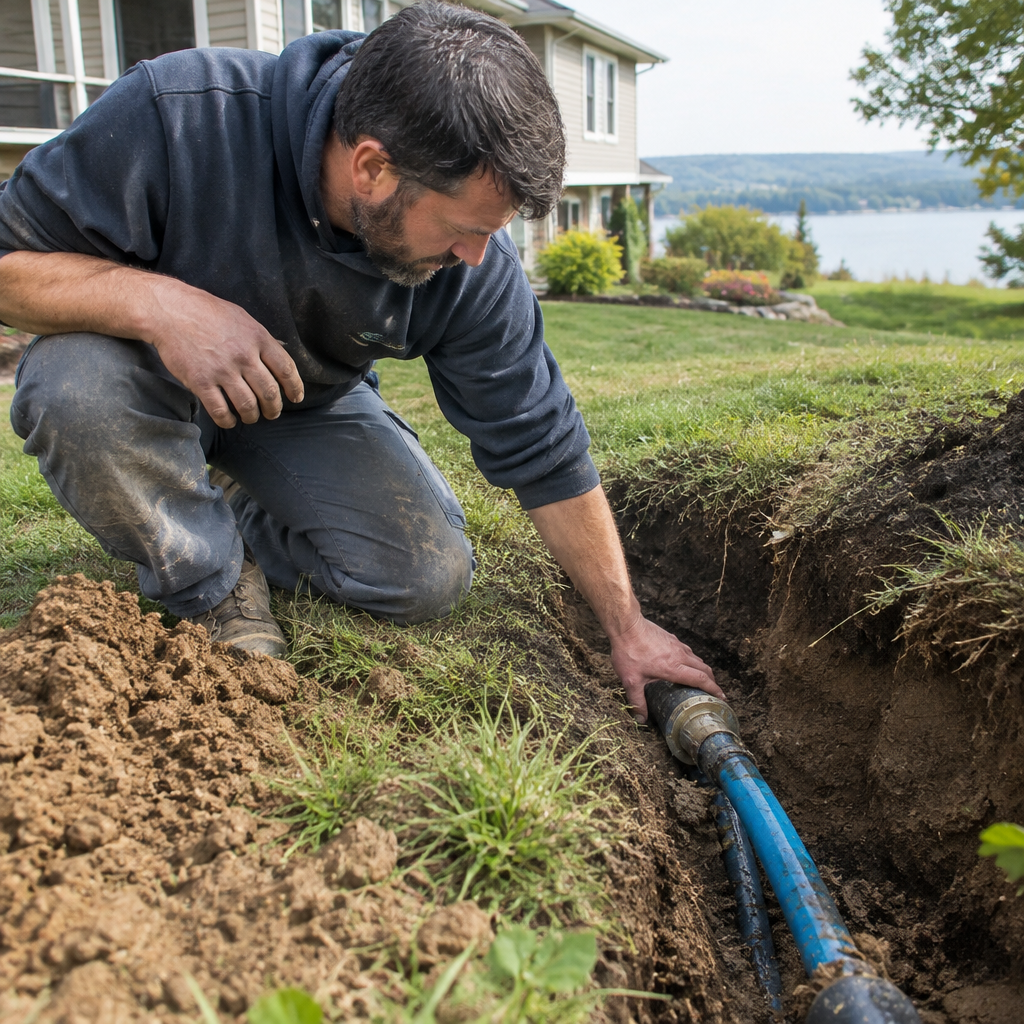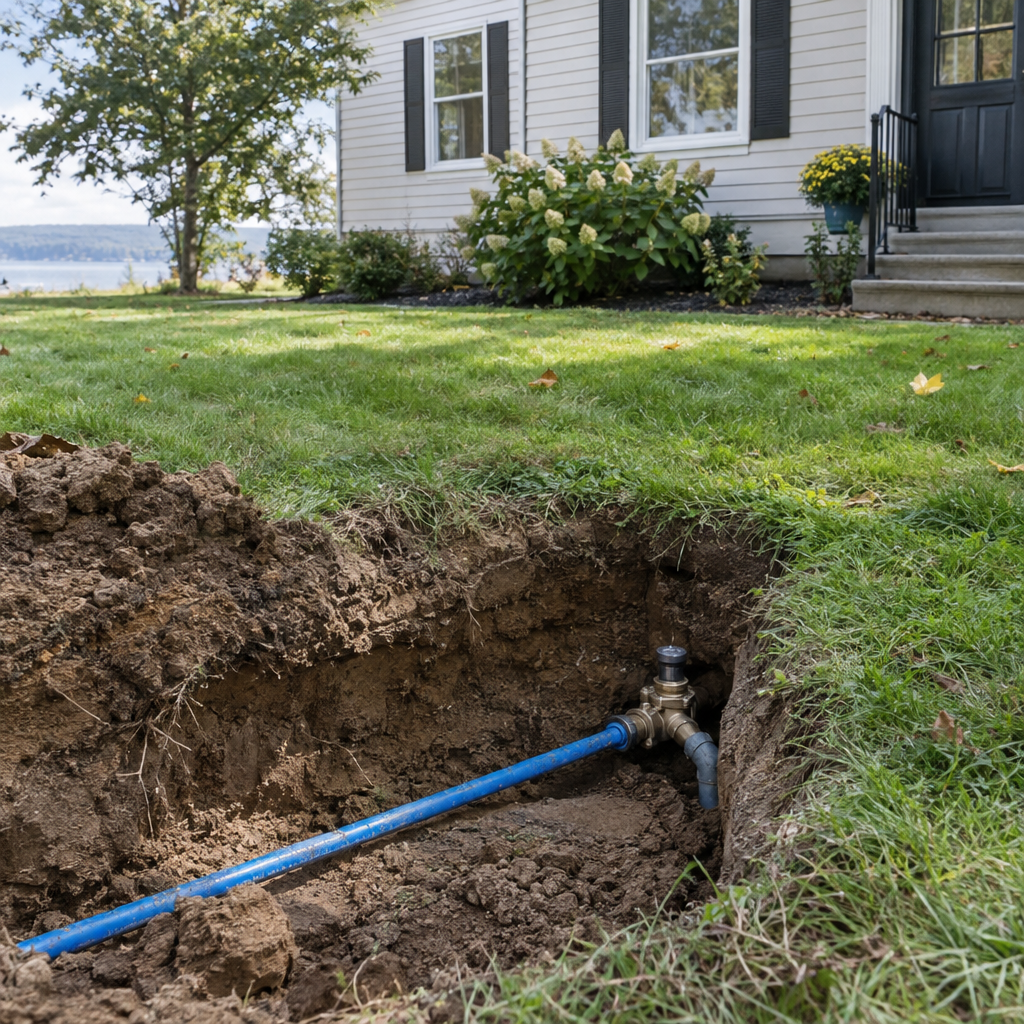
A water leak beneath your lawn can be difficult to see, but repairing it may require digging, replacing a section of pipe, and restoring the ground afterward. Before deciding whether to buy protection for that expense, you need answers to two questions: Which part of the buried line are you responsible for, and what would a policy actually pay to repair?
For many homeowners, “exterior water line insurance” means optional service line coverage added to a homeowners policy. Depending on its terms, it may help pay for a covered failure of an underground water line. Some endorsements extend to sewer, electrical, or other utility lines as well. Coverage is not identical across insurers, and the name alone does not tell you which pipes, causes of damage, or repair costs are included.
So, is exterior water line insurance worth it? The answer depends on your responsibility for the line, the potential cost and disruption of a repair, the policy’s limits and exclusions, and your ability to pay an unexpected bill yourself. For Finger Lakes homeowners, a useful decision starts with the utility’s rules and your own policy—not a generic estimate of what repairs or premiums might cost.
What exterior water line coverage may pay for
A water service line carries water from the supply system toward your home. Service line coverage is generally an optional homeowners endorsement intended to address eligible damage to specified underground lines. Depending on the contract, a covered claim might include work to locate and access a damaged pipe, repair or replace it, and restore certain surfaces disturbed by the work.
Those potential benefits are important, but they are not promises of payment. An endorsement may define where an insured line begins and ends, which causes of failure qualify, and whether excavation or surface restoration is covered. It may also place separate limits on particular expenses. A policy that helps with a pipe beneath a lawn, for example, should not automatically be assumed to pay the full cost of restoring a driveway.
Check precisely which utilities are listed. A water line brings fresh water into the house; a sewer line carries wastewater away. An endorsement may insure both, only one, or additional service lines. The fact that a product is described broadly as “service line coverage” does not establish that every buried pipe on the property qualifies. Lines serving detached buildings, shared lines, wells, and septic-related components warrant specific questions because eligibility depends on the wording.
The same distinction applies to the type of expense. Repairing a damaged underground line is one issue. Paying for damage inside the house after water enters is another. More than one policy provision could be relevant to an incident, or none may apply to a particular expense. Ask an agent to walk through the available coverage rather than treating “water damage” as a single category.
Why a homeowners policy may leave a gap
Homeowners insurance is not a single, uniform contract. As the National Association of Insurance Commissioners explains, covered perils, limits, and deductibles all affect how a policy responds. Coverage for certain resulting damage to your home does not, by itself, establish coverage for repairing the buried line that caused the problem.
Suppose a line fails outside and water eventually reaches the house. There may be a charge to locate and repair the line, a separate charge to restore the yard or pavement, and another expense to address damage indoors. Each needs to be considered under the applicable policy language and circumstances. It would be a mistake to assume either that all of those costs are covered or that none could be.
Water-backup coverage is another source of confusion. It may address certain damage from a sewer or drain backup into the home, when the endorsement’s terms are met. It is not necessarily protection for repairing the underground pipe. The New York State Department of Financial Services notes that some insurers offer sewer-backup endorsements, including coverage involving certain sump-pump failures, and that the wording and selected limits matter. Its guidance also distinguishes flood damage, which typical homeowners or renters policies do not cover, from these other water-related risks.
If a basement or utility room is a concern, review those coverages separately. Our guide to homeowners insurance and sump-pump failure discusses a related question, but it cannot replace a review of your policy. Knowing which protection addresses the pipe and which might address resulting damage makes a comparison far more useful.
First, find out which section of pipe is your responsibility
Insurance for a service line matters most when you may have to pay to repair that line. Do not assume responsibility begins at the property line, the street, or the water meter. Utilities can assign maintenance duties using a curb box, shut-off valve, or another point in the system, and the rules may differ from one provider to another.
As a local example, the Monroe County Water Authority says it maintains the water service line from the main to the outside shut-off valve, while the homeowner is responsible for the line from the curb box to the house and for interior shut-off valves. MCWA also advises customers who notice water in the yard to contact the authority so a technician can help determine where the leak is. That guidance is useful for its customers; it is not a statewide rule.
Ask your own water provider to identify the maintenance boundary for your address. If you use a private water source or have an unusual property arrangement, ask how those facts affect responsibility and whether an available endorsement covers the line at all. A neighbor’s repair experience may offer a reason to investigate, but it cannot establish who is responsible for your pipe.
It also helps to learn what you can about the line itself. Prior repair invoices, property records, inspection documents, or information from a qualified plumber may clarify its route, length, material, or approximate age. Do not assume the line was installed when the house was built; it may have been replaced later. If its condition is unknown, treat that uncertainty as a question to investigate, not proof that failure is imminent.
Which property details make coverage more or less valuable?
There is no universal point at which exterior water line insurance becomes a good purchase. Start with the repair exposure you might actually face. A short, accessible section beneath a lawn may present a different challenge from a line that passes under a walkway or driveway. Digging, access, pipe work, and surface restoration can all affect the final bill. A contractor can assess a specific problem; an example repair estimate from an article or advertisement is not a quote for your property.
Pipe age and material are worth investigating, especially if you have records of earlier repairs. Older lines may have had more time to wear or corrode, but age alone does not establish their condition. Mature trees near a buried line may also prompt questions for a plumber, particularly about a sewer line. Their presence does not prove damage or mean a future claim will be covered. Known problems should be discussed before you buy coverage, since policies may exclude existing or pre-existing conditions.
Consider access as well as the pipe. If a line runs beneath a hard surface or landscaped area, ask what a policy would pay to remove and restore that surface after a covered repair. “Restoration included” may still be subject to a dollar cap, a sublimit, or a definition that does not cover everything you would expect.
Finally, put the possible expense in the context of your finances. One household may prefer a predictable premium because an unexpected repair would disrupt its budget. Another may have sufficient emergency savings and prefer to retain the risk. Neither position is inherently better. The meaningful question is whether the protection offered under a particular endorsement is valuable relative to its price, deductible, and limitations for your circumstances.
How to compare service line coverage without focusing only on price
Request the proposed endorsement and a current quote, then compare them with your existing homeowners policy. The lowest premium is not necessarily the best value if it buys a narrower definition of covered lines or a lower payment limit. Likewise, a generous limit is less useful if the cause of damage you are concerned about is excluded.
Work through these points before deciding:
- Eligible lines: Is coverage limited to the exterior water line, or does it include sewer, electrical, gas, or communication lines? Where does coverage begin and end?
- Covered causes: How does the policy treat wear, corrosion, freezing, root intrusion, or ground movement? Do not assume that every failure of an eligible pipe qualifies.
- Limits: What is the most the insurer would pay for one incident? Is there also a total limit for the policy period or a smaller limit for restoration?
- Deductible: How much would you pay toward a covered claim, and is that deductible different from the one on your homeowners policy?
- Access and restoration: Are excavation, debris removal, and repairs to lawn, pavement, or walkways included? Are they paid within the main limit or under separate restrictions?
- Timing and existing problems: Is there a waiting period? How are known leaks, earlier damage, or pre-existing conditions handled?
- Claim procedures: Whom should you call first if you suspect a leak? Does the insurer require authorization, a particular contractor, photographs, or other documentation before work begins?
- Property-specific exclusions: Are private wells, septic systems, shared lines, or lines serving another building eligible? Ask about the actual arrangement at your home.
Consider a simple comparison: two options may have similar premiums, but one may include sewer lines while the other covers only water. That difference could matter if your objective is to protect both systems. Yet the broader option is not automatically preferable; its deductible, causes of loss, limits, and exclusions still need review. Compare the protection you would receive, not just the list of utilities in a brochure.
Also check whether another contract already provides any relevant protection. Review the scope rather than assuming that two products with similar names duplicate each other. If you are reviewing your entire homeowners policy at the same time, our guide to choosing home insurance coverage offers a broader framework for evaluating limits and deductibles.
Keep water lines, sewer lines, backup, and flood risks separate
These distinctions are easy to overlook until a problem occurs. An exterior water line failure concerns the pipe supplying water to the home. A sewer line failure concerns the pipe carrying wastewater away. A sewer or drain backup concerns water entering the house through that system. Flooding is another category. The cause and location of damage matter because different policy provisions may apply.
For example, an endorsement that pays for a covered sewer line repair does not automatically pay for every form of interior cleanup. A water-backup endorsement does not necessarily pay to excavate and replace a damaged sewer line. And neither should be treated as a substitute for flood insurance. New York DFS advises homeowners to review optional backup protection and its limits rather than assume it is part of a standard policy.
When discussing coverage, describe a possible loss in specific terms: Where is the pipe? What failed? Did water enter the home, and if so, how? Which repair costs are you trying to insure? These questions help an agent identify which policy sections or endorsements warrant review. They also reveal gaps that a broad label such as “water coverage” can hide.
A practical decision checklist for your household
Before purchasing or declining coverage, gather enough information to make a comparison that reflects your home:
- Confirm with your water provider where its maintenance responsibility ends and yours begins.
- Identify, as far as reasonably possible, the water line’s route, material, age, and repair history. Ask separately about the sewer line if you want that protection too.
- Consider whether a repair might involve lawn, landscaping, pavement, or other surfaces that would need restoration.
- Get a quote for the specific coverage available to you, including any option to insure additional service lines.
- Read the deductible, per-incident limit, restoration provisions, waiting period, and exclusions in the proposed endorsement.
- Compare the endorsement with coverage you already have, including any water-backup protection, without assuming they address the same expenses.
- Decide whether paying for an eligible repair yourself would be manageable or would strain your household budget.
- Learn whom to contact if a leak is suspected and what documentation the insurer may need before repairs proceed.
A “yes” or “no” on any one point rarely settles the decision. A line that is your responsibility creates potential exposure, but that does not mean every offered endorsement fits. Conversely, a homeowner with savings may still prefer to insure a covered risk for budget certainty. The goal is to make a deliberate choice with a clear view of what you retain and what you transfer to the insurer.
Is exterior water line insurance worth it for you?
It may be worth considering if you are responsible for a buried line and would value help with eligible repair costs. It may be less compelling if you can comfortably fund a repair yourself, your exposure appears limited after investigation, or the available policy’s deductible, exclusions, or limits do not meet your needs. The decision should rest on the actual endorsement, not a promise that every underground leak will be paid for.
For homeowners in Naples, Honeoye Falls, Rushville, and across the Finger Lakes, the next steps are straightforward: confirm responsibility with your utility, learn what you can about your lines, and review coverage alongside your existing policy and budget. Mitchell-Joseph Insurance can help you compare available options and ask the right questions about limits, deductibles, and exclusions. Coverage availability and terms depend on the insurer and your individual circumstances.