
You open your laptop to compare insurance and end up with a mess of tabs. One quote looks cheap until you notice the deductible. Another mentions exclusions you don't fully understand. A third asks questions about your roof, your dog, your business property, or whether you ever use your pickup for work. By the time you're done, you're not really comparing prices. You're comparing different promises written in different languages.
That's where people start asking a very practical question. What is an independent insurance broker, and why would I use one instead of just buying online myself?
The short answer is this. An independent insurance broker is a licensed professional who represents the client’s interests and shops coverage across multiple insurance companies, instead of being tied to just one carrier. If you own a home in Pittsford, run a small shop in Rochester, insure a boat, or need farm or cyber liability coverage in the Finger Lakes, that difference is often underestimated.
Your Guide Through the Insurance Maze
A lot of insurance shopping starts the same way. A homeowner wants to renew coverage after rates climb. A business owner needs proof of insurance before signing a contract. A family buys a new car and figures adding it to the policy should take five minutes.
Then the questions begin.
Why does one company care about an older roof while another seems fine with it? Why does one quote include water backup and another leave it out? Why does a business auto policy treat personal use differently than commercial use? Individuals don't struggle because they're careless. They struggle because insurance is built on details.
Why so many people want a guide
An independent insurance broker helps sort through those details. Instead of asking you to become an underwriter overnight, the broker learns your situation, compares options, and explains the tradeoffs in plain English.
When your basement takes on water, you don't just want a low number on a declarations page. You want to know what property insurance may cover, including common questions around insurance for water, fire, mold damage. The same principle applies before you buy the policy. A broker helps you understand what you're purchasing, not just what you're paying.
The need for that kind of help hasn't gone away. The insurance broker and agency sector grew 1.6% annually on average from 2020 to 2025 and is projected to reach 435,454 businesses in 2026, according to Agent Methods' insurance industry statistics. That tells you something important. Even with online quote tools everywhere, people still want advice when the coverage gets complicated.
Why local knowledge still matters
In a New York community, insurance isn't abstract. It's storm damage, snow load, older housing stock, farm exposures, teen drivers, lake property, contractor vehicles, and businesses that need liability coverage written correctly the first time.
Practical rule: If the risk would be expensive, disruptive, or hard to explain during a claim, it deserves a human review before you buy.
A good broker acts like a translator and a guide. They know where people usually get tripped up, which questions carriers ask for certain risks, and where a cheap quote can hide a costly gap.
Independent Broker vs Captive Agent What's the Difference
People often use the words agent and broker as if they mean the same thing. In everyday conversation, that's common. In insurance, the distinction matters.
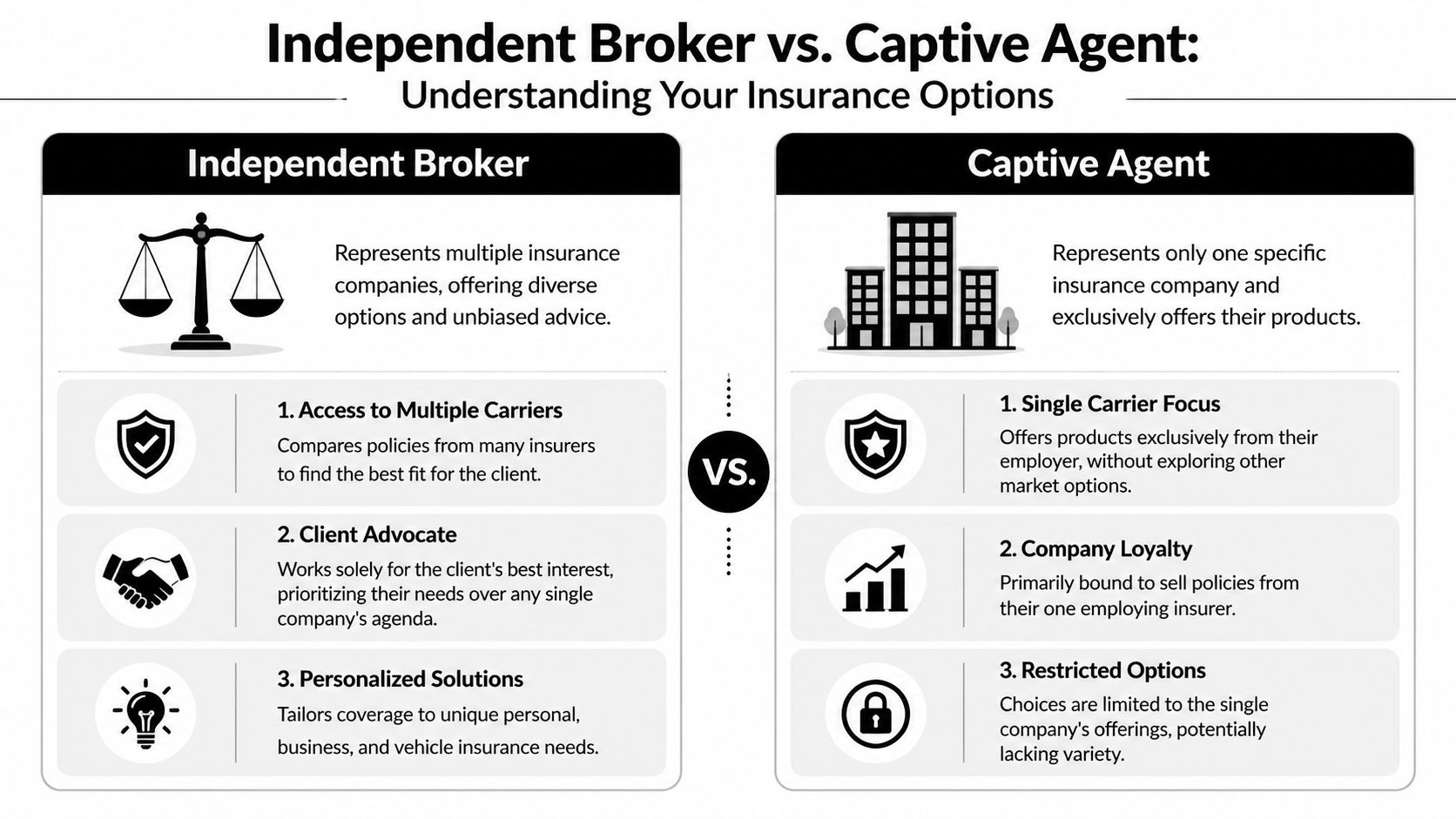
A captive agent works for one insurance company and sells that company's products. An independent broker works from the client side, comparing options across multiple carriers and recommending coverage based on the client's needs.
The easiest way to picture it is a shopping analogy. A captive agent is like a specialist at one brand store. They may know that store very well, but they can only sell what's on that store's shelves. An independent broker is more like a personal shopper who can walk the whole mall and compare options.
The legal difference people miss
The biggest confusion isn't just access to multiple companies. It's who owes loyalty to whom.
Independent brokers operate under a fiduciary standard of care, which means they must prioritize the client's best interests and conduct a real needs analysis before making a recommendation, as explained by AgentSync's breakdown of agents, brokers, and producers. That isn't just nice service. It's a legal responsibility.
That affects how a broker should work. A broker shouldn't recommend the cheapest quote if it leaves you underinsured. If you own a farm, a rental property, or a business with cyber exposure, the broker's job is to look at your situation as a whole and recommend coverage that fits the risk.
The cheapest policy and the right policy aren't always the same thing.
There's another nuance worth clearing up. Many local agencies are called independent agencies, and many professionals at those firms are called agents in daily conversation. But when people ask what is an independent insurance broker, what they're usually trying to understand is this client-first role: someone who compares multiple carrier options and advocates for the insured rather than a single insurance company.
Independent Broker vs Captive Agent At a Glance
| Feature | Independent Insurance Broker | Captive Insurance Agent |
|---|---|---|
| Carrier access | Works across multiple insurers | Works with one insurer |
| Primary loyalty | Client-focused role | Company-focused role |
| Choice of products | Broader selection for different risks | Limited to one company's offerings |
| Advice style | Compares fit across options | Explains one carrier's product line |
| Best use case | Complex or changing insurance needs | People who want one brand's products |
For homeowners comparing options across carriers, working with an independent home insurance agent can make the quote review much easier, especially when endorsements and exclusions differ from one company to the next.
Why this distinction matters in real life
If you insure a straightforward risk, either model may work. But complexity changes the equation.
- Older homes: One carrier may be more comfortable with aging systems than another.
- Farm operations: Equipment, structures, liability, and seasonal exposures often don't fit neatly into a standard package.
- Cyber liability: A business handling customer data may need coverage details that a bare-bones policy won't address.
- Multi-policy households: Auto, home, umbrella, boat, RV, and rental property needs often benefit from broader market comparison.
A broker's value isn't just that they can shop. It's that they can explain why one quote is appropriate and another only looks cheaper.
The Broker Process From Consultation to Coverage
Insurance feels mysterious until you see the workflow. In practice, a broker's process is pretty orderly. Good brokers don't start with a price. They start with your risk.

Step one is fact-finding
The first conversation should feel less like a sales pitch and more like a careful interview.
A broker may ask about the age of your home, prior claims, vehicles, drivers in the household, business operations, property values, payroll, tools, equipment, data handling, or whether customers come to your premises. For a farm, the questions get even more specific. Are there barns, livestock, roadside sales, seasonal workers, or custom equipment?
Those details matter because insurance pricing and eligibility depend on the exact shape of the risk.
Then the broker shops the market
An independent broker's approach differs from that of a single-carrier representative.
Brokers use a multi-carrier network to submit one risk profile to different underwriters. A situation one carrier dislikes may fit another carrier's underwriting appetite much better, as described in Experior Financial's explanation of how independent agencies work. That's why two quotes can look surprisingly different even when they're based on the same home, car, or business.
A local agency such as Mitchell-Joseph Insurance Agency works with 24 carriers, which gives clients a broader set of options for personal and commercial lines. In plain terms, that means a classic car, a restaurant, a contractor's truck, and a farm don't all have to be forced through the same company's rules.
How the review should sound
Once quotes come back, a broker should narrow the field and explain the important differences without jargon overload.
Here are the kinds of things a broker should point out:
Coverage gaps
One quote may exclude something another includes, such as higher liability limits, replacement cost details, or optional endorsements.Underwriting fit
A carrier might price your risk well today but have stricter renewal habits for your type of property or business.Bundling opportunities
Combining home, auto, umbrella, or business-related policies can simplify account management and sometimes improve the overall package.Practical service issues
Claims handling style, billing flexibility, and documentation requirements matter after the sale.
A quote isn't a verdict. It's an offer based on a carrier's appetite, rules, and assumptions. A broker's job is to read those assumptions before you sign.
From recommendation to binding
After the comparison, the broker helps with applications, signatures, supporting documents, and follow-up with the carrier. That's especially useful when a policy needs inspection information, loss history, payroll details, or clarification about operations.
This stage is where people often feel the relief. Instead of filling out the same forms over and over with slightly different wording, they have one knowledgeable contact helping move the process along.
What the process does for you
The broker process saves more than time. It helps reduce mismatches between what you think you bought and what the policy does.
- For homeowners: clearer answers on deductibles, water-related exclusions, and property details
- For drivers: better alignment for collector cars, RVs, boats, or mixed personal and work use
- For business owners: stronger coordination between liability, property, auto, workers' compensation, and cyber coverage
- For farmers: policy structure that reflects the operation instead of treating it like a standard home account
A good broker isn't making insurance more complicated. They're absorbing the complexity so you don't have to.
Specific Benefits for Your Home Business and Vehicles
Shopping across multiple carriers is useful. Its greatest value shows up when your situation isn't standard.
A first-time renter may need a simple policy. A homeowner with an older roof, a family with a teen driver, a contractor with commercial autos, or a farm with several structures needs something more careful. That's where independent broker work becomes practical instead of theoretical.
Homeowners and renters
Home insurance looks simple until the questions become specific. Is your basement finished? Do you have a detached garage? Has the roof been updated? Do you run a small business from home? Is there a trampoline, pool, wood stove, or dog breed that changes underwriting?
Different carriers respond differently to those facts. A broker can compare options and tell you where one company is more flexible and where another may add restrictions.
Water claims are a common source of confusion. Many homeowners assume every kind of water damage is covered the same way. It isn't. If you want a plain-language explanation of common distinctions, AMPM Restoration's insurance guide is a useful companion resource because it helps people understand how policy wording can affect what happens after a loss.
For renters, the value is often educational. Many people underestimate how much personal property they have until they imagine replacing clothes, electronics, furniture, and kitchen items all at once.
Drivers with everyday and specialty vehicles
Auto insurance isn't just for commuters. Families often have mixed needs under one roof. One person has a daily driver, another has a collector car, someone else owns a camper or boat, and now a teen is added to the policy.
That's where broad market access helps. Some carriers are more comfortable with specialty vehicles. Others are stronger for bundling, household driver issues, or higher liability limits. If you use vehicles in a company setting, a broker can also help sort out the line between personal auto and commercial auto. This business auto insurance guide is a good example of the kind of education people need before they assume a personal policy covers work-related use.
Small businesses with real liability exposure
Business insurance is where people most often learn that "good enough" wasn't good enough.
A retail shop may need general liability and property coverage. A contractor may also need tools, inland marine considerations, commercial auto, and workers' compensation. A professional office may need cyber liability because client information creates a different kind of risk than inventory on shelves.
Here are situations where a broker earns their keep:
- Restaurants and bars: Liquor-related exposures, equipment, spoilage, premises liability, and employee issues often require a coordinated package.
- Contractors: Vehicle use, job site liability, certificates of insurance, and subcontractor concerns can create coverage traps.
- Professional services: Errors, data storage, and privacy concerns may require cyber and professional liability coordination.
- Retail and mixed-use properties: Property limits, business interruption issues, and tenant-related details need careful review.
A captive setup may still offer a viable policy. But if the business has unusual operations, multiple locations, or layered liability needs, comparison becomes far more valuable.
Farmers and agribusiness owners
Farm insurance is one of the clearest examples of why role clarity matters. A farm isn't just a home with acreage. It can involve dwellings, barns, tractors, liability exposures, produce sales, hired help, and seasonal shifts in activity.
A broker can help separate what belongs under farm coverage, what falls under personal policies, and where a commercial-style solution may be more appropriate. That kind of judgment matters because farm risks don't fit neatly into standard personal insurance boxes.
If your operation earns money, stores equipment, welcomes visitors, or depends on outbuildings, don't assume a standard homeowners policy covers the whole picture.
The value after the policy is sold
This is the part many articles skip. Insurance isn't only about buying the policy. It's about what happens when something goes wrong.
Independent agencies report 25% higher client retention rates, which is tied to proactive claims advocacy, according to The Hartford's overview of independent agent value. That matters in a New York market where complex cyber and flood claims have also risen 18% year over year in the same source. When a claim gets messy, the broker's role shifts from shopper to advocate.
That can mean helping you organize documents, communicate with the carrier, explain next steps, and keep the claim from drifting because no one is driving it. You still report the claim to the insurer. But you don't have to handle the process alone.
How to Choose the Right Independent Broker in New York
Not every broker works the same way. Some focus mainly on personal lines. Others handle a lot of business insurance. Some are highly responsive during the quoting stage but thinly staffed when renewal or claims season gets busy.
If you're choosing a broker in New York, look for fit before you look for charm.

Questions worth asking directly
A good broker shouldn't hesitate when you ask practical questions.
How many carriers do you represent?
This helps you understand whether they can shop around or whether their choices are narrow.Have you worked with clients like me?
Homeowners, farms, restaurants, contractors, landlords, and professional offices all bring different issues.Who helps me during a claim?
Ask what the process looks like if you have a property loss, vehicle accident, or liability issue.How do you review coverage at renewal?
A broker should revisit changes in property, vehicles, payroll, drivers, operations, or assets.What information do you need from me to quote accurately?
The right answer usually involves more than a ZIP code and a rough estimate.
Signs of a stable agency
Longevity matters because insurance is a long-term relationship. You want a firm that will still be there when a renewal changes, a claim appears, or your needs become more complicated.
The 2024 Agency Universe Study shows a maturing market, with only 27.1% of agencies under $150,000 in revenue, down from 38%, and 75% reporting revenue growth, according to the Insurance Information Institute's distribution channel data. The practical takeaway is simple. Stability usually means better staffing, stronger carrier relationships, and more consistent service.
A simple local checklist
Use this short checklist when comparing brokerages:
| What to check | Why it matters |
|---|---|
| State licensing | Confirms the firm and producers are authorized to do business |
| Carrier access | Broader access improves fit for unusual risks |
| Experience by industry | Farm, contractor, restaurant, and cyber needs aren't interchangeable |
| Claims support process | Service after the sale is where value gets tested |
| Community presence | Local familiarity helps with practical guidance and accountability |
A firm offering independent auto and home insurance options in Rochester NY may be a strong fit if your needs center on personal lines and you want local access, but the same selection process still applies. Ask questions, compare answers, and pay attention to whether the broker explains things clearly or just hurries toward a quote.
The right broker doesn't make you feel sold. They make you feel understood.
Your Partner in Protection Not Just a Policy
By the time you ask what is an independent insurance broker, you're already dealing with uncertainty. Maybe rates changed. Maybe you bought a home. Maybe a business contract now requires new coverage. Maybe you had a claim and realized how hard it is to sort out insurance language when you're under stress.
That's why the broker relationship matters.
An independent broker gives you choice, because they can compare more than one carrier. They give you judgment, because not every low quote is a good fit. And they give you advocacy, because insurance problems rarely happen at a convenient time.
In a local New York setting, that relationship has another advantage. A nearby broker usually understands the practical risks people in this region face. Older homes, lake property, farm exposures, commercial vehicles, snow, water issues, and small business liability all require more than a generic answer.
Insurance works best when it fits your life before a loss happens. This is a broker's essential value. Not just access to policies, but help making the policy make sense.
Frequently Asked Questions About Independent Brokers
Do I pay a broker directly?
Usually, clients don't write a separate check to the broker for a standard personal or commercial policy placement. Compensation is typically built into the insurance transaction through the carrier relationship. From your side, the practical question isn't "Do I pay extra for a broker?" It's "Am I getting advice that helps me buy the right coverage?" In many situations, that's the more important issue.
Can an independent broker switch my insurance company for me?
A broker can help you compare alternatives and move to a different carrier when it makes sense, but they shouldn't move coverage casually or without explaining timing and paperwork. Mid-term changes, cancellations, effective dates, financed premiums, and lender requirements all need to be handled carefully. The goal is a clean transition with no accidental gaps.
Can a broker bind coverage on the spot?
Often, people misunderstand the division of responsibilities. The broker's role is client-facing and advisory, but final underwriting and binding involve the insurer and its appointed processes. In plain terms, a broker can guide the placement and help move it along, but the insurer's side still controls final acceptance and issuance.
Is an independent broker only for complicated insurance?
No. A simple renters or auto policy can still benefit from a clear explanation and access to multiple carriers. But complexity is where a broker becomes especially useful. If you have multiple properties, a home business, a farm, specialty vehicles, employees, or cyber exposure, comparison and interpretation become much more valuable.
Will a broker still help me after the sale?
They should. Good broker service includes renewals, policy changes, certificates, vehicle additions, property updates, and claims guidance. If a brokerage is highly attentive before the sale but hard to reach afterward, that's a warning sign.
How do I know if a broker is actually listening to my needs?
Listen to their questions. A broker who asks careful follow-ups about how you use property, vehicles, buildings, equipment, or customer data is doing real underwriting prep. A broker who rushes toward a price without digging into details may be giving you a quick quote, not a sound recommendation.
Should I choose based on price alone?
No. Price matters, but insurance is one of those products where a lower cost can mean narrower protection. The better approach is to compare coverage, exclusions, deductibles, service process, and carrier fit, then weigh price within that bigger picture.
What's the biggest mistake people make when buying through any channel?
They assume all policies are basically the same. They aren't. Two policies can look similar at first glance and behave very differently during a claim. That's why explanation matters as much as quoting.
If you want a second set of eyes on your current coverage or you're starting fresh, Mitchell-Joseph Insurance Agency can help you review options, compare carriers, and understand where your protection is strong and where it may need work.

