

Understanding Water Line Responsibility and Protection
Have you ever wondered who’s responsible for that underground pipe bringing water to your home? Most homeowners are surprised to learn it’s their responsibility—and even more surprised by the repair bills when something goes wrong.
Water line insurance provides peace of mind by covering the underground service line that connects your home to the municipal water supply. This specialized protection addresses a critical blind spot in standard homeowners insurance that many people find only after facing a costly repair.
When I explain water line insurance to my clients here in the Finger Lakes region, I often describe it as an umbrella for a rainy day you hope never comes. For about $20-$50 annually as an add-on to your existing homeowners policy, you gain protection against leaks, breaks, corrosion, and even those pesky tree roots that seem determined to find their way into pipes.
Picture this scenario: You wake up on a frigid February morning to find no water coming from your taps. After some investigation, you find a break in the line between your home and the street. Without proper coverage, you’re facing an average repair cost of $3,750—and that’s if things go smoothly. In complex cases involving difficult access or extensive damage, bills can skyrocket to $22,500.
The most troubling part? Standard homeowners insurance typically excludes these repairs entirely.
Over my years at Mitchell-Joseph Insurance Agency, I’ve helped hundreds of homeowners secure appropriate water line insurance before disaster strikes. The relief on their faces when they understand they’ve protected themselves from potentially budget-breaking expenses is always rewarding.

When you have water line insurance, you’re covered for excavation costs (yes, someone has to dig up your yard), pipe repair or replacement, and—importantly—property restoration to get things looking normal again. These policies are sometimes called service line coverage or may be part of broader protection like a sewer line home warranty.
Water service lines can fail for numerous reasons: age (most have a lifespan of about 50 years), ground shifting during freeze-thaw cycles, gradual corrosion, or extreme temperature fluctuations. The pipes don’t care about your budget or timing—they fail when they fail, creating unexpected and often urgent repair situations.
As your neighbors and local insurance experts, we at Mitchell-Joseph Insurance Agency understand the unique challenges homeowners face in our region. We’re here to help you understand your options and find coverage that fits your needs and budget before you’re left high and dry—or perhaps more accurately, with a very wet yard and a very dry faucet.
What Is Water Line Insurance?
Water line insurance (also called service line coverage) protects you from the financial shock of repairing or replacing that underground pipe bringing fresh water from the municipal main to your home. This critical line typically runs from your property boundary right up to where it enters your house.
One of our clients put it perfectly: “There are two ways to find that your water main is leaking—slowly, when your water bill creeps up and your lawn mysteriously thrives, or suddenly, when a brook bubbles up in your azaleas.”
Understanding who’s responsible for what is crucial here. While the utility company maintains the water main under the street, you as a homeowner are typically responsible for the entire service line running to your home—even the portion under public sidewalks. This surprises many homeowners who find this responsibility only when facing a repair bill.
Water Line Insurance Coverage Basics
You can typically get water line insurance in two main forms. Many homeowners find adding it as an endorsement to their existing homeowners policy is the most cost-effective approach. Others prefer standalone policies or service plans, often offered directly by utility companies or specialized providers.
The coverage generally protects the pipe span from your property line (where utility responsibility ends) to where the pipe enters your home’s foundation. This is precisely the gap that standard homeowners insurance policies leave exposed.
As Jason Kiddy, an engineering consultant quoted in industry publications, notes: “If your water main is 50 years old or more, you’re probably rolling the dice a bit.” This reality resonates with many of our clients in older homes throughout Canandaigua, Victor, and Honeoye Falls.
Why Homeowners Need Water Line Insurance
There’s a significant blind spot in standard homeowners insurance that many find too late. Most policies simply don’t cover damage to underground service lines outside your home’s foundation.
The financial stakes are considerable. An average water line replacement runs about $3,750, but costs vary widely. A relatively simple 10-foot PVC water line replacement might cost around $1,215, while a worst-case scenario involving a 100-foot copper pipe could set you back up to $22,500.
Water service lines typically last about 50 years, but our Upstate NY homes face particular challenges that can lead to premature failure. Ground shifting from our freeze-thaw cycles, aggressive tree roots seeking moisture, corrosion in older metal pipes, and our extreme temperature swings all take their toll on these essential pipes.
I remember a client in Pittsford who called us puzzled about their water bill suddenly doubling. After investigation, they finded a slow leak in their 60-year-old service line that had been gradually worsening for months. Without water line insurance, they would have faced not only the substantial repair cost but also months of inflated water bills.
When you consider the peace of mind against these potential expenses, water line insurance becomes less of an optional add-on and more of a prudent safeguard for protecting your home and budget.
The True Cost of Water Line Failures vs Premiums
When you’re weighing whether water line insurance makes financial sense for your home, it helps to look at both sides of the equation – what you might pay for repairs versus what you’ll spend on coverage.

According to Fixr.com, the average water line replacement runs about $3,750. But that’s just the middle of a pretty wide range. I’ve seen projects vary dramatically depending on your specific situation.
Here’s what those costs typically look like:
| Pipe Material | Length | Installation Method | Estimated Cost |
|---|---|---|---|
| PVC | 10 ft | Trenchless | $1,215 |
| PVC | 50 ft | Trenched | $5,000-$8,000 |
| Copper | 50 ft | Trenched | $8,000-$15,000 |
| Copper | 100 ft | Trenched | $15,000-$22,500 |
Now compare those potential repair bills to what water line insurance typically costs you:
– As an add-on to your homeowners policy: about $20-$50 per year
– Through utility-offered plans: roughly $60-$96 per year ($4.99-$7.99 monthly)
Even at the higher end of premium costs, you’d pay around $500-$960 over ten years for coverage. That’s significantly less than even a modest repair job, which could easily hit several thousand dollars in a single afternoon.
Factors Driving Repair Costs
When I talk with homeowners about potential water line failures, I explain that several key factors determine how much they might end up spending.
Line Length makes a huge difference. If your house sits far back from the street, you’ve got more pipe to potentially repair or replace. I’ve seen this especially in rural properties around Canandaigua where homes might sit hundreds of feet from the road.
Depth of the Line matters significantly in our Upstate New York climate. Water lines need to be buried below the frost line – typically 4-5 feet deep here – to prevent freezing. Deeper excavation means more work and higher costs.
Soil Type and Conditions can turn a straightforward job into a complicated one. Rocky soil or clay (which we have plenty of in parts of Victor and surrounding areas) can make digging much more labor-intensive.
Regional Labor Rates affect your bottom line too. Fortunately for our clients in the Rochester area and surrounding communities, our labor rates tend to be reasonable compared to major cities.
Landscaping and Hardscape Restoration often gets overlooked in estimates. Beyond fixing the pipe itself, you’ll likely need to restore disturbed landscaping, driveways, or sidewalks. I remember one client in Honeoye Falls who ended up spending almost as much on restoring their intricate stone pathway as they did on the actual pipe repair.
As one contractor told a client of mine in Canandaigua: “If it’s short and shallow, that’s not as bad, but if it’s long and deep, it’s going to be more expensive. It’s not an easy repair, it’s relatively disruptive, and that’s why it has some cost to it.”
How Much Does Water Line Insurance Cost?
The price tag for water line insurance varies based on who’s providing it and what limits they offer.
Utility Company Plans typically run $4.99-$7.99 monthly (about $60-$96 for the year). These usually come with zero deductibles – a nice perk – but often cap coverage at $1,000 to $3,000 annually. That might not cover a major repair completely, but it certainly helps offset the cost.
Homeowners Insurance Add-ons generally cost $20-$50 yearly with much higher coverage limits, typically $10,000-$15,000. The trade-off is you might have deductibles between $500-$1,000. For many of our clients, this represents the best value, especially for older homes.
Home Warranty Service Line Coverage falls somewhere in between at approximately $30-$100 annually. Coverage limits vary significantly between providers, and these plans often bundle protection for multiple utility lines together.
Here at Mitchell-Joseph Insurance Agency, we help homeowners throughout Honeoye Falls, Canandaigua, Victor and nearby communities find their best option by comparing multiple providers. We’ve seen how having the right coverage can turn a potential financial disaster into a manageable inconvenience.
What Does Water Line Insurance Cover—And Not Cover?
Understanding exactly what water line insurance covers—and what it doesn’t—is crucial to making an informed decision about this protection.
When a water line fails, homeowners are often shocked by what their standard insurance won’t cover. I’ve seen the relief on clients’ faces when they learn their water line insurance will handle not just the pipe repair, but also the excavation and landscape restoration that often costs more than the pipe itself.
The coverage typically extends to breaks, leaks, and corrosion damage that naturally occurs over time. Most policies also address one of the most common culprits we see in the Finger Lakes region – tree root intrusion. Those beautiful maples that give our neighborhoods character can unfortunately wreak havoc on underground pipes.
What surprises many homeowners is that water line insurance typically covers the restoration of your property after repairs. This means your driveway, sidewalk, or cherished garden won’t remain a construction zone after the plumbers leave.
Typical Coverage Inclusions
Most policies provide comprehensive protection that goes beyond just fixing the pipe. Labor costs are covered, which is significant since professional plumbing work isn’t cheap. Materials for replacing damaged sections are included, as is the backfilling and compaction of the excavated area.
Some of our clients have been particularly grateful for coverage of temporary lodging when water service was disrupted for multiple days. I remember one family in Victor who avoided a costly hotel stay because their policy included this benefit.
Another valuable inclusion that many don’t consider until they need it is water bill reimbursement. One Canandaigua homeowner finded their underground leak only after receiving a $900 water bill – their water line insurance covered not only the repair but also the excess water charges.
“We never thought we’d use this coverage,” a client from Mendon told me recently, “but when our 1960s cast iron pipe finally gave out, having the insurance saved us nearly $5,000 in repair costs.”
Common Exclusions & Limitations
While water line insurance provides valuable protection, it’s important to understand its boundaries. Most policies don’t cover pre-existing damage that occurred before you purchased coverage. This is why we recommend adding this protection sooner rather than later, especially for older homes.
Interior plumbing typically falls outside these policies’ scope since standard homeowners insurance usually covers pipes within your home’s foundation. Similarly, backflow prevention devices often require separate coverage or endorsements.
Be aware of coverage caps and annual limits. Most policies specify maximum payout amounts per incident or per year. At Mitchell-Joseph Insurance Agency, we help you understand these limits and determine if they’re sufficient for your property’s specific needs.
One exclusion that catches homeowners by surprise involves frozen pipes. While many policies cover pipes that freeze and break, they may not cover pipes that freeze but remain intact. This distinction becomes important during our harsh upstate New York winters.
The good news is that with proper understanding of these coverages and limitations, you can make an informed decision about Service Line Insurance that gives you peace of mind without unpleasant surprises.
As I tell clients from Honeoye Falls to Naples, the right coverage isn’t about paying for something you’ll never use – it’s about sleeping soundly knowing you’re protected from a potentially budget-busting emergency that affects thousands of homeowners every year.
How Water Line Insurance Plans Work
Ever wonder what actually happens when your water line breaks? Water line insurance transforms what could be a chaotic emergency into a surprisingly smooth process. Think of it as your backstage pass to handling water line disasters without the usual homeowner panic.
When you notice a mysterious wet spot in your yard or your water bill suddenly skyrockets, you don’t have to scramble for solutions. Instead, you make one phone call to your provider’s 24/7 claim hotline, and the wheels start turning immediately. Most policies have a 30-day waiting period after enrollment before coverage begins, so it’s smart to get protected before problems arise.
I remember when the Johnsons in Canandaigua called our office in a panic. Their driveway had developed a suspicious wet spot despite no rain for weeks. Within hours of filing their claim, they had a licensed contractor at their door, and the repair was completed two days later with minimal disruption to their landscaping.
Water line insurance plans typically work in one of two ways: either the provider pays the contractor directly, or you pay upfront and get reimbursed. At Mitchell-Joseph Insurance Agency, we generally recommend plans with direct payment to contractors – it’s one less headache during an already stressful situation. You can learn more about these options on our Service Line Coverage page.
Filing a Claim Step-by-Step
When disaster strikes, here’s what happens:
First, you’ll need to confirm there’s actually a problem with your water line. Look for telltale signs like unexplained puddles in your yard, a sudden drop in water pressure, or an unusually high water bill.
If you spot a major leak, immediately shut off your main water valve – usually located in your basement or crawl space – to prevent further damage and water waste.
Next, call your provider’s claim number (most operate 24/7). You’ll speak with a representative who will verify your coverage and start the claim process. For our Mitchell-Joseph clients, we often help facilitate this conversation to ensure everything goes smoothly.
The insurance company then dispatches a pre-screened, licensed contractor to your home. They’ll assess the damage, explain what needs to be done, and schedule the repair – often within 1-2 days for emergency situations.
After the work is complete – which might involve excavation, pipe replacement, and property restoration – you’ll typically pay nothing or just your deductible, regardless of whether the final bill is $1,500 or $15,000.
As Mary from Victor told me after her water line repair: “I was bracing for financial disaster when I saw the trench across my front yard. When I realized I only had to pay my $500 deductible on a $6,200 repair, I almost cried with relief.”
Choosing In-Network Contractors
One of the hidden benefits of water line insurance is access to quality contractors without the usual hassle of vetting them yourself.
These aren’t random plumbers pulled from the phone book. Insurance providers carefully vet their network contractors, ensuring they have proper licensing, insurance coverage, and expertise in water line repairs. Many plans even include workmanship guarantees on the repairs performed.
For our clients in the Finger Lakes region, this means contractors who understand the unique challenges of our climate – like the deep frost line that requires specialized excavation techniques or the prevalence of older clay and cast iron pipes in historic neighborhoods.
The billing process is refreshingly simple too. In most cases, the insurance company pays the contractor directly, eliminating the need for you to front thousands of dollars and wait for reimbursement. During emergency situations or seasonal repair backlogs, insured customers often receive priority service.
One important note: most plans require you to use their approved contractors. If you hire your own plumber without prior authorization, your claim might be denied or only partially covered. It’s always best to follow the process your provider outlines.
With water line insurance, the path from finding a problem to having it solved becomes remarkably straightforward – turning what could be a homeowner’s nightmare into just a minor inconvenience.
Water Line Insurance vs Sewer Line & Combo Plans
When protecting your home’s underground infrastructure, you’ll face an important choice: should you get water line insurance, sewer line coverage, or a plan that combines both? Understanding the differences helps you make the right decision for your property and budget.
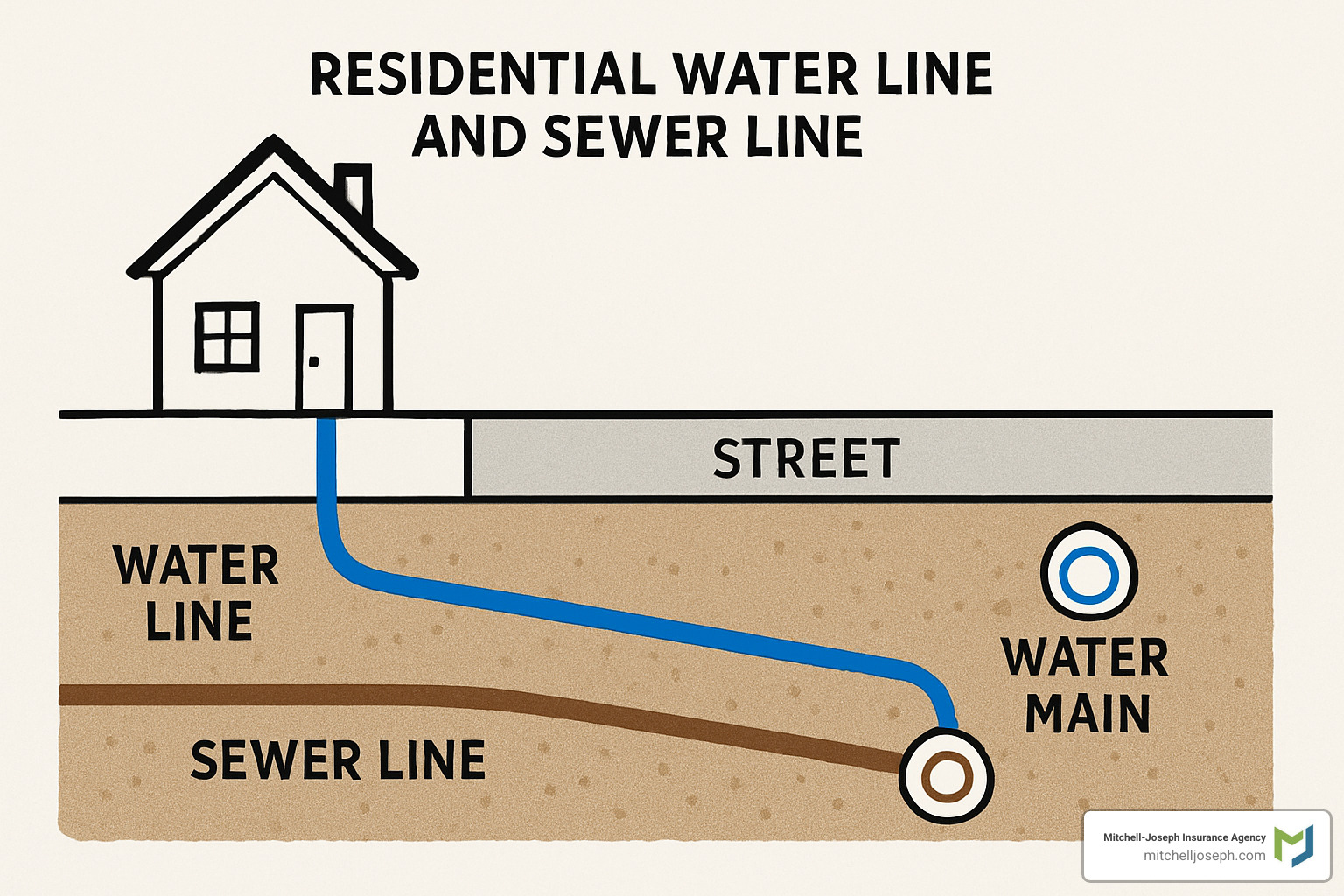
Water Line Insurance vs Sewer Line Insurance
Though they might seem similar at first glance, these coverages protect very different systems with their own unique challenges:
Water Line Insurance focuses on the fresh water supply line that brings clean water into your home. This line typically runs from the municipal connection point to your home’s foundation. The most common issues we see with water lines include corrosion (especially in older metal pipes), freezing damage during our harsh Upstate NY winters, and physical damage from ground shifting or construction. When these lines need repair, homeowners typically face costs between $1,200 and $4,500.
Sewer Line Insurance, on the other hand, protects the waste water line that carries sewage away from your home. This line runs from your house to either the municipal sewer connection or your septic tank. Sewer lines face different challenges – tree roots love to invade these pipes, they can collapse under pressure, and they’re prone to blockages from things that shouldn’t have been flushed. These repairs tend to be more expensive, ranging from $3,000 to $15,000.
I remember a conversation with a plumber explaining this to my client in Bloomfield: “Your water line is under pressure pushing water in; your sewer line relies on gravity to move waste out. That’s why sewer lines tend to have more issues with clogs and backups.” That simple explanation really clarifies why these two systems need different types of protection.

Is a Combo Plan Right for You?
At Mitchell-Joseph Insurance Agency, we often recommend combination plans that cover both water and sewer lines. These combo plans make a lot of sense for most homeowners for several compelling reasons.
First, you’ll typically save money with bundled coverage compared to purchasing separate policies. The price difference is often surprisingly small – sometimes just $10-15 more per year than a single-line policy, but you get protection for both critical systems.
Second, having comprehensive protection means you won’t be caught in that frustrating scenario where you’re covered for one type of line but find your problem is with the other. I’ve had that uncomfortable conversation with clients before, and it’s never pleasant.
Third, when you do need to file a claim, having one point of contact simplifies the whole process. You make one call and get help right away, without trying to figure out which policy covers what.
Combo plans are especially valuable if your home has any of these risk factors:
– It’s more than 50 years old with original plumbing
– You have mature trees with spreading root systems near your utility lines
– Your home was built before 1980 and might have clay or Orangeburg pipes
– Your utility lines run under expensive-to-repair areas like driveways or landscaped gardens
One of our clients in Canandaigua summed it up perfectly: “We initially only wanted sewer line coverage because of the large maple tree in our front yard. But when we learned the combo plan was only $12 more per year, it was an easy decision to protect both lines.”
For most homeowners in our service area, the peace of mind that comes with knowing both your water and sewer lines are protected is well worth the modest additional cost of a combo plan. After all, these are two systems you absolutely can’t live without.
Alternatives & When Water Line Insurance Is Worth It
Let’s face it—nobody wakes up excited to spend money on insurance. But when it comes to water line insurance, the decision isn’t always straightforward. Is it worth the expense, or would you be better off setting money aside for potential problems?
Evaluating Your Risk Profile
Your home has its own unique “risk fingerprint” when it comes to water line failures. Several factors significantly increase your odds of needing repairs:
If your home was built before the Nixon administration (pre-1970), your risk jumps considerably. I recently helped a client in Victor whose 1920s home had its original cast iron pipes—they were practically antiques! While cast iron can last 80-100 years, many homes in our Finger Lakes communities are pushing those limits.
The material of your pipes tells an important story too. Copper pipes typically last 50+ years, while modern PVC might serve your grandchildren well at 75+ years. Some pre-1950s homes still have lead pipes, which bring both reliability concerns and serious health risks.
Our Upstate NY winters don’t do your pipes any favors either. As one Rochester homeowner told me after a January repair: “The ground freezes, thaws, freezes again—it’s like my pipes were doing yoga they weren’t designed for.”
Large trees with wandering root systems can be surprisingly destructive. Those beautiful maples lining Canandaigua streets? Their roots can crush pipes with remarkable strength as they search for water sources.
Here’s a simple test: have your neighbors needed water line repairs? Homes in the same development typically have similar materials and installation methods—their problems today might be yours tomorrow.
Building an Emergency Fund vs Buying Insurance
There are essentially two approaches to handling potential water line failures: self-insuring through savings or purchasing water line insurance.
Many financial advisors recommend building emergency funds for home repairs. Setting aside $50-100 monthly until you reach about $5,000 creates a solid buffer against service line surprises. This approach gives you flexibility—if your pipes behave themselves, that money remains available for other needs.
However, building an adequate emergency fund takes time. As one client in Honeoye Falls finded when facing a $4,200 repair just three months after purchasing their home: “We hadn’t even unpacked all our boxes, let alone built up savings for something like this.”
Water line insurance, by contrast, provides immediate protection for a modest annual premium of $20-$100. Instead of tying up thousands in a designated fund, you’re paying for access to financial protection when you need it.
The AARP offers balanced guidance on coverage worth, noting that for many older Americans on fixed incomes, the predictable small premium is preferable to an unexpected large expense.
Beyond just financial coverage, these policies typically include valuable extras like pre-screened contractors, workmanship guarantees, and simplified claims processes. When a pipe bursts at 2 AM, having a 24/7 hotline to call with professionals ready to help is priceless.
For many homeowners in communities we serve like Naples, Rushville, and Avon, the peace of mind is the real value. As I tell my clients: “Insurance isn’t about preventing bad things from happening—it’s about preventing those bad things from creating financial hardship.”
The municipal programs available in some areas offer another alternative. Several communities in our region provide optional repair programs through local utilities, though coverage limits tend to be lower than private insurance options.
In the end, the decision comes down to your comfort with risk, your home’s specific factors, and your current financial situation. For older homes with aging pipes in our freeze-prone region, water line insurance often makes tremendous sense. For newer construction with modern materials, self-insuring might be reasonable—if you have the discipline to actually set that money aside.
Choosing the Right Water Line Insurance Provider
With multiple options available for water line insurance, selecting the right provider and plan requires careful consideration of several factors.

When we sit down with homeowners across the Finger Lakes region, we often find they’re overwhelmed by the options. At Mitchell-Joseph Insurance Agency, we’ve developed a straightforward approach to evaluating providers based on what truly matters.
First, look at the coverage limits. You’ll want a policy with at least $10,000 in coverage per incident. This might seem high, but it ensures you’re protected even in those worst-case scenarios where excavation gets complicated.
Your deductible options matter too. It’s a simple trade-off – lower deductibles mean less money out of your pocket during claims, but usually come with slightly higher premiums. We help our clients find that sweet spot based on their comfort with risk.
The reputation of the provider speaks volumes. We dig into customer satisfaction rates before recommending any company. For example, Service Line Warranties of America boasts a 99% customer satisfaction rate from their post-repair surveys – that’s the kind of number that gives our clients peace of mind.
Having a strong contractor network is non-negotiable. Quality providers maintain relationships with licensed, insured local professionals who understand the unique challenges of our region. When a pipe bursts in January in Victor or Canandaigua, you need someone who knows how to handle frozen ground and protect your landscaping.
Most people don’t realize that waiting periods are standard in this industry – typically 30 days before coverage kicks in. This prevents folks from buying coverage only after finding a problem. We make sure our clients understand this timing so there are no surprises.
Cancellation terms should be flexible. We prefer policies that allow you to cancel without penalties if your circumstances change.
Finally, regional experience matters tremendously. A provider familiar with the unique challenges of Upstate NY water systems – our clay soils, freeze-thaw cycles, and older infrastructure in communities like Rochester – will serve you better than a generic national program.
Key Questions to Ask Before Enrolling
Before you sign on the dotted line for water line insurance, arm yourself with the right questions. When a client in Pittsford recently asked me what they should know before enrolling, I shared these essential questions:
“What exactly is covered?” This seems obvious, but the coverage area can vary – from municipal connection to foundation, or perhaps just on private property. Get specifics in writing.
“Are there exclusions I should know about?” Every policy has them, but they shouldn’t be hidden in fine print. Good providers are transparent about what isn’t covered.
“How does the claims process work?” Understanding how quickly contractors are dispatched can make a huge difference when water is pooling in your yard.
“Is there a limit to annual claims?” Some policies restrict how many times you can file in a year, which could be problematic for older homes.
“Does this cover landscaping restoration?” The pipe repair might be covered, but what about your prized perennial garden that had to be dug up to access it?
“Can I choose eco-friendly replacement materials?” For environmentally-conscious homeowners in Honeoye Falls and beyond, this matters.
“How do premium increases work over time?” No one likes surprise rate hikes.
“What happens if additional issues are finded during repair?” This scenario is common, and you need to know if you’ll face unexpected costs.
At Mitchell-Joseph Insurance Agency, we guide homeowners through these questions to find comprehensive service line insurance coverage custom to their unique situation.
Regional & Municipal Programs to Know
Beyond traditional insurance options, you might have access to local protection programs that fly under the radar. When I met with a family in Canandaigua last month, they were surprised to learn about their municipal options.
Municipal service line programs are offered by some local governments as optional coverage for residents. These typically come with lower costs but may have more limited coverage than comprehensive insurance options. They’re worth investigating as part of your research.
Utility-sponsored plans have become increasingly common. Many water utilities partner with warranty companies to offer service line protection, often with the convenience of adding the premium directly to your water bill. One client in Victor loves this option – she never forgets to pay because it’s bundled with a bill she pays anyway.
Local water authority programs vary widely by community. Some operate their own protection plans with different coverage levels and approaches to claims.
Across our service area in the Finger Lakes region, availability of these programs differs by town and village. We make it our business to stay current on all local options, from Naples to Rushville to Avon. This ensures our clients can make fully informed decisions about their coverage needs without having to become insurance experts themselves.
After all, knowing all your options is the difference between a stressful emergency and a simple phone call when that inevitable day comes and water starts bubbling up through your front lawn.
Frequently Asked Questions about Water Line Insurance
When it comes to protecting your home’s vital water service line, homeowners across our region share many common questions. Let’s address the ones we hear most frequently at our agency.
Does my standard homeowners policy cover exterior water lines?
The short answer is no, and this surprises many homeowners. Your standard homeowners insurance typically covers water damage that occurs inside your home (like if a pipe bursts in your kitchen), but it almost never extends to the underground service lines outside your home’s foundation.
This coverage gap is precisely why water line insurance exists. Without it, you’re on your own financially if that underground pipe fails.
I remember explaining this to a client in Pittsford who had just finded a leak in their front yard. “But I have the premium homeowners package,” they told me. Unfortunately, even the most comprehensive standard policies typically exclude service line damage due to normal wear and tear, leaving homeowners exposed to potentially significant repair costs.
Who pays if the leak is under the street?
This question highlights one of the most confusing aspects of water line responsibility. The answer depends on exactly where the leak occurs:
If the leak is under the street but before your property line, it’s typically the water utility’s responsibility to fix. You can breathe easy.
If the leak is under the street but in the portion of the service line you own, things get complicated. Some municipalities actually make homeowners responsible for their service line all the way to the main connection, even when it runs under public property like sidewalks or streets. In these situations, water line insurance becomes particularly valuable.
When the leak occurs on your property, it’s almost always your responsibility as the homeowner.
I always recommend checking your local water utility’s specific regulations. Each municipality has slightly different rules. For example, in Victor and Canandaigua, homeowners are typically responsible for the entire service line from their home to the connection at the municipal water main.
What should I do first if I suspect a water-line leak?
If you notice signs of a potential water line leak—like unexplained wet areas in your yard, a sudden drop in water pressure, or a water bill that’s mysteriously higher than normal—here’s what to do:
First, confirm your suspicions by turning off all water-using appliances and fixtures in your home, then check your water meter. If it’s still moving, you likely have a leak somewhere in your system.
If you confirm a significant leak, shut off your home’s main water valve right away to minimize water loss and potential damage. This is especially important in winter when escaping water can create dangerous ice patches.
For those with water line insurance, your next step is to contact your provider’s claims number. They’ll guide you through the process and dispatch qualified repair professionals.
While waiting for help to arrive, document the situation by taking photos of any visible evidence of the leak for your claim. And resist the temptation to attempt DIY repairs—underground water line repairs require specialized equipment and expertise that most homeowners don’t have. Improper repairs can void your coverage and potentially violate local building codes.
One of our clients in Victor shared their experience: “When we noticed our water bill had doubled and found a soggy spot in the front yard, we called Mitchell-Joseph Insurance Agency immediately. They guided us through shutting off the water and filing a claim. Within 48 hours, the repair was complete, and we only paid our $500 deductible on what would have been a $4,200 repair.”
We’ve seen how having the right coverage and knowing what to do in an emergency can turn a potential disaster into a manageable inconvenience. That’s why we take the time to explain these details to every client who asks about service line insurance coverage.
Conclusion
When your water line fails, it’s not just an inconvenience—it’s potentially a major financial setback. These underground emergencies can strike without warning, leaving you facing repair bills from $1,200 for simple fixes to a staggering $20,000+ for complex replacements. And here’s the kicker: your standard homeowners policy probably won’t help you one bit.
That’s where water line insurance comes to the rescue. For what amounts to about the cost of a pizza dinner each year, you can shield yourself from these unexpected expenses. This specialized coverage makes particular sense if you’ve got an older home, mature trees with adventurous roots, or you simply sleep better knowing you’re protected from surprise four-figure repair bills.
At Mitchell-Joseph Insurance Agency, we’ve walked hundreds of homeowners through this decision across Honeoye Falls, Canandaigua, Victor, Rochester, and throughout the Finger Lakes region. Our team’s 200+ years of combined experience and relationships with 24 different insurance companies means we can pinpoint coverage that truly fits your specific situation—not just a one-size-fits-all policy.
Maybe you’re concerned about that 60-year-old galvanized pipe under your front yard, or perhaps you’ve noticed your neighbor’s recent water line disaster and thought, “That could happen to me.” Whatever your situation, we can help you understand your options in plain English and find water line insurance that gives you meaningful protection without unnecessary bells and whistles.
The peace of mind that comes from knowing a sudden water line failure won’t drain your savings account is invaluable. As one of our clients recently put it, “I never thought about my water line until it broke—then I couldn’t think about anything else for days. I wish I’d gotten the coverage sooner.”
To learn more about protecting your home’s critical underground connections, reach out to our team at Mitchell-Joseph Insurance Agency today. You can also visit our website for additional information about service line insurance coverage.
When it comes to those invisible pipes keeping your household running smoothly, a small investment in protection today can save you thousands tomorrow. That’s not just smart insurance—it’s smart homeownership.

