

Getting Your Tractor Protected: What You Need to Know
A tractor insurance quote is your first step toward protecting one of your most valuable farm or property assets. Whether you’re a farmer, landscaper, or property owner with a compact tractor, getting the right coverage doesn’t have to be complicated.
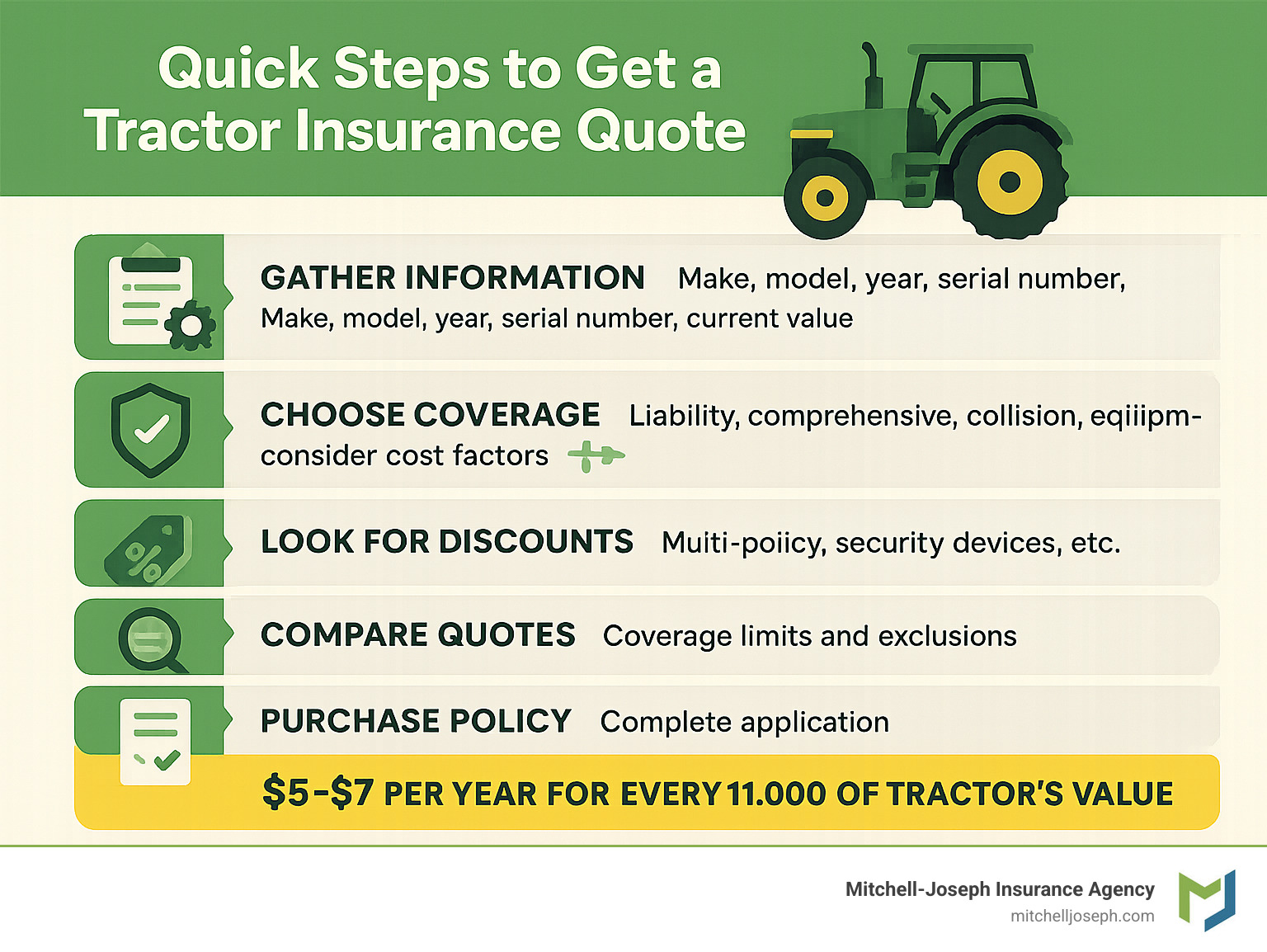
Quick Steps to Get a Tractor Insurance Quote:
- Gather your tractor details – make, model, year, serial number, and current value
- Determine your usage – farming, landscaping, or personal property maintenance
- Choose coverage types – liability, comprehensive, collision, and equipment protection
- Select your deductible – higher deductibles mean lower premiums
- Apply available discounts – multi-policy, responsible driver, and security device savings
- Compare quotes – review coverage limits and exclusions from multiple insurers
- Purchase your policy – complete application and arrange payment
Most tractor owners can expect to pay $5-$7 per year for every $1,000 of their tractor’s value. For example, a $30,000 tractor typically costs $150-$210 annually to insure, while basic liability coverage can start as low as $75 per year.
Your tractor faces real risks every day – from theft and weather damage to liability claims if someone gets hurt. Many homeowners policies won’t cover tractors over 25-30 horsepower, leaving you exposed to major financial losses.
I’m Jeffrey Joseph from Mitchell-Joseph Insurance Agency, and I’ve been helping Finger Lakes region property owners secure comprehensive tractor coverage since 1999. My experience with tractor insurance quotes has shown me that the right policy gives you peace of mind while protecting your investment and livelihood.
Why You Need Tractor Insurance Today
Your tractor isn’t just another piece of equipment – it’s likely one of your most expensive investments, often worth tens of thousands of dollars. And unlike that old pickup truck, your tractor faces unique risks every single day.
Most states don’t legally require tractor insurance since tractors aren’t considered street-legal vehicles. But just because it’s not required doesn’t mean you can afford to skip it.
Thieves love tractors because they’re often stored in remote locations without security measures. Farm equipment theft costs the agricultural industry millions every year, and a stolen tractor can shut down your entire operation.
Weather damage from hail, windstorms, floods, and fires can destroy your tractor in minutes. Just last spring, one of our clients faced $18,000 in repair bills after a severe hailstorm – thankfully, his comprehensive coverage took care of it.
Liability claims can be financially devastating. If your tractor causes property damage or someone gets hurt, you could face lawsuits worth hundreds of thousands of dollars. Even minor accidents can result in major liability exposure.
If you’re financing your tractor, insurance isn’t optional – it’s mandatory. Lenders require comprehensive and collision coverage to protect their investment.
What Is Tractor Insurance & Who Really Needs It?
Tractor insurance is specialized coverage designed for the unique risks that tractors face. Unlike car insurance, tractor policies understand that your equipment might sit idle for months, then work 16-hour days during planting season.
Farmers are obvious candidates – whether growing crops, raising livestock, or maintaining farm property. Landscapers and contractors who depend on tractors need this protection just as much.
Property owners with compact tractors often assume they don’t need coverage. But if that $25,000 compact tractor gets stolen or damaged, you’re still out $25,000.
Anyone financing a tractor will find insurance isn’t negotiable – lenders require it. And if you take your tractor on public roads, even just to move between fields, you absolutely need coverage.
Tractor Insurance vs. Farm Equipment & Homeowners Policies
Your homeowners policy might cover small tractors – typically those under 25-30 horsepower – but anything larger usually falls outside standard homeowners coverage.
Even when covered, homeowners policies often exclude commercial use. So if you’re mowing lawns for profit or doing custom work, your claim might get denied.
Farm equipment insurance typically uses blanket coverage, protecting multiple pieces under one shared limit. Scheduled coverage lists your tractor individually with its own specific amount. For high-value tractors, scheduled coverage often makes more sense.
The biggest concern is liability gaps. Your homeowners policy might exclude liability coverage when using equipment commercially – a dangerous gap that could leave you personally responsible for major claims.
More info about farm insurance policy
Understand Your Coverage Choices
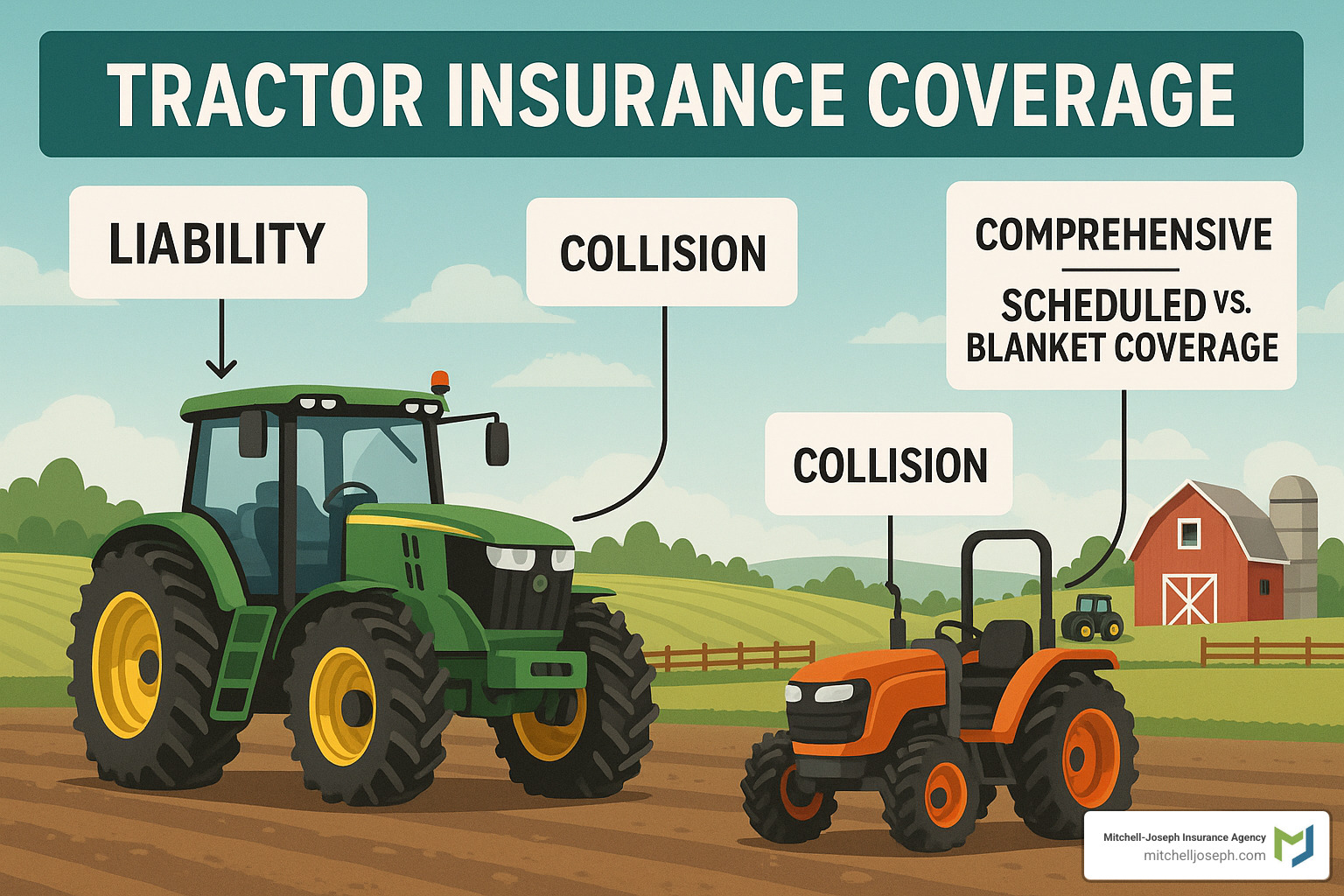
When getting a tractor insurance quote, you’ll encounter several coverage options. Let me walk you through each one so you can make informed decisions.
Liability coverage is your financial shield when accidents happen. If your tractor damages property or injures someone, this coverage handles the costs. I typically recommend at least $300,000 in liability coverage – it’s not much more expensive than lower limits but provides substantially better protection.
Comprehensive coverage protects against theft, vandalism, fire, hail damage, and deer collisions. This is especially important if you store your tractor outdoors or in an unsecured barn. Comprehensive coverage automatically includes up to $3,000 in protection for accessories like front-end loaders and mowers.
Collision coverage handles damage during normal use – backing into fence posts or tipping over on uneven ground. If you’re using your tractor in challenging terrain or transporting it regularly, this coverage becomes essential.
Equipment breakdown coverage addresses modern tractors’ complex hydraulic systems, computerized controls, and expensive electronics that can fail without warning. When your warranty expires, this coverage can save thousands in repair bills.
Medical payments coverage provides immediate help when someone gets hurt, regardless of fault. Uninsured motorist coverage protects from drivers without insurance. Cab glass coverage eliminates deductibles for glass repairs.
You can choose blanket coverage (one overall limit for all equipment) or scheduled coverage (each piece listed individually). For high-value tractors, scheduled coverage often provides better protection.
Common exclusions include normal wear and tear, intentional damage, racing, and employee injuries. Vintage tractor coverage requires special consideration for machines over 25 years old, often providing agreed value coverage.
More info about Farm Equipment Insurance Coverage
Does Tractor Insurance Cover Implements & Accessories?
Most tractor insurance policies automatically include $3,000 in coverage for implements and accessories like front-end loaders, mowers, plows, and other attachments without applying depreciation.
If you have expensive implements, you can increase this coverage to $30,000 or more. This makes sense if you have a $15,000 front-end loader or specialized attachments.
One limitation: most policies only cover implements when they’re connected to the tractor. If you store attachments separately, you might need separate coverage.
Special Policies for Vintage & Classic Tractors
Vintage tractors need special attention because they don’t follow normal depreciation patterns. Agreed value coverage establishes your tractor’s value upfront – instead of receiving depreciated actual cash value after a loss, you receive the full agreed-upon amount.
Restoration coverage protects the time, money, and effort invested in bringing vintage tractors back to life. Show and transport coverage extends protection when traveling to shows, parades, or demonstrations.
Most insurers define vintage tractors as machines 25 years or older.
What Determines the Cost of Your Policy?

Understanding what drives your tractor insurance quote helps you make smarter coverage decisions and spot savings opportunities.
Your tractor’s value sits at the heart of pricing. Most insurers use $5-$7 for every $1,000 of value. A $20,000 compact tractor costs around $100-$140 annually, while a $50,000 farm tractor runs $250-$350 per year.
Horsepower matters significantly. A 25-horsepower compact tractor creates different risks than a 150-horsepower machine. Bigger tractors can cause more damage and cost more to repair, pushing premiums higher.
Usage determines risk level. Running a landscaping business means more hours and exposure compared to cutting grass twice weekly. Commercial use typically adds 20-30% to premiums.
Your driving record affects rates. Clean records earn discounts while violations increase costs. Some insurers offer discounts for completing tractor safety courses.
Location influences rates. Rural areas with lower crime often enjoy better pricing than urban locations with higher theft rates. Weather patterns matter too – tornado alley or hail country means higher comprehensive costs.
Coverage choices directly control premiums. Higher liability limits cost more but protect better. Smart deductible choices dramatically impact annual costs.
| Tractor Value | $250 Deductible | $500 Deductible | $1,000 Deductible |
|---|---|---|---|
| $20,000 | $140/year | $120/year | $100/year |
| $50,000 | $350/year | $300/year | $250/year |
Average Premium Benchmarks
The $5-$7 per $1,000 rule gives you a solid starting point for comprehensive protection. A $30,000 tractor typically runs $150-$210 annually for full coverage, while basic liability might cost as little as $75 per year.
Monthly examples: A $20,000 tractor costs about $8-$12 monthly, a $30,000 machine runs $12-$18 monthly, and a $50,000 workhorse costs $20-$30 monthly.
Financed tractors cost more because lenders require comprehensive and collision coverage with lower deductibles, typically adding 20-30% to premiums.
Smart Ways to Save on Premiums
Multi-policy bundling offers your biggest savings. Combining tractor insurance with auto and homeowners policies can slash total costs by 5-15%.
Clean driving records earn substantial discounts. Keep your record violation-free for three to five years for lower rates.
Paying annually eliminates billing fees and often provides 5-10% additional savings. Shopping early can earn advance-quote discounts.
Security devices like GPS tracking and alarms earn discounts by reducing theft risk. Safety course completion shows commitment to safe operation and earns discounts.
Step-by-Step: How to Get a Tractor Insurance Quote Online
Getting a tractor insurance quote online puts you in control. You can compare options at your own pace without pressure, and most systems provide instant estimates.
Start by gathering your tractor information – make, model, year, serial number, purchase price, and current estimated value. Having this ready speeds up the process significantly.
The quote process moves quickly once organized. Most systems walk you through tractor details first, then coverage options. You’ll input specifications, select coverage types, and choose deductible levels that fit your budget.
Coverage selection deserves careful thought. Consider your risk tolerance and what you can afford out-of-pocket. Liability protects others, while comprehensive and collision protect your investment.
Deductible choices directly impact premiums. Higher deductibles mean lower payments but more out-of-pocket costs when filing claims. Most owners find $500-$1,000 deductibles provide good balance.
Apply for discounts during the quote process. Multi-policy discounts often provide biggest savings when bundling with existing coverage.
Review everything carefully before submitting. Make sure coverage limits meet your needs and you understand inclusions and exclusions.
Information Checklist for a tractor insurance quote
Basic details: make, model, year, serial number – found on the machine or purchase paperwork.
Value information: original purchase price and current market value. Include expensive accessories like front-end loaders.
Usage details: farming, landscaping business, or personal maintenance. Be honest – commercial use costs more but provides appropriate coverage.
Storage and security: locked barns cost less to insure than outdoor parking. Document security measures like GPS tracking for potential discounts.
Operator information: primary user’s age, experience, and driving record. Multiple operators should be mentioned during quoting.
Fast Savings: Discounts to Ask For on a tractor insurance quote
Bundling with existing policies often provides largest savings – combining with auto and homeowners significantly reduces total costs.
Clean driving records earn responsible operator discounts. Some insurers offer additional reductions for completing safety courses.
Security investments like GPS tracking and alarms reduce risk profiles and premiums. Advance shopping before current coverage expires often earns discounts.
Annual payment instead of monthly eliminates billing fees and often earns additional discounts.
Making a Claim After You’re Insured
Safety first – ensure everyone is okay and call emergency services if needed.
Document thoroughly – take photos from multiple angles, get witness information, note weather conditions.
Contact your agent quickly – ideally within 24 hours. At Mitchell-Joseph Insurance Agency, we guide you through the entire process.
Claims timeline: Most insurers acknowledge claims within 24-48 hours, assign adjusters within 2-5 business days, and complete inspections within 5-10 business days. Settlement offers typically arrive 10-15 business days after inspection.
Compare, Decide, and Protect Your Investment

Now comes the crucial part – making a smart decision that protects your investment without breaking your budget. Getting multiple tractor insurance quotes is just the beginning. The real work lies in comparing what each policy actually covers and how well each insurer will serve you when you need them most.
Coverage limits deserve your closest attention. That lower premium might look appealing until you realize it only provides $100,000 in liability coverage when you really need $300,000. Your tractor can cause serious damage or injury, and skimping on liability limits could cost you everything you’ve worked to build.
Deductible choices require honest self-assessment. Choosing a $250 deductible instead of $1,000 will cost you more each year, but can you comfortably handle a thousand-dollar hit if something happens? Balance your monthly budget against your emergency fund reality.
The devil truly lives in the details when it comes to exclusions and limitations. One policy might exclude coverage when you’re doing custom work for neighbors, while another welcomes that income source. Some policies limit coverage for implements and attachments to $3,000, while others offer $30,000 protection. These differences matter when claims happen.
Claims service reputation separates good insurers from great ones. You want an insurance company that answers the phone promptly, sends adjusters quickly, and settles claims fairly. A company’s financial strength ratings tell you whether they’ll still be around to pay your claim in five or ten years.
At Mitchell-Joseph Insurance Agency, we’ve learned that the cheapest quote often becomes the most expensive mistake. Our access to 24 insurance companies lets us find that sweet spot where comprehensive coverage meets reasonable pricing. Our team’s 200+ years of combined experience helps spot coverage gaps that could leave you exposed when you can least afford it.
Red flags should make you pause and ask questions. If one quote is dramatically lower than others, find out why. Maybe they’re excluding coverage you need, or perhaps their claims service reputation explains the discount. Policies loaded with exclusions might save money upfront but cost you dearly when you file a claim.
Your decision should feel right both financially and practically. The coverage limits should protect your assets and income potential. The deductibles should fit your comfort zone. The policy exclusions shouldn’t eliminate protection for how you actually use your tractor. Most importantly, the premium should fit your long-term budget, not just this year’s cash flow.
Latest insight on tractor coverage
More info about Farm Insurance 101
Frequently Asked Questions about Tractor Insurance Quotes
Getting a tractor insurance quote often raises common questions. Here are answers to questions I hear most often from tractor owners.
Is tractor insurance required by law?
No – state law doesn’t require tractor insurance since tractors aren’t street-legal vehicles. But that doesn’t mean you can skip it.
If you’re financing your tractor, your lender will almost certainly require comprehensive and collision coverage. Banks want to protect their investment, making insurance necessary for most purchases.
Things get complicated if you take your tractor on public roads. Even occasional road travel may require liability coverage depending on local regulations.
The real question isn’t whether it’s legally required, but whether you can afford to go without it. Your tractor represents thousands in investment and creates significant liability exposure.
Does my homeowners policy ever cover my tractor?
Sometimes, but probably not adequately. Most homeowners policies provide limited coverage for tractors under 25-30 horsepower – protecting small lawn tractors but not larger farm equipment.
Even when covered, homeowners policies typically exclude commercial use entirely. If you’re farming or doing custom work, coverage likely won’t apply when needed.
Liability limits on homeowners policies often fall short for tractor-related claims. Accidents can cause serious damage or injuries, potentially exceeding homeowners liability coverage.
Homeowners policies also won’t cover expensive implements and attachments. Dedicated tractor policies provide comprehensive protection designed specifically for agricultural equipment.
What’s the difference between individual and blanket equipment coverage?
Individual coverage schedules each piece separately with its own coverage amount. Your tractor gets $30,000, brush hog $5,000, loader $15,000 – each with guaranteed coverage up to specific amounts.
Blanket coverage protects all equipment under one shared limit – say $100,000 total. This applies to any covered loss, but you’re sharing protection among all equipment.
Individual coverage works better for expensive tractors needing guaranteed protection. Blanket coverage makes sense for diverse equipment with varying values – it’s simpler and often costs less administratively.
Conclusion
Getting the right tractor insurance quote is really about protecting what matters most to you – whether that’s your livelihood, your hobby, or simply your peace of mind. After helping thousands of tractor owners over the past 25 years, I can tell you that the right coverage makes all the difference when life throws you a curveball.
At Mitchell-Joseph Insurance Agency, we’ve built our reputation on understanding exactly what tractor owners need. From the farmer in Rushville worried about storm damage to the weekend hobbyist in Pittsford concerned about theft, we’ve seen it all. Our family-owned business has been serving the Finger Lakes region since 1999, and we know that every tractor owner’s situation is unique.
What sets us apart isn’t just our over 200 years of combined experience – though that certainly helps when you’re navigating coverage options. It’s our access to 24 different insurance companies that really makes the difference. While other agencies might only offer you one or two options, we can shop around to find the perfect fit for your specific needs and budget.
Here’s what happens next: Gather up your tractor information using our handy checklist, then reach out to us however works best for you – online, over the phone, or stop by one of our convenient locations. We’ll walk you through your options without any pressure or insurance jargon, and you’ll have a personalized quote that actually makes sense for your situation.
Whether you’re protecting a brand-new compact tractor or a vintage restoration project, whether you’re farming commercially or just maintaining your property, we understand the risks you face in our region. Your tractor represents a significant investment, and frankly, it deserves better protection than hoping your homeowners policy might cover it.
Don’t let another season pass without proper coverage. Tractor theft happens more often than you’d think, and weather in the Finger Lakes can be unpredictable. One hailstorm or break-in could cost you thousands – money that proper insurance would have covered for just a few dollars a month.
More info about insurance coverage: farm insurance
Ready to protect your investment? Contact Mitchell-Joseph Insurance Agency today for your tractor insurance quote. With locations throughout the Finger Lakes region and a quarter-century of experience protecting agricultural and commercial equipment, we’re not just your insurance agency – we’re your neighbors, and we’re here to help.

