Why Health Insurance is a Game-Changer for Rochester Businesses
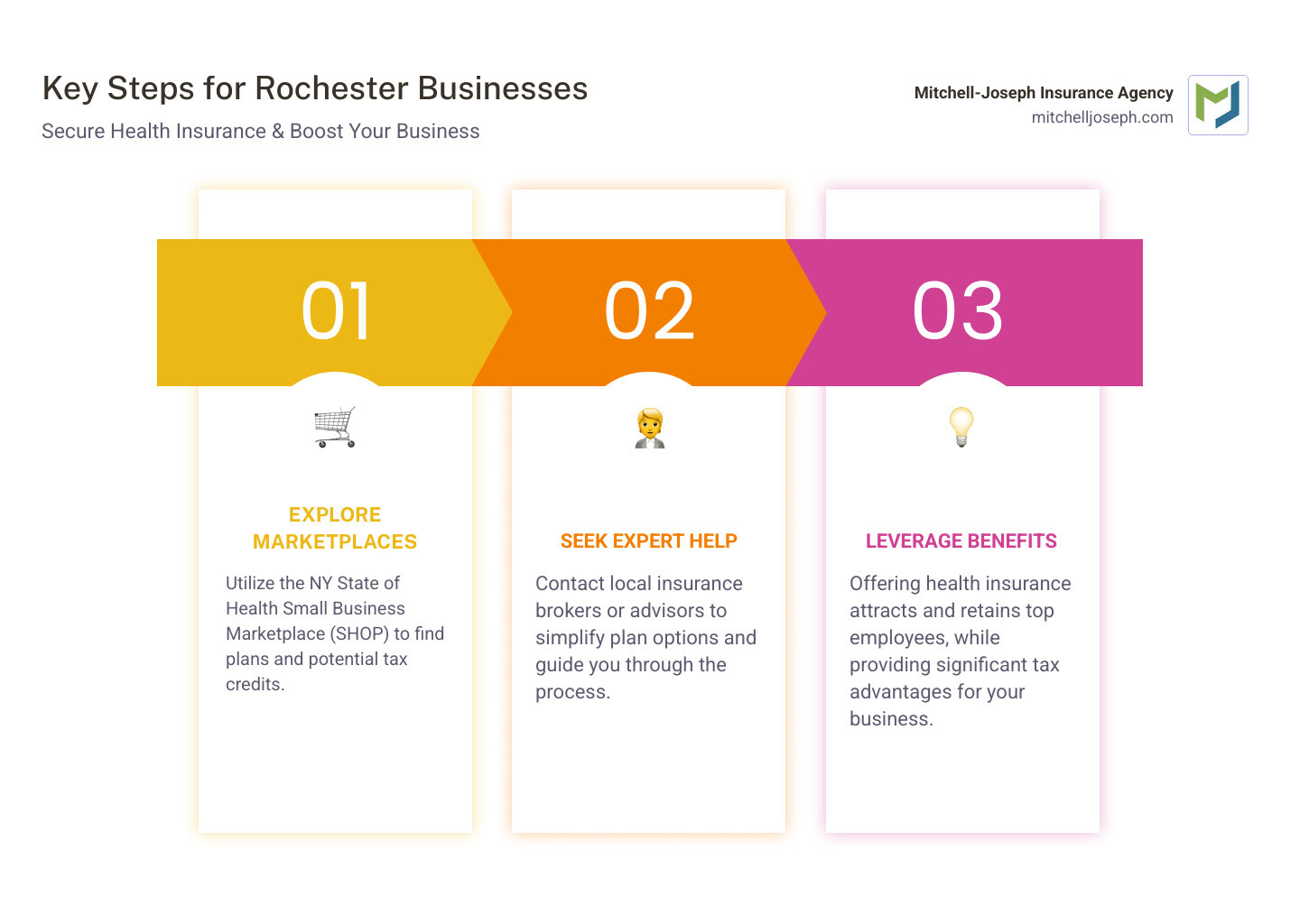
Navigating small business health insurance Rochester NY can feel like a maze, but securing quality coverage for your team is crucial. Here’s a quick guide to getting started:
- Small Business Health Insurance in Rochester, NY: Quick Start Guide
- Marketplaces: Explore the NY State of Health Small Business Marketplace (SHOP) for plans and potential tax credits.
- Broker Help: Contact local insurance brokers or advisors to simplify options and guide you.
- Key Benefits: Offering health insurance attracts and retains employees, and provides tax advantages for your business.
Providing health insurance is more than just a perk; it’s a smart business decision. For small businesses in Rochester, NY, offering competitive health benefits is a powerful tool. It helps you attract top talent and keep your best employees happy.
Consider this: 88% of employers see health care benefits as very important to their workforce. This isn’t surprising. A strong benefits package makes your business stand out. It helps you build a loyal team. Plus, you can often enjoy significant tax savings, making it a smart move for your bottom line.
I’m Jeffrey Joseph. For over two decades at Mitchell-Joseph Insurance, I’ve helped small businesses steer complex insurance needs, including small business health insurance Rochester NY, serving clients across the Finger Lakes Region.
Basic small business health insurance rochester ny terms:
- business insurance agents near me
- business insurance for contractors
- business insurance for startups
Navigating Small Business Health Insurance in Rochester, NY
Finding the right small business health insurance Rochester NY doesn’t have to feel overwhelming. Think of it like building a solid foundation for your team’s wellbeing – and your business’s success. Most small businesses in Rochester have several pathways to provide quality health coverage, with group health plans being the most popular choice for good reason.
Group plans offer real advantages that individual policies simply can’t match. You’ll often see lower costs per employee, better coverage options, and the buying power that comes from pooling together with other businesses. Plus, there are state programs and tax benefits specifically designed to help small businesses like yours make health insurance more affordable.

The key is understanding your options and finding what works best for your specific situation. Whether you’re a startup with five employees or an established company with fifty, there’s a solution that fits your budget and your team’s needs.
For comprehensive business protection beyond health insurance, consider exploring our Business Owners Policy to safeguard all aspects of your operation.
Understanding Your Plan Options
When you’re exploring small business health insurance Rochester NY, you’ll encounter several plan types and funding models. Each has its own personality, if you will – some are more flexible, others more budget-friendly, and some offer the best of both worlds.
Common Health Plan Types:
Health Maintenance Organization (HMO) plans work like having a trusted family doctor who coordinates everything. Your employees choose a primary care physician within the network, and this doctor becomes their healthcare quarterback, managing referrals to specialists when needed. HMOs typically offer lower out-of-pocket costs, but employees need to stay within the network for coverage. It’s perfect for teams who value coordinated care and predictable costs.
Preferred Provider Organization (PPO) plans are for those who want more freedom to choose. Employees can see any doctor or specialist without referrals, both inside and outside the network. Going out-of-network costs more, but the flexibility is there when needed. This works well for employees who have established relationships with specific doctors or specialists.
Exclusive Provider Organization (EPO) plans split the difference nicely. Like PPOs, employees don’t need referrals to see specialists within the network. But like HMOs, there’s typically no coverage for out-of-network care except in emergencies. It’s a sweet spot for many businesses – offering specialist access without the higher costs of full PPO flexibility.
High Deductible Health Plans (HDHP) come with higher deductibles but lower monthly premiums. The real advantage? They can be paired with Health Savings Accounts (HSAs), letting employees save pre-tax dollars for medical expenses. This option appeals to younger, healthier workforces who want to take charge of their healthcare spending.
Health Plan Funding Models:
How your plan is funded affects both your costs and your financial risk. Fully-insured plans are the traditional choice – you pay a fixed monthly premium, and the insurance company handles all the financial risk. It’s predictable budgeting with no surprises, though you won’t see savings if your employees have fewer claims than expected.
Level-funded plans offer an interesting middle ground. You pay a fixed monthly amount based on your group’s expected claims, but here’s the kicker – if your employees’ actual claims come in lower than projected, you might get money back at year’s end. It’s like getting a refund for being healthy! There’s still protection if claims run high, as the insurer covers excess costs up to certain limits.
Self-funded plans give you the most control but also the most risk. Your business pays employees’ medical claims directly, which can lead to significant savings if claims are low. To protect against catastrophic costs, these plans typically include stop-loss insurance that kicks in when claims exceed predetermined thresholds. While more common among larger businesses, some smaller companies explore this option with proper guidance.
Beyond basic medical coverage, you can improve your benefits package with additional products like dental, vision and life insurance coverage. These extras can make your overall benefits package much more attractive to current and potential employees.
Group vs. Individual Plans: A Cost and Coverage Comparison
The question comes up often: should we offer a group plan or just let employees buy individual coverage? While individual plans might seem simpler on the surface, group plans almost always deliver better value for both you and your team.

Group health insurance brings the power of collective bargaining to small businesses. When you pool together with other employers, insurance companies offer better rates because they’re spreading risk across a larger group. You can typically share premium costs with employees, making coverage more affordable for everyone. The coverage options are usually more comprehensive, and employees don’t have to worry about being denied coverage due to pre-existing conditions.
Individual health insurance puts each employee on their own to steer the marketplace. While they have complete control over their choices, they also face higher costs and limited options. There’s no employer contribution to help with premiums, and the administrative burden falls entirely on each person.
The numbers tell the story clearly. Group plans consistently offer lower per-person costs, better coverage options, and stronger financial protection. Plus, offering group health insurance helps you attract and retain quality employees – it’s become an expected benefit in today’s job market.
Group plans also ensure ACA compliance more easily, as they’re designed to meet all federal requirements from the start. This takes a major administrative burden off your shoulders and ensures your business stays on the right side of healthcare regulations.
State Programs and Tax Advantages for small business health insurance in rochester, ny
New York State offers several programs designed specifically to help small businesses provide affordable health coverage. These aren’t just nice-to-have benefits – they can make the difference between offering insurance and going without.
The NY State of Health Marketplace includes a Small Business Health Options Program (SHOP) that’s worth exploring. This marketplace is designed specifically for businesses with 50 or fewer full-time employees, offering access to qualified health plans with potential tax advantages.
Speaking of taxes, the Small Business Health Care Tax Credit can be a game-changer for qualifying businesses. If you have fewer than 25 full-time equivalent employees with average wages below certain thresholds, you could claim up to 50% of your premium contributions as a tax credit. Even if you don’t qualify for the full credit, you can still deduct premiums as a business expense.
The eligibility requirements focus on business size and employee wage levels, making this benefit accessible to many Rochester small businesses. The credit is particularly valuable for newer businesses or those in growth phases where every dollar counts.
These programs recognize that small businesses are the backbone of the economy and deserve support in providing quality benefits to their teams. Taking advantage of available programs and tax benefits can make offering small business health insurance Rochester NY much more affordable than you might expect.