Why Your Sewer Line Needs Protection
Sewer line break insurance is a critical but often overlooked form of homeowner protection. Here’s what you need to know:
Quick Answer:
- Standard homeowners insurance does NOT typically cover sewer line breaks caused by common issues like wear and tear, tree roots, or corrosion
- Service line coverage is an optional endorsement that protects the physical sewer pipes on your property
- Costs around $40-$50 per year for coverage of $10,000-$12,000
- Average repair costs range from $4,000 for repairs to $3,000-$6,000 for full replacement
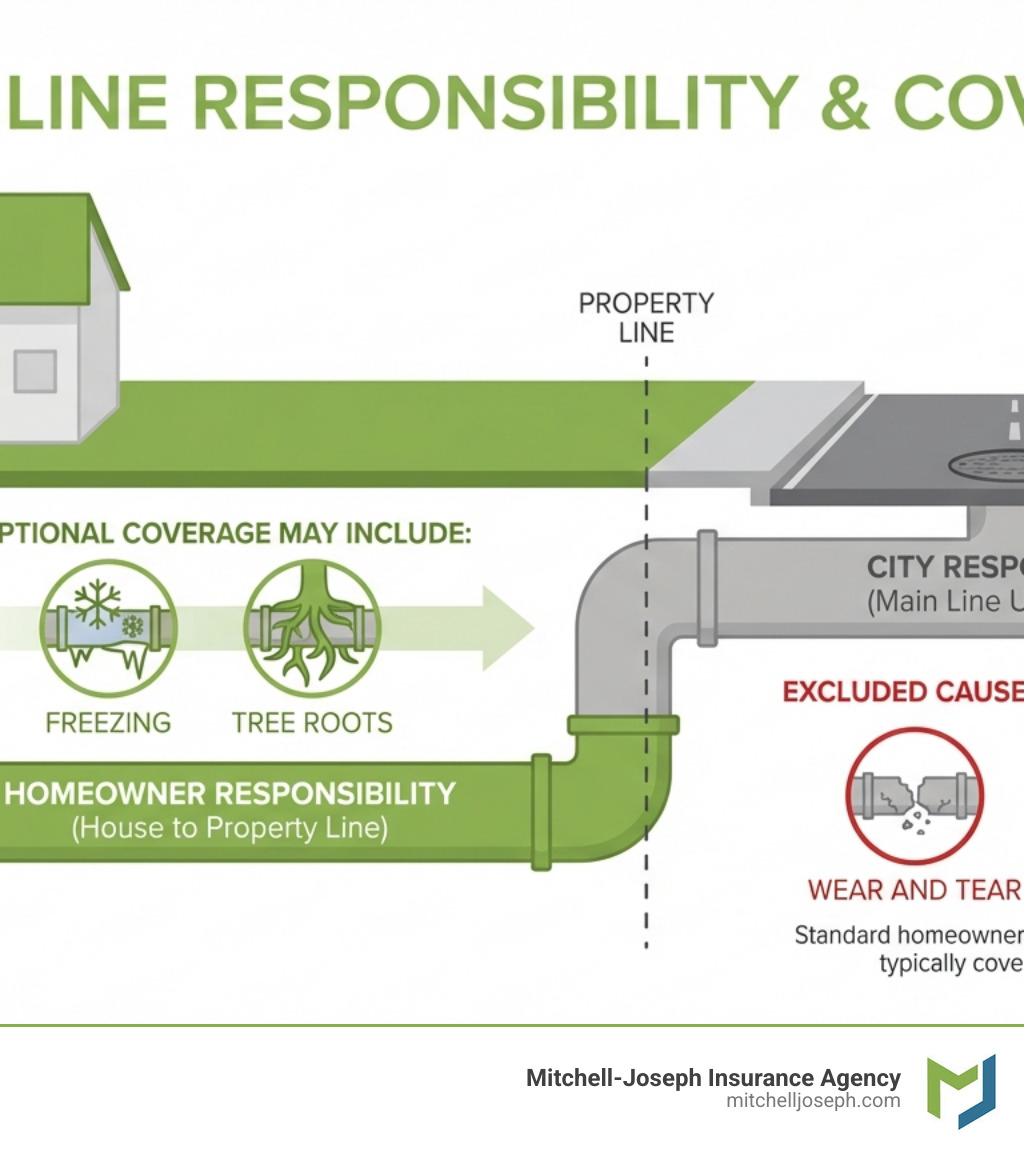
- Homeowners are responsible for the sewer line from their house to the street connection
The reality surprises most homeowners: you own and maintain the sewer line running through your property, including the portion under the street. A Nationwide survey found that 32 percent of homeowners incorrectly think service lines are covered by a standard home policy. This misconception can lead to thousands in unexpected expenses when a pipe breaks, corrodes, or is invaded by tree roots.
A typical sewer line replacement costs $3,000 to $6,000, but complex repairs can be much more. Without proper coverage, you’re responsible for excavation, pipe replacement, and restoring your yard, driveway, or landscaping. Standard homeowners policies usually only cover damage from sudden events like fire or explosions—not the gradual wear and tear causing most failures.
I’m Jeffrey Joseph of Mitchell-Joseph Insurance Agency. Since 1999, I’ve helped homeowners across the Finger Lakes region understand their insurance. Many clients find gaps in their coverage too late, which is why I ensure every homeowner understands their options for sewer line break insurance before an emergency strikes.
Understanding Your Coverage: Standard Policies vs. Sewer Line Break Insurance
Most homeowners I speak with in the Finger Lakes region assume their home insurance covers everything. It’s a natural assumption, but when it comes to pipes buried beneath your lawn, standard policies have significant gaps.
The sewer line is a critical component we rarely think about until it fails. Understanding your policy’s handling of underground service lines is key to avoiding devastating expenses. That’s where sewer line break insurance, an endorsement or add-on, becomes essential. It fills the gaps in standard policies, covering the real-world causes of sewer line failures.
Let’s review what your standard policy covers, what it excludes, and how service line coverage can protect you.
What Standard Homeowners Insurance Typically Covers (and Excludes)
Standard homeowners insurance typically does not cover sewer line breaks from common causes. Your policy protects against “named perils”—sudden events like fire, explosions, or vandalism. If a car damages your sewer line or vandals break it, you might have coverage.
Your sewer line falls under “Other Structures Coverage,” typically 10% of your dwelling’s insured value. For a $600,000 home, that’s $60,000 in coverage—but only for named perils.
The problem is that real sewer line failures rarely result from named perils. They happen due to gradual causes that standard policies exclude, like wear and tear (aging pipes) and corrosion, which are considered maintenance issues.
Tree roots are a major culprit. They seek water, infiltrate cracks in your sewer line, and cause blockages or breaks. This is almost always excluded from standard coverage. Your policy might cover resulting water damage inside, but it won’t pay to fix the pipe.
Other common exclusions are poor upkeep, faulty construction, floods, earthquakes, pest damage, and most blockages. Freezing and ground shifting are also often excluded unless tied to a covered peril.
Crucially, you own the sewer line from your house to the public main connection—often under the street. The municipality only handles the main lines. If a break occurs on your property, you’re responsible for the entire repair bill. For more details, see our Homeowners Insurance Water Sewer Lines Guide.
An Introduction to Sewer Line Break Insurance: Service Line Coverage
This is where service line coverage—your actual sewer line break insurance—comes in. It’s an optional endorsement for your homeowners policy that protects the underground lines standard insurance ignores.
Service line coverage addresses real-world causes of pipe failures. Unlike a standard policy, this endorsement covers tree roots, freezing, mechanical breakdown, wear and tear, corrosion, ground shifting, and damage from the weight of equipment, animals, or people.
This protection often extends beyond the sewer line, covering other buried utilities you own, like water, power, and natural gas lines.
A service line endorsement typically covers excavation costs, pipe repair or replacement, and restoration costs (fixing your lawn, landscaping, or pavement). Restoration alone can cost thousands.
Most endorsements offer limits of $10,000 to $12,000 per occurrence with a $500 deductible. For details, see our Service Line Coverage Complete Guide or learn more about Service Line Insurance Coverage on our site.
Sewer Backup vs. Service Line Coverage: What’s the Difference?
This is a common point of confusion. Both coverages deal with sewer issues but protect against different problems.
Service line coverage (your sewer line break insurance) covers damage to the physical pipe. It pays to repair or replace the line when it breaks from causes like tree roots, freezing, or wear and tear. The focus is on fixing the pipe.
Sewer backup coverage covers damage from a sewer problem, like when sewage backs up into your home. It handles the aftermath inside your house: ruined carpets, damaged walls, and cleanup. It does not pay to fix the sewer line that caused the backup.
Standard homeowners insurance excludes sewer backup damage, making this another wise optional endorsement. Simply put: service line coverage fixes the pipe, while sewer backup coverage cleans up the mess inside your home.
Here’s a quick comparison:
| Feature | Service Line Coverage | Sewer Backup Coverage |
|---|---|---|
| What it covers | Physical damage to the underground sewer line | Damage inside your home from sewer/drain backup |
| Causes it addresses | Tree roots, freezing, wear & tear, corrosion | Blockages (any cause), sump pump failure, heavy rain |
| Examples of costs | Excavation, pipe repair/replacement, landscaping | Water damage cleanup, replacing flooring, furniture |
| Standard HO coverage? | No (for common causes) | No |
| Primary purpose | Repair/replace the pipe | Restore your home’s interior and personal property |
Having both endorsements offers complementary protection. One addresses the cause (the broken pipe), and the other addresses the effect (damage in your home), providing comprehensive protection.
Making an Informed Decision: Costs, Prevention, and Next Steps
Now that we understand the coverage nuances, let’s discuss making an informed decision. For homeowners in the Finger Lakes region, this means understanding the costs, taking preventative steps, and securing the right coverage.

The Financial Impact: Repair Costs vs. Insurance Premiums
The cost of repairing or replacing a sewer line can be substantial. A repair averages around $4,000, while sewer line replacement costs can vary depending on the severity of the damage, typically running $3,000 to $6,000. Complex issues can cost even more.
Compare that to the cost of sewer line break insurance. A service line endorsement costs just $40 to $50 per year, securing $10,000 to $12,000 in coverage.
You could pay thousands out of pocket or invest $40 to $50 annually for protection. In our experience helping clients across local communities like Honeoye Falls and Victor, this is one of the most impactful and affordable additions to a homeowners policy. The peace of mind is worth it.
Proactive Homeownership: Warning Signs and Prevention Tips
While insurance is a safety net, proactive measures can prevent problems. Knowing the warning signs and taking preventative steps can save you headaches and money.
Your home often gives warning signs before a total failure. Look for: slow drains throughout the house, gurgling sounds from toilets, foul sewage odors inside or out, and soggy or lush patches in your yard near the sewer line. A frequently clogging toilet can also signal a deeper issue.
Prevention is key. Never pour grease, fats, or oils down drains; scrape them into the trash. For flushing, follow the “Three Ps” rule: only pee, poop, and (toilet) paper. “Flushable” wipes, paper towels, and other items cause severe blockages. Learn more about this rule at Follow the Three Ps rule for flushing.
Be mindful of tree placement, as roots infiltrate sewer lines. Consider periodic inspections for older trees. A professional inspection can catch small problems early and include cleaning to remove buildup. Simple drain catchers also help prevent clogs from hair and food. These habits significantly reduce your risk.
How to Get the Right Sewer Line Break Insurance
Getting the right sewer line break insurance is simple with an independent agency like Mitchell-Joseph. We offer personalized service and competitive quotes from many insurers. With over 200 years of combined experience, we understand the needs of homeowners in local communities from Avon to West Bloomfield.
Start by reviewing your current policy with our help to understand your existing coverage and exclusions. We’ll also consider your home’s age, pipe material, and nearby trees to determine your risk profile.
We’ll explain the specifics of service line and sewer backup endorsements, including limits, deductibles, and costs. Bundling home and auto insurance can often save you money. Since we work with 24 different insurance companies, we can shop for the best rates and coverage for you.
You can also explore how a sewer line home warranty complements insurance. While different, a warranty can cover normal wear and tear. Some homeowners choose both for comprehensive protection. Our guide on Is Water Backup Insurance Worth It? offers more insights.
As an independent, family-owned business, our goal is to find the best custom coverage for you. We can answer your questions, compare options, and secure the right sewer line break insurance for your home. Don’t wait for a disaster. Reach out to us at Mitchell-Joseph Insurance Agency today to make securing your home’s future simple.