Why Protecting Your Underground Utility Lines Matters
Service line coverage is an optional insurance add-on that protects homeowners from the costs of repairing or replacing damaged underground utility lines on their property. This coverage fills a crucial gap in standard homeowners insurance policies.
What is service line coverage?
- Covers repair/replacement of underground utility lines (water, sewer, gas, electric, etc.)
- Typically costs $20-$50 per year
- Includes excavation and landscape restoration costs
- Usually has a $500 deductible
- Coverage limits typically range from $10,000-$25,000 per occurrence
Imagine waking up to find no running water in your house. A tree root has collapsed the line between your home and the city’s water main—and because the broken pipe is on your property, you’re responsible for repairs that could cost thousands. Most homeowners don’t realize they’re liable for service lines on their property until they face an unexpected bill averaging $3,000-$4,000.
The truth is, standard homeowners insurance typically doesn’t cover damage to underground service lines. Without specific coverage, you could be left paying out-of-pocket for expensive excavation, repairs, and landscape restoration.
I’m Jeffrey Joseph, and as an insurance agent with over 20 years of experience at Mitchell-Joseph Insurance Agency, I’ve helped countless homeowners understand their options for service line coverage and protect themselves from unexpected utility line failures.
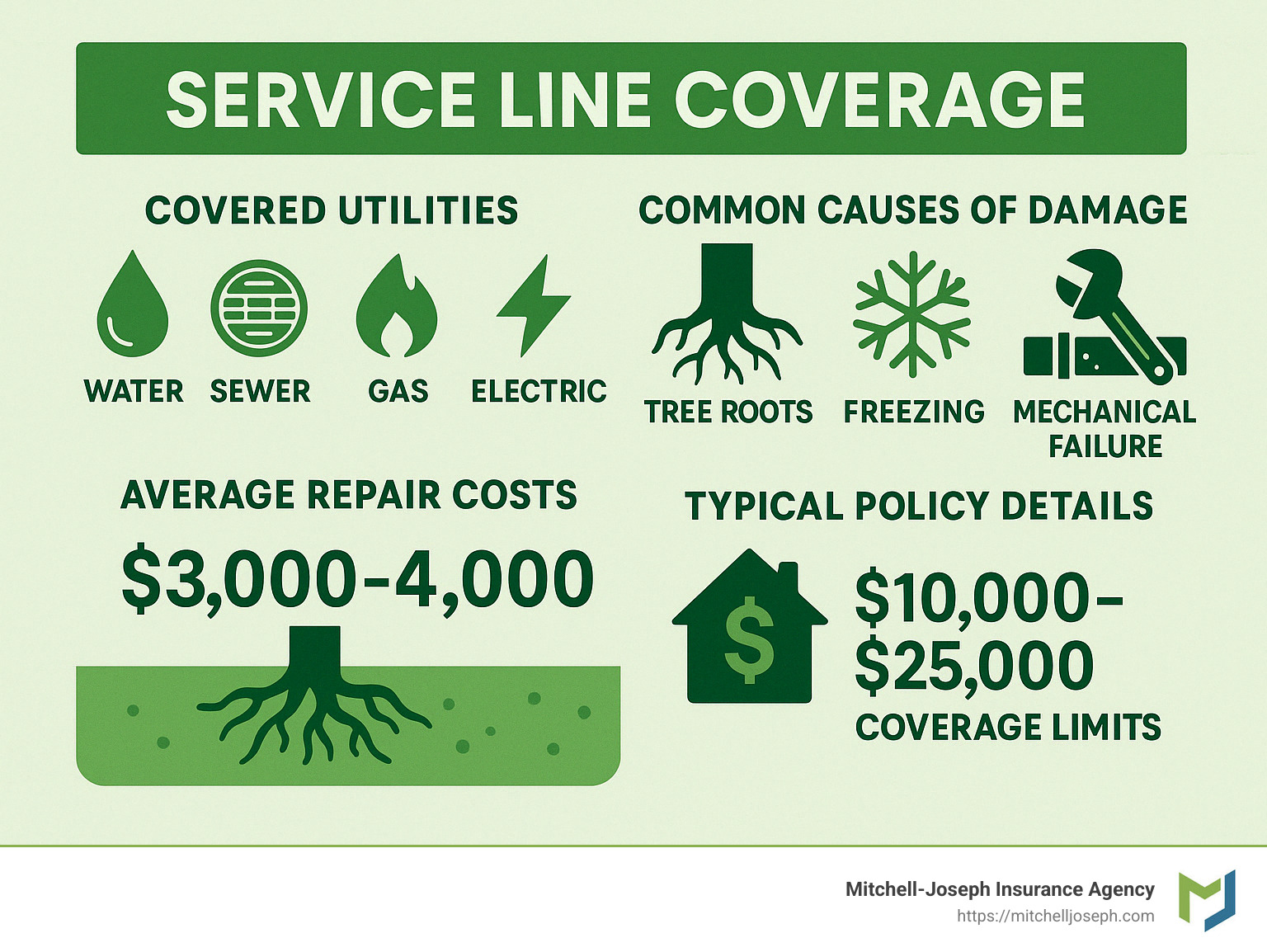
Simple service line coverage word guide:
What Is Service Line Coverage?
Service line coverage is a specialized type of coverage in residential property insurance that covers the cost of repairing or replacing various underground utility lines in the event of a loss. Think of it as a safety net for all those essential pipes and wires that run beneath your property—out of sight, but definitely not something you want out of mind.
Most homeowners are surprised to learn that they’re legally responsible for the underground service lines running from the street to their home. Yes, those water pipes, sewer lines, and electrical cables that you never see? They’re your property and your responsibility, even though you probably didn’t install them yourself.
Here’s the kicker: your standard homeowners insurance policy typically doesn’t cover damage to these underground lines. This creates a significant protection gap that could leave you facing thousands in unexpected repair costs.
“Service line coverage is a specialized type of coverage in residential property insurance that covers the cost of repairing or replacing various underground utility lines in the event of a loss.”
When an underground pipe bursts or an electrical line fails, service line coverage steps in to help with:
- The actual repair or replacement of the damaged line
- Excavation costs (which are often the most expensive part)
- Restoring your landscaping after the necessary digging
- Additional living expenses if you need to relocate temporarily
- In some cases, even upgrading to more environmentally friendly materials
At Mitchell-Joseph Insurance Agency, we’ve seen how this coverage has saved our neighbors in Honeoye Falls and Canandaigua from significant financial strain. One client faced a $7,500 bill when tree roots damaged their sewer line—but with service line coverage, they paid only their $500 deductible.
The peace of mind that comes from knowing you’re protected against these hidden risks is invaluable. After all, these service lines are the lifelines that bring water, electricity, internet, and other essentials into your home. When they fail, life can quickly become complicated and expensive—unless you’re properly covered.
Types of Service Lines Covered
When you add service line coverage to your homeowners policy, it typically protects a wide range of underground utility lines that service your home. Understanding which lines are covered is essential for making informed decisions about your insurance needs.
Think of your home as a living organism with these underground lines serving as vital arteries. Just like our own bodies, when one of these systems fails, it can affect your entire home’s wellbeing.
Water Lines
These are the lifelines that bring fresh water into your home from the municipal water supply or private well. When water lines fail, you might turn on the tap to find only a trickle, or worse – discolored water that’s unsafe to drink. One of our clients in Brighton finded their water line issue when their water bill suddenly doubled, indicating an underground leak they couldn’t see.
Sewer Lines
Nobody likes to think about sewer lines until there’s a problem – and trust me, when there is one, it’s all you can think about! These critical pipes carry wastewater away from your home to the municipal sewer system or your private septic tank. Signs of failure include multiple clogged drains, gurgling toilets, or that unmistakable “rotten egg” smell in your yard.
Gas Lines
Your gas lines deliver fuel for heating, cooking, and other appliances. Damage to these lines isn’t just an inconvenience – it can create serious safety hazards. That’s why many homeowners find particular peace of mind knowing these lines are covered. Just last winter, a family in Mendon detected the faint smell of gas in their yard and finded a line damaged by frost heave.
Electric Lines
When underground electrical lines fail, you might experience anything from flickering lights to complete power outages. In older neighborhoods around Rochester, these lines are particularly vulnerable to age-related deterioration. Service line coverage can save you from sitting in the dark – and from the shocking repair bill.
Cable and Internet Lines
In today’s connected world, losing internet service can feel almost as disruptive as losing electricity. These lines provide your telephone, cable television, fiber optic, and internet connections. When they fail, you’re suddenly cut off from work, entertainment, and communication.
Sprinkler Systems
Many homeowners are surprised to learn that underground sprinkler system pipes can sometimes be included in service line coverage. This can be especially valuable for homes in Victor and Pittsford with extensive landscaping investments.
At Mitchell-Joseph Insurance Agency, we’ve seen how valuable this coverage can be. One memorable case involved a Pittsford homeowner who noticed an unusually green and soggy patch in their yard despite dry weather – a telltale sign of a water line leak. Thanks to their service line coverage, the $4,200 repair bill (including excavation and landscape restoration) was covered after their $500 deductible.
Every insurance provider offers slightly different coverage, which is why we work with 24 different insurance companies to find the perfect fit for our clients throughout the Rochester area. We’ll help you understand exactly which lines are covered under your specific policy, giving you confidence that your home’s underground infrastructure is protected.
Damages Covered by Service Line Coverage
When your underground utility lines fail, service line coverage steps in to save the day—and your wallet. This valuable protection covers a surprisingly wide range of damages that might affect those hidden pipes and lines running beneath your property.
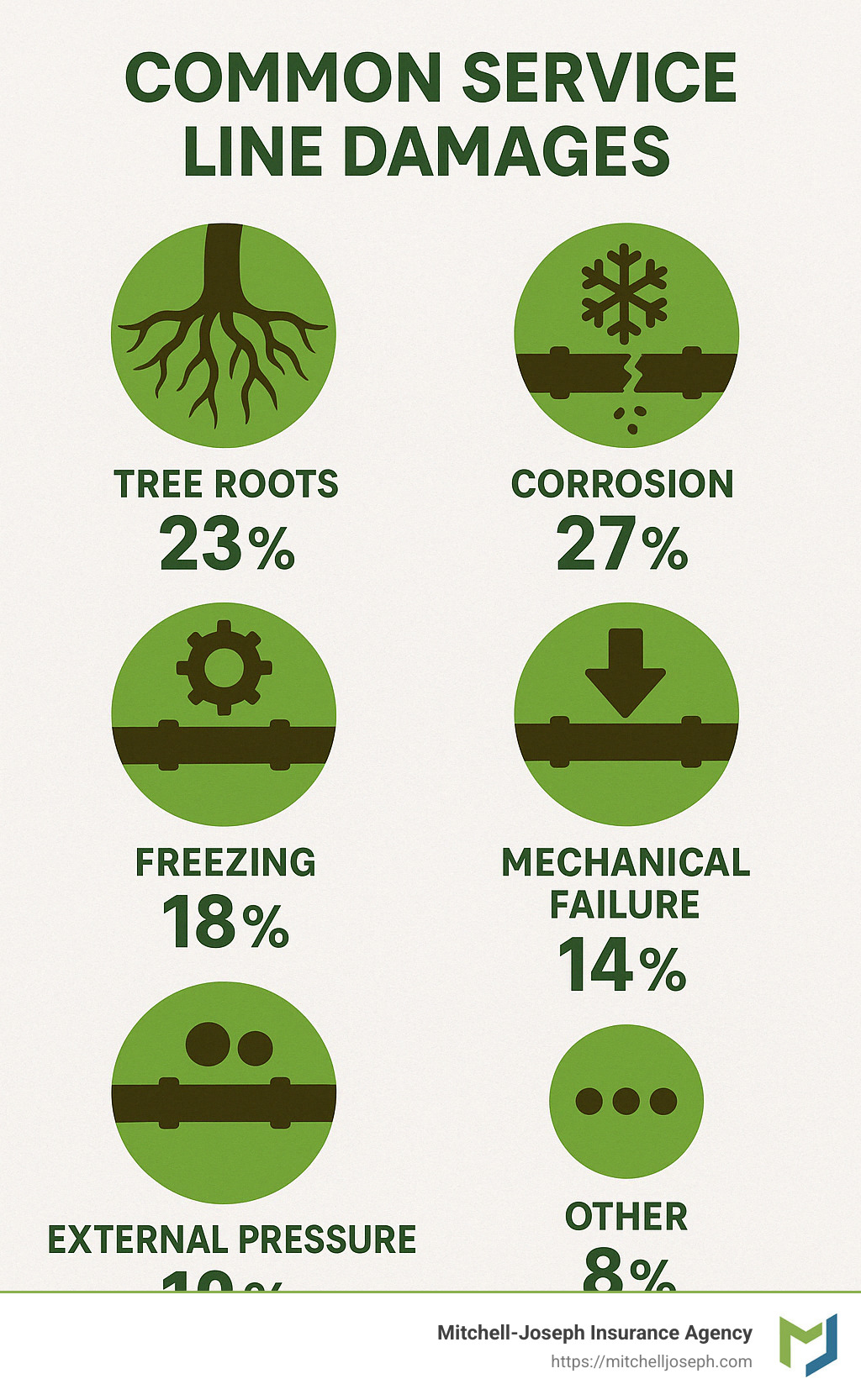
Common Causes of Service Line Damage

That peaceful maple tree in your front yard might be secretly causing thousands of dollars in damage underground. Tree root invasion is one of the most common culprits we see at Mitchell-Joseph Insurance. Those roots may look harmless, but they’re surprisingly powerful—wrapping around pipes and slowly crushing them until they crack or completely collapse.
Over time, wear and tear takes its toll on even the best-installed service lines. Nothing lasts forever, especially pipes that have been buried underground for decades. This natural deterioration is particularly problematic in older homes throughout the Rochester area, where some original pipes may date back 50+ years.
Our New York winters bring another serious threat: freezing. When water inside your pipes freezes, it expands with incredible force—enough to split metal pipes wide open. We’ve seen countless claims from homeowners in Canandaigua and surrounding areas after particularly cold snaps.
Corrosion and rust silently eat away at metal pipes year after year. Certain soil conditions can accelerate this process, turning sturdy pipes into fragile, leak-prone liabilities. Homes with older iron or galvanized steel pipes are particularly vulnerable to this type of damage.
Sometimes the problem is simply mechanical breakdown—a manufacturing defect or pressure issue that causes a line to fail despite proper installation and maintenance. These failures can happen in both new and older homes, often with no warning signs.
The natural ground shifting or settling beneath your home can place tremendous stress on rigid pipes. As the earth moves slightly over time, pipes that can’t flex might develop cracks or complete breaks. This is especially common in areas with clay soil that expands and contracts with moisture changes.
Don’t forget about animal damage—particularly in more rural areas like Naples or Rushville. Rodents, insects, and other critters can gnaw through or damage underground lines, creating leaks or service interruptions when you least expect them.
Finally, external pressure from above can crush underground lines. A delivery truck temporarily parking on your lawn, construction equipment, or even the weight of accumulated snow can damage service lines that aren’t buried deep enough.
I remember helping a client in Avon who experienced a service line nightmare when a delivery truck temporarily parked on their lawn while unloading supplies for a new deck project. The weight of the truck accidentally crushed their underground sewer line, leading to a backup that needed immediate attention. The replacement cost would have been $3,000, but with service line coverage in place, they only paid their $500 deductible. Insurance covered the remaining $2,500, saving them from a significant unexpected expense.
What Is Not Covered Under Service Line Coverage?
While service line coverage provides excellent protection, it’s just as important to understand what typically isn’t covered. Being clear about these exclusions helps prevent surprises when you need to file a claim.
| Typically Covered | Typically Not Covered |
|---|---|
| Underground water lines | Above-ground utility lines |
| Underground sewer lines | Septic systems (tanks and leach fields) |
| Underground gas pipes | Fuel tanks |
| Underground electric lines | Water wells and well pumps |
| Underground cable/internet lines | Piping under bodies of water |
| Excavation costs | Damage during installation or repair |
| Landscape restoration | Piping not connected and ready for use |
| Additional living expenses | Damage from flood or earth movement |
Most policies won’t cover above-ground utility lines—these are typically considered part of your regular homeowners policy. Similarly, septic systems themselves (the tanks and leach fields) usually fall outside service line coverage, though the pipe running from your home to the septic tank is typically protected.
If you have fuel tanks or water wells on your property, be aware that these systems generally require separate coverage beyond what’s included in standard service line protection. The same goes for any piping that runs under bodies of water—a consideration for lakefront properties in Canandaigua or Honeoye.
It’s worth noting that damage occurring during installation or repair is almost always excluded. The coverage is designed for unexpected failures of properly installed lines, not for mistakes made during installation or repair work.
Many homeowners don’t realize that some of these exclusions might be covered under other parts of their homeowners policy or through separate endorsements. At Mitchell-Joseph Insurance Agency, we’ve helped countless homeowners throughout Ontario and Livingston counties understand these distinctions, ensuring they have appropriate coverage for their specific property configurations.
For more detailed information about what’s typically excluded from service line coverage, you can check out this comprehensive guide to service line exclusions.
After all, your home is unique—shouldn’t your insurance coverage be custom to match?
How Does Service Line Coverage Work?
When a service line fails, understanding how your coverage works can help you steer the claims process smoothly and get your home back to normal as quickly as possible.
The Claims Process
The moment you notice signs of a potential service line issue—whether it’s water mysteriously pooling in your yard or an unexplained spike in your water bill—it’s time to act. First, contact your insurance company to report the claim. At Mitchell-Joseph Insurance Agency, we’re there to help our clients through this process, making those initial connections and explaining what comes next.
Your insurance company will typically assess the damage, often sending an adjuster to take a look at the situation. Once the problem is confirmed, you’ll need to hire a qualified contractor to perform the repairs. Some insurance companies have relationships with preferred contractors who are familiar with the claims process.
The repair process itself can be quite involved. Your contractor will need to excavate to reach the damaged line, complete the necessary repairs or replacement, and then restore your landscaping afterward. This is often the most disruptive part of the process—having a trench dug across your yard isn’t anyone’s idea of fun!
After the work is complete, you’ll submit all repair bills to your insurance company. They’ll review the expenses, apply your deductible (typically around $500), and then reimburse you up to your coverage limit for all covered expenses. Most policies offer coverage limits between $10,000 and $25,000 per occurrence, which is sufficient for most service line repairs.
Real-World Example
Let me share a story about one of our clients in Honeoye who experienced a water line failure during a particularly brutal winter. The line froze and burst, requiring excavation through rock-hard frozen ground. Their total costs added up quickly:
The excavation alone cost $3,950, while the actual water line replacement was $1,000. Restoring their landscaped yard after the repair added another $1,450. Since they couldn’t use their water for several days, they needed to stay in a hotel, which cost $800. All told, they were looking at a total repair bill of $7,200.
Thankfully, they had added service line coverage to their homeowners policy. They paid only their $500 deductible, and their insurance covered the remaining $6,700. Without this coverage, they would have faced a significant unexpected expense during an already stressful situation.
Cost of Service Line Coverage
One thing that surprises many of our clients is just how affordable service line coverage actually is, especially compared to the protection it provides.
Annual premiums typically range from $20 to $50 per year—about the cost of a nice dinner out. Some insurance companies even offer rates as low as $9 per year for newer homes less than 16 years old, since these properties generally have newer, less vulnerable service lines.
Several factors influence what you’ll pay for coverage. The age of your home plays a big role, as older homes often have older service lines that are more prone to failure. Your location matters too—soil conditions, climate, and local repair costs in different areas from Rochester to Naples can affect premiums. Choosing higher coverage limits will generally increase your premium, while opting for a higher deductible can lower it. And if you’ve filed prior claims for service line issues, your premium may be higher.
To put the value in perspective, consider the potential costs with and without coverage. Without service line coverage, an average sewer line repair of $3,200 comes entirely out of your pocket. In more complex cases, these repairs can run up to $25,000—a devastating financial hit for most families.
With coverage (assuming a $30 annual premium), that same $3,200 repair would cost you just your $500 deductible plus your annual premium. The insurance company would cover the remaining $2,700, saving you over $2,600 even after accounting for the premium.
When you consider that a single service line failure could cost thousands of dollars to repair, the modest annual premium for service line coverage represents an excellent value for most homeowners. It’s one of those insurance add-ons that truly delivers peace of mind at a reasonable price.
Is Service Line Coverage Worth It for Homeowners?
When it comes to protecting your home, some insurance options are clearly must-haves, while others might leave you wondering if they’re worth the additional cost. Service line coverage falls into an interesting middle ground—it’s affordable enough that many homeowners add it without much deliberation, but valuable enough that those who skip it often regret their decision when facing unexpected repairs.

Benefits of Service Line Coverage
The value of service line coverage becomes crystal clear when you’re facing a flooded yard from a broken water line or sewage backing up into your basement. For most homeowners, the benefits far outweigh the modest premium.
Financial protection is perhaps the most compelling reason to consider this coverage. When your water line springs a leak or your sewer line collapses, you’re looking at repair costs that average $3,000-$4,000—and can climb to $25,000 in complex cases. For the price of a few coffees each month, you can shield yourself from these potentially budget-breaking expenses.
What many homeowners appreciate most about service line coverage is its comprehensive nature. It doesn’t just cover the pipe itself—it typically includes excavation (often the most expensive part), landscape restoration to get your yard looking normal again, and sometimes even temporary living expenses if you need to relocate during repairs.
There’s also something to be said for peace of mind. Knowing you’re protected from these unexpected failures lets you sleep easier at night. As Jeffrey Joseph, our agency principal often says, “Good insurance doesn’t just protect your assets—it protects your peace of mind.”
Many policies also include a green materials option, paying up to 150% of standard replacement costs if you choose environmentally friendly materials. This allows you to make a responsible choice without worrying about the additional expense.
Factors to Consider
Not all homes face the same level of risk when it comes to service line failures. Here in Western New York, our clients face some specific challenges that make this coverage particularly valuable.
Age is perhaps the most significant factor. If your Canandaigua Victorian or Honeoye Falls historic home is more than 25 years old, your service lines have already endured decades of use. Older pipes made of clay, cast iron, or galvanized steel are particularly vulnerable to failure as they age.
The beautiful mature trees that shade many properties throughout Ontario County can be silent threats to your underground lines. Their expanding root systems seek out the moisture and nutrients that surround your pipes, eventually causing cracks and blockages. If you have large trees within 10-20 feet of your service lines, your risk increases substantially.
Our Western New York soil conditions and climate also play important roles. The freeze-thaw cycles we experience each year put tremendous pressure on underground pipes. When water freezes, it expands with enough force to crack concrete—imagine what it can do to an aging pipe.
Your financial preparedness is another important consideration. Could you comfortably handle a $5,000 emergency expense tomorrow? Many Americans can’t—in fact, a Federal Reserve survey found that 40% of adults would struggle to cover an unexpected $400 expense. If you’re in this category, service line coverage provides valuable financial security.
Who Benefits Most from Service Line Coverage?
After helping hundreds of homeowners throughout the Rochester area with their insurance needs, we’ve noticed patterns in who benefits most from this coverage.
Owners of older homes consistently see the greatest value. When your home has stood for several decades, its underground infrastructure has endured years of stress. Homes in established neighborhoods like Pittsford and Mendon often have service lines that are approaching or exceeding their expected lifespan.
Properties with mature trees nearby should strongly consider this protection. Those gorgeous maples and oaks that give your yard character can send roots extending 2-3 times their height in search of water—often finding your pipes in the process.
Homes in our region’s varied climate benefit greatly from service line coverage. Our temperature swings from summer to winter (and sometimes within the same week!) create ideal conditions for pipe stress and failure.
Homeowners who prefer predictable expenses over potential large, unexpected costs find particular value in this coverage. For about $30-40 annually, you can transform an unpredictable risk into a manageable, budgeted expense.
Properties set back from the street face increased risk simply because they have more pipe length that could potentially fail. If your home sits 100 feet from the road, you have significantly more underground infrastructure to protect than someone whose home is 30 feet from the street.
One of our Lima clients recently shared: “I never thought about my underground pipes until my neighbor had a $5,800 water line repair. Adding service line coverage was a no-brainer for just $32 a year. It’s some of the best insurance value I’ve found.”
For most homeowners across our 25 service locations, from Rochester to Naples and everywhere in between, service line coverage provides valuable protection at a very reasonable cost. It’s one of those insurance options where the math simply makes sense—the modest premium is dwarfed by the potential benefit when things go wrong.
Alternatives If Your Provider Doesn’t Offer Service Line Coverage
Not every insurance provider offers service line coverage as an option, but that doesn’t mean you’re left unprotected. If you find yourself in this situation, several alternatives can help shield you from those unexpected repair bills when your underground utility lines fail.
Utility Company Service Plans
Many homeowners don’t realize that their local utility companies often offer protection plans specifically for their service lines. These plans work like mini insurance policies focused on just one type of utility.
Your water authority might offer water and sewer line protection plans, while your natural gas provider likely has options for gas line coverage. Even electrical companies sometimes provide protection for electrical service lines.
The convenience of these plans is appealing—they’re usually easy to add to your utility bill. However, they typically cover only one specific utility at a time, which can add up quickly.
I recently spoke with a client in Victor who was paying separately for water line protection ($85/year) and sewer line protection ($143/year) through their utility company. That’s $228 annually for just two service lines—compared to roughly $30-40 for comprehensive service line coverage that would protect all their underground lines through a single homeowners insurance endorsement.
Home Warranties
Home warranty companies have started recognizing this coverage gap too. Many now offer service line protection either built into their standard plans or available as add-ons.
These warranties typically bundle coverage for multiple types of service lines and arrange repair services through their network of contractors. You’ll generally pay either monthly or annually for the coverage.
The downside? Home warranties usually charge service fees (similar to deductibles) when you make a claim—often $75-$125 per service call. They may also have more restrictions on what’s covered compared to insurance-based service line coverage.
A family in Canandaigua learned this the hard way when their home warranty only partially covered their sewer line repair because the damage extended beyond their property line. With proper service line coverage, they would have been better protected.
Municipal Programs
Don’t overlook programs offered by your local government. Some municipalities, particularly in larger communities like Rochester, provide assistance programs specifically for service line repairs.
These programs vary widely by location—some offer direct financial assistance for repairs, others provide low-interest loans, and some organize group discount programs with local contractors to help reduce costs.
These can be particularly helpful for water and sewer lines, which tend to be the most expensive to repair. A quick call to your town or city offices can help you find what might be available in your area.
Coverage Comparison
When weighing your options, consider the whole picture:
| Factor | Insurance Endorsement | Utility Company Plan | Home Warranty |
|---|---|---|---|
| Coverage scope | All service lines | Specific utility only | Varies by plan |
| Annual cost | $20-$50 typically | $50-$200+ per utility | $50-$150+ for line coverage |
| Deductible | Usually $500 | Often none, but limited coverage | Service fee ($75-$125 typically) |
| Coverage limits | $10,000-$25,000 | Often lower limits | Varies by plan |
| Contractor choice | Often your choice | Usually their contractors | Usually their network |
| Claims process | Standard insurance claim | Through utility company | Through warranty company |
One of our longtime clients in Honeoye Falls recently told me, “I was paying for three different utility protection plans before Jeff showed me how much I could save by switching to an insurance company that offers service line coverage. Now I’m paying less for better protection, and I only have to deal with one company if something goes wrong.”
At Mitchell-Joseph Insurance Agency, we understand that finding the right protection for your home can feel overwhelming. If your current provider doesn’t offer service line coverage, we’re happy to explore all available options with you. With our access to 24 different insurance companies, we can often find a provider that includes this valuable protection as part of a comprehensive homeowners policy that fits your needs and budget.
Frequently Asked Questions About Service Line Coverage
What Is the Average Cost to Repair a Service Line?
When your underground utility lines fail, the repair bills can be shocking. Most homeowners don’t budget for these unexpected expenses, and they can quickly drain your savings.
The typical service line repair ranges from $3,000 to $4,000, but costs vary widely depending on what’s damaged. Water line repairs average around $2,556, while sewer line problems tend to be more expensive. A complete sewer line replacement might run anywhere from $3,000 to a jaw-dropping $25,000, with most homeowners paying around $3,200. Gas line repairs typically cost between $1,500 and $3,000, while electrical line repairs generally fall in the $2,000 to $4,000 range.
What makes these repairs so expensive? It’s not just the pipe itself. The biggest part of your bill often comes from excavation—digging through your yard to reach the damaged line. And if you live in an area with rocky soil (like parts of Ontario County) or need repairs during our freezing New York winters, expect to pay even more.
Then there are the “hidden” costs that pile up: restoring your torn-up lawn, repairing a driveway that had to be excavated, or even temporary housing if you can’t stay in your home during repairs.
I remember helping a client in Fishers last year who faced a $7,800 bill when their sewer line collapsed under their driveway. The concrete replacement alone was nearly half the cost! Thankfully, their service line coverage meant they only paid their $500 deductible instead of emptying their savings account.
How Do Deductibles and Claims Work with Service Line Coverage?
If you experience a service line failure, knowing how the claims process works can save you time and stress during an already difficult situation.
Most service line coverage policies come with a $500 deductible per occurrence. This is typically separate from your regular homeowners insurance deductible. You’ll pay the first $500 of repair costs, and your insurance covers the rest up to your policy limit.
One nice feature is that if multiple service lines are damaged in the same event—say, a tree root damages both your water and gas lines—it’s usually considered one occurrence. That means you only pay one deductible, not multiple.
The claims process is straightforward, but timing matters:
First, document everything. Take plenty of photos before repairs begin. This documentation helps support your claim and can be crucial if there are any questions later.
Contact your insurance company right away—most have 24/7 claims reporting. If you need emergency repairs (like a water line break flooding your basement), go ahead and make them, but keep detailed records and all receipts.
Most policies allow you to choose your own qualified contractor. Your insurance might recommend someone, but you’re rarely required to use their suggestions. Once you have a detailed estimate, the insurance company might send an adjuster to assess the damage or might work directly from your contractor’s estimate.
After approval, payment typically comes after repairs are completed, minus your deductible. Some companies will pay contractors directly, while others reimburse you.
At Mitchell-Joseph Insurance Agency, we don’t just sell you a policy and disappear. We stay by your side throughout the claims process, helping you understand what to expect and advocating on your behalf when needed.
What Should Homeowners Consider When Deciding on Service Line Coverage?
When deciding if service line coverage makes sense for your home, several factors come into play. I’ve helped hundreds of homeowners throughout our service area make this decision, and here’s what I recommend you consider:
First, assess your risk factors. Older homes face significantly higher risks of service line failures. If your home was built before 1980, your underground lines may already be approaching or exceeding their expected lifespan. The materials matter too—clay pipes (common in older sewer lines), cast iron, polybutylene (used between 1978-1995), and especially lead pipes (in very old homes) are all more prone to problems.
Environmental factors play a huge role too. Those beautiful mature trees in your yard? Their roots are constantly seeking water and can crush or infiltrate your service lines. Our harsh New York winters with freezing and thawing put additional stress on pipes. Even your soil type matters—clay soils expand and contract more with moisture changes, potentially damaging pipes.
Also consider how far your home sits from the street. Homes with longer service lines have more pipe that could potentially fail, increasing both risk and potential repair costs.
From a financial standpoint, ask yourself: Could you comfortably handle a surprise $5,000 expense? For many families, that would mean depleting emergency savings or taking on debt. For about $30 a year (less than a dinner out), service line coverage transforms that potential $5,000 hit into a manageable $500 deductible.
When reviewing policies, pay attention to coverage limits (typically $10,000-$25,000), any specific exclusions relevant to your property, and whether landscape restoration is included. The best policies also cover temporary relocation expenses if you can’t stay in your home during repairs.
In my experience serving homeowners throughout our 25 service locations, service line coverage makes sense for most people, especially those with older homes or significant risk factors. It’s one of those insurance add-ons that delivers tremendous value relative to its modest cost, and the peace of mind it provides is worth every penny.
Conclusion
When it comes to homeownership, those underground utility lines rarely cross our minds—until something goes wrong. And when those essential connections fail, the financial impact can be shocking. Imagine facing an unexpected $3,000-$4,000 repair bill (or sometimes much more) that your standard homeowners insurance won’t cover. That’s the reality many homeowners face when service lines fail.
This is exactly where service line coverage makes all the difference. For about the cost of a pizza dinner each year—typically just $20-$50 annually—you gain protection against a wide range of service line failures that would otherwise come straight out of your pocket.
What does this affordable coverage protect? Pretty much everything that matters underground:
Your water and sewer lines that keep your home functional. Your gas and electric lines that keep you comfortable. Even communication lines that keep you connected. Plus, it covers the often-overlooked expenses like excavation and putting your yard back together afterward.
I’ve seen how service line coverage has rescued homeowners across Western New York from financial strain. Our region presents unique challenges for underground utilities—aging infrastructure in places like Rochester, those brutal freeze-thaw cycles we all endure each year, and the beautiful mature trees in neighborhoods from Victor to Naples that silently damage lines with their growing root systems.
The beauty of this coverage is its comprehensive nature. It protects against the most common causes of damage—wear and tear, corrosion, freezing, tree roots—and typically covers expenses up to $10,000-$25,000 per occurrence after your $500 deductible.
At Mitchell-Joseph Insurance Agency, we take pride in finding the right protection for your specific situation. With access to 24 different insurance companies, we can tailor service line coverage that fits both your home’s needs and your budget.
Don’t wait until you’re standing in your yard watching contractors dig up your lawn with the meter running. Contact us today to learn more about Service Line Insurance Coverage and get a personalized quote.
The best time to consider service line coverage is now—before you need it. A small investment today can prevent a major financial headache tomorrow.
For additional information about the costs associated with service line repairs, check out this detailed analysis of sewer line repair and replacement costs.