

The Hidden Risk in Your Yard: Understanding Service Line Responsibility
Did you know that the underground utility lines running to your home are your financial responsibility? Most homeowners find this the hard way—with a surprise repair bill that can easily top $7,000. These essential pipes and wires are typically excluded from standard homeowners insurance, creating a major coverage gap.
When a service line fails due to age, tree roots, or freezing, you are responsible for the excavation, repair, and restoration of your property. For a small annual fee, typically $30-$100, Service Line Coverage can provide $10,000-$25,000 in protection against these costly events.
As Mitchell-Joseph Insurance Agency, we’ve helped countless homeowners in the Finger Lakes region steer their Service Line Coverage options. With over 200 years of combined experience, we’ve seen the stress these unexpected repairs cause and are committed to helping you find the right protection.

What Exactly is a Service Line?
Service lines are the underground pipes and wires connecting your home to public utilities. You are responsible for these lines from the municipal connection point (usually at the street) to your house. Common service lines include:
- Water Lines: Bring fresh water to your home.
- Sewer Lines: Carry wastewater away from your home.
- Electrical Lines: Deliver power from the utility grid.
- Communication Lines: Includes cable, internet, and phone lines.
- Natural Gas Lines: Supply gas for heating and appliances.
- Geothermal Piping: For homes with geothermal heating and cooling.
If any of these lines on your property break, the repair cost falls to you. This is where Service Line Coverage becomes essential.
Why Your Standard Homeowners Policy Falls Short
A common misconception is that homeowners insurance covers any and all property damage. In reality, standard policies are designed to protect the structure of your home and belongings—typically from the ground up. They usually exclude the underground pipes and wires running beneath your yard.
For example, if a pipe bursts inside your wall, your policy may cover the damage. But if that same pipe fails underground between your house and the street, you are likely not covered for the excavation, repair, or landscape restoration. This is a critical distinction. While we also offer Water Sewer Backup Coverage for Homeowners, it’s important to know this is separate from Service Line Coverage. Water backup insurance covers damage inside your home from a backup, while service line coverage addresses the failure of the underground line itself.

A Deep Dive into Service Line Coverage
Now that you understand the gap in standard policies, let’s explore how Service Line Coverage protects you. This optional endorsement is designed to cover the high costs of underground utility failures.
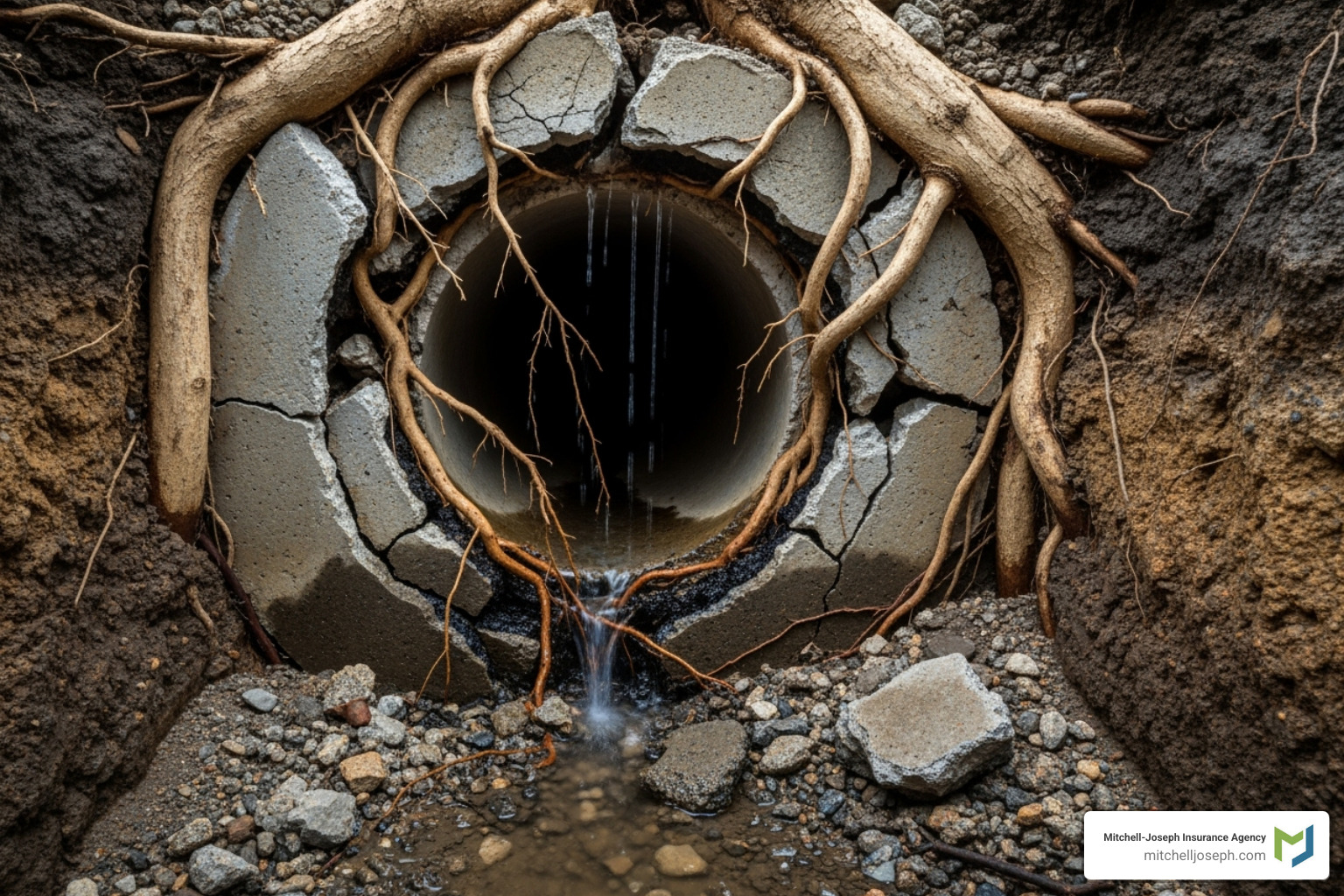
Beneath your yard, service lines are under constant assault from shifting ground, invasive tree roots, and simple aging. The causes of failure are common, but the financial impact can be devastating. Wear and tear is inevitable as pipes corrode and materials degrade over time, especially in older homes. Tree root invasion can block or rupture water and sewer lines. Our region’s freezing and frost heave cycles put immense pressure on buried pipes, causing them to burst. Other causes include mechanical breakdown, electrical arcing, and accidental damage from digging or the weight of heavy equipment.
What Your Service Line Coverage Policy Actually Protects
Service Line Coverage is comprehensive, covering the full scope of expenses related to a failure. It protects the essential underground connections to your home, including water, sewer, electrical, communication, natural gas, and geothermal lines. For more details on sewer-specific protection, see our guide to Sewer Line Insurance.
The policy covers a wide range of damage, including leaks, breaks, ruptures, collapses, arcing, freezing, and damage from tree roots. Crucially, it also covers gradual damage like wear and tear, deterioration, rust, and corrosion.
Beyond just fixing the line, the coverage typically includes:
- Excavation Costs: The expense of digging to access the damaged line.
- Repair Costs: The labor and materials to fix or replace the line.
- Landscaping Restoration: The cost to restore your lawn, trees, shrubs, and driveway.
- Loss of Use: Pays for temporary housing and living expenses if your home becomes uninhabitable.
- Efficiency Improvements: Many policies cover the extra cost to upgrade to better, more efficient materials during a repair. Learn more about the Service Line Improvement Endorsement.
The Financial Breakdown: Costs, Limits, and Potential Savings
Without coverage, the cost of a service line repair can be staggering. A main sewer line replacement can easily cost $15,000 to $25,000, while a simpler water line repair might run around $5,000. The average loss we see is over $7,000—a significant, unplanned expense for any family. For more context on water-related costs, see our page on Water Backup Damage.
This is where Service Line Coverage provides incredible value.
- Annual Cost: Typically $30 to $100 per year.
- Coverage Limits: Most policies offer $10,000 to $25,000 in protection per incident.
- Deductible: A typical deductible is $500.
For about the cost of a coffee each month, you can protect yourself from a five-figure repair bill. Paying a $500 deductible on a $15,000 sewer line replacement is a financial lifesaver.
Common Exclusions and How Service Line Coverage Works
While this coverage is broad, it’s important to understand its limits. The policy is designed to be affordable by focusing on the most common risks to the lines connecting your home to municipal services.
| Covered by Service Line Endorsement | Not Covered |
|---|---|
| Underground water, sewer, power, gas, and communication lines on your property | Septic systems, on-site water wells, and fuel tanks |
| Damage from wear & tear, rust, corrosion, tree roots, freezing, and accidental breakage | Sprinkler/irrigation systems and sump pumps |
| Cost of excavation and repair/replacement of the line | Damage you knew about before buying coverage (pre-existing conditions) |
| Cost to restore your lawn, landscaping, driveway, etc. | Lines that are not on your property (e.g., past the municipal connection) |
| Additional living expenses if your home is uninhabitable during repairs | Damage from neglect or lack of maintenance |
A major benefit is that you can typically choose your own licensed contractor for repairs. The policy also covers accidental damage. For example, if you’re installing a new fence and accidentally strike a line, you’re protected. (This is why it’s always critical to call 811 before you dig!).
The claims process is straightforward: you report the issue, pay your deductible, and your insurance covers the rest of the approved costs up to your policy limit. For a complete overview, read our guide on Understanding Service Line Coverage.
Is This Coverage a Smart Move for Your Home?

So, is Service Line Coverage a worthwhile investment for you? For most homeowners, the answer is a resounding yes. The risk of a line failure is real, and the financial consequences can be severe.
You are at a higher risk if:
- Your home is over 20 years old, as original pipes and wires are nearing the end of their lifespan.
- You have mature trees on your property, as their roots can invade and damage underground lines.
- You live in a climate with freeze-thaw cycles, like our Finger Lakes region, which puts immense stress on buried infrastructure.
Beyond the financial protection, this coverage offers invaluable peace of mind. Knowing that a sudden $15,000 repair bill won’t derail your budget allows you to enjoy your home without worrying about the hidden infrastructure beneath your feet.
Be aware of warning signs of a potential service line failure, such as a sudden drop in water pressure, slow drains, sewage odors, or unexplained wet or lush patches in your yard. If you notice these, it’s time to investigate.
How to Get the Right Protection for Your Property
Securing Service Line Coverage is a simple and affordable process. The best way to get this protection is by adding an endorsement to your existing homeowners policy.
As an independent agency, the team at Mitchell-Joseph Insurance Agency can help you evaluate your specific risk factors and find the best option for your needs. We work with 24 different insurance companies to ensure you get competitive pricing and custom coverage.
Don’t wait for an emergency to find a gap in your home insurance. The small annual cost of Service Line Coverage is a wise investment against a potentially massive out-of-pocket expense.
Get a quote for your Service Line Coverage today and gain peace of mind knowing your home is fully protected, from the roof down to the pipes underground.

