

Unpacking the Average Cost of RV Insurance
How much is RV insurance varies dramatically, but here’s what you need to know right away:
Average RV Insurance Costs:
- Annual cost: $500 – $1,500 per year
- Monthly cost: $40 – $125 per month
- Travel trailers: $200 – $600 annually ($15 – $50 monthly)
- Class A motorhomes: $600 – $2,500 annually ($50 – $200 monthly)
- Class B camper vans: $480 – $1,000 annually ($40 – $80 monthly)
- Class C motorhomes: $540 – $1,500 annually ($45 – $125 monthly)
The cost depends on your RV type, how you use it, where you live, and what coverage you choose. Full-time RVers can pay up to $3,000 per year, while weekend warriors might pay as little as $200 annually.
With 11.2 million US households now owning RVs, many are surprised by insurance costs that can range from basic liability at $125 per year to comprehensive coverage exceeding $4,000 annually.
The good news? Understanding the factors that drive these costs puts you in control of your premium.
I’m Jeffrey Joseph, and I’ve been helping Finger Lakes region families steer RV insurance decisions since 1999 at Mitchell-Joseph Insurance Agency. Through two decades of experience, I’ve learned that knowing how much is RV insurance before you buy can save you hundreds of dollars annually and prevent coverage gaps that leave you exposed.

Key Factors That Determine How Much RV Insurance Is
Understanding how much is RV insurance isn’t as simple as looking at a price tag. Your premium depends on a unique mix of factors that tell your story as an RV owner. Let me walk you through what really matters when insurance companies calculate your costs.
Your RV’s Profile: Type, Class, and Value
Your RV’s type, class, and value are the biggest factors in your insurance cost.

Motorhome classes each have their own insurance personality. Class A motorhomes are the largest, built on commercial frames with values from $50,000 to over $600,000. They are the most expensive to insure, typically $1,150 to $2,500+ annually, due to their size and value.
Class B motorhomes (camper vans) are built on van chassis and valued between $40,000 and $150,000. They are easier to handle and more affordable to insure, averaging around $1,000 per year.
Class C motorhomes feature a distinctive over-cab area and strike a balance in cost. Insurance averages around $900 annually, often making them cheaper than Class A or B models.
Towable trailers don’t have engines, so your tow vehicle’s liability often extends to them while driving. You still need separate physical damage coverage. Travel trailers are the most affordable to insure ($250-$500 yearly), while larger fifth-wheel trailers cost slightly more.
The value and age of your RV also matter. Newer, high-value RVs cost more to insure. However, poorly maintained older RVs can also be expensive due to mechanical risks. A well-maintained older RV often has lower premiums.
We often discuss agreed value versus actual cash value coverage. Agreed value guarantees a pre-set amount if your RV is totaled. Actual cash value pays the depreciated amount at the time of loss, which means cheaper premiums but a potentially larger financial gap.
For more insights on different RV types, check out our guides on Top Rated Recreational Vehicles and Affordable Recreational Vehicles.
Your Travel Style: Full-Time RVer vs. Weekend Warrior
How you use your RV dramatically impacts your insurance cost. The difference between full-time living and weekend trips is significant.
Full-time RVing means your RV is your primary residence for six+ months a year. Insurers view this as higher risk, similar to a home. Policies are more comprehensive, covering personal liability and emergency expenses, and range from $1,500 to $4,000 annually.
Part-time use is much cheaper. Recreational users might pay as little as $200 annually for basic coverage, as less time on the road means lower risk.
Usage frequency also matters. Fewer days of use can lower premiums. Storing your RV securely when not in use also reduces costs. Many companies offer storage discounts for keeping it in a garage or covered facility, which protects it from theft and weather.
For inspiration on RV trips, explore our insights on Fun Recreational Vehicles.
Your Policy Choices: How much is RV insurance with different coverages?
The coverage you choose directly impacts your premium. While some protections are required by law, others are optional but can save you thousands if something goes wrong.
Liability coverage is your policy’s foundation and legally required for motorhomes. It covers property damage or medical expenses for others if you cause an accident. For towables, your tow vehicle’s liability often extends to the trailer while hitched.
Comprehensive and collision coverage protect your RV itself. Comprehensive handles non-collision damage like theft, vandalism, fire, and weather events. Collision covers damage from crashes with vehicles or objects. If your RV is financed, your lender will almost certainly require both.
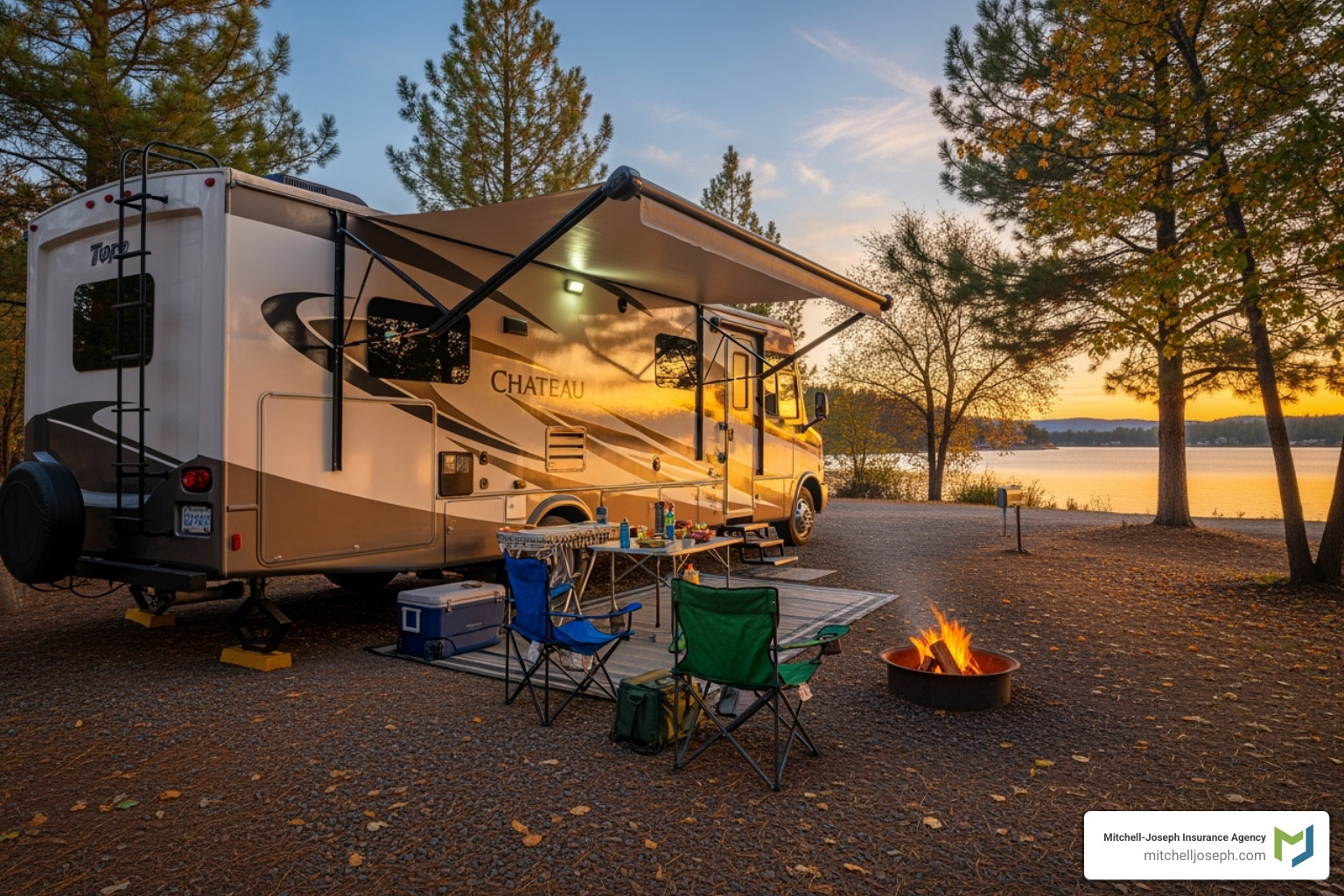
Vacation liability insurance is unique to RVs. Standard liability only covers driving incidents. Vacation liability protects you when you’re parked and using the RV as a temporary home, covering incidents like a guest tripping over your awning at a campsite.
Personal effects coverage protects all the stuff inside your RV – electronics, camping gear, clothing, kitchen items. Without it, you might find your homeowner’s policy offers limited coverage for items away from home.
Other valuable options include medical payments coverage for injuries regardless of fault, uninsured motorist coverage for accidents with drivers who lack adequate insurance, roadside assistance for those inevitable breakdowns, and emergency expense coverage for temporary living costs if your RV becomes uninhabitable.
Total loss replacement can be a game-changer for new RVs, replacing your totaled unit with a brand-new similar model rather than paying depreciated value.
Choosing higher liability limits increases premiums but offers greater financial protection. Higher deductibles typically lower premiums but mean more out-of-pocket costs when you file a claim. We work with clients to find the right balance between coverage and cost.
For a deeper dive into these options, visit our RV Insurance Coverage Options page.
Your Personal Details: Location, Driving Record, and Discounts
Your personal circumstances significantly influence how much is RV insurance costs. Insurance companies assess individual risk factors to calculate your unique premium.
Geographic location plays a huge role. Urban areas with higher population density and crime rates often have higher premiums. Weather risks are also crucial; areas prone to hurricanes, floods, or wildfires will see higher comprehensive rates.
State-specific regulations create dramatic cost differences. For example, Michigan’s rates can be as high as $4,500 annually due to state requirements, while Oregon averages under $1,100. Here in New York, we understand the local factors that influence rates in the Finger Lakes region.
Your driving record directly reflects your risk. A clean record with no accidents or violations means lower premiums. Serious infractions or a history of claims will increase rates. Experience driving large vehicles also helps, as veteran RVers often pay less than newcomers.
Common discounts can significantly reduce your premium. Ask about bundling policies (auto, home, life), good driver discounts, safety feature discounts (anti-theft, GPS), paid-in-full discounts, storage discounts, and claim-free renewal discounts.
Other potential savings include original owner discounts, RV association membership discounts, safety education course discounts, multi-vehicle discounts, and military or professional discounts for certain groups.
For more detailed RV valuation information, reference the NADA RV value guides.
How much is RV insurance for motorhomes vs. travel trailers?
The cost difference between motorhomes and travel trailers is significant. The key reason: motorhomes are self-propelled vehicles, while trailers are towed.
Motorhome insurance must include liability coverage to meet state minimums, just like a car. They are generally more expensive to insure than cars or trailers because their size, weight, and value create a higher potential for costly accident damage. Motorhome insurance typically costs $1,000 to $2,000 annually. Besides liability, comprehensive and collision are usually needed, especially if financed. We also highly recommend roadside assistance, total loss replacement, and vacation liability.
Travel trailer insurance is different because trailers are non-motorized. Liability coverage usually extends from the tow vehicle’s policy while on the road. This is why trailer insurance costs much less. Travel trailer insurance typically costs $250 to $500 annually. While your car’s policy may cover liability, you still need comprehensive and collision to protect the trailer itself from damage or theft. Vacation liability is also crucial for when the trailer is parked and used as living space.
The key differences break down simply: motorhomes need their own liability policy and cost more. Travel trailers use the tow vehicle’s liability and cost less. A motorhome policy is like a hybrid of auto and home insurance, while a trailer policy focuses on physical damage and campsite liability.
Whether you own a motorhome or travel trailer, we can help steer the specific insurance requirements for your situation. For more comprehensive information on RV protection, explore our Insurance Coverage for RVs.
Finding the Best RV Insurance Rate for You
Now that we’ve demystified how much is RV insurance and the factors that influence it, let’s talk about how you can take control of your premiums. Finding the right policy isn’t just about chasing the lowest number – it’s about getting solid protection at a fair price, ensuring you’re covered without breaking the bank.
Actionable Steps to Get the Cheapest RV Insurance
Getting affordable RV insurance doesn’t require a crystal ball. With some smart moves and a bit of legwork, you can significantly lower your premiums while keeping the coverage you need.

Compare quotes from multiple providers. Rates can vary by $500 or more for the same RV and driver. Getting 3-5 quotes is essential, as insurers assess risk differently.
Adjust your deductibles strategically. Raising your deductible from $500 to $1,000 can save you hundreds annually, but ensure you can afford the higher out-of-pocket cost in case of a claim.
Ask for every discount you qualify for. Don’t assume they’re applied automatically. The biggest savings often come from bundling home, auto, and RV policies. Also inquire about good driver, safety feature (anti-theft/GPS), paid-in-full, and storage discounts.
Keep that driving record spotless. A clean record is one of the best ways to keep all your insurance rates low, as a single ticket or accident can raise them for years.
Take an RV safety course. Many insurers offer discounts for completing approved RV driving courses. You’ll become a better, safer driver while saving money – that’s a win-win.
Store your RV securely. Keeping it in a garage, covered facility, or locked yard reduces theft and weather risks, often earning you a discount on comprehensive coverage.
Here’s where working with an independent agent makes all the difference. As an independent agency, we don’t work for any single insurance company – we work for you. With access to 24 different insurers, we can shop around on your behalf, comparing not just prices but coverage quality.
Think of us as your personal insurance shoppers. Instead of you spending hours comparing confusing policies, we do the heavy lifting. We know which of our 24 insurers offer the best rates for your specific RV, usage, and which provide the best claims service.
With 200+ years of combined experience, we know the right questions to ask, the coverage gaps to avoid, and the discounts you might miss. For RV owners in Honeoye Falls, Rochester, Canandaigua, and the entire Finger Lakes region, we are your local experts.
Regular maintenance won’t directly lower your premium, but it prevents the kinds of problems that lead to claims. A well-maintained RV is less likely to have a breakdown that results in an expensive tow or repair claim.
Be completely honest when getting quotes. Providing accurate information about your RV’s value, how you use it, and your driving history ensures you get the right coverage and avoid claim issues later.
Ready to see how much is RV insurance will actually cost you? We make it easy. Whether you need coverage for a massive Class A motorhome or want to get a quote for pop-up camper insurance, we’ll find you the best combination of coverage and price.
Let’s get you back on the road with confidence, knowing you’re properly protected without overpaying. After all, the money you save on insurance is money you can spend on your next trip.

