

Why Every Renter Needs to Understand Their Insurance Costs
A Renters insurance premium calculator is an online tool that estimates your insurance costs. To use one, you’ll typically:
- Enter Your ZIP Code: Location affects risk factors like local crime and weather.
- Select Coverage Amounts: Choose limits for personal property (e.g., $20,000-$50,000) and liability (e.g., $100,000-$300,000).
- Choose Your Deductible: Select the amount you’d pay out-of-pocket (e.g., $250-$1,000). A higher deductible means a lower premium.
- Review Your Estimate: Get an approximate monthly cost in seconds.
Key Difference: A calculator provides an anonymous estimate in seconds. A formal quote gives an exact price but requires personal details and takes a few minutes.
Renters insurance is an affordable way to protect your belongings, typically costing around $16 per month in the U.S. Understanding what you’ll pay before you commit is a smart financial move.
I’m Jeffrey Joseph, and since 1999, I’ve helped renters across the Finger Lakes region understand their insurance options. A premium calculator is often the first step my clients take. Let me walk you through how these tools work and how to use them to find the best coverage at the best price.
What is a Renters Insurance Calculator and Why Use One?
When you’re renting, what happens if a pipe bursts, your laptop is stolen, or a guest is injured in your home? That’s where renters insurance (also known as tenant insurance) provides a financial safety net for your personal belongings and liability.
Many renters mistakenly believe their landlord’s insurance covers their personal property. It doesn’t. A landlord’s policy protects the building itself—the walls and roof—but not your sofa, electronics, or clothes. If a fire or theft occurs, you are responsible for replacing everything unless you have your own coverage.
Renters insurance prevents you from facing potentially devastating out-of-pocket costs. For example, replacing all your belongings after a break-in could cost thousands. Or, if a basement flood occurs, repairs can average $43,000. While your landlord would fix the structural damage, your ruined furniture would be your problem to replace.
A tenant insurance calculator is an online tool designed to give you a quick, anonymous estimate of your potential insurance costs. It’s a great way to budget without filling out lengthy forms.
Why use one?
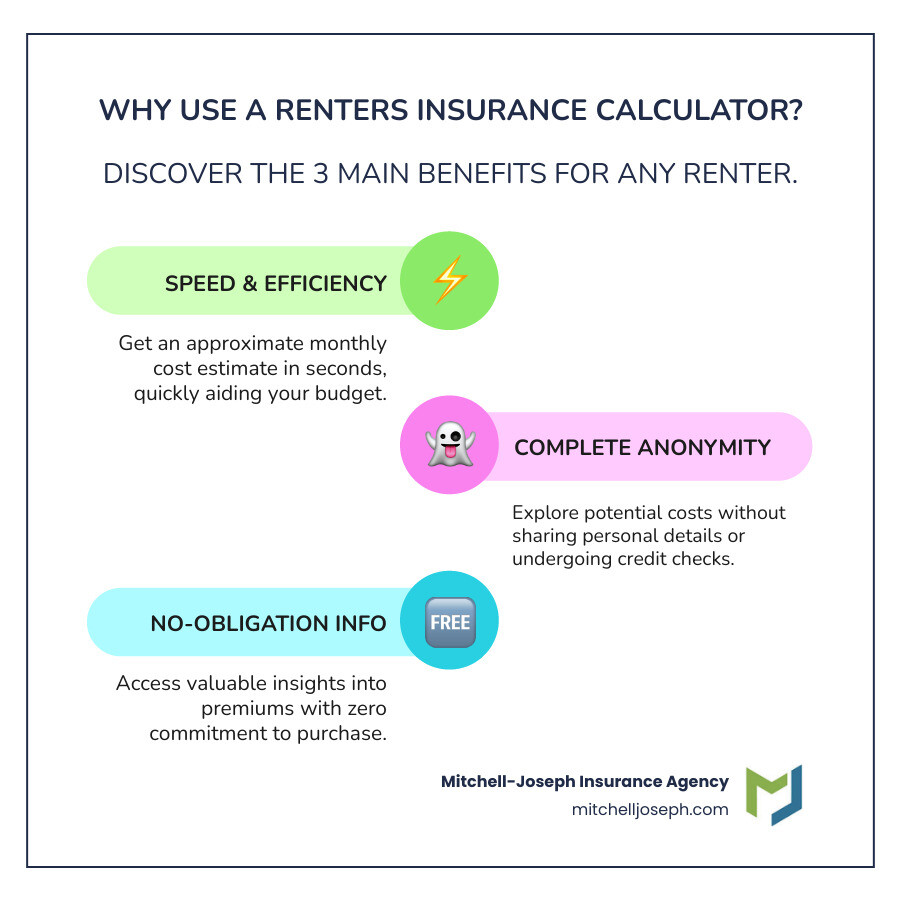
- Quick Estimate: Get an idea of costs in seconds.
- Budgeting Tool: See how renters insurance fits into your monthly expenses.
- Anonymity: No need to provide personal contact information, so you won’t get unwanted calls or emails.
- No Commitment: It’s a research tool with no obligation to buy.
Here at Mitchell-Joseph Insurance Agency, we believe in empowering our clients with knowledge. Using a Renters insurance premium calculator is an excellent first step to understanding your potential investment in peace of mind.
How to Use a Renters Insurance Premium Calculator

Using a Renters insurance premium calculator is a simple, stress-free way to estimate your policy cost. This guide will walk you through the process, so you know what to expect.
Step 1: Determine Your Coverage Needs
Before using a calculator, you need to know what you’re protecting.
First, create a personal property inventory by listing everything you own—furniture, electronics, clothes, etc. Taking photos or videos is a great idea. This list is crucial if you ever need to file a claim. The Personal Property Inventory guide from the Insurance Bureau of Canada is a helpful resource.
Next, decide between Replacement Cost Value (RCV) and Actual Cash Value (ACV).
- ACV pays what your items are worth today (with depreciation). It has a lower premium but may not cover the full cost of a new item.
- RCV pays the cost to replace your items with new ones. The premium is slightly higher, but it provides better protection. Most of our clients choose RCV.
Then, select your liability coverage. This protects you if someone is injured in your apartment or you accidentally damage another person’s property. Limits typically start at $100,000, but many people opt for $1 million or more for greater peace of mind. For more guidance, see our Renters Insurance FAQs.
Finally, ensure your policy includes Additional Living Expenses (ALE). This covers costs like hotel stays and meals if a covered event makes your apartment uninhabitable.
Step 2: Understand the Key Factors That Influence Your Premium
A Renters insurance premium calculator uses several factors to generate your estimate:
- Location: Your ZIP code is a major factor, as it reflects local risks like crime rates and weather patterns. Rates can vary even within the Finger Lakes region, from Rochester to Naples.
- Coverage Limits: Higher limits for personal property and liability will increase your premium.
- Deductible: This is what you pay out-of-pocket on a claim. A higher deductible (e.g., $1,000 vs. $500) lowers your monthly premium.
- Claims History: A history of frequent claims can increase your rate.
- Building Characteristics: The age, construction, and number of units in your building can affect your premium.
- Credit-Based Insurance Score: In many states, a higher credit score can lead to lower premiums. A formal quote may involve a soft credit check that doesn’t affect your rating.
- Security Features: Discounts are often available for monitored alarms, deadbolts, and smoke detectors.
- Pets: Certain dog breeds may increase your liability premium. Always be upfront about pets to ensure you’re properly covered.
Step 3: Compare Your Estimate to a Formal Quote
An estimate from a calculator is a great starting point, but it’s not the same as a formal quote.
- Estimate: An anonymous, approximate price for budgeting, generated in seconds with basic information.
- Quote: An exact, purchasable price based on detailed personal information, your claims history, and a soft credit check. It takes a few minutes to generate.
An estimate gives you a ballpark figure, while a quote is the final price you’ll pay. Use the calculator to set your budget, then seek formal quotes with confidence.
At Mitchell-Joseph Insurance Agency, we work with 24 different insurance companies to compare quotes for you, finding the right coverage for your needs and budget. Ready to turn that estimate into real protection? We’re here to help.
From Estimate to Policy: Maximizing Your Coverage

Now that you’ve used a Renters insurance premium calculator to get an estimate, it’s time to tailor a policy that offers real protection while remaining affordable.
Customizing Your Coverage Options
A standard renters policy is a great foundation, including personal property protection, personal liability, and additional living expenses. However, you can add optional coverages, or endorsements, to customize it to your life.
Consider these common endorsements:
- Sewer Backup & Overland Water: Standard policies often exclude damage from sewer backups or flooding from heavy rain. This add-on is crucial, especially for basement apartments. Learn more in our guide on Does Tenant Insurance Cover Water Damage?
- High-Value Items: If you own expensive jewelry, art, or collectibles, a standard policy may have low coverage limits (e.g., $1,500 for all jewelry). Scheduling these items individually ensures they are covered for their full appraised value.
- Other Options: Depending on your needs, you might also consider endorsements for earthquakes, a home-based business, or short-term rentals, as these are typically not covered by a standard policy.
Most policies don’t automatically cover roommates; they usually need their own insurance. However, some insurers may allow up to two roommates on a single policy, so it’s always best to ask.
How to Save Money on Your Premiums
Affordable premiums don’t have to mean sacrificing protection. Here are some of the best ways to save:
- Bundle Your Policies: Combining your renters and auto insurance with the same provider is one of the easiest ways to get a significant discount.
- Increase Your Deductible: Choosing a higher deductible (e.g., $1,000 instead of $500) will lower your monthly premium. Just be sure you can afford the deductible in an emergency.
- Install Safety Devices: Monitored alarms, smoke detectors, and deadbolt locks can earn you discounts.
- Maintain a Claims-Free Record: A clean claims history signals to insurers that you are a lower risk, which can lead to better rates.
- Ask About Discounts: You may be eligible for discounts through your employer, an alumni association, or by paying your premium annually instead of monthly.
For more tips, check out our guide on the Cheapest Renters Insurance.
Next Steps: Getting Your Official Quote
While renters insurance isn’t always required by law, many landlords now mandate it in their lease agreements. Even if it’s not required, the affordable peace of mind it offers makes it a smart choice.
This is where working with an independent agent from Mitchell-Joseph Insurance Agency provides a huge advantage. As a family-owned business serving the Finger Lakes region, we don’t work for one insurance company—we work for you.
We partner with 24 different carriers, allowing us to shop the market on your behalf. Instead of you filling out multiple forms, we do the legwork to compare quotes and find you the best rate and coverage.
Here’s how it works:
- Gather Your Information: Have your property value, desired liability limits, and personal details ready.
- Contact Us: Call, visit our office, or start the process online.
- Review Your Options: We’ll present you with competitive quotes and explain the details.
- Get Covered: Once you choose a policy, we’ll handle the paperwork and provide proof of insurance for your landlord.
If you ever need to file a claim, contact your insurance company immediately after ensuring everyone is safe and documenting the damage. They will guide you through the process.
Ready to turn your estimate into solid protection? Get a personalized renters insurance quote today!

