Understanding Renters Insurance and Its Average Price
Renters Insurance Cost is surprisingly affordable for most people. Here’s a quick overview:
- Average Monthly Cost: $14-$23 per month ($168-$276 per year) in the United States
- Typical Coverage: $30,000-$40,000 in personal property, $100,000 in liability protection, and additional living expenses
- Cost Factors: Location, coverage limits, deductible, claims history, and credit score
- Cheapest States: Wyoming ($8-$16/month), North Dakota, Montana
- Most Expensive States: Louisiana ($21-$36/month), Arkansas, Mississippi
Renters insurance provides a financial safety net for your belongings and protects you from liability if someone is injured in your rental. Despite its perceived expense, most people can get adequate coverage for less than the cost of a few streaming subscriptions. For example, renters in upstate New York typically pay between $15 and $25 per month for a standard policy.
I’m Jeffrey Joseph, and at Mitchell-Joseph Insurance Agency, I’ve been helping residents across the Finger Lakes Region with their insurance needs since 1999. Understanding the factors behind Renters Insurance Cost helps our clients in Naples, Honeoye Falls, and Rushville secure the right protection without overpaying—which is what this guide will help you do.
What Does a Typical Policy Cover (and Not Cover)?
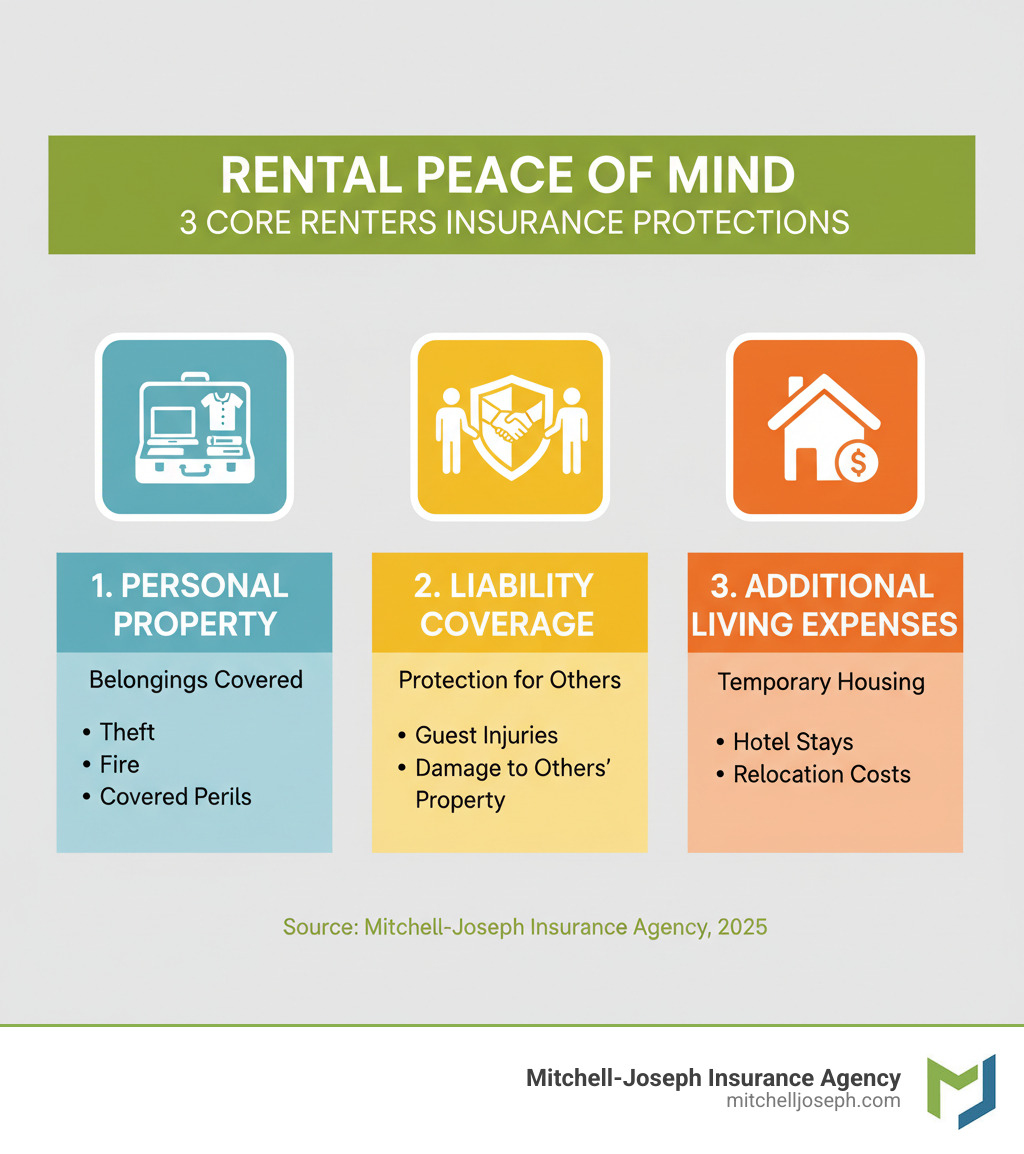
A standard renters insurance policy is a package of coverages designed to protect you as a tenant. Here are the core components:
1. Personal Property Coverage: This protects your belongings (furniture, electronics, clothing) from events like fire, theft, or a burst pipe. It often extends to items temporarily away from home, like a laptop stolen from your car. We recommend “replacement cost” coverage, which pays to buy new items, over “actual cash value” (depreciated value).
2. Liability Protection: This is a critical component. It covers you if you’re found legally responsible for injuring someone or damaging the property. For example, if a guest slips and falls in your apartment or you accidentally cause water damage to the unit below, this coverage helps pay for medical bills, legal fees, and settlement costs. Coverage typically starts at $100,000.
3. Additional Living Expenses (ALE): Also known as “loss of use,” ALE covers temporary housing, meals, and other necessary expenses if a covered event (like a fire) makes your rental uninhabitable.
4. Medical Payments to Others: This covers minor medical expenses for guests injured on your property, regardless of who is at fault, helping to prevent small incidents from becoming large liability claims.
Policy Types and Exclusions
Policies are typically either Named Perils (covering only specific events listed in the policy) or All-Risk (covering any event unless it’s specifically excluded). While comprehensive, renters insurance doesn’t cover everything. Common exclusions include:
- Flooding: Damage from natural floods requires a separate policy. Learn more by visiting our page on Can Renters Get Flood Insurance.
- Earthquakes: This also requires separate coverage.
- Pest Infestations: Damage from insects or rodents is generally not covered.
- High-Value Items: Expensive items like jewelry or fine art often have coverage limits. You may need a separate endorsement, or “floater,” to insure them for their full value.
- It’s also important to understand what water damage is covered. A sudden pipe burst is typically covered, but damage from external water or sewage backups may not be. You can explore more on this topic here: Does Renters Insurance Cover Flooded Basements.
Is Renters Insurance Required and How Does It Differ from Homeowners Insurance?

While renters insurance is not legally mandatory in New York State, many landlords require it as a condition of the lease. This protects them from liability you might cause and clarifies that your belongings are your responsibility. Failing to maintain a required policy could be a breach of your lease.
Many renters mistakenly believe they are covered by their landlord’s policy or that insurance is too expensive. The Renters Insurance Cost is a small price to pay for significant peace of mind.
Tenant Insurance vs. Homeowner’s Insurance
The key difference is what’s covered:
- Homeowner’s Insurance: Covers the physical structure of the home (the dwelling), personal belongings, and liability for the property owner.
- Tenant (Renters) Insurance: Does not cover the building’s structure. That is the landlord’s responsibility. Renters insurance focuses on your personal belongings, personal liability, and additional living expenses.
Think of it this way: the landlord’s policy covers the “bones” of the building, while your renters policy covers everything “inside the bones” that belongs to you. Your landlord’s policy won’t replace your stolen laptop or pay your legal fees if a guest sues you. For more information specific to apartment living, check out our insights on Apartment Insurance.
Key Factors That Determine Your Renters Insurance Cost

Your Renters Insurance Cost isn’t random; it’s based on a detailed risk assessment. Insurance companies analyze several factors to predict the likelihood of a claim. The higher the perceived risk, the higher your premium.
At Mitchell-Joseph Insurance Agency, we work with 24 different insurance companies, allowing us to compare how each carrier weighs these factors. This helps us find the most competitive rate for your specific situation, whether you’re in Lima, Cohocton, or Gorham. Understanding these factors can help you make smart choices to keep your costs down.
How Coverage Limits, Deductibles, and Location Impact Your Premium
These three elements are the foundation of your premium calculation. Adjusting any one of them can significantly shift your Renters Insurance Cost.
1. Coverage Amount: This is straightforward—the more your belongings are worth, the more coverage you need, and the higher your premium will be. Most renters need between $30,000 and $40,000 in personal property coverage. It’s surprising how quickly the value of furniture, electronics, and clothing adds up. Increasing your coverage is often affordable; going from $30,000 to $40,000 might only cost an extra $3 to $5 per month. For high-value items like jewelry or art, which have coverage sub-limits, you’ll need to schedule them separately with a “personal articles floater” to ensure they’re fully protected.
2. Deductible: This is the amount you pay out-of-pocket on a claim before your insurance pays the rest. A higher deductible ($1,000) leads to a lower monthly premium, while a lower deductible ($500) means you’ll pay more each month. When choosing, ask yourself: “What amount could I comfortably pay from savings tomorrow?” Select a deductible that balances monthly savings with what you can afford in an emergency.
3. Location: Where you live matters. Insurers use your ZIP code to assess risks like:
- Crime rates: Areas with higher rates of theft or vandalism typically have higher premiums.
- Natural disaster risk: While upstate New York is safer than hurricane-prone regions, risks like severe winter storms and thunderstorms are still factored in.
- Proximity to a fire station: Being closer to fire protection can lower your rate, as it reduces the potential for severe fire damage.
The nationwide average for renters insurance is about $14 to $23 per month. In New York State, the average is around $161 per year (about $13.39/month), but in upstate New York, we typically see rates between $15 and $25 per month. For more details, you can review our page on the Average Cost Of Renters Insurance or see Data on average costs by state.
The Role of Your Profile and Property in Determining Renters Insurance Cost
Beyond the big three, insurers also look at your personal history and the property you’re renting to finalize your Renters Insurance Cost.
-
Claims History: If you’ve filed multiple claims in the past 5-7 years, insurers view you as a higher risk, which can increase your premium. This history is tracked in a C.L.U.E. (Comprehensive Loss Underwriting Exchange) report.
-
Credit-Based Insurance Score: This score, derived from your credit history, is used by insurers in many states, including New York. A better score often correlates with fewer claims, leading to lower rates. Managing your credit responsibly can positively impact your insurance costs.
-
Property Type and Age: The type of building you live in (e.g., single-family house vs. large apartment complex) and its age can influence your rate. Older buildings may have a higher risk of issues like faulty wiring or burst pipes, which can slightly increase your premium.
-
Security Features: You can earn discounts for having safety and security measures. Insurers reward features that reduce risk, such as:
- Smoke detectors and carbon monoxide detectors
- Deadbolt locks
- Burglar alarms (especially monitored systems)
- Sprinkler systems
- Living in a gated community
If you’re renting a condo, there are unique considerations. We’ve compiled more information on our page about Renters Insurance For Condos.
How to Get the Best Value on Your Renters Insurance

Understanding what drives your Renters Insurance Cost is the first step. Now, let’s focus on getting the most protection for your money. Smart shopping isn’t about finding the absolute cheapest policy; it’s about securing robust coverage that fits your budget. Our goal is to help you find that sweet spot, whether you’re renting in Avon, Stanley, or Rush.
Effective Strategies for Lowering Your Renters Insurance Cost
Lowering your premium doesn’t have to mean sacrificing protection. Here are several proven strategies to reduce your Renters Insurance Cost:
-
Bundle Policies: This is often the most effective way to save. Purchasing your renters policy from the same carrier as your auto insurance can open up a multi-policy discount that sometimes exceeds the cost of the renters policy itself.
-
Choose a Higher Deductible: Opting for a $1,000 deductible instead of $500 will lower your premium. Just be sure you can comfortably afford that amount out-of-pocket if you need to file a claim.
-
Install Safety Features: Features like smoke detectors, deadbolt locks, and burglar alarms demonstrate lower risk to insurers and can earn you valuable discounts.
-
Maintain Good Credit: A strong credit-based insurance score can lead to lower rates, as it correlates with filing fewer claims.
-
Compare Quotes: Insurance rates change. As an independent agency working with 24 different carriers, we can shop the market for you annually to ensure you’re always getting a competitive price.
-
Pay Annually: Paying your premium in one or two large installments instead of monthly often comes with a small discount from the insurer.
-
Create an Accurate Inventory: Knowing the value of your belongings helps you buy the right amount of coverage—not too much or too little.
-
Ask About Other Discounts: You may qualify for savings for being claims-free, a non-smoker, or based on your profession. It never hurts to ask.
For more tips on finding affordable coverage, visit our page on Cheapest Renters Insurance.
The Simple Process of Getting a Quote and Securing Coverage
Getting renters insurance through Mitchell-Joseph Insurance Agency is a straightforward process designed to get you from curious to covered without the hassle.
1. Take Inventory: Start by estimating the value of your personal property. Walk through your rental and list your furniture, electronics, clothing, and other items you’d need to replace. This helps determine your personal property coverage limit.
2. Consider Your Needs: Think about how much liability protection you need and what deductible amount you can comfortably afford.
3. Gather Your Information: To provide quotes, we’ll need basic details: your name, rental address, information about the building, and any security features. With your permission, we can also use your credit-based insurance score to find better rates.
4. Let Us Do the Shopping: As an independent agency, we do the heavy lifting. We’ll compare policies and costs from our network of 24 insurance carriers to find the best combination of coverage and price for your needs in Honeoye, Bristol, or Canadice.
5. Choose Your Policy: We’ll present you with the best options, explain the details in plain English, and answer your questions. Once you choose the policy that fits you best, we’ll help you complete the purchase, and you’ll be protected.
Our role as your independent agent is to be your advocate and provide personalized service—something you won’t get from a faceless website. Protecting your belongings and financial future is easier and more affordable than you might think.
Get a personalized quote for your renters insurance needs today and find how affordable peace of mind can be.