

Why Poultry Farmers Need Specialized Insurance Protection
Poultry farm insurance coverage protects chicken, turkey, and egg operations from unique risks that generic farm policies often miss. Unlike traditional livestock, poultry operations face specific challenges like ventilation failures, disease outbreaks, and rapid flock turnover that require custom protection.
Essential Poultry Farm Insurance Components:
- Property Coverage – Broiler houses, egg facilities, and specialized equipment
- Livestock Mortality – Bird death from covered perils (fire, storms, suffocation)
- Equipment Breakdown – Ventilation systems, generators, and feed equipment
- Business Interruption – Lost income during flock replacement periods
- General Liability – Protection from visitor injuries and product claims
- Specialized Add-ons – Avian influenza, pollution liability, and disease coverage
The poultry industry faces unique volatility, as recent egg price surges from avian influenza outbreaks demonstrate. A typical poultry farm insurance policy covering $1.3 million in assets averages around $9,450 annually, but many farmers find too late that their coverage has dangerous gaps – like suffocation sub-limits capped at just $25,000 when actual losses can reach ten times higher.
Modern poultry operations require significant investments in climate-controlled buildings, sophisticated ventilation systems, and backup generators. When these critical systems fail, entire flocks can be lost within hours. Standard farm policies often group poultry with dairy and row crops, missing the specialized risks that can devastate a poultry operation overnight.
I’m Jeffrey Joseph from Mitchell-Joseph Insurance Agency, and I’ve helped countless farmers in the Finger Lakes region steer the complexities of agricultural insurance since 1999. My experience with poultry farm insurance coverage has shown me that the difference between adequate protection and financial disaster often comes down to understanding these specialized policy details.

Poultry farm insurance coverage vocabulary:
What Is Poultry Farm Insurance & Why It Matters
Poultry farm insurance coverage is specialized protection designed specifically for operations raising chickens, turkeys, ducks, and geese for meat or egg production. Unlike generic farm policies that treat all agricultural operations the same way, this specialized coverage recognizes that your poultry operation faces unique risks that require custom protection.
Your livelihood depends on keeping thousands of birds healthy and comfortable around the clock. One power outage, equipment failure, or disease outbreak can destroy months of hard work and investment in just hours. I’ve seen too many farmers find after a devastating loss that their “comprehensive” farm policy didn’t actually cover the specific problems that wiped out their operation.
Livelihood protection becomes even more critical when you consider how disasters like fires and storms can spread rapidly through poultry facilities. The difference between contract growers and farm owners also matters significantly for insurance purposes. If you’re a contract grower, the integrator typically owns and insures the birds themselves, but you still need coverage for your buildings, equipment, and lost income when operations shut down.
Financial stability in poultry operations requires understanding that you’re dealing with unpredictable commodity prices, uncontrollable weather, and disease outbreaks that can strike without warning. Insurance provides the foundation that lets you rebuild and keep operating when disaster hits.
Key Risks Unique to Poultry Operations
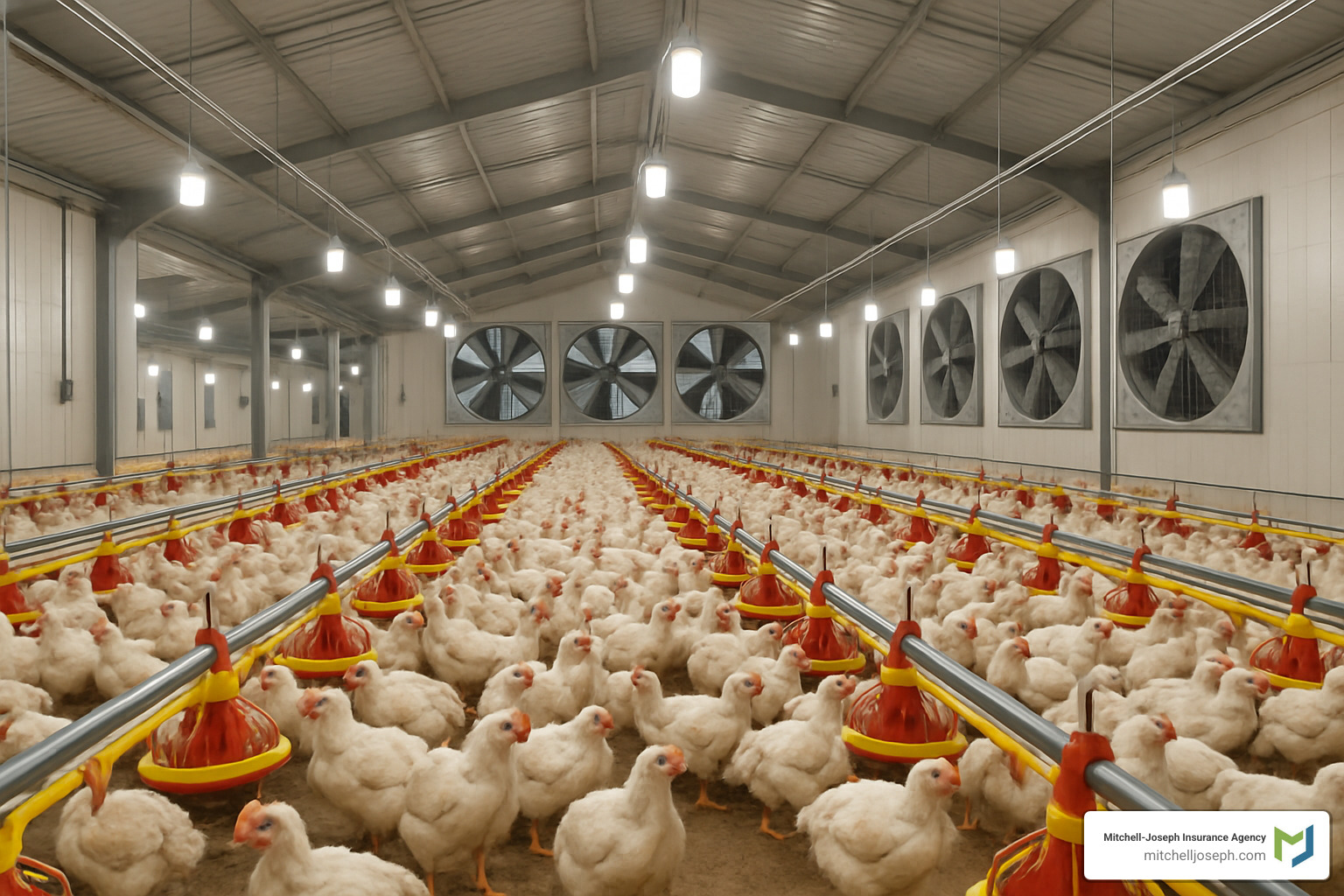
Poultry operations face specialized risks that simply don’t exist in other types of farming. Temperature control is absolutely critical because birds cannot survive significant temperature swings, and maintaining optimal conditions requires sophisticated climate control systems running 24/7.
Power failure represents one of the most immediate threats to your operation. Without electricity, ventilation fans stop, feeders quit working, and watering systems fail. Even brief outages can lead to suffocation losses, especially in modern high-density housing.
Disease outbreaks, particularly avian influenza, can devastate entire operations overnight. When AI is detected, government agencies often require immediate depopulation of entire flocks, quarantine of facilities, and extensive sanitization before you can restock.
Why Generic Farm Policies Fall Short
Generic farm insurance policies treat all agricultural operations as basically the same, but poultry farming has species-specific exposures that require custom coverage. Ventilation equipment represents a massive investment in poultry operations that doesn’t exist in crop farming or traditional livestock operations.
The fast flock turnover in poultry operations creates unique business interruption exposures that generic policies miss. While a beef cattle operation might take years to rebuild after a loss, poultry operations can face multiple flock cycles per year.
Core Components of Poultry Farm Insurance Coverage
Think of poultry farm insurance coverage like a safety net with multiple layers – each component protects a different part of your operation, and they all work together when disaster strikes.
The foundation starts with property coverage that protects your buildings and equipment from fire, storms, and other covered perils. Then livestock mortality coverage steps in to protect the birds themselves. Equipment breakdown coverage addresses those middle-of-the-night phone calls when critical systems fail.
General liability protection shields you from lawsuits if someone gets hurt on your property or claims your products caused harm. Business interruption coverage keeps money flowing when operations shut down due to covered losses.
Property & Building Protections within Poultry Farm Insurance Coverage
Modern poultry buildings aren’t just barns – they’re sophisticated climate-controlled environments that cost significantly more than traditional farm structures. Your broiler houses, laying facilities, and egg-gathering operations represent major investments that need proper protection.
The choice between replacement cost and actual cash value (ACV) coverage can make or break your recovery after a loss. Replacement cost coverage pays to rebuild using current materials and methods without deducting for depreciation. For newer buildings and critical structures, replacement cost coverage is typically the smart choice.
Ventilation systems deserve special attention because they’re both expensive and absolutely critical to bird survival. These sophisticated systems include intake fans, exhaust fans, computerized controllers, environmental sensors, and backup systems.
Standby generators are essential for serious poultry operations, but they need coverage limits that reflect their true replacement cost. Our Farm Insurance Policy page provides more details about structuring comprehensive property coverage for agricultural operations.
Livestock Mortality & Business Interruption in Poultry Farm Insurance Coverage
Livestock mortality coverage protects against the financial impact when birds die from covered perils like fire, lightning, storms, theft, and equipment breakdown. This coverage typically provides broad-perils protection, meaning it covers losses unless they’re specifically excluded.
However, suffocation sub-limits represent one of the biggest gaps in many poultry policies. Some carriers cap suffocation losses at just $25,000, even when the actual value of birds lost can reach $250,000 or more.
Business interruption coverage becomes your financial lifeline when operations shut down due to covered events. For egg operations, this means replacing daily revenue lost when hens can’t lay in damaged facilities. For meat bird operations, it covers the income lost during the time needed to restock and raise replacement flocks to market weight.
Recent scientific research on insurance litigation shows the importance of understanding exactly what your policy covers and how claims are handled.

Specialized & Optional Protections for Modern Poultry Operations
The poultry industry has evolved dramatically over the past decade, and so have the risks facing modern operations. What used to be straightforward farming has become a complex business requiring protection against threats that didn’t even exist when many current policies were written.
Avian influenza coverage has shifted from optional to essential as AI outbreaks have devastated operations across the country. Specialized AI coverage addresses both the direct costs of losing your birds and the months of lost income during quarantine and restocking periods.
Pollution liability coverage protects against environmental claims that can arise even when you’re doing everything right. Our Farm Pollution Liability Insurance page explains how this coverage works specifically for agricultural operations.
Cyber risk coverage might sound unnecessary for a farm, but modern poultry operations rely heavily on digital systems. Your environmental controls, feeding systems, and monitoring equipment are all potential targets for cyber attacks.
Commercial auto coverage goes beyond basic farm vehicle protection. Builder’s risk coverage becomes crucial when you’re investing hundreds of thousands of dollars in new poultry facilities.
Care, custody, and control coverage addresses a critical gap for contract growers. You’re responsible for the integrator’s birds while they’re in your care, but their insurance and your property coverage may both exclude certain scenarios.
Animal rights activism coverage represents one of the newest additions to comprehensive poultry insurance programs. False allegations, protest disruptions, and trespassing incidents are becoming more common.
| Coverage Type | Generic Farm Policy | Poultry-Specific Policy |
|---|---|---|
| Suffocation Limits | Often $25,000 cap | Adequate limits based on flock value |
| Disease Coverage | Typically excluded | Available as endorsement |
| Ventilation Equipment | Basic coverage | Specialized equipment breakdown |
| Business Interruption | Generic calculation | Flock-cycle specific |
| Avian Influenza | Not available | Specialized coverage available |
| Animal Rights Defense | Not addressed | Available as endorsement |
For more information about protecting your specialized equipment, visit our Farm Equipment Insurance Coverage page. If you need help finding an agent who understands agricultural risks, you can Find a farm agent through our network.

Calculating Premiums & Customizing Your Policy
When you’re ready to get poultry farm insurance coverage, understanding how premiums are calculated helps you make smart decisions about your protection. The age and size of your barns are probably the biggest factors in determining your premium. Construction type makes a real difference – steel-frame buildings with proper ventilation and fire protection systems generally qualify for lower rates.
Your flock value directly impacts what you’ll pay for livestock mortality coverage. Claims history plays a huge role in premium calculations. Your location and local weather patterns influence premiums based on what’s actually happened in your area over the years.
Deductible choices give you real control over your premium costs. Higher deductibles reduce your monthly premiums but increase what you pay out-of-pocket when something happens. Coverage limits need to be just right – adequate to protect your operation without paying for coverage you don’t need.
Money-Saving Tips & Bundling Strategies
Smart farmers know that risk management discounts can significantly reduce their premiums while making their operations safer. Installing backup generators, maintaining proper ventilation systems, and following solid biosecurity protocols often qualify for premium reductions.
Multi-policy packages often provide the best value by combining your farm insurance with your auto, home, and other coverage needs. Since we work with 24 different insurance companies, we can usually find combinations that save you money while giving you better protection.
Generator maintenance programs can earn you additional discounts while ensuring your backup power actually works when you need it. Biosecurity protocols that reduce disease risk can qualify for specialized discounts on livestock mortality coverage.
Regular policy reviews ensure you’re not paying for coverage you don’t need while catching gaps that could leave you exposed. We recommend annual reviews to adjust coverage limits, evaluate new risks, and take advantage of new discount opportunities.
For more comprehensive information about farm coverage options, visit our More info about farm coverage page.
Avoiding Pitfalls & Navigating Claims
When disaster strikes your poultry operation, knowing how to steer the claims process can make the difference between a fair settlement and a financial nightmare. Over my years helping farmers in the Finger Lakes region, I’ve seen too many good people get caught off guard by policy limitations they didn’t know existed.
Suffocation cap awareness is absolutely critical for poultry farmers. Your policy might show $500,000 in livestock mortality coverage, but buried in the fine print is a suffocation sub-limit of just $25,000. When a summer power outage causes ventilation failure and you lose $150,000 worth of birds to suffocation, that sub-limit becomes a very expensive lesson.
Disease exclusions represent another major pitfall in standard farm policies. Most basic property coverage excludes losses from illness or disease, which means if avian influenza hits your operation, you could be facing catastrophic losses with no coverage.
Underinsurance happens gradually as your operation grows and equipment values increase. The broiler house you insured for $200,000 five years ago might cost $350,000 to rebuild today. Regular coverage reviews help prevent this silent killer of farm operations.
When a loss occurs, timely notice of loss becomes crucial. Most policies require immediate notification, and delays can give insurers grounds to deny claims. Documentation and photos are your best friends during the claims process. Before you start cleanup, take extensive photos from multiple angles.
Adjuster coordination becomes important when multiple coverage sections respond to the same loss. You might have separate adjusters for property damage, equipment breakdown, livestock mortality, and business interruption. We help coordinate these moving parts so nothing falls through the cracks.
Our Farm Insurance 101: Frequently Asked Questions page provides additional guidance on common insurance questions and concerns.
Frequently Asked Questions about Poultry Farm Insurance Coverage
Do contract growers need different Poultry Farm Insurance Coverage?
Contract growers face a unique situation that many people don’t fully understand until they’re dealing with a claim. In most poultry integration arrangements, the company you’re growing for actually owns the birds – they provide the chicks, feed, and veterinary care, then pay you based on how well you raise them to market weight.
This ownership structure means contract growers need different coverage than farmers who own their flocks outright. Since you don’t own the birds, you typically don’t need livestock mortality coverage. However, you’re still responsible for maintaining the proper environment for those birds.
Your primary coverage needs focus on protecting your investment – the buildings, equipment, and income stream that depend on keeping those birds healthy. Property coverage protects your broiler houses and equipment. Equipment breakdown coverage is absolutely essential because if your ventilation system fails and birds die, you might be held responsible under your contract terms.
Business interruption coverage becomes crucial when you can’t fulfill your contract obligations due to covered losses. Care, custody, and control coverage fills the gap between the integrator’s bird insurance and your property coverage.
What steps should I take immediately after a loss?
Safety always comes first – make sure everyone is safe and accounted for before you worry about anything else. Once you’ve ensured safety, call your insurance company immediately. Most carriers have 24-hour claim reporting lines specifically for agricultural operations.
Documentation is absolutely critical. Take photos of everything before you start cleanup – damaged buildings, equipment, and yes, any bird losses. Keep detailed records of every expense related to the loss. Emergency repairs, equipment rentals, additional labor costs – document everything.
Don’t throw anything away unless it’s a safety hazard or your adjuster gives you permission. Call us right away so we can help coordinate the entire process.
How often should I review my Poultry Farm Insurance Coverage limits?
We recommend reviewing your coverage annually. Construction costs have increased dramatically in recent years. That broiler house you insured for $200,000 five years ago might cost $300,000 to rebuild today.
Equipment values change constantly as you add new technology, upgrade ventilation systems, or install backup generators. Major changes to your operation definitely require immediate review. Building new houses, switching from broilers to layers, or changing your flock capacity all affect your insurance needs.
We also recommend property appraisals every three to five years, especially for older buildings. Regular reviews also give us the chance to find you better coverage or lower premiums.

Conclusion & Next Steps
Your poultry operation represents more than just a business – it’s your family’s livelihood, your children’s future, and often a legacy that spans generations. Poultry farm insurance coverage isn’t something you buy and forget about; it’s the foundation that allows you to sleep soundly knowing your life’s work is protected.
After helping hundreds of poultry farmers across the Finger Lakes region for over two decades, I’ve learned that every operation has its own personality and unique risks. That’s exactly why we don’t believe in one-size-fits-all solutions. Instead, we take the time to understand your specific challenges, whether you’re a contract grower worried about equipment failures or a family operation planning for succession.
Working with 24 different insurance companies gives us the flexibility to craft custom solutions that actually make sense for your operation and budget. More importantly, having a single advisor who knows your farm inside and out means you won’t have to explain your business to a stranger when disaster strikes.
The insurance landscape for poultry operations has become increasingly complex, with new risks like cyber threats and animal rights activism joining traditional concerns like equipment failures and disease outbreaks. Trying to steer these waters alone can leave dangerous gaps in your protection.
Don’t wait for a crisis to find that your current coverage isn’t adequate. We’ve seen too many farmers learn the hard way that their generic farm policy couldn’t handle the specialized risks of poultry farming. A comprehensive review of your current program costs nothing but could save you everything.
Your farm deserves protection that’s as specialized as your operation. Contact us today for a thorough evaluation of your insurance needs and a customized quote that addresses the real risks you face every day. We’re here to help you protect not just your buildings and equipment, but the dreams and hard work they represent.
For more information about our comprehensive farm insurance solutions, visit our Insurance Coverage: Farm Insurance page or give us a call. Let’s make sure your poultry operation has the protection it deserves.

