

Why Pop Up Camper Insurance Protects Your Trips
Pop up camper insurance provides essential financial protection for your recreational vehicle, covering damage from accidents, theft, weather events, and liability claims. While not legally required in most states unless financed, this specialized coverage fills critical gaps that your auto and homeowners insurance typically don’t address.
Key Facts About Pop Up Camper Insurance:
- Average Cost: $75-$350 annually (often under $20/month)
- Required When: Financed campers, some campgrounds
- Core Coverage: Liability, collision, comprehensive, theft protection
- Your Auto Insurance: Only covers liability while towing, not camper damage
- Best Value: Comprehensive protection for a few hundred dollars per year
Pop-up campers face unique risks that make insurance a smart investment. Weather damage from hailstorms can cost thousands to repair, while theft of your entire unit or personal belongings inside can happen at campsites or storage facilities. Even a simple accident while backing up can cause significant damage that your tow vehicle’s insurance won’t cover.
The research shows real owners paying anywhere from $18 to $650 annually, with most falling in the $100-$200 range. As one camper owner put it: “My pop up costs me $97 per year, that is cheap for peace of mind.”
I’m Jeffrey Joseph, and I’ve been helping families across the Finger Lakes region secure the right insurance coverage since 1999 at Mitchell-Joseph Insurance Agency. Over the years, I’ve guided countless pop up camper owners through finding pop up camper insurance that protects their investment without breaking their budget. Let me show you how to compare your options and find the coverage that’s right for your camping trips.

Understanding Your Pop Up Camper Insurance Options
This section breaks down the essentials of insuring your pop-up camper, from legal mandates to the specifics of what a policy covers. We’ll explore how this specialized insurance differs from your standard auto or home policies and what factors determine your premium.
Is Insurance Legally Required for a Pop-Up Camper?
Here’s the honest answer: pop up camper insurance isn’t legally required in most states – unless you’ve financed your camper. If you took out a loan to buy your pop-up, your lender will absolutely require full coverage to protect their investment. It’s just like financing a car; they want to make sure they’re covered if something happens. While laws vary by state, you can find general information on vehicle regulations from sources like the U.S. Department of Transportation.
But here’s where it gets interesting. Even if you own your camper outright, your existing insurance probably isn’t doing you any favors. Your car insurance will cover liability while you’re towing – meaning if you accidentally back into someone’s car at a gas station, you’re protected. But what about damage to your own camper? That’s where things get tricky.
Your auto insurance won’t cover damage to your pop-up camper itself. If you cause an accident and your camper gets mangled, your car’s liability coverage will pay for the other person’s damages, but you’re on your own for repairs to your camper.
And once you unhitch that camper at your campsite or park it in storage? Your car insurance coverage basically waves goodbye. Whether it’s sitting at a beautiful lakeside campground or tucked away in your driveway for winter, standard auto insurance offers little to no protection.
Most campgrounds don’t check for insurance proof, but having proper liability coverage gives you real peace of mind. Imagine if your awning comes loose in a windstorm and damages someone’s expensive RV next door – you’ll be glad you have coverage.
For more detailed information about various insurance coverages, check out our resource: More info about Insurance Coverage.
Core Coverage: What’s Typically Included?
When you get a dedicated pop up camper insurance policy, you’re getting protection that’s actually designed for recreational vehicles. It’s like the difference between using a butter knife and a proper screwdriver – sure, you might make it work, but why not use the right tool?
Liability coverage works just like your car insurance, protecting you when you’re legally responsible for someone else’s injuries or property damage. If your camper somehow rolls away and dents another vehicle, or someone trips over your setup and gets hurt, liability coverage handles the medical bills, repairs, and legal costs. It’s your financial safety net when things go wrong.
Collision coverage is where things get really different from your auto policy. This pays to repair or replace your pop-up camper when it’s damaged in an accident with another vehicle or object, or if it flips over. Whether you’re in a fender-bender while towing or you accidentally back into a tree at your campsite, collision coverage has your back. Your car insurance? It’s not interested in fixing your camper.
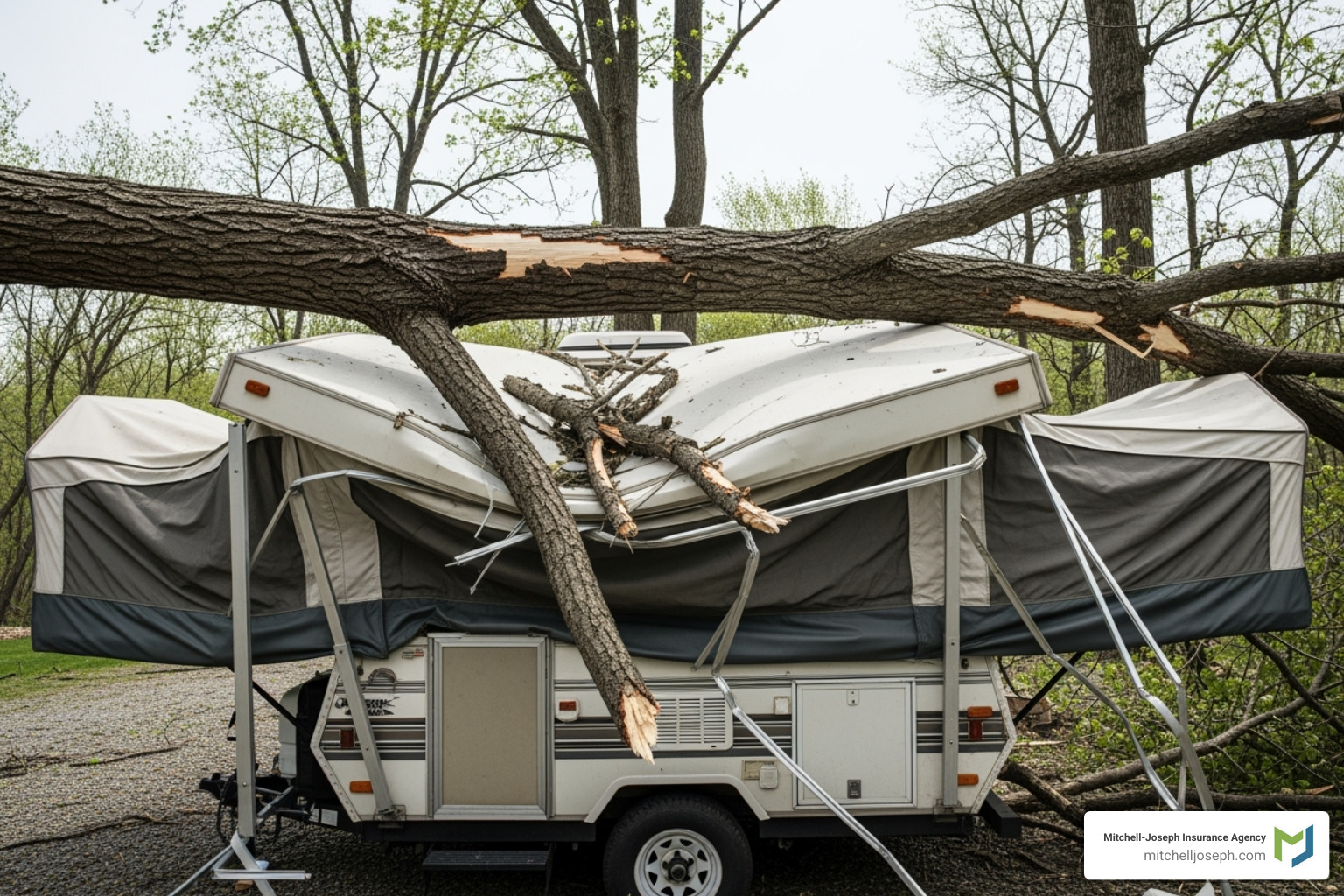
Comprehensive coverage handles all those “life happens” moments that aren’t collisions. We’re talking about theft (and pop-ups can be tempting targets since they’re portable), vandalism, fire, and weather damage like hailstorms, wind damage, or that massive tree branch that decides to fall on your camper during a storm. If someone steals your camper from storage or a hailstorm turns your roof into Swiss cheese, comprehensive coverage steps in to help.
The big difference from auto insurance is simple: your car policy might cover liability while towing, but it won’t touch the physical damage to your camper. Without dedicated coverage, you’re paying for repairs and replacements out of your own pocket.
Optional Coverages for Improved Protection
The core coverages give you solid protection, but many pop-up owners choose additional coverages that address specific camping scenarios. Think of these as the extras that can turn a stressful situation into just a minor bump in your trip.
Personal effects replacement covers all the stuff that makes your camper feel like home – camping gear, electronics, clothes, cooking supplies, and everything else you pack for your trips. Your homeowner’s policy might have limitations here, and standard camper policies often don’t include personal belongings. Some policies will reimburse you up to $5,000 for stolen or damaged personal items.
Vacation liability extends your protection when your camper is parked and set up at a campsite. If someone gets injured while visiting your site, or your awning breaks free and damages someone else’s property, this coverage handles the medical expenses and legal fees. It’s like having a security blanket for your temporary home away from home.
Roadside assistance can be a real lifesaver when you’re towing. Picture this: you’re 50 miles from nowhere and your tow vehicle breaks down. Roadside assistance provides towing, jump-starts, tire changes, and emergency fuel delivery. It can turn a potential camping disaster into just an interesting story to tell later.
Emergency expense allowance kicks in when your camper becomes unusable due to a covered loss while you’re away from home. If your camper gets totaled in an accident during a cross-country trip, this coverage can reimburse you for temporary lodging, meals, and even rental fees for a substitute camper. Many policies offer up to $3,000 for transportation and $1,500 for meals and accommodation.
Total loss replacement is particularly valuable for newer pop-ups. Instead of getting the depreciated cash value if your camper is stolen or destroyed, this coverage pays to replace your totaled camper with a brand-new model of similar kind and quality. It’s especially beneficial for campers that are five model years old or less.
These optional coverages let you customize your pop up camper insurance policy to match how you actually use your camper. For more information on various RV insurance coverage options, visit: More info about RV Insurance Coverage Options.
The Cost of Pop Up Camper Insurance
Here’s some good news: pop up camper insurance is surprisingly affordable. While those big motorhomes might cost a fortune to insure, pop-up campers are much gentler on your wallet. Since they can’t be driven independently and rely on your auto policy for liability while towing, the premiums stay reasonable.
Most pop-up owners pay between $75 and $350 annually for coverage, with many falling into the $100-$200 range. That works out to less than $20 per month for most people – probably less than you spend on coffee each month. Some lucky owners report paying as little as $18 per year for basic coverage.

Several factors influence what you’ll actually pay for your premium. Your camper’s value is the biggest factor – a shiny new $20,000 model will cost more to insure than a well-loved $5,000 used one. How often you use it matters too; occasional weekend warriors often pay less than people who camp every month.
Your driving record plays a role, just like with car insurance. A clean record with no accidents or violations can qualify you for better rates, while recent at-fault accidents might bump up your premium. Where you live and store your camper also affects costs – areas with higher crime rates or severe weather tend to have higher premiums.
Your deductible choice gives you some control over your premium. Choosing a higher deductible (like $1,000) lowers your monthly cost but means you’ll pay more out-of-pocket if you file a claim. A lower deductible ($250-$500) increases your premium but reduces your financial hit when something goes wrong.
Don’t forget about discounts. Many insurers offer savings for bundling your pop up camper insurance with your auto or home insurance, being the original owner, or maintaining an accident-free record. These can add up to real savings.
When you consider that repairing or replacing a damaged pop-up camper can easily cost thousands of dollars, spending a few hundred dollars a year for comprehensive protection is really a no-brainer. It’s like buying peace of mind for the price of a nice dinner out each month.
Finding the Best Policy for Your Needs
Securing the right insurance is about more than just meeting a requirement; it’s about finding a policy that fits your specific needs and budget. This section provides actionable steps to help you compare options and make a confident choice.
How to Find the Best Pop Up Camper Insurance
Finding the best pop up camper insurance policy isn’t about finding the cheapest option – it’s about finding the right value. You want comprehensive coverage that protects your investment without emptying your wallet. After helping countless families in the Finger Lakes region find the perfect policy, I’ve learned that the most successful approach combines smart shopping with honest self-assessment.

The foundation of finding great coverage starts with shopping around and comparing quotes. I can’t stress this enough – don’t settle for the first quote you receive. Insurance companies evaluate risk differently, which means rates can vary dramatically for identical coverage. One carrier might quote you $300 annually while another offers the same protection for $150. As an independent agency, we work with 24 different insurance companies, which means we can do the heavy lifting of comparison shopping for you.
Before you start collecting quotes, take a moment to assess your needs honestly. Think about your camper’s current value, including any custom modifications you’ve added. Consider how often you actually use it – are you weekend warriors hitting the road every chance you get, or do you take a couple of longer trips each year? Where do you store your camper when it’s not in use? A secure storage facility presents different risks than parking it in your driveway.
These details matter because they help determine what coverage you truly need. There’s no point in paying for coverage you’ll never use, but being underinsured can be even more costly in the long run.
Bundling policies often creates significant savings opportunities. Many of our clients save hundreds of dollars annually by combining their auto, homeowners, and pop up camper insurance with the same carrier. Beyond the financial benefits, bundling simplifies your life – one agent, one renewal date, one point of contact when you need service.
Don’t forget to ask about available discounts. Insurance companies offer various discounts, but they won’t always volunteer this information. The original owner discount rewards you for buying new, while safe driver discounts recognize your clean driving record. Some carriers offer safety feature discounts for anti-theft devices or fire extinguishers, and association discounts might be available through camping clubs or RV organizations.
Working with a trusted independent agency makes all the difference in your experience. Unlike captive agents who represent only one company, we’re free to find you the best coverage from our entire network of carriers. We’re not trying to fit you into a one-size-fits-all solution – we’re crafting a policy that matches your specific situation.
With over 200 years of combined experience, our team understands the nuances of pop up camper insurance. We’ll help you balance deductibles and coverage limits, explain policy features in plain English, and make sure you understand any exclusions or limitations. Since we’re right here in the Finger Lakes region, you’re working with neighbors who understand local conditions and risks.
Get Your Personalized Quote Today
I hope this guide has shown you why pop up camper insurance is such a smart investment. The peace of mind alone is worth the modest annual cost. Whether you’re worried about hailstorms, theft, or that inevitable backing-into-a-tree incident that seems to happen to everyone eventually, having the right coverage means you can focus on making memories instead of worrying about potential disasters.
The best time to get coverage is right now – before you need it. If you’ve just bought your first pop-up camper, or if you’ve been relying on your auto insurance’s limited protection, don’t wait. Every day without proper coverage is a day you’re gambling with your investment and your financial security.
At Mitchell-Joseph Insurance Agency, we take pride in treating every client like family. We know that every camper owner has different needs, different budgets, and different camping styles. That’s why we take the time to understand your specific situation before recommending coverage options. Our experienced team will walk you through the process, answer all your questions, and make sure you feel confident about your decision.
Ready to protect your camping trips? We’re here to help you find the perfect pop up camper insurance policy that fits your needs and budget.
Get your personalized quote for pop-up camper insurance today.

