Why Personal Property Condo Insurance is Essential for Your Financial Protection
Personal property condo insurance is the part of your HO-6 policy that safeguards what you own inside the unit. In a nutshell:
- What it covers: Furniture, electronics, clothing, appliances, and other belongings damaged by covered perils such as fire, theft, or vandalism
- What it doesn’t cover: Floods, earthquakes, or anything already insured by your association’s master policy
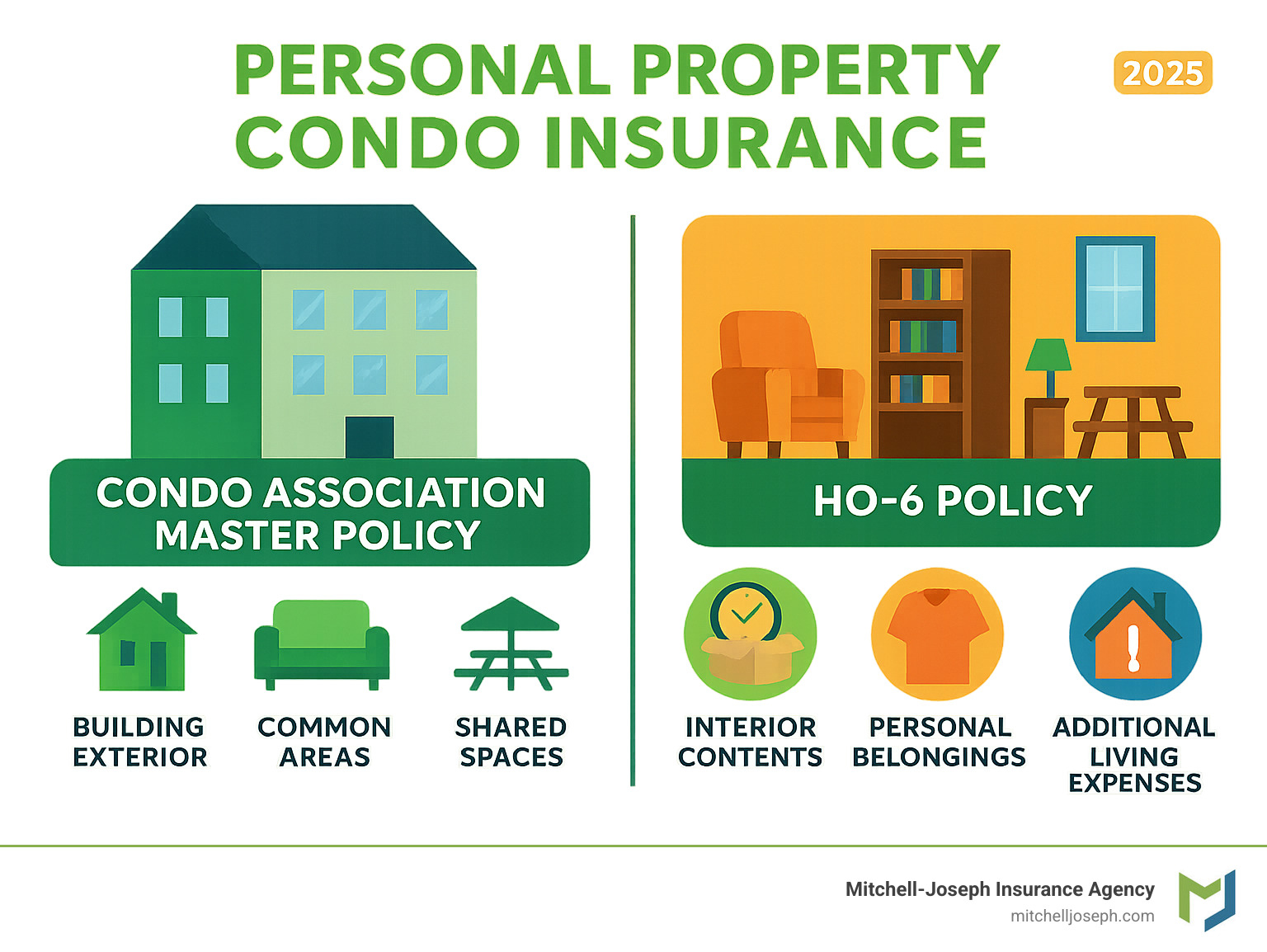
- Why you need it: The master policy stops at your walls; everything you could load into a moving truck is on you
- Coverage amounts: Choose limits from $0 to $500,000, paid at actual cash value or replacement cost
- Special items: Jewelry, art, or collectibles usually require separate “scheduled” coverage
If you flipped your condo upside down, everything that would fall out needs its own protection. Without personal property coverage you would pay out of pocket to replace every chair, shirt, and charger.
I’m Jeffrey Joseph, and since 1999 I’ve helped Finger Lakes condo owners avoid that exact scenario through Mitchell-Joseph Insurance Agency.
Personal property condo insurance glossary:
Understanding Your Condo Insurance Landscape
Owning a condo means sharing some risks with your neighbors and carrying others yourself. The condo association’s master policy usually pays for the exterior structure and common areas—lobbies, roofs, elevators, the pool.
Everything inside your four walls is your responsibility, and what the master policy covers depends on its form:
- “Walls-in” (bare walls) – association pays only for the building shell. You insure drywall, flooring, cabinets, and everything else.
- “Single entity” – adds original fixtures that came with the unit.
- “All-in” – broadest association protection, but it still stops at your personal property.
Knowing which version your complex carries tells you how much HO-6 dwelling, liability, and personal property coverage you need. Always get a copy of the bylaws or ask the property manager for confirmation.
Why You Need Personal Property Condo Insurance
Master policy gaps can cost tens of thousands of dollars. The average condo owner easily has $40,000-plus in belongings. Mortgage lenders and many associations therefore require owners to maintain HO-6 policies that include personal property and liability coverage. If your dishwasher leaks and damages the unit below, liability insurance saves you from paying those repairs out of pocket.
For a deeper dive, read what is condo insurance, and how does it protect you?
How It Differs from Other Policies
- HO-3 homeowners coverage insures a whole house—overkill for a condo.
- HO-4 renters insurance ignores interior fixtures you may own.
- Landlord packages apply when you rent the unit out.
Learn more at apartment insurance and renters insurance coverage.
What Your Personal Property Condo Insurance Covers (And What It Doesn’t)

Your HO-6 policy supplies “contents” protection against named perils such as fire, lightning, wind, hail, theft, vandalism, and sudden water discharge.
What Is Covered
Typical covered items include:
- Furniture (sofas, beds, tables)
- Electronics (TVs, laptops, gaming systems)
- Clothing and accessories
- Kitchenware and small appliances
- Tools and hobby equipment
- Decorations, artwork, and mirrors
- Bicycles and sporting gear
- Belongings in storage or temporarily away from home (subject to sub-limits)
Most policies even protect your laptop stolen on vacation, though off-premises coverage is usually capped at about 10% of your personal property limit.
What Isn’t Covered
Standard exclusions mean your condo policy will NOT pay for:
- Flood or earthquake damage (buy separate policies; you can learn more about federal options at the National Flood Insurance Program)
- Sewer or drain back-up (optional endorsement)
- Wear & tear, mold, insects, or rodents
- Intentional acts, war, nuclear hazard
- Business property above the small sub-limit
For water-related exclusions, see water backup insurance vs. flood insurance.
Knowing these boundaries lets you decide which extra policies or endorsements you actually need.
Determining How Much Coverage You Need
Guessing at coverage is risky. Industry averages suggest about $40,000 for the first 1,000 sq. ft. plus $5,000 for each additional 500 sq. ft., but lifestyle matters more than square footage. High-end electronics, designer clothes, or hobby gear can easily double that estimate.
Underinsuring means you’ll pay the difference after a loss; overinsuring wastes premium dollars. Our guide is your home underinsured? explains the danger in detail.
How to Create a Simple Home Inventory
- Walk through your condo with your phone. Shoot a quick video of every room, closet, and drawer.
- Photograph serial numbers and save digital receipts for big-ticket items.
- Store the file in the cloud and update it when you buy or sell something.
Even a 20-minute walkthrough makes claim time easier and helps pinpoint the right coverage amount. More tips are in our home insurance coverage types article.
Actual Cash Value vs. Replacement Cost
Actual Cash Value (ACV) subtracts depreciation; Replacement Cost (RC) pays today’s price for a new item. The premium difference is small—often 15-20%—but RC puts you back where you were financially, while ACV leaves you upgrading at your own expense.
| Coverage Type | ACV | RC |
|---|---|---|
| Payout | Depreciated | Current retail |
| $500 TV after 5 yrs | $100 | $500 |
| Premium | Lower | Higher |
| Best for | Budget only | Full recovery |
Protecting Your Valuables: Sub-Limits, Floaters, and Scheduling

Even generous personal property limits won’t fully cover certain “high-risk” categories. Most HO-6 policies cap payouts per loss at roughly:
- $200 for cash or coins
- $1,000 for jewelry, watches, or furs (theft)
- $2,500 for firearms or silverware
- $2,500 for business property kept at home
These sub-limits apply regardless of your overall limit. Lose a $5,000 engagement ring and you’ll still collect only $1,000.
How to Insure Valuables Correctly
Add a scheduled personal property endorsement (sometimes called a floater). After an appraisal, each item receives:
- Coverage for almost any cause of loss (all-risk)
- No deductible
- Payment at the scheduled amount
Premiums run roughly 1-3% of the item’s value per year—small change compared to replacing heirloom jewelry or custom instruments. Our resources on expensive jewelry insurance explain the process step-by-step.
Schedule anything whose value exceeds the built-in limits: fine art, collectibles, high-end cameras, or that prized guitar.
Frequently Asked Questions about Personal Property Condo Insurance
Condo insurance can feel confusing, especially when you’re trying to understand what’s covered where. These are the questions I hear most often from condo owners in our area, and I think the answers will help clarify how your coverage works.
What is the difference between dwelling and personal property coverage in a condo policy?
Think of it this way: dwelling coverage (Coverage A) protects everything that would stay behind if you moved out tomorrow. This includes your interior walls, floors, ceilings, built-in appliances, cabinets, and fixtures – basically anything permanently attached to your unit.
Personal property coverage (Coverage C) protects everything you’d pack up and take with you. Your furniture, clothing, electronics, kitchenware, and all your personal belongings fall into this category. The key difference is simple: dwelling coverage protects what stays, personal property condo insurance protects what goes.
Here’s what makes condo coverage unique – the exact items covered under dwelling protection depend on your condo association’s master policy type and your state’s regulations. Some associations cover more of the interior structure, while others leave more responsibility to individual owners.
Your coverage limits work independently too. You might carry $25,000 in dwelling coverage for interior fixtures and $75,000 in personal property coverage for your belongings. The right amount for each depends on your specific situation and what your association’s master policy already covers.
Does personal property coverage protect my items if they are not in my condo?
Yes, and this is one of the great benefits of personal property condo insurance that many people don’t realize they have. Most policies provide worldwide coverage for your belongings, though this off-premises protection typically covers a percentage of your total personal property limit – usually around 10%.
So if you have $50,000 in personal property coverage, up to $5,000 might be available for items outside your condo. This coverage can protect items stolen from your car, belongings in storage units, personal items while traveling, or things temporarily at friends’ or family members’ homes.
Of course, there are some limitations. Business property, vehicles, and items you’ve intentionally left at other locations for extended periods may have different coverage rules. I always recommend reviewing your specific policy language to understand the exact terms – every policy can be slightly different.
If I rent out my condo, are my tenant’s belongings covered?
No, your personal property condo insurance doesn’t cover your tenant’s belongings at all. Tenants need their own renters insurance to protect their personal property – that’s their responsibility, not yours.
When you rent out your condo, you’ll actually need to modify your coverage to reflect the changed occupancy. This usually means switching to a landlord or rental dwelling policy that provides appropriate coverage for your investment property while recognizing that tenants handle their own belongings.
This is an important distinction because standard condo policies assume you’re living in the unit. Rental situations create different risks and liability exposures that require specialized coverage.
For detailed information about insurance when renting out your condo, I recommend checking out our guide on condo insurance for landlords. It covers all the coverage changes you’ll need to make when transitioning from owner-occupied to rental property.
Conclusion
Personal property condo insurance serves as your financial safety net in ways that many condo owners don’t fully appreciate until they need it. Think of it this way: your condo association’s master policy is like an umbrella that covers the building, but it stops at your front door. Everything inside – from your morning coffee maker to your favorite armchair – needs your personal protection.
The most eye-opening part of our work with condo owners is watching them create their first home inventory. We’ve seen people find they own $60,000 worth of belongings when they thought they had maybe $20,000. Your everyday items add up faster than you’d expect, and that’s exactly why adequate personal property condo insurance becomes so important.
Your choice between actual cash value and replacement cost coverage will determine whether you can truly rebuild your life after a loss or just scrape by with depreciated payouts. Replacement cost coverage costs a bit more each month, but imagine trying to replace your entire wardrobe, electronics, and furniture with money that reflects what they’re worth used rather than what it costs to buy new.
Don’t forget about those special items that mean the most to you. Your grandmother’s ring, your art collection, or that guitar you’ve been playing for years – these treasures need extra attention through scheduling or floaters. The standard policy limits often fall short of protecting what matters most.
At Mitchell-Joseph Insurance Agency, we’ve spent over 200 years of combined experience helping families in the Finger Lakes region protect what they’ve worked hard to build. Our access to 24 different insurance companies means we can find coverage that fits your specific situation, whether you’re in a downtown Rochester high-rise or a quiet Canandaigua complex.
We believe insurance should make sense, not create confusion. That’s why we take time to explain your options, help you understand what you actually need, and make sure you’re not paying for coverage you don’t require or missing protection you do.
Your financial security deserves more than guesswork. Let’s sit down together, review your current situation, and create a protection plan that actually works for your life. Get a comprehensive home insurance quote today and find how proper coverage can give you the peace of mind you deserve.