

Why Property Owners Face a Critical Insurance Gap
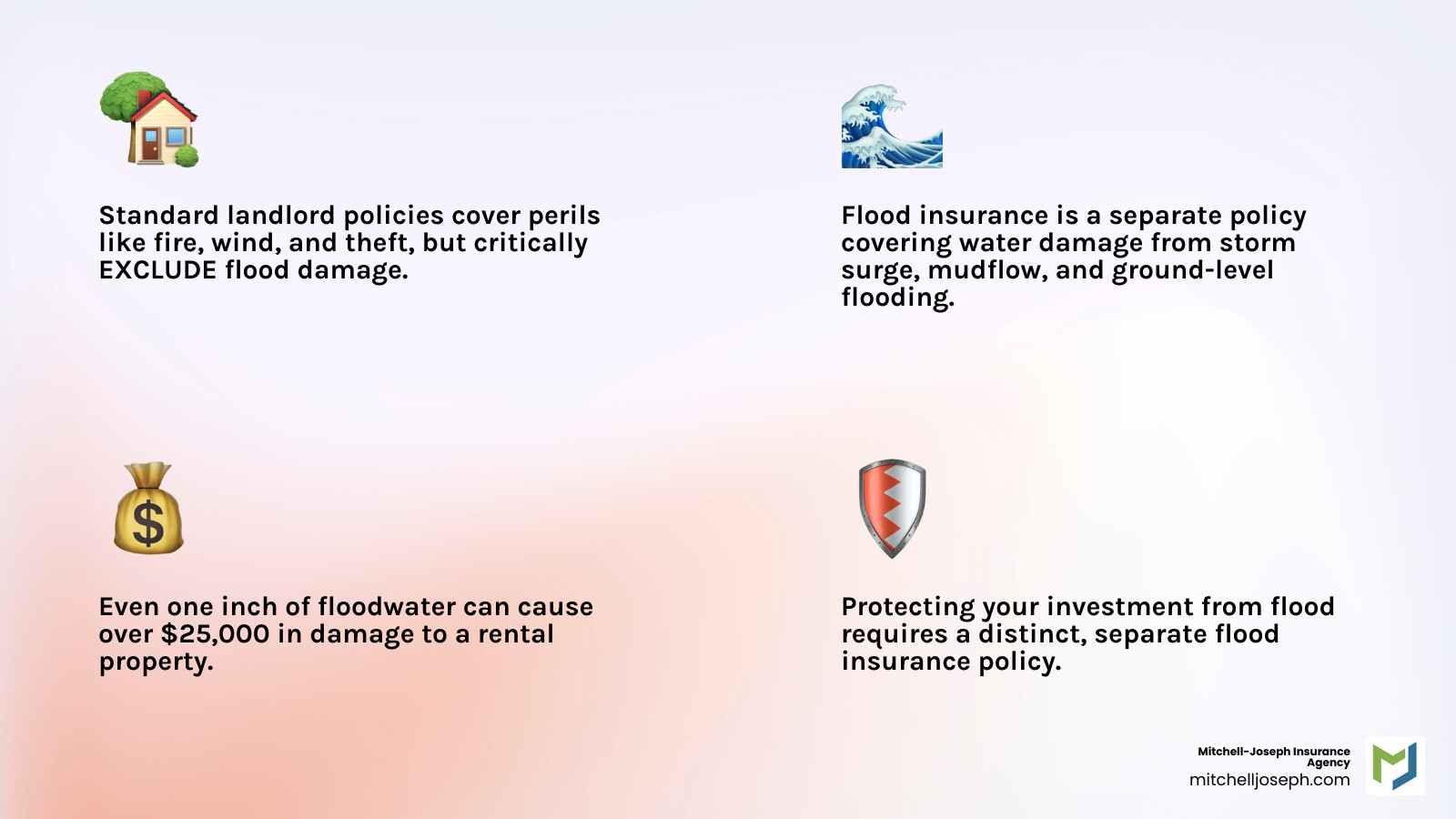
Landlord vs Flood Insurance is a critical, often misunderstood distinction that can devastate rental property investments. Here’s the essential difference:
| Landlord Insurance | Flood Insurance |
|---|---|
| Covers fire, wind, theft, liability | Covers water damage from floods, storm surge, mudflow |
| Does NOT cover flood damage | Separate policy required |
| Protects structure + lost rent | Covers building systems + landlord contents |
| Required by most lenders | Mandatory in high-risk flood zones |
Floods are the most common and costly U.S. natural disaster. Yet, most landlord insurance policies don’t cover flood damage, leaving property owners financially vulnerable.
The harsh reality? Even one inch of floodwater can cause over $25,000 in damage. Your landlord policy covers a kitchen fire but won’t pay for flood damage from a storm surge.
This creates a dangerous coverage gap. While your landlord policy protects against common perils like fire and theft, flood insurance is a completely separate policy that you must purchase to protect your investment from water damage.
I’m Jeffrey Joseph of Mitchell-Joseph Insurance. Since 1999, I’ve helped Finger Lakes property owners steer complex insurance decisions. I’ve seen too many landlords find this coverage gap only after disaster strikes. Let me explain what each policy covers to help you protect your investment.
The Fundamental Divide: What Landlord Insurance Covers (and What It Doesn’t)
As a rental property owner, protecting your investment is essential. Landlord insurance is designed to shield you from the unique risks of renting out a home. While not always legally required, most mortgage lenders insist on it to protect their investment. Lenders often prefer insurers with a strong financial standing (e.g., AM Best Rating of A- VIII or better).
A good landlord policy covers property damage, liability protection, and loss of rental income. It helps you rebuild after a fire or windstorm and covers theft or vandalism. If someone is injured on your property, it can cover medical payments and legal costs. Lenders may require specific liability limits, such as $500,000 per incident, often with a $1,000 deductible.
Crucially, standard landlord policies explicitly do not cover flood damage—the core of the Landlord vs Flood Insurance debate. Other common exclusions are earthquake damage and some tenant-caused damage, though endorsements may be available. Learn more in our guide on Landlord Insurance 101: Cover Your Assets.
What a Standard Landlord Policy Protects
A standard landlord insurance policy is your main line of defense against many common risks. Here’s what it typically protects:

- Dwelling Coverage: Protects the physical structure of your rental property (foundation, walls, roof) from perils like fire damage, wind damage, hail, and lightning.
- Other Structures: Covers detached garages, sheds, and fences from the same perils.
- Landlord’s Personal Property: Covers items you own for servicing the rental, like appliances or maintenance equipment.
- Liability Protection: If a tenant or visitor is injured on your property and you’re found responsible, this helps pay for their medical payments, legal fees, and settlements.
- Loss of Rental Income: If a covered peril makes your property unlivable, this reimburses you for the lost rent during repairs.
- Covered Perils: Comprehensive DP-3 policies are broad, covering most causes of damage unless specifically excluded.
The Critical Exclusion: Why Floods Aren’t Covered
The Landlord vs Flood Insurance confusion arises here. Many landlords mistakenly believe their policy covers all water damage. The key is the insurance definition of a “flood.”
A landlord policy typically covers internal water damage from a burst pipe but explicitly excludes damage caused by a “flood.”
The National Flood Insurance Program (NFIP) defines a flood as a general inundation of two or more acres or properties from overflow of waters, rapid runoff of surface water, or mudflow.
This means if water comes from the ground up—from rising rivers, heavy rain, surface water, or mudflow—your landlord policy won’t pay. A separate flood policy is essential to avoid being financially vulnerable. Learn more about Business Insurance for Landlords.
Filling the Gap: The Critical Role of Flood Insurance for Rentals
Since landlord insurance excludes flood damage, a separate flood insurance policy is a critical part of your risk management. Secured through the National Flood Insurance Program (NFIP) or a private insurer, it provides protection your landlord policy can’t.
Floods are the most common and costly U.S. natural disaster, occurring in all 50 states, including our service areas from Honeoye Falls to Rochester. Just one inch of floodwater can cause over $25,000 in damage.
Without flood insurance, you’re responsible for all repair costs, which could wipe out your rental income. It’s a necessity that fills the coverage gap, protecting your investment. For details, see our An Essential Guide to Flood Insurance FAQs.
What Flood Insurance Specifically Covers for a Rental Property
Flood insurance targets damages from external flooding, covering your rental’s structure and certain landlord-owned contents.
A flood policy typically covers:
Building Coverage protects the physical structure and its essential systems. This includes the foundation, walls, roof, electrical and plumbing systems, central air conditioning, furnaces, and water heaters. It also covers built-in appliances, permanently installed carpeting, cabinets, and detached garages (up to 10% of the building limit).
Landlord-Owned Contents Coverage is for personal property you own and use in the rental. This includes items like washer and dryer units, portable air conditioners, and microwave ovens. The NFIP provides limited coverage (up to $2,500) for valuables like artwork.
This coverage is for your property only and does not cover your tenant’s belongings. They need their own renters flood insurance. For a full list, see the NFIP’s page: What you need to know about buying flood insurance.
Actual Cash Value (ACV) vs. Replacement Cost: A Key Distinction for Landlords
A critical distinction for landlords is Actual Cash Value (ACV) vs. Replacement Cost Value (RCV). This is a key difference between flood insurance for rental and owner-occupied properties.
Actual Cash Value (ACV) is the standard for rental property flood claims, especially from the NFIP. ACV pays for the depreciation value of an item, not the cost of a new one. For example, a 10-year-old roof would only be partially covered, reflecting its age and wear.
In contrast, Replacement Cost Value (RCV), common for owner-occupied homes, pays the full cost to replace damaged property with new items, without deducting for depreciation.
Understanding this is crucial, as an ACV payout may not fully cover replacement costs, leaving you with out-of-pocket expenses. We can help you steer these nuances and explore private flood options that may offer RCV. Learn more about our Property and Casualty Insurance services.
What Flood Insurance Typically Excludes
While vital, flood insurance has specific exclusions. Understanding these is key to avoiding surprises.
Here’s what flood insurance typically doesn’t cover:
- Tenant’s Personal Belongings: Your policy does not cover your tenant’s property. They need their own renters flood insurance.
- Loss of Rental Income: Standard NFIP policies exclude this, though some private policies offer it as an add-on.
- Outdoor Features: Landscaping, trees, plants, fences, decks, patios, swimming pools, and hot tubs are generally not covered.
- Valuables and Vehicles: Currency, precious metals, and valuable papers are excluded. Vehicles are covered under comprehensive auto insurance, not flood insurance.
- Basement Contents: NFIP policies have strict limitations on basement coverage. Most personal property stored there is not covered, though essential appliances like washers and dryers may be.
- Sewer Backup: Damage from sewer backup is not covered unless it’s a direct result of a widespread flood event.
- Temporary Housing for Tenants: The cost for your tenant’s temporary housing is not covered.
Knowing these exclusions helps you plan accordingly, whether by accepting the risk or seeking specialized endorsements.
Navigating Your Options in the Landlord vs Flood Insurance Landscape
Understanding the Landlord vs Flood Insurance difference is the first step. The next is choosing the right flood insurance option for your rental property.
In the Finger Lakes region, we help landlords steer these choices. You have options, but each has trade-offs regarding coverage limits, waiting periods, and costs.
Let’s review the key decisions to help you protect your investment. For more, see our guide on Flood Insurance for Landlords.
NFIP vs. Private Flood Insurance: A Landlord’s Dilemma
For your rental, you have two main flood insurance paths: the government’s National Flood Insurance Program (NFIP) or private flood insurance from independent companies.
| Feature | National Flood Insurance Program (NFIP) | Private Flood Insurance |
|---|---|---|
| Provider | Federally funded program administered by FEMA, sold by participating insurers. | Independent insurance companies. |
| Building Coverage | Up to $250,000 for 1-4 unit residential; $500,000 for 5+ family unit. | Often much higher, up to $2,000,000 or more for rentals (some up to $15 million). |
| Contents Coverage | Up to $100,000 (Actual Cash Value). | Often higher, up to $500,000 or more (some may offer Replacement Cost Value for landlord contents). |
| Waiting Period | 30 days (except for real estate transactions). | Typically 10-15 days. |
| Cost | Often standardized, can be cheaper in some cases, but includes a $250 landlord fee. | Varies by insurer, can be more competitive or offer better value for higher coverage; no landlord-specific fee. |
| Covered Items | Standardized coverage; typically excludes pools, unattached structures, lost rent, most basement contents. | Can offer broader coverage, including loss of rent, pools, unattached structures, and more comprehensive basement coverage (depending on policy). |
| Availability | Available in over 23,000 participating communities. | May not be available in all areas, but growing. |
The NFIP has long been the standard choice. It’s widely available, standardized, and federally backed. You can get coverage via the National Flood Insurance Program or an agent.
However, NFIP has drawbacks for landlords. The coverage limits ($250,000 building/$100,000 contents for 1-4 units) may be too low for higher-value properties. It also has a 30-day waiting period and a $250 landlord fee.
Private flood insurance is a growing alternative. It can offer much higher limits (e.g., building coverage up to $2 million or more), a shorter 10-15 day waiting period, and no landlord fee.
Private policies often provide broader coverage, including for loss of rental income, pools, and basements—items the NFIP typically excludes. Many of our clients have saved significantly while getting better coverage by switching.
The main drawback is that private flood insurance isn’t available everywhere, and the NFIP may still be more affordable for some properties.
Is Flood Insurance Mandatory for Your Rental Property?
This is a common question with a nuanced answer.
Flood insurance is mandatory if your rental is in a Special Flood Hazard Area (SFHA) (Zone A or V) and you have a federally-backed mortgage (including conventional, FHA, VA, and many DSCR loans). This means there’s at least a 1% annual flood chance, or a 26% chance over a 30-year mortgage.
Even outside SFHAs, some lenders may require it for properties they deem at risk, which is common in the Finger Lakes region.
But we strongly recommend it even when not required. A surprising 25% of all flood claims occur in low-risk zones.
Check your property’s status at FEMA’s Flood Map Service Center to see if insurance is mandatory and to understand your risk. Without flood insurance, you’re personally responsible for all repairs, a risk most landlords can’t afford.
Understanding the Cost Factors for Landlord vs Flood Insurance
The pricing for Landlord vs Flood Insurance differs, though some cost factors overlap.
Flood insurance cost is driven by your flood zone designation. Low-risk zones might cost $500-$1,000 annually, while high-risk zones can be $1,000-$5,000+.
Property elevation is also key. A higher elevation relative to the Base Flood Elevation means a lower premium. An Elevation Certificate can document this and lower your costs.
Deductibles affect cost; higher deductibles mean lower premiums. Flood deductibles can be substantial, often a percentage of your coverage amount. Coverage amounts and building characteristics (age, foundation) also influence your premium.
Landlord insurance premiums are typically $500 to over $2,000 annually, driven by property value and location. Higher-value properties or those in areas with severe weather risk cost more. The property’s age, condition, and claims history also impact pricing.
An Umbrella Insurance Coverage policy can provide affordable extra liability protection.
Clearing the Waters: Common Misconceptions and Coverage Gaps
Navigating Landlord vs Flood Insurance can be confusing. Common myths and hidden coverage gaps can leave your investment unprotected. Our goal is to clarify these points so you can protect your rental property. For general questions, see our FAQs.
Debunking Common Myths in the Landlord vs Flood Insurance Debate
Let’s shine a light on some persistent myths that can mislead landlords:

-
Myth #1: “I don’t need flood insurance because my property isn’t in a flood zone.” This is a dangerous myth. Floods happen everywhere. In fact, 25% of all flood claims come from low-to-moderate risk zones. Heavy rain or snowmelt can cause flooding anywhere, regardless of what a map says. Don’t let a false sense of security leave your investment vulnerable. For more, see these FEMA facts on flood insurance.
-
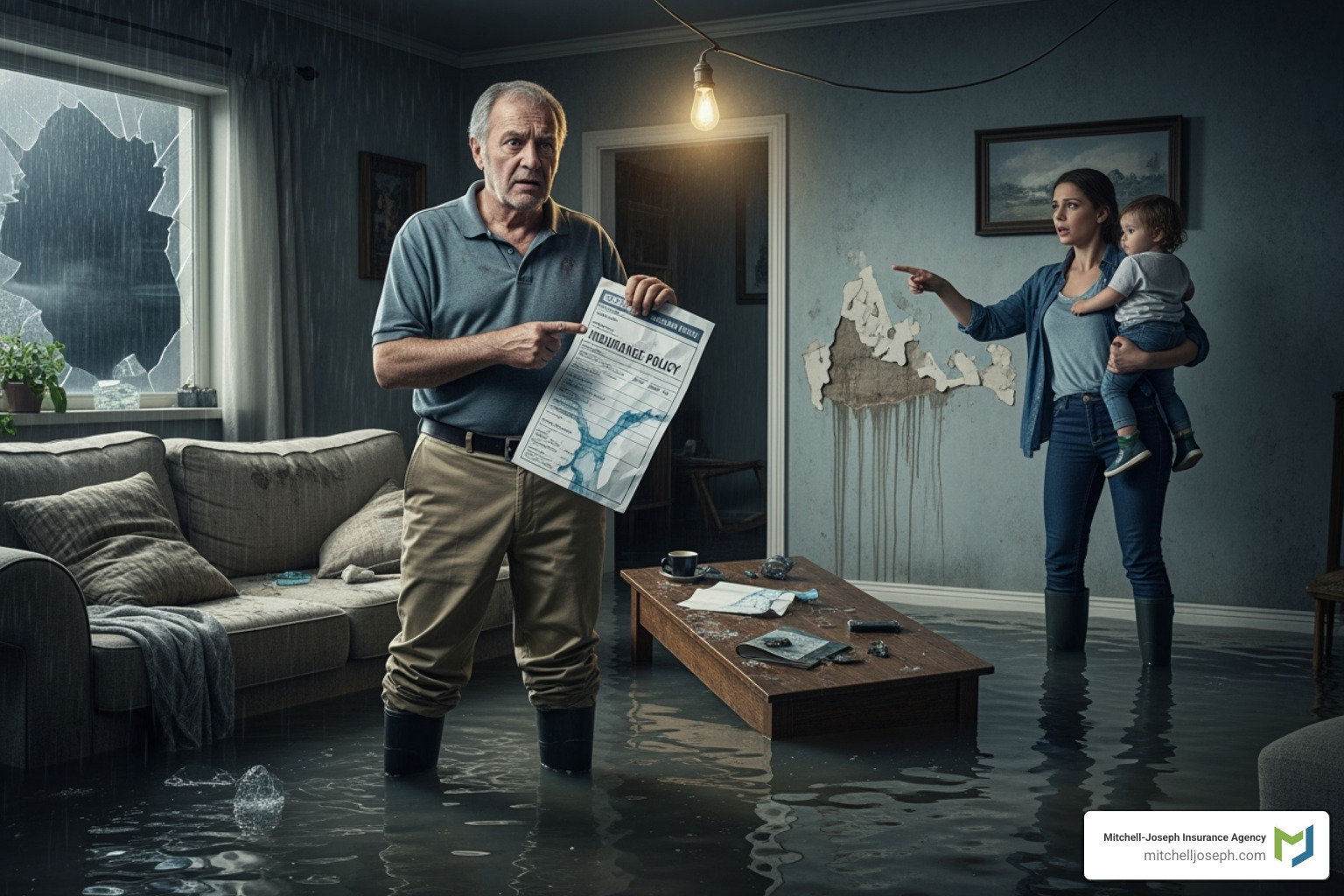
Myth #2: “My landlord policy covers all water damage.” This is a major misunderstanding. Landlord insurance covers internal water damage (like a burst pipe) but explicitly excludes damage from external water sources like rising rivers or surface water. That’s what flood insurance is for, and it’s the core of the Landlord vs Flood Insurance distinction.
-
Myth #3: “FEMA will bail me out if my property floods.” Federal disaster aid is not a substitute for insurance. It’s typically a low-interest loan, not a grant, and the average payout is only around $5,000—far less than the cost of typical flood damage. This aid is meant to assist recovery, not make you whole.
By understanding these myths, you can see how crucial separate flood insurance is for your rental property.
The Tenant’s Role: Advising on Renters and Flood Insurance
While your job is to protect your property, communicate with tenants about their responsibilities. Your landlord and flood policies do not cover your tenant’s personal property—a key point in the Landlord vs Flood Insurance discussion.
Here’s what you should tell your tenants:
- Educate Tenants: Clearly state that your insurance does not cover their personal belongings from any peril, including fire, theft, or flood.
- Require Renters Insurance: Strongly recommend or require in your lease that tenants get renters insurance. It’s affordable (often ~$20/month) and covers their property from perils like fire, theft, and some water damage.
- Stress the Need for Renters Flood Insurance: Explain that standard renters insurance excludes flood damage. Advise them to buy a separate “contents-only” flood policy, which can protect up to $100,000 of their belongings. The NFIP offers these policies for renters. You can share our video on Why you need renters insurance to help explain.
Open communication empowers your tenants and protects you from potential disputes.
Mind the Gaps: Sewer Backup and Other Water Woes
Beyond floods, other water incidents like sewer backup, drain backup, and sump pump overflow can create unexpected and costly coverage gaps.
- Sewer/Drain Backup: Standard landlord and flood policies typically do not cover damage from sewer or drain backups unless the backup is a direct result of a widespread flood. A backup from a municipal blockage is usually excluded.
- Sump Pump Overflow: Similarly, damage from a failed or overflowing sump pump is typically not covered by standard landlord or flood policies.
How can landlords address these gaps?
- Add a Sewer/Drain Backup Endorsement: The best solution is to add a specific endorsement (or rider) to your landlord policy. This separate coverage protects against damage from sewer/drain backups and sump pump overflows.
- Perform Regular Maintenance: Insurance covers the damage, not the cause. Regular upkeep of drains and sump pumps can help prevent these incidents.
Knowing about these exclusions and adding the right endorsements can save you from huge, unexpected costs. Learn more in our articles on Water Backup Insurance vs Flood Insurance and Does Flood Insurance Cover Water Backup?.
Conclusion
Navigating rental property insurance can be complex, but the key takeaway is this: Landlord vs Flood Insurance are not the same. They are two separate, vital policies for protecting your investment.
Your landlord policy is a shield against fire, wind, and liability, and it can protect your rental income. However, it absolutely does not cover flood damage.
Flood insurance is your lifeline against the most common and costly natural disaster. It covers damage from external water sources like overflowing rivers or storm surges. Since many claims occur outside high-risk zones, it’s essential protection.
This guide covered the differences between NFIP and private flood insurance, when it’s required, its cost factors, and common myths. We also highlighted coverage gaps like sewer backup and the importance of tenants having their own renters and flood insurance.
At Mitchell-Joseph Insurance Agency, we understand the challenges of owning rental properties in the Finger Lakes region, from Honeoye Falls to Victor and Canandaigua. With over 200 years of combined experience, our family-owned business provides personalized service, working with 24 insurers to find you competitive quotes and custom coverage.
Don’t wait for a disaster to find a coverage gap. Be proactive and secure your investment for true peace of mind. Let us help you complete your insurance puzzle. Get a quote for Flood Insurance today and ensure your investment is protected.

