

Why Insurance for Condominium Owners is Essential
Insurance for condominium owners protects your personal belongings, unit improvements, and provides liability coverage that your condo corporation’s master policy doesn’t include. Here’s what every condo owner needs to know:
Essential Condo Owner Coverage:
- Personal property – furniture, electronics, clothing, and belongings
- Unit improvements – renovations, upgrades, and betterments you’ve made
- Personal liability – protection if someone is injured in your unit
- Additional living expenses – hotel and meal costs if your unit becomes uninhabitable
- Loss assessment – coverage for your share of common area damage deductibles
Your condo corporation’s insurance only covers the building structure and common areas. It does not protect your personal belongings or provide liability coverage for incidents in your unit. Even though condo insurance isn’t mandatory in Canada, most mortgage lenders and condo corporations require it as part of your purchase agreement.
The gap between what you think is covered and what actually is covered can be expensive. Water damage now accounts for a significant portion of home insurance claims, and condo owners face unique risks from shared plumbing systems and common area assessments that can reach thousands of dollars per unit.
I’m Jeffrey Joseph, and I’ve been helping condo owners steer insurance for condominium owners since 1999 at Mitchell-Joseph Insurance Agency across the Finger Lakes region. I’ve seen too many condo owners find coverage gaps after it’s too late, which is why understanding your options upfront is crucial.
Insurance for condominium owners vocab explained:
Understanding Insurance for Condominium Owners
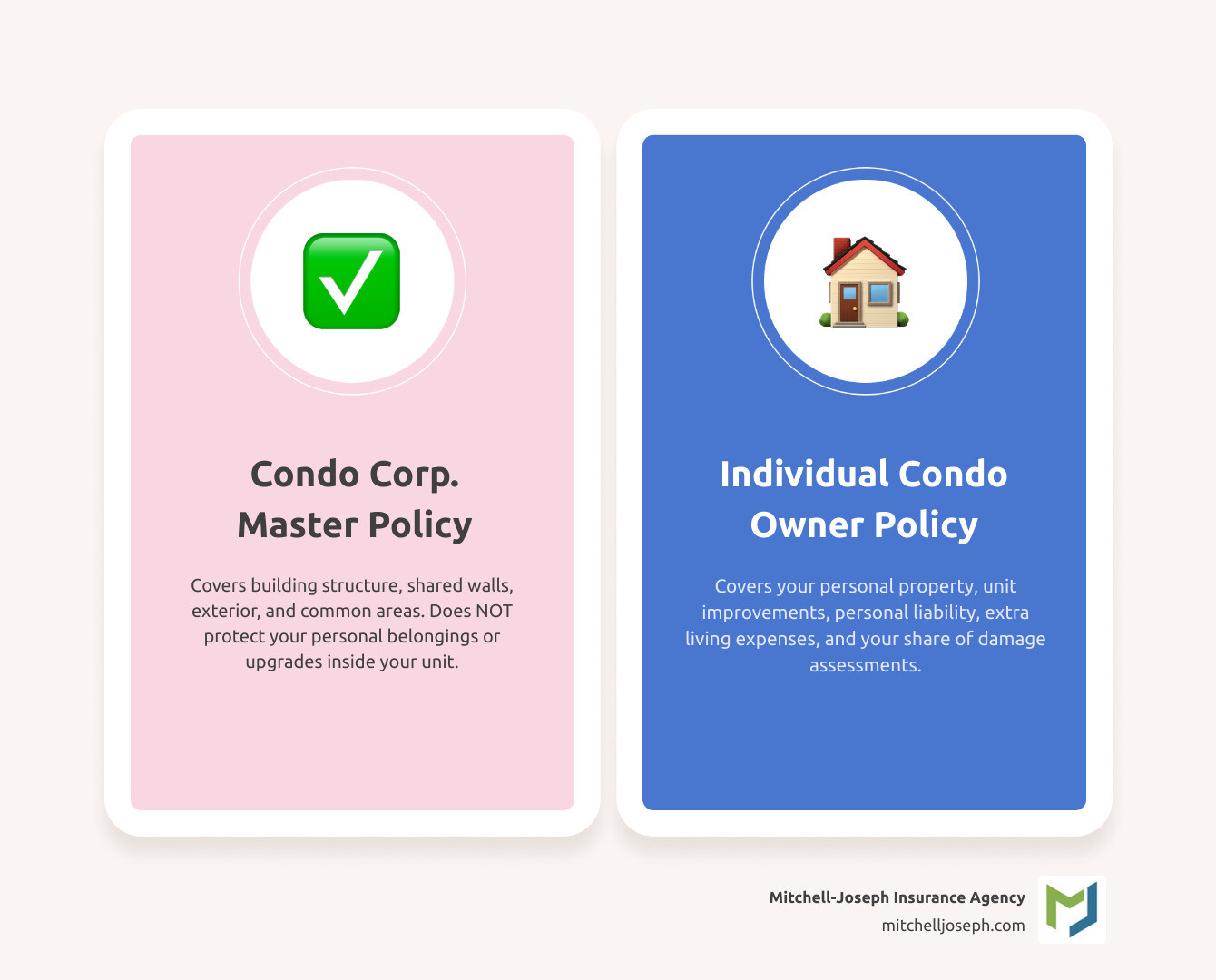
Insurance for condominium owners is a specialized type of coverage designed to fill the gaps left by your condo corporation’s master policy. Think of it as the missing piece of your protection puzzle – while your building’s insurance covers the exterior walls and common areas, your individual policy protects everything inside your unit and your personal liability.
The master policy held by your condominium corporation typically covers the building’s structure, common elements like hallways and elevators, and shared amenities. However, it doesn’t extend to your personal belongings, the improvements you’ve made to your unit, or liability issues that originate within your space.
Legal requirements vary by location, but most mortgage lenders require condo insurance as a condition of financing. In our experience serving communities from Rochester to Canandaigua, we’ve found that even when it’s not legally mandated, condo corporations often require unit owners to carry their own insurance policies as part of the bylaws.
Condo insurance vs. homeowners & tenants insurance
Condo insurance operates on what’s called a “walls-in” basis, which means it covers everything from the interior walls inward. This is fundamentally different from homeowners insurance, which covers the entire structure including the roof, exterior walls, and foundation.
Unlike homeowners insurance that protects the dwelling structure itself, condo insurance focuses on your unit’s interior, your personal property, and your liability exposure. It’s also distinct from renters insurance because as a condo owner, you actually own the interior space and any improvements you’ve made to it.
The technical term you might see is HO-6 coverage, which is the insurance industry’s designation for condominium unit owner policies. This coverage type recognizes that you own your unit’s interior but share ownership of the building’s common elements with other unit owners.
Why every condo unit needs its own policy (insurance for condominium owners)
Here’s where we see the biggest misconceptions among new condo owners. Many assume that because their building has insurance, they’re fully protected. Unfortunately, that’s not the case, and the gaps can be financially devastating.
Consider this scenario: A pipe bursts in the unit above you, flooding your condo and destroying your furniture, electronics, and personal belongings. The building’s master policy might cover repairing the pipe and any structural damage, but your ruined possessions? That’s on you without your own policy.
Mortgage lenders understand these risks, which is why they typically require condo insurance before approving your loan. They want to ensure their investment is protected, and they recognize that the master policy alone doesn’t provide adequate coverage for individual unit owners.
Personal liability is another critical gap. If someone slips and falls in your unit, or if you accidentally cause damage to a neighbor’s unit, the master policy won’t protect you. Your individual policy provides liability coverage that can protect your assets and future earnings from lawsuits.
Corporation coverage vs. owner coverage
Understanding where the corporation’s coverage ends and yours begins is crucial for avoiding expensive surprises. We’ve created this comparison to help clarify the responsibilities:
| Coverage Area | Corporation Master Policy | Your Condo Policy |
|---|---|---|
| Building Structure | ✓ Covered | Not covered |
| Common Areas | ✓ Covered | Not covered |
| Your Unit’s Interior | Limited/Varies | ✓ Covered |
| Personal Belongings | Not covered | ✓ Covered |
| Unit Improvements | Not covered | ✓ Covered |
| Personal Liability | Not covered | ✓ Covered |
| Loss Assessments | Not covered | ✓ Covered (optional) |
The key takeaway is that corporation coverage focuses on shared elements and building structure, while your policy protects your personal interests within the unit. Some overlap exists in areas like unit improvements, which is why reviewing both policies together is essential.
Core Coverages You Can’t Skip
When we work with condo owners throughout the Finger Lakes region, we always emphasize these non-negotiable coverages. These are the foundation of any solid insurance for condominium owners policy, and skipping any of them can leave you financially exposed.

Think of these core coverages as the legs of a table – remove one, and the whole thing becomes unstable. I’ve seen too many condo owners try to save money by reducing coverage in these areas, only to face thousands in out-of-pocket costs when something goes wrong.
The reality is that living in a condo creates unique risks. You’re sharing walls, plumbing, and electrical systems with neighbors. Water can travel between units, and a single incident can affect multiple owners. That’s why comprehensive coverage isn’t just smart – it’s essential for protecting your investment and peace of mind.
Personal property & unit improvements
Your personal property coverage is probably more valuable than you think. Most people underestimate what they own until they have to replace everything at once. Start adding up your furniture, electronics, clothes, kitchen items, and personal belongings – you’ll likely reach $40,000 to $60,000 pretty quickly.
We always recommend replacement cost coverage over actual cash value. Here’s why: if your five-year-old laptop gets destroyed in a water leak, replacement cost coverage gives you enough money to buy a new laptop of similar quality. Actual cash value only pays what your old laptop was worth after depreciation – maybe $200 for something that costs $1,200 to replace new.
Content limits typically range from $25,000 to $100,000 or higher. The key is being honest about what you own. I encourage clients to walk through their unit with their phone camera, documenting everything room by room. It’s eye-opening and helps ensure you have adequate coverage.
Unit improvements coverage protects the money you’ve invested in making your condo your own. New hardwood floors, upgraded kitchen cabinets, bathroom renovations, built-in appliances – these improvements can easily represent $20,000 to $50,000 or more of your investment. The condo corporation’s policy won’t cover these personal upgrades, so your individual policy needs to step in.
Personal liability protection (insurance for condominium owners)
Personal liability might be the most important coverage you never think about until you need it. This protection kicks in when someone gets hurt in your unit or when you accidentally cause damage to someone else’s property. We’re talking about real financial protection here – lawsuits can easily reach hundreds of thousands of dollars.
Standard liability coverage typically starts at $1 million, though we often recommend higher limits depending on your assets and situation. If you have significant savings, investments, or own other property, you’ll want more protection. The good news is that increasing liability limits is relatively inexpensive compared to the protection it provides.
Here’s what many people don’t realize: your condo liability coverage follows you everywhere. If you’re playing softball and accidentally hit someone with a ball, causing dental injuries, your insurance for condominium owners policy would typically respond. It’s truly worldwide protection for your personal liability.
Medical payments coverage provides immediate help for minor injuries to guests in your unit, regardless of who’s at fault. Usually set at $5,000, it can pay for emergency room visits or urgent care if someone gets hurt in your unit. It’s a goodwill coverage that can prevent small incidents from becoming bigger problems.
Additional living expenses (ALE)
When your unit becomes uninhabitable due to covered damage, additional living expenses coverage becomes your financial lifeline. This coverage pays for hotels, restaurant meals, laundry, and other necessary costs while your unit is being repaired or rebuilt.
Most policies provide ALE coverage equal to 25% of your contents limit, but the time period varies. We’ve seen situations where condo owners were displaced for three to six months due to extensive water damage or fire restoration. Hotel costs of $150 per night plus meals can quickly reach $10,000 to $15,000 over several months.
The coverage extends beyond just housing costs too. If you have to board your pet because the hotel doesn’t allow animals, or if you need to rent furniture for a temporary apartment, ALE coverage typically helps with these expenses. It’s designed to help you maintain your normal standard of living during a difficult time.
Loss assessment coverage
This might be the most misunderstood but crucial coverage for condo owners. Loss assessment coverage protects you when your condo corporation faces a major loss that exceeds their insurance coverage, and the shortfall gets divided among all unit owners.
Here’s a real scenario: A major fire causes $3 million in damage to your building, but the corporation only carries $2.5 million in insurance. That $500,000 shortfall doesn’t just disappear – it gets assessed to individual unit owners based on their ownership percentage. In a 50-unit building, you could be looking at a $10,000 bill.
Loss assessment coverage typically provides protection equal to $1,000 per $1,000 of contents coverage, often up to $50,000 or more. Given that special assessments can reach tens of thousands of dollars per unit, this coverage can literally save you from financial hardship.
The coverage also applies to shared deductibles on the master policy. If the corporation has a $25,000 deductible on a water damage claim and assesses each unit owner for their share, your loss assessment coverage would typically respond to protect you from that unexpected expense.
Optional Add-Ons, Deductibles & Premium Drivers
Once you’ve secured the essential coverages, it’s time to consider the optional endorsements that can make your insurance for condominium owners policy truly comprehensive. Think of these as the extra layers of protection that address the unique risks condo owners face in today’s world.
Popular add-ons & endorsements
Water damage has become the number one claim we see at Mitchell-Joseph Insurance Agency, which is why improved water coverage should be at the top of your consideration list. This endorsement extends beyond basic water damage to include sewer backup, sump pump overflow, and in some cases, even overland flooding. Given that one burst pipe can cause tens of thousands in damage, this relatively inexpensive add-on often pays for itself with just one claim.
Cyber risk and identity theft coverage has become increasingly relevant as more of our lives move online. If someone steals your personal information and racks up fraudulent charges, this coverage helps pay for the specialists who can restore your identity and credit. It also covers the time you’ll spend dealing with banks, credit agencies, and law enforcement – time that can easily add up to hundreds of hours.
For condo owners who rent out their units, a landlord rider provides essential additional protection. This endorsement covers loss of rental income if your unit becomes uninhabitable, plus extra liability protection for tenant-related issues. We’ve seen too many condo owners find after a loss that their standard policy doesn’t cover rental situations.
Claim protector programs reward your claims-free years by reducing your deductible or protecting your premium discounts after your first claim. These programs recognize that sometimes claims happen through no fault of your own, and you shouldn’t be penalized for one unfortunate incident.
How deductibles work & shared deductibles for common areas
Understanding deductibles in the condo world can be tricky because you’re dealing with both your individual deductible and potentially shared deductibles from the corporation’s policy. Your personal deductible works just like any other insurance – you pay this amount before your coverage kicks in for claims affecting your unit.
The twist comes with all-perils deductibles that apply to the corporation’s master policy. When the condo corporation files a claim for common area damage, their deductible – which can be $25,000 or more – often gets divided among all unit owners. In a 50-unit building, that could mean $500 per owner, but in smaller buildings, your share could be much higher.
Split deductibles are becoming more common, where different deductible amounts apply to different types of claims. You might have a $1,000 deductible for most claims but a $5,000 deductible for water damage claims. Deductible recovery endorsements can protect you from these shared corporation deductibles, typically providing up to $25,000 in protection.
What determines your premium & ways to save
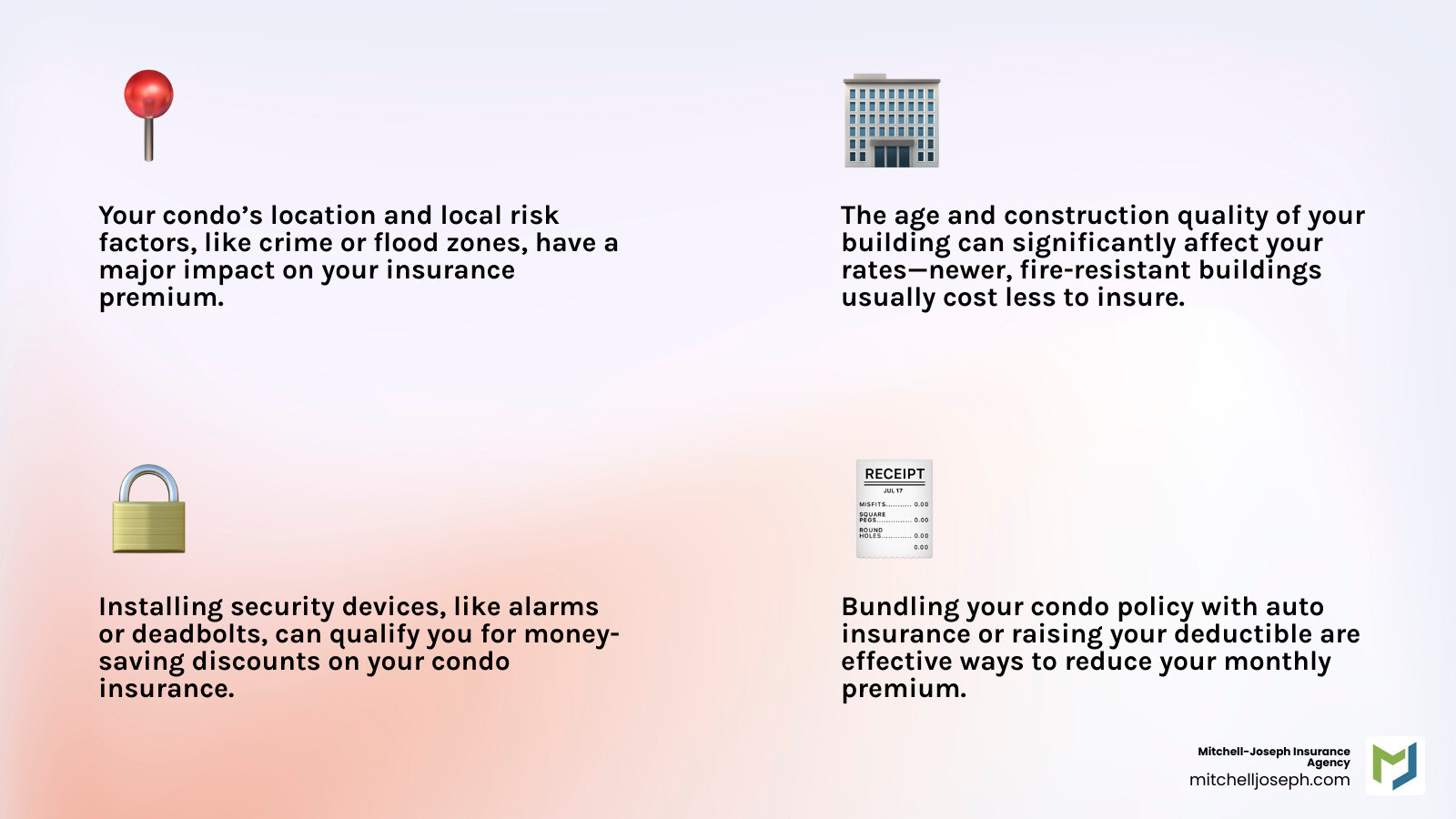
Your condo insurance premium depends on several factors, and understanding these can help you make smart decisions about both coverage and cost. Location plays a huge role – a unit in downtown Rochester will typically cost more to insure than one in a quiet Honeoye Falls neighborhood, simply due to crime rates and claim frequency.
Building age and construction matter significantly. Newer buildings with modern fire suppression systems and updated electrical and plumbing typically qualify for better rates. The age of your building’s roof, heating system, and plumbing can all impact your premium.
Your coverage choices directly affect cost, but don’t let the tail wag the dog here. Security devices like monitored alarm systems, deadbolts, and smoke detectors can earn you meaningful discounts. Bundle discounts for combining your condo and auto insurance often provide the biggest savings opportunity.
Maintaining a claims-free record helps keep premiums reasonable, but insurance is there to be used when you need it. Taking preventive steps like regular maintenance and safety measures helps you avoid claims naturally. Choosing a higher deductible can lower your premium, but make sure you can comfortably afford that deductible if you need to file a claim.
Get your free quote to see how these factors apply to your specific situation and find what discounts you might qualify for.
Avoiding Coverage Gaps: Coordinating with Your Condo Corporation
One of the most critical aspects of insurance for condominium owners is ensuring your coverage coordinates properly with your corporation’s master policy. Gaps in coverage can be expensive, while overlapping coverage wastes money on duplicate protection.
Reviewing bylaws & master policy line-by-line
Your condo corporation’s bylaws and master insurance policy are essential documents that define where the corporation’s responsibility ends and yours begins. We always recommend reviewing these documents carefully with your insurance professional.
The bylaws typically specify maintenance responsibilities, which often align with insurance responsibilities. If you’re responsible for maintaining something, you’re usually responsible for insuring it too. These documents also often specify minimum insurance requirements for unit owners.
Pay particular attention to sections dealing with improvements and betterments, water damage responsibilities, and deductible sharing arrangements. Some corporations require unit owners to carry specific endorsements or minimum coverage limits.
In our experience serving communities throughout Monroe County and the Finger Lakes region, we’ve found that many condo owners never read these crucial documents until after a loss occurs. Don’t make this mistake – ask your broker to review these documents with you when setting up your coverage.
Insuring rented units & landlord responsibilities
If you rent out your condo unit, your insurance needs change significantly. Standard condo owner policies assume you occupy the unit personally, and renting it out without proper coverage modifications can void your policy.
Landlord endorsements or separate landlord policies provide coverage for rental-related risks, including loss of rental income if the unit becomes uninhabitable due to a covered loss. These policies also typically include improved liability coverage for tenant-related issues.
You’ll also need to coordinate with your tenants’ renters insurance. While their policy should cover their personal belongings, you remain responsible for the unit itself and any improvements or furnishings you provide.
Scheduling jewellery, art & collectibles
Standard condo policies include special limits for certain types of property – typically $1,000 to $2,500 for jewelry, $2,500 for artwork, and similar limits for other valuable items. If you own items worth more than these limits, you’ll need to schedule them separately.
Scheduling valuable items provides several benefits: higher coverage limits, broader coverage (including mysterious disappearance), and no deductible on covered losses. You’ll need recent appraisals for high-value items, and it’s important to update these appraisals regularly as values change.
Consider not just obvious valuables like jewelry and artwork, but also collections, high-end electronics, musical instruments, and other items that might exceed standard policy limits.
Frequently Asked Questions about insurance for condominium owners
Is condo insurance mandatory in my province or state?
If you’re wondering if insurance for condominium owners is legally required, you’re not alone. In most places—including New York State, where we’re based—it isn’t a law that you have to carry condo insurance. But here’s the catch: just because the government doesn’t require it, doesn’t mean you can skip it.
Almost all mortgage lenders will expect you to have a policy before they hand you the keys. Condo corporations often put insurance requirements right in their bylaws too. So, for most owners, it’s pretty much a must-have—even if it isn’t spelled out in state law.
Even when nobody is forcing you, going without condo insurance is a big gamble. The cost of a policy is usually far less than what you might face if something goes wrong. For peace of mind (and your wallet!), we always recommend having solid insurance for condominium owners in place.
How do I decide the right amount of coverage?
Choosing the right coverage might seem tricky, but it’s really about taking a good look at what you own and what you could lose. Start by walking through your space and adding up the value of everything you own—furniture, electronics, clothes, sports gear, even what’s in your storage locker. Most folks are surprised by how quickly it adds up!
Next, think about any upgrades or improvements in your unit. Did you install new flooring, fancy countertops, or custom closets? Make sure your policy covers the cost to replace these, not just the basics.
For liability coverage, consider your own financial situation. If you have a home, savings, or future earnings to protect, you’ll want higher liability limits. Many condo owners choose at least $1 million, but you might want more—especially if you have significant assets. If you’re not sure, we often recommend an umbrella policy for extra protection.
Don’t forget to factor in your comfort level with risk. Would you rather pay a little more for plenty of coverage, or are you okay with a higher deductible to save on your premium? If you need help sizing up your needs, we’re always happy to walk you through the options.
What’s the process for making a claim?
If you ever need to use your insurance for condominium owners, we’re here to help you through the claims process. First things first: contact your insurance company as soon as possible after something happens. Most insurers offer 24/7 phone lines and online claim forms, so you won’t be left hanging.
Before you start cleaning up, take photos or videos of the damage. This helps document your loss. Hang onto any receipts for emergency repairs or extra living expenses—if you need a hotel or special meals, those receipts are gold for your claim.
Once your claim is started, an adjuster will step in to assess the damage and guide you through the next steps. If there’s damage that involves a common area or spans multiple units, your insurance provider will work with the condo corporation’s master policy to sort things out. While the paperwork can seem daunting, your insurance company will handle most of the coordination—but it helps if you stay informed and keep lines of communication open.
The most important part? Report your claim as soon as possible and give your insurer all the details they need. Waiting too long or leaving out important facts can make the process much harder—and could even affect your coverage.
If you have questions about the claims process or want more details about your options, just reach out or check out our insurance coverage page. We’re always ready to help you protect your piece of the condo community.
Conclusion
Getting the right insurance for condominium owners doesn’t have to be overwhelming once you understand the basics. The most important thing to remember is that your condo corporation’s master policy leaves significant gaps in your protection – gaps that could cost you thousands of dollars if you’re not prepared.
We’ve seen too many condo owners find these coverage gaps after it’s too late. The water damage that destroys your furniture and electronics, the liability claim from a guest injured in your unit, or the special assessment when the building’s insurance falls short – these situations happen more often than you might think.
At Mitchell-Joseph Insurance Agency, we’ve been helping families throughout the Finger Lakes region protect what matters most since 1999. As an independent, family-owned business, we’re not tied to any single insurance company. Instead, we work with 24 different insurers to find coverage that fits your specific needs and budget.
Here’s what every condo owner should remember: your personal belongings need protection, liability coverage is essential, and loss assessment coverage can save you from expensive surprise bills. Beyond these basics, endorsements like water damage protection and identity theft coverage provide valuable additional security in today’s world.
The peace of mind that comes with proper coverage is worth far more than the modest cost of a good policy. Most condo owners are pleasantly surprised by how affordable comprehensive coverage can be, especially when you consider the financial protection it provides.
Don’t put off reviewing your coverage until tomorrow. Whether you’re buying your first condo or haven’t looked at your policy in years, we’re here to help. Our 200+ years of combined experience means we understand the unique challenges condo owners face, and we know how to build protection plans that actually work when you need them.
Contact Mitchell-Joseph Insurance Agency today for a personalized quote and coverage review. We’ll take the time to understand your situation, explain your options in plain English, and help you make informed decisions about protecting your investment. More info about coverage options is available on our website, or give us a call to discuss your specific needs.
Your condo represents a significant investment in your future. Make sure it’s protected with the right insurance for condominium owners coverage.

