

Why Understanding Condo Association Insurance Is Critical for Board Success
Insurance for condo associations protects your community’s shared property, common areas, and financial stability while shielding board members from personal liability. Here’s what every board needs to know:
Essential Coverage Types:
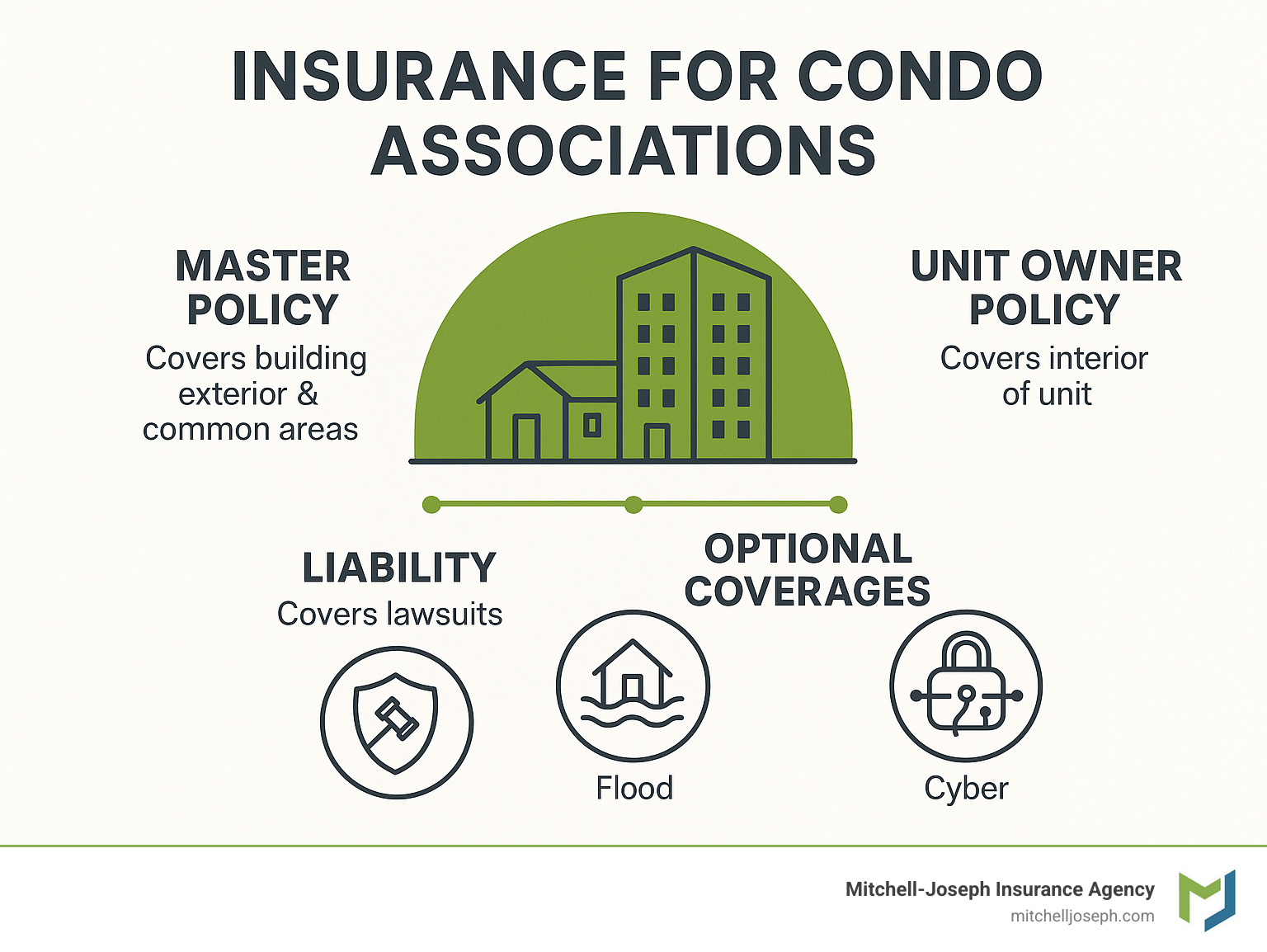
– Master Policy – Covers building structure and common areas
– General Liability – Protects against slip-and-fall claims and property damage
– Directors & Officers – Shields board members from personal lawsuits
– Crime/Fidelity – Guards against theft of association funds
Three Main Policy Types:
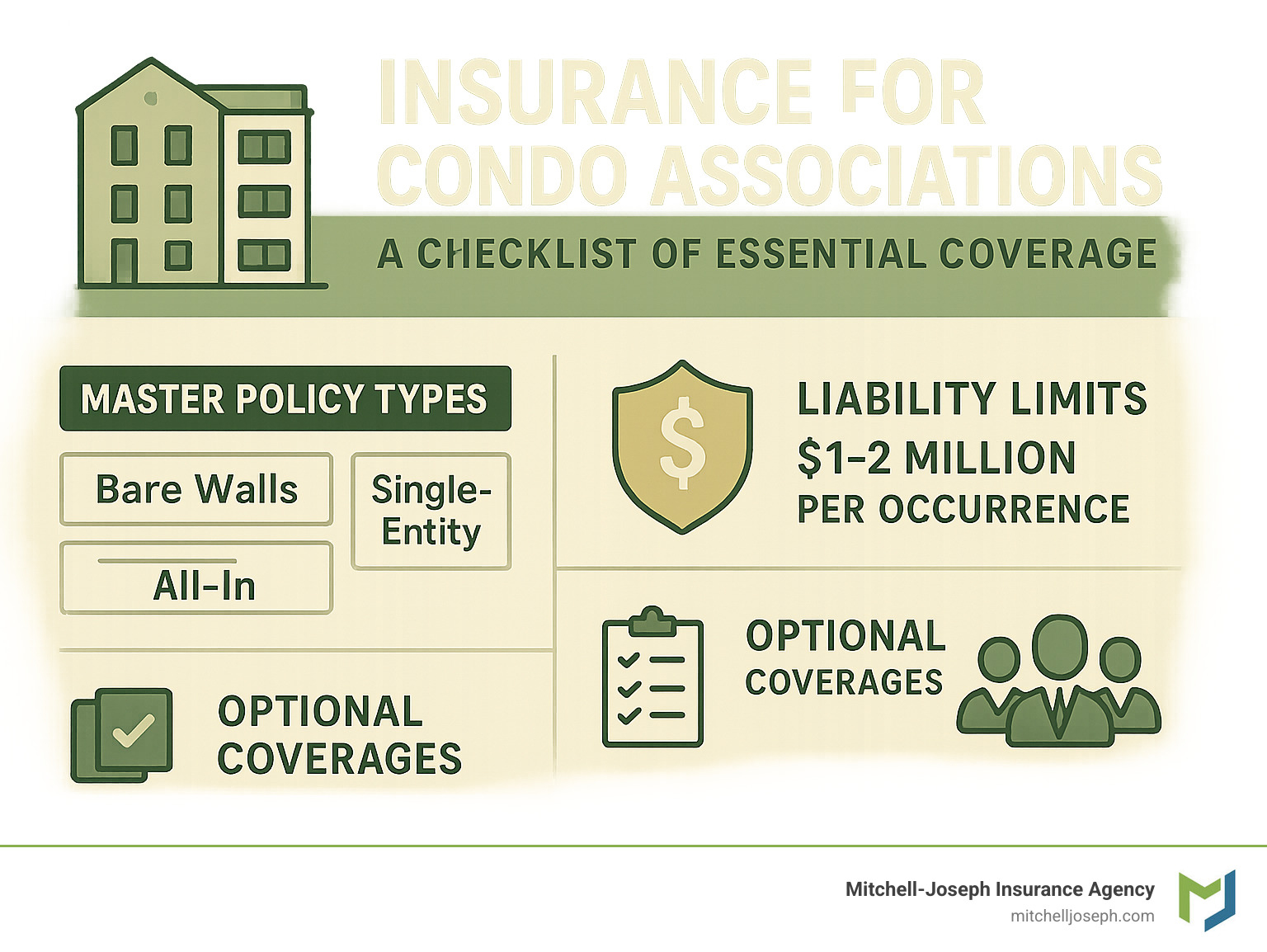
1. Bare Walls – Covers structure only (studs out)
2. Single-Entity – Includes original fixtures and finishes
3. All-In – Covers everything including unit improvements
The stakes are high. 1 in 4 Americans live in a homeowners association, and associations face unique risks that standard commercial policies don’t address. A single slip-and-fall lawsuit or major fire can trigger special assessments that burden unit owners for years.
Board members have a fiduciary duty to protect the association’s assets and maintain adequate coverage. Without proper insurance for condo associations, your community risks financial devastation and personal liability for directors.
I’m Jeffrey Joseph, and I’ve been helping property owners steer complex insurance challenges since 1999 at Mitchell-Joseph Insurance Agency. My experience with insurance for condo associations has shown me that the right coverage strategy can save boards thousands while protecting their communities from catastrophic loss.
Why Every Condo Association Needs Adequate Coverage
Insurance for condo associations isn’t optional – it’s legally required. Most states mandate that condominium associations maintain insurance on common property at full replacement value.
As a board member, you have a fiduciary duty to protect the association’s assets and maintain adequate coverage. When boards fail to secure proper insurance, they can face personal liability lawsuits from unit owners.
Your lenders are watching too. Many unit owners’ mortgage companies require proof that the association maintains adequate master policy coverage. When your building is underinsured, it can trigger demands for individual owners to buy expensive additional coverage.
Beyond legal requirements, your association’s physical assets often represent millions of dollars in replacement value. One catastrophic event without proper coverage can financially devastate your entire community.
The Real-World Cost of Going Uninsured
A kitchen fire spreads from one unit to adjacent units and common areas. Total repair costs hit $500,000. The association’s policy only covered $300,000, leaving a $200,000 gap. Result? Special assessments averaging $6,000 per unit owner.
A visitor slips on an icy walkway and suffers serious injuries. Medical bills and legal settlements reached $250,000. Without adequate liability coverage, the association faced potential bankruptcy.
When insurance falls short, your reserves disappear first. Then come the special assessment levies that can burden unit owners for years.
Loss Assessment Coverage: Your Safety Net
Loss assessment coverage bridges the gap when repair costs exceed policy limits or when owners share responsibility for large deductibles.
Special assessments get triggered when repair costs exceed the association’s policy limits, when claims fall below the master policy’s deductible, or when coverage exclusions leave expensive gaps.
This coverage, typically purchased by individual unit owners, can cover assessments up to 250% of their contents coverage limits. It’s like having a financial safety net that catches you when the association’s coverage isn’t enough.
For more comprehensive protection strategies that work hand-in-hand with your association’s master policy, explore our Home Insurance Coverage Types to understand how individual and association policies work together to protect your investment.
Master Policy Types & What They Actually Cover
Think of your master policy as drawing a line between what the association insures and what individual unit owners need to cover. Where that line falls makes a huge difference in everyone’s wallet.
The three main policy types create very different boundaries. Bare walls policies cover just the building shell and common areas. Single-entity policies add original fixtures and finishes. All-in policies cover everything including unit owner improvements.
| Policy Type | Structure Coverage | Interior Coverage | Unit Owner Responsibility |
|---|---|---|---|
| Bare Walls | Building shell, common areas | None – studs out only | All interior finishes, fixtures, appliances |
| Single-Entity | Building shell, common areas, original fixtures | Original finishes and built-ins only | Upgrades, improvements, personal property |
| All-In | Building shell, common areas, all fixtures | Everything including improvements | Personal property only |
Every master policy covers your building’s structure – the roof, exterior walls, foundation, and shared spaces like lobbies, hallways, elevators, pools, and recreational facilities.
Here’s what no master policy ever covers: your personal belongings. Whether it’s insurance for condo associations with bare walls or all-in coverage, your furniture, electronics, and personal belongings always need separate HO-6 condo insurance.
Understanding “Bare Walls” Policies – Pros & Cons
When we talk about insurance for condo associations using bare walls coverage, we mean protection that stops right at your unit’s interior walls. Everything inside becomes your responsibility as a unit owner.
The studs-out definition means coverage typically begins behind your unit’s drywall. Your hardwood floors, paint, kitchen cabinets, bathroom fixtures, and appliances fall on your shoulders to insure.
This approach offers real advantages. Association premiums stay lower since you’re not covering interior elements. Individual owners get control over their coverage limits. Claim handling stays simpler for association property.
But bare walls coverage creates headaches too. Unit owners face higher individual insurance costs to fill the coverage gap. Boundary disputes can pop up over what exactly counts as association versus individual property.
“All-In” & “Single-Entity” Explained for Boards
Single-entity coverage strikes a middle ground by covering original fixtures and finishes as they existed when your building was completed. Think built-in appliances, original flooring, and factory-installed cabinets.
All-in coverage goes the distance, protecting everything within unit walls including improvements and upgrades that owners make over time. This creates the cleanest boundary between association and individual coverage, but comes with higher association premiums.
The key is matching your policy type to your community’s needs and budget. A newer building with minimal unit variations might thrive with single-entity coverage, while an older building with lots of individual improvements might need the flexibility of bare walls or the simplicity of all-in coverage.
Key Liability & Optional Protections Every Board Should Review
When you’re serving on a condo board, protecting your community goes far beyond just insuring the building itself. The liability risks facing associations today are more complex than ever.
General liability coverage forms the foundation of your protection strategy. This insurance for condo associations shields you when someone gets hurt in your common areas or when property damage occurs during association activities. Most associations start with $1 million to $2 million per occurrence, but many communities find they sleep better with higher limits.
Directors & Officers liability might be the most important coverage that volunteer board members don’t fully understand. When you agree to serve on your association’s board, you’re taking on personal liability for management decisions, employment issues, and potential discrimination claims. Without D&O coverage, board members could face personal financial disaster.
Crime and fidelity protection guards your association’s funds against both internal theft and external fraud. With associations managing substantial reserves and monthly collections, you’re an attractive target for sophisticated criminals.
Cyber liability coverage has become essential as associations accept digital tools for communication, payments, and record-keeping. When hackers breach your systems or steal resident data, cyber coverage handles investigation costs, notification expenses, and credit monitoring for affected residents.
Liability Hotspots in Common Areas
Your common areas create ongoing liability exposures. Pools and recreational facilities top the risk list – drowning incidents, slip-and-fall accidents around wet areas, and chemical-related injuries all generate serious claims.
Elevators present another significant concern. When mechanical systems fail and someone gets hurt, the resulting claims often reach six figures.
Parking lots and walkways might seem mundane, but they’re lawsuit magnets. Snow and ice create seasonal hazards, while poor lighting contributes to accidents year-round.
Playgrounds require special attention due to attractive nuisance laws and heightened child safety standards.
Optional Coverages That Often Pay for Themselves
Cyber breach protection addresses a growing threat that many associations underestimate. According to Policygenius research on HOA insurance trends, cybercriminals increasingly target community associations because they store valuable resident information and maintain accessible bank accounts.
Improved crime coverage goes beyond basic employee dishonesty to address modern fraud techniques. Computer fraud, funds transfer fraud, and social engineering attacks have become sophisticated.
Comprehensive Directors & Officers coverage should include employment practices liability and extend protection to volunteer committee members beyond just board members.
Equipment breakdown coverage protects essential mechanical systems including elevators, HVAC equipment, and electrical systems. When these systems fail, repair costs can strain budgets.
For associations that also operate as businesses, our Business Insurance Quotes NY page provides additional insights into comprehensive commercial protection strategies.
Navigating Insurance for Condo Associations: Premiums, Deductibles & Claims
Understanding how insurance for condo associations costs work doesn’t have to give you a headache. The price depends on what you’re buying, where you live, and your building’s characteristics.
Your location matters more than you might think. If your building sits in hurricane alley or an area where lawsuits are common, expect higher premiums.
Building age plays a starring role too. That charming 1970s building with original everything? It’s going to cost more to insure than newer construction with modern safety features.
Replacement cost considerations keep many boards up at night. If you guess wrong on what it would cost to rebuild your property today, you could face nasty surprises. Construction costs have skyrocketed in recent years.
Claims history follows you like a shadow. Insurance companies have long memories when it comes to previous claims.
How Premiums Are Calculated & Negotiated
Replacement-cost appraisals form the backbone of your coverage decision. A professional appraiser calculates what it would actually cost to rebuild your building from scratch today.
Getting this number wrong can be expensive. If you’re underinsured and face a major claim, coinsurance clauses can reduce your payout.
Safety features earn you gold stars with insurance companies. Sprinkler systems, security cameras, proper lighting, and professional property management can all knock money off your premium.
Working with the right insurance advisor makes all the difference. At Mitchell-Joseph Insurance Agency, we represent 24 different insurance companies, which means we can shop around for you. For comprehensive business coverage options, check out our Business Insurance Quotes NY services.
Who Pays the Deductible & How to Budget for It
Deductible responsibility isn’t always straightforward, and your association’s by-laws should spell out exactly who pays what and when.
By-law provisions typically allow associations to charge deductibles back to unit owners when their negligence causes a claim. This protects the association’s money while making sure people take responsibility for their actions.
Charge-back rules become crucial when someone’s overflowing bathtub floods three units below. The association might pay the deductible upfront to get repairs started, then recover the cost from the responsible owner.
Reserve funding for potential deductibles shows smart financial planning. Setting aside money for insurance deductibles prevents those dreaded special assessment letters.
Filing a Claim Without Hassle
Incident documentation starts the moment something goes wrong. Take photos immediately, get witness statements while memories are fresh, and keep detailed records of everything.
Emergency mitigation means stopping additional damage while you wait for the insurance adjuster. Your board should have emergency protocols identifying approved contractors and spending limits for urgent repairs.
Adjuster coordination requires patience and organization. Maintain regular communication with your adjuster and provide requested documentation quickly.
Restoration vendors should be qualified, licensed professionals who understand condo association work. Get multiple estimates for significant repairs and make sure all work meets current building codes.
Best Practices to Control Risk & Lower Costs
Smart risk management does more than prevent costly claims – it shows insurance companies that your association takes safety seriously. This proactive approach often leads to lower premiums and better coverage terms.
The foundation of good risk management starts with preventive maintenance programs. Regular roof inspections catch small leaks before they become major water damage claims. HVAC servicing prevents expensive equipment failures. Simple plumbing maintenance stops minor drips from turning into flooding disasters.
Here’s the key: document everything. Keep detailed records of all maintenance activities. Insurance companies love seeing this kind of due diligence.
Reserve studies and capital planning help you plan for major repairs before they become emergencies. Well-funded reserves signal financial stability to insurers and provide resources when you need to pay deductibles.
Safety improvements as investments that pay dividends. Installing sprinkler systems, upgrading security cameras, improving lighting, and adding slip-resistant surfaces can earn premium discounts while making your community safer.
Vendor contract management protects your association from unnecessary liability. Require all contractors and service providers to carry adequate insurance and name your association as additional insured.
Board training and education creates better decision-makers. When board members understand insurance and risk management, they make smarter choices about maintenance, safety, and coverage.
Annual policy reviews ensure your coverage keeps pace with your community’s evolution. Your association changes over time – new amenities, updated property values, changing regulations.
Partnering With the Right Insurance Advisor
The right insurance advisor makes all the difference in managing your association’s coverage effectively. Independent agents like us represent multiple insurance companies, giving you access to broader markets and competitive pricing.
Market knowledge matters enormously in association insurance. We understand which insurers specialize in insurance for condo associations and know how to steer complex underwriting requirements.
Coverage customization separates specialist agents from generalists. Generic commercial policies often leave dangerous gaps in association coverage. Our experience helps identify unique exposures and recommend appropriate improvements.
Renewal strategy starts months before your policy expires, not weeks. This proactive approach allows time to address coverage gaps, explore market changes, and secure competitive pricing.
The best part? A good agent becomes your advocate when claims happen. We know how to present your association’s story to insurers and fight for fair settlements when disputes arise.
For comprehensive business protection strategies custom to community associations, explore our Property and Casualty Insurance options designed specifically for your unique needs.
Frequently Asked Questions about Condo Association Insurance
Let’s clear up the most common questions we hear from board members and unit owners about insurance for condo associations. These answers come from real conversations we’ve had with clients over the years.
What’s the difference between the master policy and individual unit owner policies?
Think of it like this: the master policy protects everything the association owns together, while your individual HO-6 policy protects what’s yours personally.
The master policy covers shared spaces – hallways, elevators, the roof over your head, exterior walls, and common areas like pools or gyms. Depending on your policy type, it might also cover some interior elements of your unit.
Your HO-6 policy picks up where the master policy stops. It always covers your personal belongings like furniture, clothes, and electronics. It also protects you from liability if someone gets hurt in your unit, and here’s the big one – it includes loss assessment coverage.
That loss assessment piece is crucial. If the association faces a large deductible or the master policy doesn’t cover everything, you could get hit with a special assessment. Your HO-6 policy helps protect you from those surprise bills that can run thousands of dollars.
How much liability coverage should a typical association carry?
Most associations we work with carry $1-2 million in liability coverage, but that’s just a starting point. Your association’s needs depend on what amenities you have and how many units you’re protecting.
Associations with pools need higher limits – drowning claims can easily exceed $1 million. Same goes if you have elevators, extensive common areas, or playground equipment. We’ve seen slip-and-fall settlements reach $300,000 or more, and that’s before legal costs.
Here’s a smart move: consider umbrella coverage for extra protection. A $5 million umbrella policy might only cost $500-1,500 per year, but it provides that extra cushion for catastrophic claims. It’s like buying peace of mind in bulk.
The key is working with someone who understands your specific risks. Every association is different, and cookie-cutter coverage rarely works perfectly.
Do unit owners still need HO-6 insurance if the association is “all-in”?
Yes, absolutely. This is one of the biggest misconceptions we encounter. Even with the most comprehensive “all-in” master policy, you still need your own HO-6 coverage.
“All-in” doesn’t mean all-inclusive. The master policy still won’t cover your personal belongings – your furniture, electronics, jewelry, or clothes. It also won’t protect you if someone gets hurt in your unit and decides to sue you personally.
Loss assessment coverage remains essential even with all-in policies. If the association’s coverage has gaps, faces a large deductible, or deals with coinsurance penalties, you could still face special assessments. Without HO-6 coverage, you’re paying those bills out of pocket.
Think of it this way: the association’s insurance protects the association’s interests. Your HO-6 policy protects your personal interests. Both are necessary for complete protection, regardless of how comprehensive the master policy appears to be.
Conclusion & Next Steps
Protecting your condominium association doesn’t have to feel overwhelming. After helping countless boards throughout the Rochester area and Finger Lakes region, I’ve learned that the most successful associations take a proactive approach to insurance for condo associations.
Your board’s confidence starts with understanding what you have and what you need. Begin by reviewing your current master policy to confirm whether you have bare walls, single-entity, or all-in coverage. Make sure it aligns with your association’s governing documents.
Next, take a hard look at your liability limits. With today’s litigation environment, many associations find their coverage falls short of what they actually need. Consider your specific risk exposures – that beautiful pool area or busy parking lot might require higher protection.
Don’t overlook the optional coverages that often pay for themselves. Cyber liability protection becomes more critical each year. Directors & officers coverage protects your volunteer board members from personal financial ruin. Equipment breakdown coverage can save thousands when that aging elevator finally gives out.
Planning for deductibles prevents financial surprises when claims occur. Whether through adequate reserves or clear by-law provisions for deductible allocation, your association needs a strategy before problems arise.
The real secret to long-term savings lies in smart risk management. Preventive maintenance programs, safety protocols, and proper vendor management reduce your loss exposure while often earning premium discounts.
At Mitchell-Joseph Insurance Agency, our family-owned business brings over 200 years of combined experience to every client relationship. Our independent status means we work with 24 insurance companies to find the right coverage at competitive prices.
Whether your association is in Honeoye Falls, Victor, Canandaigua, or anywhere in our service area, we understand the unique challenges facing community associations. We make insurance simple, comprehensive, and affordable because that’s what communities deserve.
Ready to give your board the confidence that comes with proper protection? Visit our insurance coverage page to learn more about our comprehensive approach to community association insurance.
Contact Mitchell-Joseph Insurance Agency today for a thorough review of your association’s insurance program. We’ll provide specific recommendations custom to your community’s needs and budget.

