

Why Business Insurance is Your Company’s Safety Net
The importance of business insurance cannot be overstated in today’s unpredictable business environment. It serves as the critical safety net that protects your company from unexpected financial losses that could otherwise be devastating.
Here’s why business insurance is essential for every company:
- Financial Protection – Shields your business from costly lawsuits, property damage, and liability claims
- Legal Compliance – Meets state and federal requirements for businesses with employees
- Business Continuity – Ensures operations can continue after unexpected disruptions
- Credibility Improvement – Builds trust with clients and partners
- Employee Protection – Safeguards your most valuable assets—your team members
- Risk Management – Transfers financial responsibility for risks to the insurance provider
Every business faces risks—from a customer slipping on your premises to a fire damaging your equipment or inventory. Without proper coverage, these incidents could drain your finances or even force you to close your doors permanently.
Business insurance isn’t just an expense—it’s an investment in your company’s future and stability. As of 2025, the median cost of a business owner’s policy is $53/month ($636/year), a small price to pay compared to the potential financial devastation of an uninsured loss.
I’m Jeffrey Joseph, and as the owner of Mitchell-Joseph Insurance Agency since 1999, I’ve helped countless businesses across the Finger Lakes region understand the importance of business insurance and develop customized protection plans that safeguard their operations and assets.

Terms related to Importance of business insurance:
- Business insurance for photographers
- Business insurance for software developers
- business insurance faq
Understanding Business Insurance
When you’re pouring your heart and soul into building a business, the last thing you want to think about is what could go wrong. But at Mitchell-Joseph Insurance Agency, we’ve seen how proper protection can make all the difference when the unexpected happens. For over 25 years, we’ve helped business owners throughout Honeoye Falls, Rochester, and the Finger Lakes region sleep better at night knowing they’re covered.
What is Business Insurance?
Business insurance is essentially a partnership between your company and an insurance provider. You pay a premium, and in return, the insurer promises to have your back when things go sideways. It’s like having a financial safety net ready to catch you when you need it most.
Think of it as a way to share risk. Instead of shouldering the entire financial burden of a disaster or lawsuit yourself, you pass some of that responsibility to the insurance company. You pay predictable premiums that fit into your budget, and if something goes wrong, the insurer steps in to cover costs up to your policy limits.
As Rachel Kallmyer, an industry expert, puts it: “General liability insurance provides protection from liability lawsuits resulting from your business activities.” This protection isn’t one-size-fits-all—it’s custom to cover the specific risks your business faces.
Importance of Business Insurance
The importance of business insurance goes far beyond simply checking a box for legal compliance. It’s about creating a foundation that allows your business to weather any storm with confidence.
When you have proper coverage, you’re implementing smart risk management. Every business faces uncertainties—from the bakery worried about a kitchen fire to the consultant concerned about a professional liability claim. Insurance is your first line of defense against these potential threats.
The financial protection business insurance provides can be the difference between a temporary setback and closing your doors forever. We’ve seen small businesses face six-figure lawsuits that would have been devastating without insurance coverage.
Business continuity is another crucial benefit. When disaster strikes, insurance can provide the funds needed to rebuild, replace equipment, or relocate temporarily. One of our clients, a restaurant owner in Canandaigua, told us after a pipe burst flooded their dining room: “I never thought it would happen to me, but when it did, our business insurance was the difference between rebuilding and bankruptcy. It wasn’t just financial support—it was peace of mind during a chaotic time.”
That peace of mind is invaluable. When you know you’re protected, you can focus on growing your business rather than worrying about what might go wrong. You can take calculated risks and seize opportunities without the constant fear of financial ruin.
Having appropriate coverage also improves your professional credibility. Clients, partners, and employees recognize that a properly insured business is stable, responsible, and prepared for contingencies. Many contracts and leases even require certain types of insurance coverage before you can sign on the dotted line.
At Mitchell-Joseph Insurance Agency, we don’t just sell policies—we help you understand exactly how business insurance protects what you’ve worked so hard to build. Because when it comes to your business’s future, having the right safety net isn’t just important—it’s essential.
Types of Risks Covered by Business Insurance
Understanding the various risks that can affect your business is essential to selecting the right insurance coverage. At Mitchell-Joseph Insurance Agency, we help businesses in Rochester, Pittsford, and throughout the Finger Lakes region identify and mitigate these risks through custom insurance solutions.

Every business faces unique challenges, but there are common risks that can affect companies of all sizes and industries. Let me walk you through the main categories of risks that the right business insurance can protect you against.
Property Damage Risks
Your physical business assets are vulnerable to a variety of threats. A fire can sweep through your office building, leaving destruction in its wake. Water damage from burst pipes can ruin inventory and equipment. Even something as simple as a storm knocking down a tree onto your property can lead to significant expenses.
I remember helping a local hardware store owner in Victor after a severe thunderstorm damaged their roof and led to water pouring into their stockroom. Their property insurance coverage meant they could replace damaged inventory and repair the building without dipping into their savings or taking out loans.
Liability Risks
The importance of business insurance becomes crystal clear when facing liability claims. A customer slipping on a wet floor in your store can lead to medical bills and potential lawsuits. If your product causes injury to a consumer, you could be held responsible. Even something as seemingly innocent as your marketing materials could lead to claims of copyright infringement or libel.
These liability risks aren’t just theoretical – they happen to real businesses in our community every day. Having the right coverage means you don’t face these challenges alone.
Employee-Related Risks
Your team members are your greatest asset, but they also present unique risks. Workplace injuries can lead to medical expenses and lost productivity. Employment practices claims like discrimination or wrongful termination can be financially devastating without proper insurance protection.
One of our manufacturing clients in Canandaigua faced a significant workers’ compensation claim after an employee was injured operating machinery. Their insurance coverage not only provided for the employee’s medical care but also protected the business from potential financial hardship.
Business Interruption Risks
What happens when your business can’t operate? Whether it’s property damage forcing temporary closure, supply chain disruptions preventing you from getting necessary materials, or utility service interruptions leaving you without power, business interruption can mean lost income during recovery periods.
Cyber Risks
Cyber risks represent a growing threat – especially for small businesses. Did you know that 43% of cyber attacks target small businesses? These attacks can include data breaches, ransomware infections, business email compromise, and customer data exposure.
A small accounting firm we work with in Brighton experienced a ransomware attack that locked them out of their systems during tax season. Their cyber insurance coverage provided not just financial support to address the attack, but also expert resources to recover data and strengthen their security.
Vehicle-Related Risks
If your business uses vehicles – whether a dedicated fleet or employees occasionally using their own cars for business purposes – you face risks on the road. Accidents, damage to company vehicles, and liability from employee use of personal vehicles for business all represent potential financial exposures.
Industry-Specific Risks
Every industry faces unique challenges. Restaurants worry about food contamination and liquor liability. Contractors need protection for completed operations and their valuable tools. Professionals like doctors, lawyers, and consultants face malpractice concerns. Manufacturers deal with product recalls and equipment breakdowns. Retailers must protect inventory from damage and theft.
One of our clients, a restaurant owner in Naples, NY, experienced a power outage that resulted in thousands of dollars of spoiled food. Their business insurance covered not only the cost of the lost inventory but also the income lost during the three days they were forced to close. This real-world example shows how the right coverage can protect against industry-specific risks.
As Devra Gartenstein aptly notes, “a potential mishap could easily wipe out the assets” of a business. This reality underscores the importance of business insurance in protecting against the wide array of risks that businesses face daily.
We’ve seen how the right insurance coverage can be the difference between a temporary setback and a business-ending catastrophe. That’s why we take the time to understand each client’s unique risk profile before recommending coverage options.
Common Types of Business Insurance
With over 200 years of combined experience at Mitchell-Joseph Insurance Agency, we’ve helped businesses across Honeoye Falls, Victor, and the entire Finger Lakes region steer the complex landscape of business insurance options. Here’s a comprehensive breakdown of the most common types of business insurance that can protect your company:

General Liability Insurance
This is the foundation of business insurance protection. General liability insurance covers bodily injury, property damage, and advertising injury claims made against your business. Imagine a customer slips on a wet floor in your store – this coverage helps with their medical bills, potential legal expenses, and even settlements if they decide to sue. It’s the safety net that catches many of the everyday risks businesses face.
Commercial Property Insurance
Your physical assets deserve protection too. Commercial property insurance safeguards your building (if you own it), equipment, inventory, furniture, and fixtures against losses from fire, theft, vandalism, and certain natural disasters. Here in the Finger Lakes region, where winter can be particularly harsh, this coverage becomes even more valuable. I remember when one of our clients, a small bakery in Victor, had pipes freeze and burst during a particularly cold snap – their property insurance made recovery possible.
Business Owner’s Policy (BOP)
Think of a BOP as the “value meal” of business insurance – it combines general liability and commercial property insurance into one convenient package, typically at a lower cost than purchasing these coverages separately. The median cost runs about $53/month ($636/year), making it an affordable way for small to medium-sized businesses to get comprehensive protection without breaking the bank.
Workers’ Compensation Insurance
If you have employees in New York State, this isn’t optional – it’s required by law. Workers’ comp provides benefits to employees who suffer work-related injuries or illnesses, covering their medical expenses and a portion of lost wages. But it protects you too, by shielding your business from lawsuits related to workplace injuries. One of our construction clients in Canandaigua told me this coverage saved their business after an employee fell from scaffolding – the medical bills would have been devastating otherwise.
Professional Liability Insurance (Errors & Omissions)
For service-based businesses, your expertise is your product. Professional liability insurance protects you when clients claim you made a mistake, gave bad advice, or failed to deliver promised services. Whether you’re an accountant whose tax advice is questioned or a consultant whose recommendations didn’t yield expected results, this coverage helps with legal defense and potential settlements.
Cyber Liability Insurance
Data is as valuable as physical inventory. With a shocking 43% of cyber attacks targeting small businesses, cyber liability insurance has become essential. When a local Rochester retailer experienced a data breach affecting customer credit card information, their cyber policy covered notification costs, credit monitoring for affected customers, and the legal expenses that followed. The importance of business insurance in the digital field simply cannot be overlooked.
Business Interruption Insurance
Sometimes the biggest cost of a disaster isn’t the physical damage – it’s the lost income while you’re closed for repairs. Business interruption insurance helps replace that lost revenue and covers ongoing expenses like rent and payroll during temporary closures due to covered events. A restaurant owner in Pittsford once told me, “After the fire, I was worried about my staff more than anything – business interruption coverage meant I could keep paying them while we rebuilt.”
Commercial Auto Insurance
If your business owns vehicles or uses them for operations, commercial auto insurance is crucial. It covers liability and physical damage related to those vehicles, protecting your business when accidents happen. This is particularly important for businesses with delivery services, service fleets, or employees who regularly drive for work purposes.
Umbrella Insurance
Think of umbrella insurance as an extra layer of protection that kicks in when your other liability policies reach their limits. It’s surprisingly affordable for the additional peace of mind it provides, especially for businesses with significant assets to protect or those in high-risk industries.
Employment Practices Liability Insurance (EPLI)
As workplace laws evolve, so do the risks of employee lawsuits. EPLI covers claims alleging discrimination, wrongful termination, harassment, or other employment-related issues. Even the most careful employers with the best intentions can face these claims – EPLI ensures one disgruntled employee doesn’t threaten everything you’ve built.
The right combination of these insurance types creates a comprehensive safety net for your business. At Mitchell-Joseph Insurance Agency, we don’t believe in one-size-fits-all solutions. We work with 24 different insurance companies to find the policy mix that perfectly matches your business’s specific needs and risks.
As one client, a hardware store owner in Honeoye Falls, put it: “Jeff didn’t just sell me insurance – he helped me understand what my business actually needed. When a delivery truck backed into our storefront, I was grateful for every conversation we’d had about coverage.”
Importance of Business Insurance for Small Businesses
Small businesses often face unique vulnerabilities that make the importance of business insurance even more critical for their survival and success. With our deep roots in communities like Honeoye Falls, Canandaigua, and Naples, we at Mitchell-Joseph Insurance Agency understand the specific challenges that local small businesses face.

Heightened Vulnerability to Financial Shocks
When you’re running a small business, every dollar counts. Unlike large corporations with substantial cash reserves, most small businesses operate with tight margins and limited savings. This makes the impact of unexpected expenses dramatically more severe.
Imagine facing a $50,000 lawsuit or a fire that destroys $30,000 worth of inventory. Without insurance, such events could drain all your resources overnight. I’ve seen it happen to hard-working business owners who thought “it won’t happen to me” – until it did. Business insurance creates that essential financial buffer that can mean the difference between a temporary setback and closing your doors for good.
Limited Legal Resources
When legal troubles arrive (and in today’s litigious society, they often do), small businesses typically don’t have in-house lawyers or hefty legal budgets. This puts them at a significant disadvantage when facing claims or lawsuits.
Good business liability insurance doesn’t just cover potential settlements – it provides experienced legal representation. This aspect alone can be worth its weight in gold. One of our clients, a small gift shop owner in Canandaigua, told me she slept better knowing that if someone claimed they were injured in her store, she wouldn’t be facing legal professionals alone with her life savings on the line.
Cyber Vulnerability
Here’s a statistic that keeps me up at night: 43% of cyber attacks target small businesses. Cybercriminals deliberately hunt for smaller operations because they know these businesses often lack sophisticated security systems. The “we’re too small to be a target” mindset is exactly what hackers count on.
For small businesses collecting customer information, processing credit cards, or storing sensitive data (which is nearly all businesses today), cyber liability insurance has moved from “nice to have” to “absolutely essential.” When a data breach costs an average of $200,000, having coverage can literally save your business.
Personal Asset Protection
For many small business owners, especially sole proprietors or partnerships, the line between business and personal finances isn’t just blurry – it barely exists. Without proper business insurance, a major claim against your business could put your personal home, car, savings, and even retirement funds at risk.
I’ve had difficult conversations with business owners who didn’t realize this until it was too late. The relief on a client’s face when they understand that their insurance creates a shield between their business liabilities and their family’s financial security is one of the most rewarding parts of my job.
Competitive Credibility
Having appropriate insurance coverage isn’t just about protection – it’s about professionalism. Many clients and partners, especially larger ones, won’t even consider working with uninsured businesses. Proper coverage signals stability and responsibility.
When you can confidently show a certificate of insurance to a potential client or landlord, you’re demonstrating that you take your business seriously. In competitive markets across the Finger Lakes region, this can be the edge that wins you the contract over a less-prepared competitor.
Employee Retention
Small businesses often struggle to compete with larger companies for talent. While you might not be able to match the salaries of corporate giants, offering comprehensive benefits – including those backed by insurance like workers’ compensation and disability coverage – can help you attract and retain quality employees.
Your team members want to know they’ll be taken care of if something goes wrong. The peace of mind that comes from proper coverage extends beyond you to everyone who depends on your business for their livelihood.
A small bakery owner in Victor shared this experience with me: “When a customer claimed they got food poisoning from our pastries, I was terrified. The lawsuit could have bankrupted us. Our liability insurance not only covered the legal fees but provided an attorney who specialized in food service cases. They helped prove our food safety protocols were solid, and the case was eventually dismissed. Without that insurance, we might have settled out of fear, even though we weren’t at fault.”
This real-world example highlights why small businesses, which may lack specialized legal knowledge or resources, particularly benefit from the protection that business insurance provides.
The median cost of general liability insurance is approximately $42/month ($500/year) – about the price of a weekly coffee run for your team. For small businesses operating on tight margins, this predictable expense provides immeasurable peace of mind and financial security. It’s not just an expense – it’s an investment in your business’s future and stability.
How Business Insurance Protects Against Financial Losses
One of the primary reasons the importance of business insurance cannot be overstated is its role in protecting against potentially devastating financial losses. At Mitchell-Joseph Insurance Agency, we’ve seen how proper insurance coverage has saved businesses throughout Rochester, Honeoye Falls, and the surrounding areas from financial ruin.
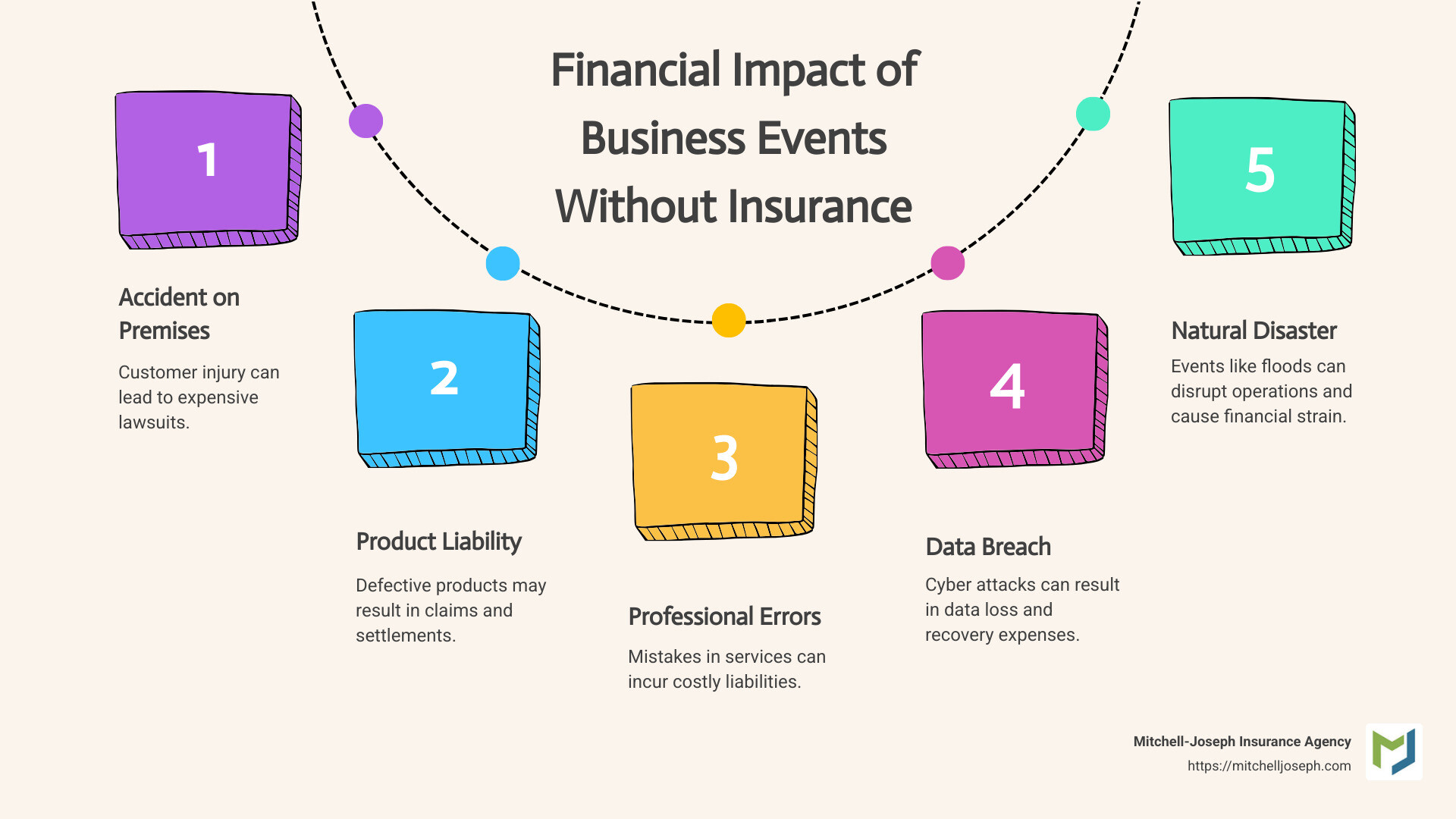
Protection Against Liability Claims
When a customer slips on your freshly mopped floor or claims your professional advice caused them financial harm, the resulting liability claims can quickly become a financial nightmare. I’ve seen businesses face legal defense costs running into tens of thousands of dollars—even when they ultimately win the case!
Without liability insurance, these expenses come straight from your business bank account. But with proper coverage, your insurance steps in to handle legal fees, settlement payments, and court costs up to your policy limits. It’s like having a financial guardian that shows up exactly when you need it most.
Recovery from Property Damage
I remember when a severe windstorm tore through Canandaigua last year, leaving several businesses with significant roof damage. For those with proper commercial property insurance, the path to recovery was straightforward—their policies covered building repairs, equipment replacement, and even data recovery costs.
For one unfortunate business without adequate coverage, the story was quite different. They had to dip into their emergency savings and take out a high-interest loan just to get back on their feet. The financial setback delayed their growth plans by nearly two years. Commercial property insurance ensures these costs don’t fall entirely on your shoulders, allowing you to rebuild without depleting your financial reserves.
Business Continuity During Interruptions
When disaster forces your business to close temporarily, the financial impact goes far beyond just property damage. The bills keep coming—rent, loan payments, employee salaries—but the revenue stops. This is where business interruption insurance becomes a lifeline.
A bakery owner in Rochester once told me, “When a water main break flooded our shop, we had to close for six weeks. Our business interruption insurance covered our lost income and ongoing expenses, including payroll. We kept our entire team employed, and when we reopened, we didn’t miss a beat.” Without this crucial coverage, many businesses are forced to lay off staff, lose customers to competitors, or even close permanently.
Protection from Employee-Related Financial Risks
Your employees are your greatest asset, but they can also represent significant financial risk. When a delivery driver for one of our clients injured his back on the job, workers’ compensation insurance covered his medical expenses and partial salary while he recovered. Without this coverage, the business would have been responsible for these costs and potentially vulnerable to a lawsuit.
Employment practices claims like discrimination, harassment, or wrongful termination can be equally devastating financially. The right insurance coverage provides both financial protection and access to legal expertise in these complex situations.
Cyber Attack Recovery
Cyber threats loom large for businesses of all sizes. When a local accounting firm experienced a ransomware attack, their cyber liability insurance proved invaluable. It covered not just the data recovery costs, but also the expenses for notifying affected clients, providing credit monitoring services, and bringing in IT security experts to strengthen their systems.
The firm’s owner shared, “What could have been a business-ending event became a manageable crisis thanks to our cyber insurance. The support we received helped us recover quickly and actually improve our security posture.”
At Mitchell-Joseph Insurance Agency, we’ve witnessed how the right insurance coverage serves as a financial safety net during life’s most unpredictable moments. One manufacturing client in Rochester put it perfectly after recovering from a devastating fire: “When the flames were finally out, I realized everything we’d built over 15 years could have been gone in an instant. Our insurance didn’t just cover the physical damage—it preserved our future by keeping our team together and our customers served during reconstruction. That peace of mind is priceless.”
This real-world example demonstrates how business insurance doesn’t just cover immediate damages—it provides the financial support needed to preserve the long-term viability of your business when disaster strikes. It’s not just an expense; it’s an investment in your business’s resilience and future.
Legal Requirements and Compliance
Understanding the legal landscape around business insurance isn’t just smart—it’s essential. As we’ve helped countless business owners throughout the Finger Lakes region steer these requirements, we’ve seen how proper compliance protects not just your business, but your dreams and hard work as well.
Workers’ Compensation Insurance Requirements
If you have employees in New York State—even just one part-timer—you’re legally required to carry workers’ compensation insurance. This isn’t just another government regulation; it’s a safety net that protects both you and your team when accidents happen.
Workers’ comp covers medical expenses, rehabilitation costs, a portion of lost wages, and even provides death benefits to dependents in worst-case scenarios. One of our clients, a small manufacturing shop in Rochester, told us how relieved they were to have this coverage when an employee suffered a serious hand injury. The insurance covered the employee’s medical bills and partial wages during recovery, preventing what could have been a financial disaster for both parties.
The penalties for skipping this coverage are severe—fines up to $2,000 for each 10-day period without insurance, potential criminal charges for willful violations, and perhaps most concerning, personal liability for injury costs. Simply put, going without workers’ comp isn’t worth the risk.
Unemployment Insurance
Most employers must pay unemployment insurance taxes under both federal and state laws. This system, administered through the U.S. Department of Labor – Unemployment Insurance, provides temporary financial assistance to workers who lose their jobs through no fault of their own.
In New York, you must register with the state Department of Labor and pay unemployment insurance taxes if you:
- Pay wages of $300 or more in any calendar quarter
- Have acquired a business from an employer who was subject to the UI law
- Are subject to the Federal Unemployment Tax Act
While this might seem like just another business expense, it’s actually part of your responsibility as an employer and contributes to the overall economic stability of your community.
Disability Insurance
Another New York State requirement is disability benefits coverage. This protects employees who become ill or injured outside of work. Many business owners don’t realize this coverage is separate from workers’ compensation, which only covers work-related incidents.
One bakery owner in Canandaigua was thankful for this coverage when her head baker broke his leg skiing on vacation. The disability benefits helped the employee stay afloat financially while healing, and he returned to work loyal and grateful for the support.
Commercial Auto Insurance
If your business owns or operates vehicles, New York State law requires commercial auto insurance with minimum liability limits of $25,000 for bodily injury per person, $50,000 for bodily injury per accident, and $10,000 for property damage.
However, these minimums rarely provide adequate protection for businesses. A fender bender can easily exceed these limits, especially if there are injuries involved. That’s why at Mitchell-Joseph Insurance Agency, we typically recommend higher limits based on your specific risk exposure and business operations.
Industry-Specific Requirements
Certain industries face additional insurance mandates that go beyond the basics. Contractors often need specific bonds or insurance to obtain licenses or permits. Professionals like doctors, lawyers, and accountants may be required by licensing boards to carry professional liability insurance. If you serve alcohol, liquor liability insurance isn’t optional—it’s mandatory. And healthcare providers need specialized medical malpractice coverage.
The importance of business insurance becomes even more evident when you consider these industry-specific requirements, which often directly impact your ability to legally operate in your field.
Contractual Requirements
Beyond government regulations, many business relationships come with their own insurance requirements. Commercial landlords typically require tenants to carry general liability and sometimes property insurance. If you have business loans, lenders often require insurance on financed equipment or property.
And if you work with larger organizations as a vendor or contractor, be prepared to meet their insurance requirements. We’ve seen many small businesses in Victor and Pittsford nearly lose valuable contracts because their coverage didn’t meet client specifications.
As one construction contractor from Victor told us: “We almost lost a major contract because our general liability limits were lower than what the client required. Thankfully, our agent at Mitchell-Joseph was able to increase our coverage quickly, and we secured the project. That contract ended up being worth ten times what the additional premium cost us.”
Navigating these complex requirements isn’t something you should tackle alone. At Mitchell-Joseph Insurance Agency, we stay current on all legal insurance requirements and help ensure your business remains compliant while also being properly protected against risks. We believe compliance shouldn’t be confusing—it should be a clear path to peace of mind.
Enhancing Credibility with Business Insurance
Beyond just protection and legal compliance, the importance of business insurance extends into an area many business owners don’t immediately consider: building your company’s reputation and credibility. We’ve seen how proper insurance coverage helps businesses throughout Rochester, Avon, and the Finger Lakes region win opportunities they might otherwise miss.
Building Client Trust and Confidence
When potential clients are deciding whether to work with you, they’re looking at more than just your products or services. They want to know you’re stable, reliable, and prepared for whatever might happen.
“Insurance is like a silent partner in my sales process,” explains a web developer from Pittsford who works with us. “When I mention my professional liability coverage to prospective clients, I can literally see them relax. It tells them I’m serious about my business and that they’re protected if something goes wrong.”
This trust factor is especially important if you’re handling valuable client property, sensitive data, or providing services where mistakes could be costly. Proper insurance signals that you have the financial backing to make things right if problems arise.
Meeting Contractual Requirements
Many business opportunities come with insurance requirements attached. Without the right coverage, you’ll find doors closing before they even open.
Government contracts typically require specific insurance types and limits. Large corporations won’t add you to their vendor list without proper coverage. Commercial landlords require insurance before you can sign a lease. Even participating in local events often requires proof of insurance.
A landscaping business owner from Victor told us: “We almost lost a major contract with a corporate office park because we didn’t have high enough liability limits. Our agent at Mitchell-Joseph helped us increase our coverage the same day, and we secured the three-year contract. That quick adjustment was worth tens of thousands in business.”
Demonstrating Professional Standards
In many industries, specific insurance coverages aren’t just nice to have—they signal your commitment to professional standards. Professional liability coverage shows clients you stand behind your expertise. Cyber liability insurance demonstrates you take data protection seriously. Product liability coverage tells customers you stand behind what you sell.
These specialized coverages do more than protect you financially—they communicate your values and professionalism to everyone you do business with.
Creating Competitive Advantage
In competitive situations, insurance can be the factor that tips the scales in your favor. When clients are choosing between similar options, the additional security that comes with proper insurance coverage can be the deciding factor.
A financial advisor from Canandaigua shared: “I was competing with a larger firm for a significant client. During our presentation, I mentioned our comprehensive professional liability coverage. The client later told me this was a deciding factor in choosing our firm—they wanted the personalized service we offered but needed assurance we had the financial backing to protect their interests if mistakes occurred.”
Enhancing Employer Reputation
Your insurance program doesn’t just impress clients—it also speaks volumes to current and potential employees. A robust workers’ compensation program shows you care about safety and employee wellbeing. Employment practices liability insurance demonstrates your commitment to a fair workplace. Offering insurance-backed benefits helps you attract and retain the best talent in your field.
“When I mention our benefits package during interviews, candidates are often surprised at how comprehensive it is for a small business,” shares a retail store owner from Honeoye Falls. “It’s helped us build a stable team in an industry known for high turnover.”
At Mitchell-Joseph Insurance Agency, we help businesses transform their insurance program from what might be seen as just a necessary expense into a valuable business credential. The right coverage, properly communicated to clients, partners, and employees, builds trust and opens doors that might otherwise remain closed.
After all, insurance isn’t just about protection against what might go wrong—it’s about creating the confidence to pursue what could go right.
Factors to Consider When Choosing Business Insurance
Selecting the right business insurance is a critical decision that requires careful consideration of multiple factors. At Mitchell-Joseph Insurance Agency, we guide businesses in Honeoye Falls, Rochester, and throughout the Finger Lakes region through this important process.
Assessing Your Specific Risks
Every business has its own unique risk fingerprint. When I sit down with clients at their shops in Canandaigua or their offices in Rochester, I always start by understanding what makes their business tick—and what could potentially make it stop.
Your industry naturally shapes your risk profile. A restaurant faces very different challenges than a consulting firm or a construction company. Your physical location matters too—businesses in flood-prone areas near the Finger Lakes have different concerns than those in urban Rochester settings.
The size of your team, the products you sell, how often you interact with the public, and even how you handle customer data all contribute to your specific risk landscape. This personalized assessment isn’t just a formality—it’s the foundation for building protection that actually works for your business.
As Rachel Kallmyer wisely points out: “Coverage must be customizable to fit the needs of your business.” One-size-fits-all protection simply doesn’t exist in the business world.
Understanding Coverage Options and Limits
Once we’ve mapped out your risks, it’s time to match them with the right protection. This is where many business owners feel overwhelmed—insurance policies aren’t exactly light bedtime reading.
Coverage scope is your starting point. What exactly does each policy protect against? Just as importantly, what’s excluded? I’ve seen too many business owners find gaps in their coverage only after filing a claim.
Policy limits deserve careful thought. These determine the maximum amount your insurer will pay, and they should align with your actual risk exposure. A million-dollar limit might sound substantial, but could fall short if you’re facing a serious liability claim.
The distinction between aggregate and per-occurrence limits matters too. An aggregate limit caps what the policy will pay during the entire policy period, while per-occurrence limits apply to each separate incident.
Your deductible represents your skin in the game—the amount you’ll pay before insurance kicks in. Higher deductibles typically mean lower premiums, but you’ll want to ensure you can comfortably cover that amount if needed.
Finally, endorsements and riders can customize standard policies to address your specific concerns. Think of these as the tailoring that turns an off-the-rack suit into a perfect fit.
Evaluating Premium Costs and Payment Options
Let’s talk money—because while the importance of business insurance can’t be overstated, I understand it’s a real expense that affects your bottom line.
Premium affordability matters. The best insurance in the world doesn’t help if you can’t maintain the payments. That said, I always encourage clients to consider value rather than focusing solely on cost. The cheapest policy often provides inadequate protection.
Most insurers offer flexible payment options—monthly, quarterly, or annual payments to match your cash flow. For larger premiums, premium financing can spread the cost without straining your budget.
Deductible levels directly impact your premiums. We often work with clients to find the sweet spot—a deductible high enough to keep premiums manageable but low enough that you could comfortably cover it if needed.
A retail client in Victor once told me: “I almost went with the cheapest quote until you showed me the coverage differences. Paying a bit more for comprehensive protection has given me peace of mind I never knew I needed.”
Assessing Insurer Reputation and Financial Stability
The promise of insurance is only as good as the company standing behind it. That’s why at Mitchell-Joseph, we carefully vet the 24 insurance companies we work with.
Financial strength ratings from independent agencies like A.M. Best or Standard & Poor’s offer objective measures of an insurer’s ability to pay claims. You wouldn’t deposit your savings in a shaky bank—similarly, you shouldn’t entrust your business protection to a financially vulnerable insurer.
Claims handling reputation matters enormously. When disaster strikes, you need an insurer that responds promptly and fairly. We regularly gather feedback from clients about their claims experiences to ensure we’re partnering with companies that deliver when it matters most.
Industry experience can make a significant difference too. Insurers who understand the nuances of your specific field are better equipped to provide appropriate coverage and handle claims effectively.
Considering Claims Process and Support
Let’s be honest—filing an insurance claim is rarely a highlight of anyone’s day. But the process shouldn’t add stress to an already difficult situation.
When evaluating insurers, we look closely at their claims reporting options. Can you file online? Is there a 24/7 hotline? These details matter when you’re dealing with an emergency.
Claims response time varies dramatically between insurers. Some pride themselves on immediate action, while others… well, let’s just say they operate on a different timeline. We favor companies that understand urgency.
Access to a dedicated claims representative can transform the experience. Having a single point of contact who knows your situation beats explaining your story repeatedly to different representatives.
And if there’s a disagreement about your claim? The dispute resolution process should be clear and fair. Some insurers have earned our trust by demonstrating they’re willing to reconsider decisions when presented with new information.
Evaluating Agent or Broker Expertise
Your insurance agent should be more than just a policy peddler. They should be a trusted advisor who understands your business almost as well as you do.
Industry knowledge matters. An agent who specializes in insuring manufacturers might not be the best fit for your dental practice. At Mitchell-Joseph, our team’s diverse experience allows us to match clients with agents who understand their specific field.
Carrier relationships determine the options available to you. As an independent agency working with 24 different insurance companies, we can shop around for the best coverage and rates rather than trying to fit every client into a single company’s offerings.
Our service approach emphasizes ongoing support. Insurance isn’t a “set it and forget it” product—your coverage should evolve as your business grows and changes. We conduct regular policy reviews to ensure your protection remains aligned with your current needs.
When claims arise, claims advocacy becomes crucial. We stand by our clients, helping steer the process and ensuring fair treatment. As one restaurant owner from Naples, NY, shared:
“When we were shopping for insurance, one agent simply quoted standard policies. But our agent at Mitchell-Joseph took the time to understand our specific operations, including our catering service and occasional outdoor events. They identified risks we hadn’t considered and found a policy that covered all our activities without unnecessary extras. That personalized approach made all the difference.”
At Mitchell-Joseph Insurance Agency, we understand that the importance of business insurance goes beyond just having a policy—it’s about having the right protection, from the right company, with the right support. Our independent status means we’re working for you, not for a single insurance company, allowing us to truly customize your coverage based on your unique business needs.
Supporting Employee Protection
One of the most significant aspects of the importance of business insurance is how it helps protect your most valuable asset—your employees. At Mitchell-Joseph Insurance Agency, we help businesses throughout Rochester, Victor, and the Finger Lakes region implement comprehensive employee protection strategies.
Workers’ Compensation Insurance
Workers’ compensation insurance is not just a legal requirement in New York State; it’s a fundamental protection that creates a safety net for both your team members and your business.
For your employees, workers’ comp provides crucial coverage for medical expenses when workplace injuries occur. It offers peace of mind through partial wage replacement during recovery periods, ensuring bills can still be paid while they heal. When more extensive support is needed, it covers rehabilitation services to help them return to work. And in the most tragic circumstances, it provides death benefits to dependents if a workplace accident proves fatal.
As an employer, workers’ comp offers you protection too. It shields your business from most employee lawsuits related to workplace injuries, creating a more predictable financial environment when accidents happen. This insurance helps your valued team members return to work safely and promptly, minimizing disruption to your operations. Perhaps most importantly, having robust workers’ compensation coverage demonstrates your genuine commitment to your employees’ wellbeing.
Disability Insurance
New York State requires employers to provide statutory disability benefits insurance, creating another layer of protection for your team. Unlike workers’ compensation, disability insurance covers non-work-related injuries or illnesses, helping bridge the financial gap when employees can’t work due to conditions that happened outside the workplace.
This coverage provides partial wage replacement for up to 26 weeks, helping your employees maintain financial stability during recovery periods. It works alongside workers’ compensation to create a more comprehensive safety net for your team.
Many of our clients choose to offer improved disability coverage beyond the state-required minimum. These improved plans typically provide greater benefits and longer coverage periods, further demonstrating commitment to employee welfare while helping attract and retain top talent.
Employment Practices Liability Insurance (EPLI)
As workplace laws and expectations continue to evolve, Employment Practices Liability Insurance has become increasingly important for businesses of all sizes. This coverage protects your company against claims of discrimination, harassment, wrongful termination, and other employment-related issues that can arise even in well-managed workplaces.
EPLI covers legal defense costs, settlements, and judgments that might result from such claims. Many policies also provide access to HR resources and risk management tools that help prevent problems before they occur. By maintaining this coverage, you’re taking steps toward creating a more equitable and compliant workplace.
Employee Benefits Liability Coverage
Even with the best intentions, mistakes in administering employee benefit plans can happen. Employee Benefits Liability coverage protects against errors that might occur when enrolling employees in health insurance or retirement plans. It covers mistakes in explaining benefits or eligibility requirements, failure to properly maintain employee benefits records, and improper advice regarding benefits options.
This coverage fills an important gap that many business owners don’t realize exists until a problem arises. With the complexity of modern benefit plans, having this protection in place is increasingly important.
Key Person Insurance
For small businesses that rely heavily on certain individuals, Key Person Insurance provides financial stability during unexpected transitions. If a key employee dies or becomes disabled, this coverage helps cover the costs of finding and training a replacement while maintaining business operations during the transition period.
This type of insurance can be structured to provide benefits to the key person’s family as well, offering additional peace of mind to those your business depends on most.
A manufacturing business owner from Avon, NY, recently shared a powerful story with us: “When one of our skilled machinists was injured at home, our improved disability coverage meant he could focus on recovery without financial stress. He returned to work grateful for the support, and his loyalty to our company has only increased. The additional premium for the improved coverage has paid for itself many times over in employee retention alone.”
At Mitchell-Joseph Insurance Agency, we understand that employee protection isn’t just about meeting legal requirements—it’s about creating a workplace where people feel valued and secure. The right insurance coverage demonstrates your commitment to your team’s wellbeing and helps create a positive workplace culture that attracts and retains top talent. With over 200 years of combined experience, we can help you design an employee protection strategy that works for both your people and your bottom line.
Business Insurance in Risk Management
The importance of business insurance comes into sharp focus when we consider it as part of your overall risk management strategy. At Mitchell-Joseph Insurance Agency, we’ve spent decades helping local businesses throughout Honeoye Falls, Canandaigua, and the entire Finger Lakes region build smarter approaches to handling risk.
The Risk Management Process
Think of risk management as your business’s immune system – it helps you identify threats, build defenses, and recover quickly when problems arise. The process isn’t complicated, but it does require attention:
First, you need to identify what could possibly go wrong – that’s risk identification. We help our clients spot potential problems they might never have considered.
Next comes risk assessment – figuring out how likely each risk is and how badly it might hurt your business. Some risks might be devastating but extremely unlikely, while others might be minor but happen frequently.
The third step is developing risk mitigation strategies – practical ways to reduce either how often problems occur or how much damage they cause when they do. This might include employee training, better security systems, or updated equipment.
Risk transfer – primarily through insurance – is where you decide which risks are better handled by someone else. And finally, risk monitoring means keeping an eye on how well your strategies are working and adjusting as needed.
Insurance as a Risk Transfer Mechanism
Insurance is essentially a financial safety valve. You pay a predictable premium to your insurer, and in exchange, they take on the unpredictable, potentially devastating costs of certain risks.
One of our clients, a small manufacturer in Rochester, puts it this way: “Insurance lets me sleep at night. I know exactly what my premium costs, instead of worrying about a lawsuit that could cost hundreds of thousands.”
This financial certainty is incredibly valuable. Instead of stockpiling cash for worst-case scenarios, you can invest in growing your business, knowing you have protection in place.
Beyond Insurance: Complementary Risk Management Strategies
While insurance is crucial, it works best as part of a broader approach. Smart business owners use multiple strategies:
Risk Avoidance means simply steering clear of certain high-risk activities. Maybe you decide not to expand into a particularly risky product line, or you avoid operating in areas prone to flooding.
Risk Reduction involves taking active steps to make bad things less likely to happen. This includes everything from workplace safety programs to cybersecurity measures. One of our clients, a retail store in Canandaigua, reduced theft by 80% after installing a modern security system – which also lowered their insurance premiums.
Risk Retention means accepting certain smaller, more predictable risks yourself. This might include choosing higher deductibles on your policies or setting aside funds for minor losses that fall below your deductible.
Creating a Balanced Approach
The most effective risk management combines these strategies thoughtfully. You might use insurance to cover catastrophic risks like major fires or lawsuits, implement preventive measures for risks you can control (like workplace accidents), and accept certain manageable risks to keep insurance costs reasonable.
A restaurant owner from Naples shared this perspective: “After working with Mitchell-Joseph, I realized I was over-insuring in some areas and under-protected in others. They helped me balance my approach – better fire prevention systems, the right insurance coverage, and a small reserve fund for minor issues. My overall costs went down, but my protection actually improved.”
The Role of Insurance Professionals in Risk Management
At Mitchell-Joseph Insurance Agency, we see our role as risk management partners, not just policy salespeople. With over 200 years of combined experience on our team, we bring valuable perspective to your planning process.
We help identify blind spots – risks you might not have considered. We recommend appropriate insurance solutions custom to your specific situation. We suggest risk control measures that might actually reduce your premiums. And we provide ongoing support as your business evolves.
Every business faces unique challenges, which is why cookie-cutter approaches to risk management rarely work well. We take the time to understand your specific operation, concerns, and goals before recommending strategies that balance protection with practicality.
The goal isn’t to eliminate all risk – that’s impossible in business. The goal is to manage risk intelligently, so you can focus on what you do best: running and growing your company.
Assessing Your Insurance Needs Effectively
Figuring out exactly what insurance your business needs isn’t always straightforward. It’s a bit like putting together a puzzle where the pieces change shape as your business grows. At Mitchell-Joseph Insurance Agency, we’ve helped countless businesses across Rochester, Pittsford, and throughout the Finger Lakes region solve this puzzle with a personalized approach.
Risk Evaluation
Every effective insurance plan starts with understanding what you could potentially lose. Think of it as taking inventory of everything that matters to your business:
Your physical assets are the most obvious starting point – your building, equipment, inventory, and those computers everyone relies on. But don’t stop there. Your reputation, intellectual property, and even your digital assets like customer databases are all valuable and vulnerable.
What about your daily operations? A restaurant faces very different risks than a consulting firm or a construction company. The way you interact with customers, the services you provide, and even where you’re located all shape your unique risk profile.
One of our clients, a small manufacturing business in Honeoye Falls, finded during our risk evaluation that their biggest vulnerability wasn’t their expensive equipment as they thought, but rather their specialized inventory that would take months to replace if damaged. This insight completely changed their insurance priorities.
Consulting Experts
While you know your business better than anyone, insurance professionals bring something equally valuable to the table – perspective from seeing hundreds of similar businesses and claims.
The importance of business insurance becomes much clearer when you can see the patterns of what actually happens to businesses in your industry. Our team at Mitchell-Joseph has over 200 years of combined experience, which means we’ve pretty much seen it all – from the common slip-and-fall to the bizarre and unexpected.
We can help identify those blind spots you might miss. For instance, many business owners don’t realize that their personal auto policy likely won’t cover accidents that happen while using their vehicle for business purposes. These are the kinds of gaps we help close before they become expensive problems.
For specialized industries, this expertise is particularly valuable. If you’re wondering about industry-specific protection, check out our detailed Business Insurance FAQ for more information.
Industry-Specific Risks
Your industry largely determines what risks you face day-to-day. A contractor worries about tools being stolen from job sites and potential injuries to subcontractors. A restaurant owner loses sleep over food safety and kitchen fire risks. A consultant might be concerned about giving advice that accidentally costs a client money.
We recently worked with a photography studio in Victor that had comprehensive coverage for their expensive camera equipment but had completely overlooked the potential liability of photographing at client venues. One conversation about their typical workflow revealed this significant exposure, which we were able to address with the right coverage.
The digital landscape has created new vulnerabilities too. With 43% of cyber attacks targeting small businesses, digital protection has become essential for nearly every industry. Even traditional “brick and mortar” businesses typically handle customer data that could be compromised.
Comparing Coverage Options
Once you understand your risks, the next step is finding the right coverage mix. This is where that comparison table comes in handy:
| Type of Coverage | What It Protects | Why It’s Important | Typical Cost Range |
|---|---|---|---|
| General Liability | Third-party bodily injury, property damage, advertising injury | Fundamental protection against common claims | $500-$1,500/year |
| Commercial Property | Buildings, equipment, inventory, furniture | Preserves your physical assets | $1,000-$3,000/year |
| Business Interruption | Income lost during temporary closure | Maintains financial stability after disasters | Often bundled with property |
| Professional Liability | Claims of errors or negligence in services | Protects service providers from costly claims | $1,000-$3,000/year |
| Workers’ Compensation | Employee workplace injuries | Legal requirement and employee protection | Varies by payroll and classification |
| Cyber Liability | Data breaches, hacking, ransomware | Critical for businesses handling data | $500-$5,000/year |
| Commercial Auto | Vehicles used for business | Covers liability and physical damage | $1,500-$3,000/vehicle/year |
But remember, these are just starting points. Your actual needs and costs will depend on your specific situation – your location, business size, claims history, and even your industry’s overall risk profile.
Ongoing Assessment
Your business isn’t static, and neither should your insurance be. A common mistake we see is businesses outgrowing their coverage without realizing it. That new location you opened, the additional services you’re offering, or that fleet of vehicles you’ve gradually built up – all these changes should trigger a review of your coverage.
A technology company owner from Canandaigua shared this experience with us: “When we shifted from primarily hardware sales to offering cloud services, our risk profile changed dramatically. Our agent at Mitchell-Joseph recognized this before we did and recommended cyber liability coverage that we hadn’t previously considered. Six months later, when we experienced a minor data breach, that coverage saved us tens of thousands of dollars in notification and recovery costs.”
We recommend an annual insurance review at minimum, with additional check-ins whenever your business undergoes significant changes. Think of it as preventive maintenance for your financial security – a little attention now can prevent major headaches later.
At Mitchell-Joseph Insurance Agency, we don’t just sell policies – we build relationships. We take the time to understand your business today and where you’re headed tomorrow, creating an insurance program that grows and changes alongside you. After all, the importance of business insurance isn’t just in having coverage – it’s in having the right coverage at the right time.
Consequences of Not Having Business Insurance
When we talk about the importance of business insurance, nothing drives the point home quite like examining what happens when a business operates without proper coverage. In my years at Mitchell-Joseph Insurance Agency, I’ve unfortunately seen too many businesses throughout the Finger Lakes region face devastating situations that could have been avoided with the right insurance protection.
Financial Devastation from Lawsuits
A single lawsuit can threaten everything you’ve built. Without liability insurance, your business stands completely exposed to these costs. Legal defense alone can drain tens or even hundreds of thousands of dollars from your accounts—even if you ultimately win the case. For serious incidents, settlements or judgments can reach into the millions.
As business expert Devra Gartenstein pointedly observes, “a potential mishap could easily wipe out the assets” of an uninsured business. This isn’t exaggeration—it’s the harsh reality many unprotected businesses face.
Unrecoverable Property Losses
Disasters don’t schedule appointments. When they strike an uninsured business, the financial burden falls entirely on the owner’s shoulders. Building damage, destroyed equipment, and lost inventory must all be replaced using whatever cash reserves you have on hand.
I remember a conversation with a retail business owner from Naples who learned this lesson the hard way: “A pipe burst in our store over a holiday weekend, causing extensive water damage. We had let our insurance lapse to save money during a slow period. That decision cost us nearly $75,000 in repairs and replacement inventory—far more than we would have paid in premiums for years of coverage. We almost didn’t recover.”
Business Interruption Consequences
When disaster forces a temporary closure, the financial clock keeps ticking. Without business interruption coverage, you face a perfect storm: your revenue stops completely while your expenses continue without pause. Rent, loan payments, and other fixed costs don’t care that your business isn’t operational.
Many businesses find themselves making painful choices—laying off loyal employees, watching customers drift to competitors, and losing the market position they worked so hard to build. What was intended as a temporary closure too often becomes permanent.
Legal Penalties and Compliance Issues
Many types of business insurance aren’t just smart protection—they’re legal requirements. Operating without workers’ compensation in New York State can result in penalties up to $2,000 for every 10-day period of noncompliance. Business owners may also face personal liability for employee injuries.
Similarly, driving company vehicles without proper commercial auto insurance can lead to fines, license suspensions, and even criminal charges in some circumstances. For many businesses, certain licenses or contracts explicitly require specific insurance coverages—losing those policies can mean losing your legal right to operate.
Damage to Business Reputation
In today’s connected business world, your reputation extends far beyond your products or services. Clients and partners evaluate your business stability and professionalism—and proper insurance coverage is a key indicator they look for.
Without appropriate insurance, you might find clients questioning your reliability, partners hesitating to enter agreements, and vendors requiring upfront payments rather than extending credit terms. If an incident does occur, your public recovery becomes much more difficult without the support insurance provides.
Personal Financial Exposure
Many business owners don’t realize how thin the protection between business and personal assets can be. For sole proprietors and partnerships, there’s no separation at all—business liabilities are personal liabilities. Even LLC and corporation owners may face personal exposure in certain circumstances, especially if they’ve personally guaranteed business obligations.
Without proper insurance, your home, vehicles, savings, and even future earnings could be at risk. The business you built to provide financial security might instead become the greatest threat to your personal finances.
Limited Recovery Options
When uninsured businesses face major losses, their options narrow dramatically. Many are forced to take on significant debt at unfavorable terms. Others must sell valuable assets quickly, often at fire-sale prices. Some seek investors, only to find they must give up substantial control to secure the needed capital.
Sadly, many businesses simply cannot recover and must close permanently—not because the business model was flawed, but because they lacked the insurance safety net that could have carried them through a temporary crisis.
A restaurant owner from Honeoye Falls shared this sobering experience: “When a grease fire damaged our kitchen, we finded our policy had exclusions we weren’t aware of. The partial coverage left us with a $30,000 gap we had to fill from savings. It was a painful lesson in the importance of working with an agent who ensures you understand your coverage completely.”
At Mitchell-Joseph Insurance Agency, we believe in transparent conversations about both coverage and exclusions. Our goal isn’t just to sell policies—it’s to help you truly understand what’s protected and what risks remain, so you can make informed decisions about your business insurance program. With over 200 years of combined experience, we’ve seen how the right insurance can be the difference between a temporary setback and a business-ending catastrophe.
Frequently Asked Questions about the Importance of Business Insurance
We hear a lot of questions about business insurance from companies across Rochester, Canandaigua, and throughout the Finger Lakes region. After helping protect local businesses for decades, our team at Mitchell-Joseph Insurance Agency has gathered the most common questions about the importance of business insurance – along with straightforward answers.
What happens if I don’t have business insurance?
Running a business without proper insurance is like walking a tightrope without a safety net. The consequences can be truly devastating.
Without coverage, you’ll personally shoulder all costs for property damage, liability claims, and lawsuits. These expenses can quickly spiral into hundreds of thousands of dollars that come directly from your business assets – or worse, your personal savings and home equity.
You might also face significant legal penalties for missing required coverages like workers’ compensation. Many valuable business opportunities will simply vanish, as clients, landlords, and partners increasingly require proof of insurance before doing business.
I remember a conversation with a Rochester business owner who learned this lesson the hardest way possible: “After a customer slipped on our wet floor and broke their hip, we faced a $350,000 lawsuit. Without liability insurance, we had to negotiate a settlement that required a second mortgage on our home and emptying our retirement accounts. The experience nearly bankrupted us both personally and professionally.”
Recovery from disasters becomes exponentially more difficult without insurance. What might have been a challenging but manageable setback with proper coverage can become an extinction-level event for an uninsured business.
How can I assess my insurance needs effectively?
Figuring out exactly what coverage your business needs isn’t something you should tackle alone. A thoughtful, systematic approach works best.
Start by conducting a thorough risk assessment of your operations, assets, and potential liabilities. What could go wrong in your specific business? Consider industry-specific risks that particularly affect your sector – a restaurant faces very different challenges than a consulting firm.
Be honest about your risk tolerance and financial capacity. How much could you afford to pay out-of-pocket for a claim? This helps determine appropriate deductible levels and coverage limits.
Consulting with an experienced insurance agent who understands your industry is invaluable. At Mitchell-Joseph Insurance Agency, we offer complimentary risk assessments to help businesses identify their unique insurance needs. We’ve seen the patterns of risk across hundreds of similar businesses and can spot vulnerabilities you might miss.
Don’t forget to review your legal obligations for mandatory coverages in New York State, along with any contractual requirements with clients, landlords, and lenders. And remember that insurance needs evolve – reassess regularly as your business grows and changes.
Is business insurance mandatory?
The answer is both yes and no – it depends on the type of coverage and your specific situation.
In New York State, certain insurance types are legally required (with some exceptions). If you have employees, you must carry workers’ compensation insurance and disability benefits coverage. Business-owned vehicles require commercial auto insurance, and employers need to provide unemployment insurance.
Other coverages aren’t legally mandated but are often essential for business survival. General liability, commercial property, professional liability, cyber liability, and business interruption coverage fall into this category. While not required by law, going without them exposes your business to significant risks.
Additionally, many business relationships effectively make insurance mandatory. Your commercial lease probably requires liability coverage. Client contracts often specify insurance minimums. Professional licenses in many fields require certain coverages. And lenders frequently mandate insurance on financed equipment or property.
How much does business insurance typically cost?
This is a bit like asking “how much does a car cost?” – it varies tremendously based on multiple factors.
Your business size and revenue play a big role – larger businesses generally pay more because they have more exposure. Your industry matters too, as high-risk sectors face higher premiums. The types of coverage and limits you choose, your claims history, location, and deductible levels all impact your costs.
As a general benchmark, the median cost for a business owner’s policy runs about $53 per month ($636 annually). General liability insurance has a median cost around $42 monthly ($500 yearly). Workers’ compensation varies significantly based on your payroll and the types of work your employees perform.
One advantage of working with Mitchell-Joseph Insurance Agency is our relationships with 24 different insurance companies. This allows us to shop around for the most competitive rates for businesses of all sizes and types, often finding options that a single-company agent simply can’t offer.
Can I bundle different types of business insurance?
Yes, and it’s often a smart move for both convenience and savings.
Many businesses benefit from a Business Owner’s Policy (BOP), which combines general liability and commercial property coverage, typically at a lower cost than purchasing these coverages separately. For more complex needs, commercial package policies allow for customized combinations of various coverages.
Umbrella policies are another effective bundling strategy, extending the limits of multiple underlying liability policies with a single additional policy. Plus, many insurers offer multi-policy discounts for purchasing several coverages together.
While bundling simplifies administration and can provide cost savings, it’s important to ensure the bundled coverage adequately addresses all your specific risks. Sometimes the standard bundles need customization to properly protect your unique business.
How often should I review my business insurance coverage?
Insurance isn’t something you can set and forget. We recommend reviewing your coverage annually as a standard practice – perhaps tied to your policy renewal date so it becomes routine.
Beyond that annual checkup, certain business changes should trigger an immediate review: adding new products or services, expanding to new locations, acquiring major equipment or property, hiring additional employees, or experiencing substantial revenue growth.
It’s also wise to review your coverage before entering major contracts that may have insurance requirements, and following any industry regulatory changes that affect your liability exposure.
Regular reviews ensure your coverage evolves with your business and continues to provide adequate protection as your risk profile changes. The business you run today might be quite different from the one you insured a few years ago – your coverage should reflect that growth and evolution.
Conclusion
Throughout this guide, we’ve explored the multifaceted importance of business insurance for companies of all sizes and across all industries. From protecting against financial losses and meeting legal requirements to enhancing credibility and supporting employees, business insurance serves as a critical foundation for sustainable business operations.
At Mitchell-Joseph Insurance Agency, we’ve been helping businesses throughout Honeoye Falls, Rochester, Canandaigua, and the entire Finger Lakes region develop comprehensive insurance programs for decades. With over 200 years of combined experience among our team members, we understand the unique challenges and risks that local businesses face.
Our approach is fundamentally different from many insurance providers. Being independent and working with 24 different insurance companies allows us to find the best coverage options and competitive rates custom to your specific needs. We don’t work for an insurance company – we work for you.
As a family-owned business with deep roots in the communities we serve, we understand the local business environment and the specific risks that companies in our region face. When you call us, you’re not reaching an anonymous call center – you’re talking to neighbors who understand your unique situation.
We believe in building long-term partnerships with our clients, providing ongoing support and regularly reassessing your coverage as your business evolves. Your insurance needs today might look very different in a few years, and we’ll be there to help you adapt.
Rather than simply selling policies, we help you develop a holistic risk management approach that combines insurance with other strategies to protect your business. It’s about more than just coverage – it’s about creating true security and peace of mind.
Business insurance isn’t just an expense—it’s an investment in your company’s future and stability. The right insurance program provides the confidence and financial security to focus on what matters most: growing your business and serving your customers. When the unexpected happens (and eventually, it will), you’ll be grateful for the protection that keeps a challenging situation from becoming a catastrophic one.
Whether you’re a new startup evaluating insurance for the first time or an established business reviewing your existing coverage, we invite you to experience the Mitchell-Joseph difference. Our personalized approach ensures that your insurance program is as unique as your business, providing protection against your specific risks without unnecessary coverage that doesn’t serve your needs.
For more information about our business insurance services and how we can help protect your company, please visit our Business Insurance Services page or contact our office directly. We look forward to partnering with you to safeguard your business’s future.

