

Your Guide to Water and Sewer Line Insurance
Does homeowners insurance cover water and sewer lines? Here’s the quick answer most homeowners need to know:
- Standard homeowners insurance typically does NOT cover water and sewer line damage from common issues like wear and tear, tree roots, clogs, or aging pipes.
- Standard policies MAY cover lines if damaged by sudden, covered perils like fire, vandalism, or falling objects.
- Service Line Coverage (optional add-on) covers repairs TO your water or sewer lines themselves, including excavation costs.
- Sewer Backup Coverage (optional add-on) covers damage FROM sewage backing up into your home.
- Most homeowners need both endorsements for comprehensive protection, typically costing under $100 per year combined.
You head down to your basement one morning and are greeted by the sharp, unpleasant odor of raw sewage. Or you find a soggy patch in your yard that won’t dry up, no matter the weather. These scenarios aren’t just inconvenient—they’re expensive. Water and sewer line issues can cost upwards of $10,000 to repair, and many homeowners are shocked to learn their standard policy won’t help.
The confusion is understandable. Almost one in three homeowners incorrectly believe service lines are covered by standard home insurance. The reality is more nuanced: your policy might cover some scenarios, but the most common causes of water and sewer line damage require additional coverage that most people don’t have.
What makes this even more frustrating? You’re responsible for the underground lines running from the city’s main connection to your home. The city handles the main sewer line under the street, but everything on your property is your problem—and your expense.
As Jeffrey Joseph, I’ve helped countless Finger Lakes homeowners steer the complexities of does homeowners insurance cover water and sewer lines questions at Mitchell-Joseph Insurance Agency since 1999, and I’ve seen how the right coverage prevents financial disasters. In this guide, I’ll walk you through exactly what’s covered, what’s not, and how to protect yourself without overpaying.

Simple word guide:
Does Homeowners Insurance Cover Water and Sewer Lines? The Surprising Answer
The question does homeowners insurance cover water and sewer lines comes up constantly in our office, and for good reason. The answer often determines whether you’re looking at a manageable insurance claim or a five-figure bill that comes straight out of your savings. The truth is more nuanced than a simple yes or no, and understanding these nuances can save you from a very unpleasant surprise.
Let’s break down exactly what your standard policy covers, what it doesn’t, and the crucial add-ons that can protect you from financial disaster.
When does homeowners insurance cover water and sewer lines?
Here’s some good news: your standard homeowners insurance can cover water and sewer line damage in certain situations. The key phrase to understand is “sudden and accidental damage from a covered peril.” Most standard policies are what we call “named perils” policies, meaning they specifically list which types of damage they’ll cover.
Think of it this way: if something dramatic and unexpected happens—something that wasn’t slowly building over time—your policy might step in. Fire damage is a perfect example. If a fire on your property (or even a neighbor’s fire) damages your underground lines, you’re typically covered. This extends to damage from firefighting efforts too. I’ve worked with homeowners whose sprinkler systems or the fire department’s efforts caused significant water damage, and thankfully, their policies covered it.
Vandalism is another covered scenario. If someone intentionally damages your plumbing or causes deliberate flooding, your policy generally has your back. Just be aware that if your home has been sitting vacant for more than 60 days, this coverage might not apply.
What about that massive oak tree that finally topples during a windstorm and crushes your underground water line? That’s covered too, because it’s a falling object caused by a sudden event. The same goes for the rare but dramatic scenarios like explosions or damage from an aircraft or vehicle crashing into your property.
The pattern here is clear: sudden, dramatic, and accidental events caused by perils specifically named in your policy are generally covered. For a deeper look at what your policy typically protects, check out our guide on Home Insurance Coverage Types. The Insurance Information Institute also has more on what disasters are covered by standard policies.
Why doesn’t standard homeowners insurance cover water and sewer lines for common issues?
Now for the part that catches most homeowners off guard: the most common reasons water and sewer lines fail are almost never covered by standard policies. This is where the “does homeowners insurance cover water and sewer lines” question gets its frustrating answer.
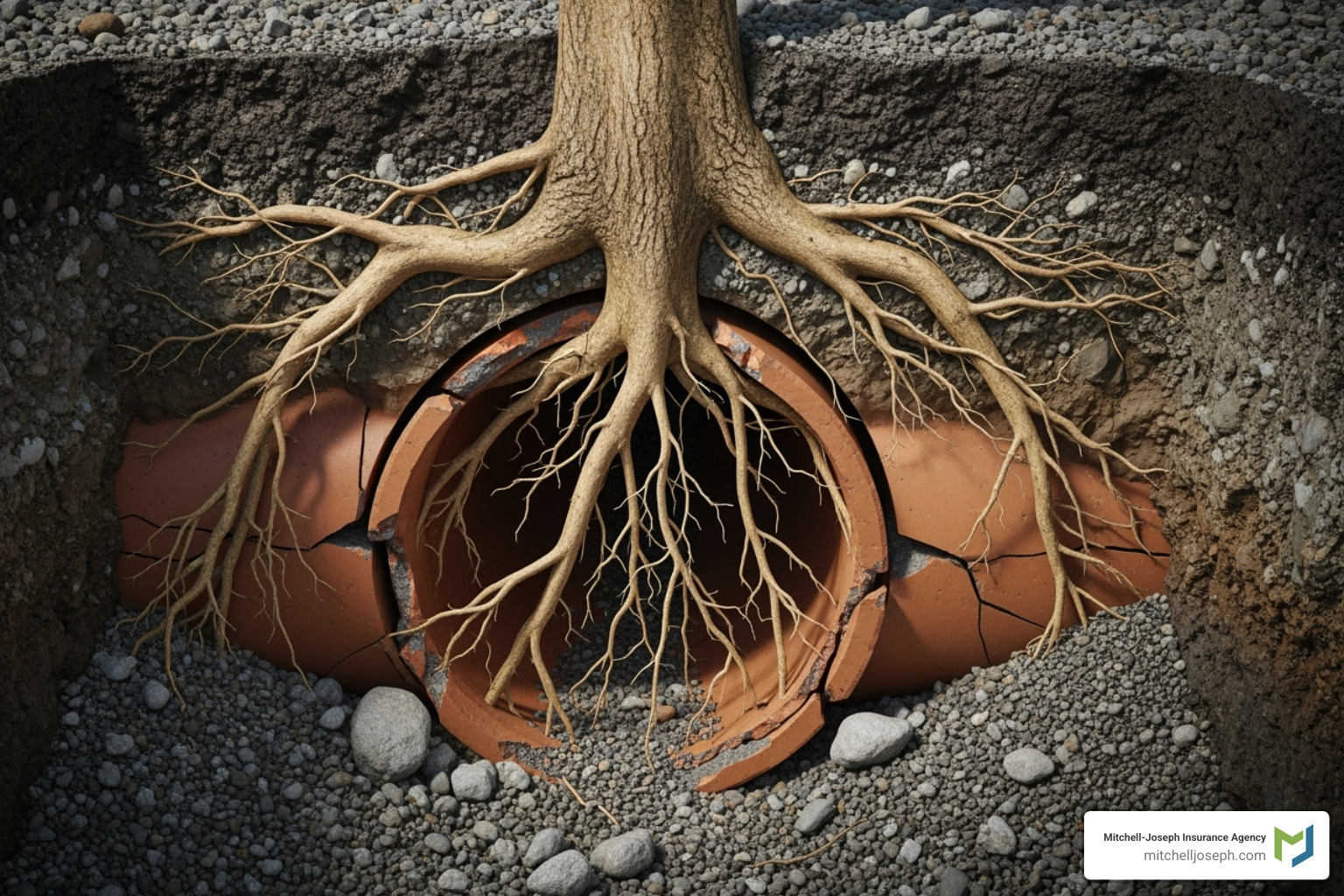
Insurance is fundamentally designed to cover sudden, unexpected events—not the gradual wear and tear that happens to every home over time. Wear and tear and gradual deterioration are explicitly excluded. Your 50-year-old cast iron sewer line that finally gives out? That’s not covered. Pipes age, corrode, crack, and eventually fail, just like any other part of your home. It’s expected maintenance, not an insurable event.
Tree root intrusion is probably the most common and frustrating cause of sewer line damage we see here in the Finger Lakes. Those beautiful mature trees in Pittsford and Canandaigua? Their roots are remarkably persistent at finding their way into tiny cracks in your sewer lines. Once inside, they grow, causing blockages and eventually rupturing the pipes. Since this happens gradually over months or years, it’s not covered.
Corrosion falls into the same category. It’s a slow chemical process that weakens pipes over time, and insurance companies view it as part of normal aging. Similarly, damage from poor maintenance or negligence won’t be covered. If you knew about a leak and ignored it, or you’ve been flushing things you shouldn’t down the toilet, don’t expect your insurer to pay for the consequences.
Then there are the big exclusions: flooding and earthquakes. Even though these are catastrophic events, damage to your water and sewer lines from floods or earthquakes requires separate, specialized policies. Standard homeowners insurance won’t cover them. If you’re in a flood-prone area, you’ll need specific flood insurance to protect your lines. Learn more about this important distinction in our article on Homeowners Insurance and Flood Insurance.
The bottom line? If the damage is preventable, gradual, or caused by something not specifically named in your policy, you’re likely on your own financially.
Bridging the Gap: Understanding Service Line vs. Sewer Backup Coverage
Given these significant gaps in standard coverage, smart homeowners turn to optional endorsements. This is where two critical types of coverage come into play: Service Line Coverage and Sewer Backup Coverage. They sound similar, but they protect against very different problems—and most homeowners need both.
Let me clarify with a simple comparison:
| Feature | Service Line Coverage (Endorsement) | Sewer Backup Coverage (Endorsement) |
|---|---|---|
| What it covers | Damage TO your underground water, sewer, or utility lines themselves | Damage FROM sewage or water backing up into your home |
| What it pays for | Excavation costs to access the damaged line; repair or replacement of the broken pipe; landscaping restoration; permits and fees | Cleanup of sewage and water; repair of damaged floors, walls, and ceilings; replacement of ruined personal property like furniture and appliances |
| When you need it | When tree roots crack your sewer line, when your water line corrodes and leaks, when normal wear and tear causes pipe failure | When a clog causes sewage to back up into your basement, when heavy rain overwhelms the municipal system and it backs up into your home |
| Typical cost | Usually $40-$60 per year | Usually $40-$60 per year |
| Coverage limits | Typically $10,000-$25,000 | Typically $5,000-$25,000 |
Service Line Coverage is your protection for the pipes themselves. When that tree root finally ruptures your sewer line or your aging water line springs a leak, this endorsement covers the cost of digging up your yard, repairing or replacing the damaged section, and restoring your landscaping. Without it, you’re looking at bills that easily run $5,000 to $15,000 or more. For a complete breakdown, read our Service Line Coverage: Complete Guide.
Sewer Backup Coverage protects everything inside your home when water or sewage backs up through your drains. Picture this: a major rainstorm overwhelms the municipal sewer system, and suddenly your basement toilet is overflowing with sewage. Or a stubborn clog causes wastewater to flood your finished basement. This endorsement covers the cleanup, repairs to your home, and replacement of damaged belongings. Learn more in our article What is Water Backup Coverage on Homeowners Insurance?
Here’s the reality I share with clients: these two endorsements typically cost less than $100 per year combined, but they can save you tens of thousands of dollars. After 25 years in this business, I’ve seen too many homeowners learn about these coverages only after they needed them. Don’t be one of them.

