

Protecting Your Business with the Right Coverage
A general liability policy is business insurance that protects against claims involving bodily injury, property damage, and advertising injury that could occur during normal business operations. This essential coverage serves as your first line of defense against lawsuits that could otherwise devastate your business finances.
What You Need to Know About General Liability Policies:
| Coverage Type | What It Protects Against | Why It’s Important |
|---|---|---|
| Bodily Injury | Customer slip and falls, injuries on premises | Average claim costs $35,000+ |
| Property Damage | Damage to client property during services | Prevents out-of-pocket repair costs |
| Advertising Injury | Copyright infringement, libel, slander | Legal defense costs can reach $500/hour |
| Medical Payments | Minor injuries without establishing fault | Quick resolution of small claims |
When shopping for a general liability policy, compare coverage limits, exclusions, and industry-specific endorsements. Most small businesses need at least $1 million in per-occurrence coverage and $2 million in aggregate limits. While not typically required by law, 4 out of 10 small businesses will likely experience a liability claim within the next decade.
The average cost ranges from $59-$80 monthly, varying based on your industry, location, and business size. Many business contracts, leases, and licensing boards require proof of coverage before you can operate.
I’m Jeffrey Joseph, and I’ve helped small businesses find the right general liability policy coverage since 1999 as the owner of Mitchell-Joseph Insurance Agency. My two decades of experience have taught me that proper liability protection isn’t just about meeting requirements—it’s about business survival.
Understanding a General Liability Policy
A general liability policy is the backbone of business protection—think of it as your financial shield against the unexpected. When we sit down with clients at Mitchell-Joseph Insurance Agency, we often describe it as your business’s safety net for those “oh no” moments involving people who aren’t on your payroll.
Bodily Injury
When someone takes a tumble on your property, a general liability policy steps in to help. Imagine a customer slipping on that just-mopped floor in your shop, breaking their wrist in the fall. Your coverage would handle their medical expenses, your legal defense, and any settlement costs.
“I’ve seen a single slip-and-fall incident nearly close a small business’s doors,” shares one of our senior agents. “Without proper coverage, those medical bills and legal fees can be devastating.”
The numbers tell the story: according to the National Floor Safety Institute, over a million emergency room visits each year are from slips and falls. With the average claim running around $35,000—and potentially ballooning to $75,000 if it turns into a lawsuit—it’s clear why this coverage matters so much. You can learn more about these risks at the Slip & Fall statistics page.
Property Damage
We all have those moments where things go sideways. Your general liability policy covers you when your business accidentally damages someone else’s property. Like when your plumber accidentally floods a customer’s kitchen, or your painter tips over a can onto an antique rug—your policy helps make things right.
Personal and Advertising Injury
This protection is broader than many business owners realize. It covers you if you’re accused of:
- Making damaging statements about another business
- Using someone’s image or idea without permission
- Publishing misleading information in your advertising
- Infringing on someone’s privacy or copyright
That social media post your marketing intern created using a stock photo without proper licensing? Your general liability policy has your back.
Medical Payments
This practical feature—often labeled “Coverage C” in your policy—pays for minor injuries to non-employees regardless of who’s at fault. With typical limits between $5,000 and $10,000 per person, it’s designed to resolve small issues before they become major headaches.
“What makes this coverage so valuable,” our claims specialist often points out, “is that it can be triggered without anyone filing a lawsuit. It’s like a pressure-release valve for minor incidents.”
What’s Not Covered
Understanding the boundaries of your general liability policy is just as important as knowing what it protects. Standard policies typically don’t extend to:
- Injuries to your employees (that’s what workers’ comp is for)
- Auto accidents (you’ll need commercial auto insurance)
- Professional mistakes or negligence (professional liability covers this)
- Damage to your own property (commercial property insurance handles this)
- Intentional wrongdoing or illegal activities
For answers to other common questions about business protection, check out our Business Insurance FAQ page.

A general liability policy isn’t just another business expense—it’s an investment in your company’s future. When the unexpected happens (and in business, it eventually will), having the right coverage means you can focus on serving your customers instead of worrying about a financial catastrophe.
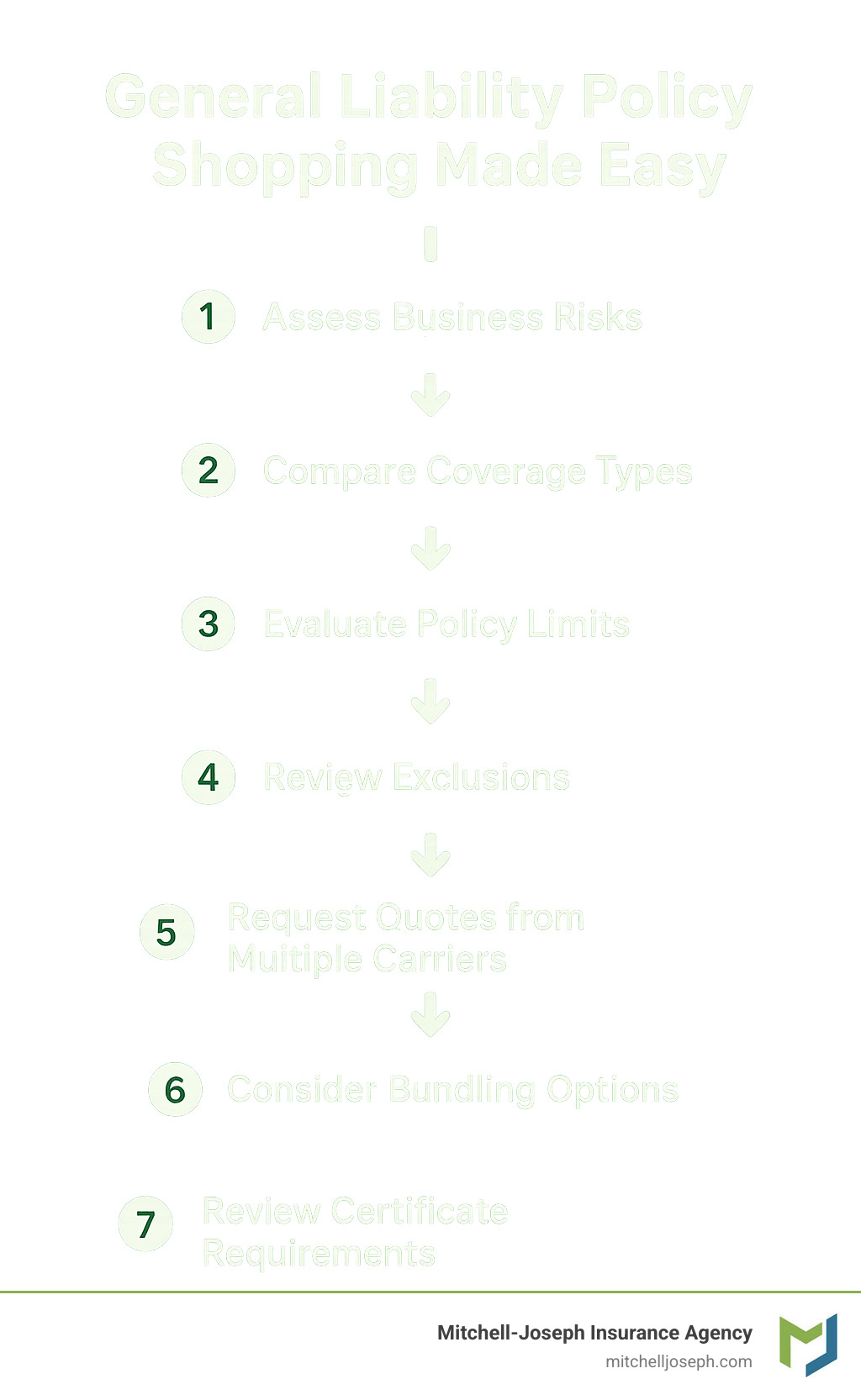
5 Must-Compare Features Before You Buy
When shopping for a general liability policy, looking at more than just the price tag can save you significant headaches down the road. Here at Mitchell-Joseph Insurance Agency, we’ve helped thousands of businesses throughout Rochester, Canandaigua, Victor, and nearby communities find the right coverage by focusing on these five critical features:
Per-Occurrence vs Aggregate Limits in a General Liability Policy
Think of these limits as your safety net’s strength – and understanding the difference between them is absolutely crucial:
- Per-occurrence limit: This is the maximum amount your insurer will pay for any single claim
- Aggregate limit: This represents the total maximum your insurer will pay for all claims during your policy period (typically one year)
Most small businesses should aim for at least $1 million per occurrence and $2 million aggregate limits. But depending on your industry or contract requirements, you might need more substantial protection.
“I’ve seen too many business owners fixate solely on getting the lowest premium without understanding their limits,” explains our senior advisor at Mitchell-Joseph. “When a serious claim exceeds a $500,000 limit, that business owner becomes personally responsible for the difference – and that can be devastating.”
| Industry | Recommended Per-Occurrence Limit | Recommended Aggregate Limit | Risk Factors |
|---|---|---|---|
| Retail | $1M | $2M | High foot traffic, slip-and-fall risk |
| Contractors | $1M-$2M | $2M-$4M | Property damage risk, worksite injuries |
| Restaurants | $1M-$2M | $2M-$4M | Food-related illness, premises liability |
| Professional Services | $1M | $2M | Client property damage, reputational risks |
| Manufacturing | $2M+ | $4M+ | Product liability exposure |
For businesses with higher exposure, we often suggest adding a commercial umbrella policy to provide additional protection beyond your general liability policy limits – think of it as an extra layer of security for those “just in case” scenarios.
Exclusions You Can’t Ignore in a General Liability Policy
Every general liability policy has exclusions – specific situations your policy won’t cover. Understanding these before you buy helps prevent that awful “you’re not covered for that” surprise when you need protection most.
The most critical exclusions to understand include employee injuries (you’ll need workers’ comp for those), auto accidents (commercial auto coverage handles these), and professional errors (that’s what professional liability insurance covers). Also be aware that most standard policies exclude cyber events and pollution incidents, which require specialized coverage.
“One exclusion that regularly surprises contractors is the ‘your work’ exclusion,” our construction specialist at Mitchell-Joseph points out. “This means if your completed work is damaged because it was defective in the first place, that repair isn’t covered. Many contractors don’t realize this until it’s too late.”
Claims-Made vs. Occurrence Form
Your general liability policy will be written on one of two forms, and this distinction dramatically impacts your protection:
With an Occurrence Form, you’re covered for claims that happen during the policy period, regardless of when they’re reported – even years later. It provides perpetual coverage for incidents that happened while the policy was active, which is why most small businesses prefer this option, despite it typically costing more initially.
A Claims-Made Form only covers claims that both occur and are reported during the policy period (or extended reporting period). This requires maintaining continuous coverage to avoid gaps and includes considerations like retroactive dates and tail coverage. While often less expensive at first, it can cost more long-term.
“The retroactive date in a claims-made policy is absolutely critical,” our risk management advisor emphasizes. “It establishes how far back in time the policy will cover incidents. If you switch insurers, maintaining your retroactive date prevents coverage gaps for past incidents that haven’t yet resulted in claims.”
If you’re transitioning from claims-made to occurrence coverage, or ending operations, “tail coverage” (Extended Reporting Period) allows you to report claims after the policy ends for incidents that occurred during the policy period.
Industry-Specific Endorsements & Additional Insured
Standard general liability policies offer broad protection, but most businesses benefit from customized coverage through endorsements custom to their specific industry.
For construction businesses, we typically recommend completed operations extensions, action over coverage for third-party claims, and height exclusion removal for roofers. Retail businesses often need product recall expense coverage and expanded advertising injury protection, while service providers benefit from care, custody, and control coverage.
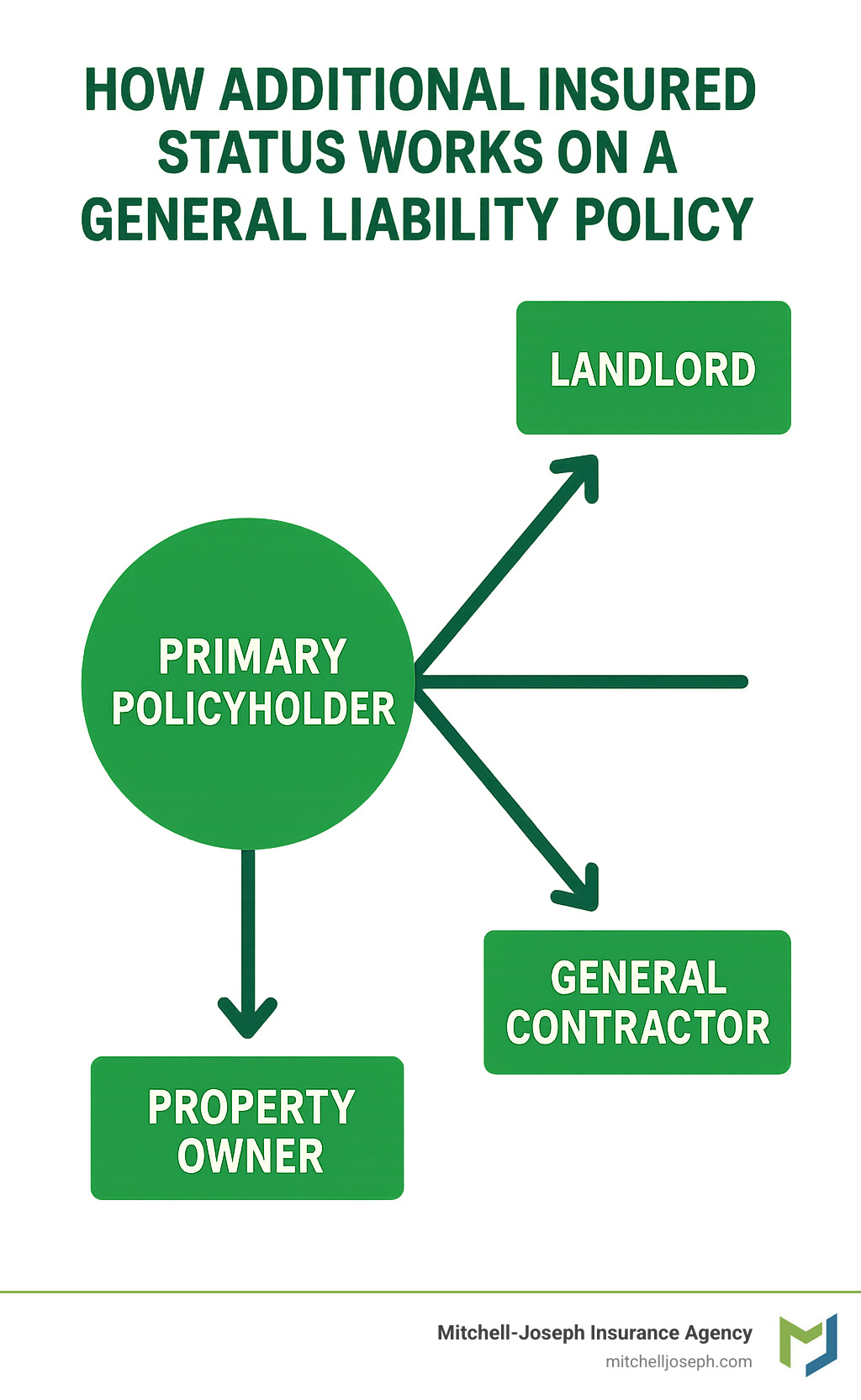
Additional Insured Status is another vital consideration. Many contracts require you to add clients, landlords, or general contractors as additional insureds on your policy, extending certain protections to these parties for claims arising from your work.
“We recommend blanket additional insured endorsements for contractors and service businesses,” suggests our commercial lines manager. “This automatically extends coverage to any party your contract requires you to add, saving you from requesting individual endorsements each time you take on a new project.”
Certificates & 24/7 Digital Access
In today’s business world, having immediate access to proof of insurance can be the difference between landing or losing a job:
“We’ve seen clients lose contracts because they couldn’t provide proof of insurance quickly enough,” our client services manager shares. “That’s why at Mitchell-Joseph Insurance Agency, we prioritize same-day certificate issuance and provide all clients with digital access to their policy documents.”
Certificates of Insurance (COI) are official documents showing your coverage details, and the speed at which you can access and share them matters. Modern insurance providers offer mobile apps that let you view and share your certificate instantly, make policy changes, file claims, and contact your agent.
This digital accessibility is particularly valuable for contractors and service providers who frequently need to provide proof of insurance to new clients or project managers – often with very little notice!
Price, Limits & Bundling Strategies
Navigating the costs of a general liability policy doesn’t have to feel like solving a complex puzzle. Let me walk you through what impacts your premium and how to potentially save some hard-earned money.
Understanding the Cost Factors
Most small businesses can expect to pay around $59 monthly (median) for their general liability policy, though the average rises to about $80 because some high-risk businesses pay substantially more. After helping thousands of local businesses find coverage, we’ve identified several key factors that influence what you’ll pay:
Your industry makes perhaps the biggest difference in your premium. A small accounting firm might pay just $400-600 annually, while a contractor could pay $1,500-3,000+ for the same policy limits. Why? The risk of someone getting injured at a construction site is simply higher than at an accounting office.
Your company’s size and revenue also matter significantly. A larger retail store with $2 million in annual sales will typically pay more than a boutique shop earning $200,000, because more customers mean more potential for accidents.
Where you’re located plays a surprising role too. Our clients in Rochester often pay different rates than those just down the road in Canandaigua or Victor. Each ZIP code has its own risk profile based on local claim statistics and legal climate.
Your coverage limits directly impact cost – that standard $1M/$2M (per occurrence/aggregate) policy costs less than a $2M/$4M policy that provides double the protection. And if you’ve had claims in the past, expect to pay more for about 3-5 years afterward.

Deductible Choices
Unlike your auto insurance, many general liability policies don’t include a deductible at all. However, opting for a policy with a deductible can trim your premium costs considerably:
| Deductible Amount | Typical Premium Reduction | Best For |
|---|---|---|
| $0 | None (standard) | Businesses wanting predictability |
| $500 | 5-10% | Small businesses with good cash flow |
| $1,000 | 10-15% | Medium-sized businesses |
| $2,500 | 15-20% | Larger businesses with strong financials |
| $5,000+ | 20-30% | Businesses with substantial resources |
I remember helping a local contractor who saved nearly $400 annually by choosing a $1,000 deductible. He had enough savings to handle a potential claim and preferred the immediate premium reduction. But for many of our smaller retail clients, the peace of mind from a zero-deductible policy is worth the extra cost.
Bundling for Savings
One of my favorite money-saving tips for clients is bundling multiple policies together. It’s like the insurance version of buying in bulk:
Combining your general liability policy with property insurance into a Business Owner’s Policy (BOP) typically saves 10-15% compared to buying them separately. For many of our Main Street businesses in Honeoye Falls, this bundling approach has been a budget-saver.
Adding workers’ compensation or commercial auto to your insurance package can yield additional discounts too – we often see around 12% savings when bundling auto coverage. Because we represent 24 different insurance companies at Mitchell-Joseph, we can shop around to find the perfect bundling options for your specific situation.
Tax Considerations
Here’s some good news for your bottom line: general liability policy premiums are generally tax-deductible as a legitimate business expense. The IRS considers liability insurance a necessary and ordinary cost of doing business under Section 162 of the Internal Revenue Code.
That said, I always remind clients that while you can typically deduct these premiums, it’s worth confirming with your accountant. Tax laws evolve, and your specific business structure might have unique considerations. For more details, you can check the IRS rules on deducting premiums.
Premium Financing Options
If paying your full annual premium upfront would strain your cash flow, premium financing can be a helpful solution. This approach typically requires a 20-25% down payment, with the remainder spread across 9-10 monthly installments. There’s usually a financing fee of about 5-10% of the premium.
Many of our seasonal businesses in upstate New York appreciate this option since it helps them maintain stronger cash positions during slower months. One local landscaper told me this approach helped him invest in new equipment during the off-season while still maintaining robust liability protection.
With over 200 years of combined experience at Mitchell-Joseph Insurance Agency, we’ve helped countless businesses throughout Rochester and surrounding communities find that sweet spot between comprehensive protection and affordability. After all, the best general liability policy isn’t just about price—it’s about value and peace of mind. Want to learn more about protecting your business? Check out our article on the Importance of Business Insurance.
Frequently Asked Questions about General Liability Policies
Is general liability insurance required by law?
Unlike car insurance, a general liability policy isn’t typically mandated by state law. However, in practice, many businesses find it’s essentially required anyway.
“I often explain to clients that while the government might not force you to have coverage, the business world often does,” shares Jeffrey Joseph, our agency founder. “We’ve seen countless situations where operating without proper liability protection simply isn’t an option.”
This happens through several common scenarios. First, many professional licensing boards require proof of insurance—especially for contractors throughout New York State who need coverage to maintain their licenses. Second, almost every commercial lease includes language requiring tenants to carry liability protection. Third, client contracts (particularly for service providers) frequently specify minimum insurance requirements. And finally, if you’re seeking a business loan, especially an SBA loan, lenders typically require liability coverage as a condition of funding.
After helping businesses in Honeoye Falls, Pittsford, and throughout the Rochester area for over three decades, we’ve unfortunately witnessed how quickly a single uninsured claim can wipe out everything a business owner has worked for. Even when not legally required, going without a general liability policy means risking both your business and personal assets.
How much coverage do I need for my general liability policy?
Finding your coverage sweet spot depends on several key factors that we carefully evaluate with each client.
Your industry risk level plays a major role—construction companies typically need higher limits than office-based businesses due to their increased exposure to accidents and property damage. Your business size matters too, as more customers, higher revenue, and multiple locations all increase your potential liability. You should also review your contracts carefully, as many specify minimum coverage amounts you must maintain.
Perhaps most importantly, consider what assets you’re protecting. Your general liability policy serves as a financial shield for everything you’ve built, both in your business and potentially your personal life if your business structure doesn’t fully protect you.
“One approach I often recommend to our clients is to start by reviewing your largest contracts to ensure your coverage meets their requirements,” explains our commercial specialist at Mitchell-Joseph. “Then ask yourself—would these same limits adequately protect everything you’ve built if something went seriously wrong?”
As a general starting point, most small businesses should carry at least $1 million per occurrence and $2 million aggregate limits. Medium-sized operations often benefit from $2 million per occurrence and $4 million aggregate. If you have significant exposure or valuable assets, consider adding umbrella coverage of $1-5 million or more on top of your base policy.
How do I file a claim under a general liability policy?
When the unexpected happens, knowing how to steer the claims process can make all the difference. Here’s what to do if an incident occurs that might lead to a claim:
First, report promptly. Contact your insurance carrier as soon as possible—most general liability policies require immediate reporting and have specific timeframes for claim notification. At Mitchell-Joseph, we make this easy with our dedicated claims team that helps guide you through the process.
Next, document everything thoroughly. Take photos of any damage or injury scene, collect contact information from witnesses, save all related communications, and keep receipts for any emergency expenses. This documentation can prove invaluable as your claim progresses.
“The single biggest mistake we see is clients waiting too long to report potential claims,” notes our senior claims advocate. “Even if you’re not sure an incident will result in a claim, it’s always better to report it early. This preserves your rights under the policy and gives the insurer time to properly investigate.”
Be sure to cooperate fully with the investigation. Your insurer will assign a claims adjuster who will look into the incident. Be honest and thorough in all communications. However, avoid admitting liability or promising specific compensation, as this could complicate your coverage.
Finally, stay engaged throughout the process. Maintain regular communication with your agent and claims adjuster. At Mitchell-Joseph Insurance Agency, we pride ourselves on claims advocacy—our team works alongside you throughout the claims process, helping steer the paperwork and ensuring fair treatment from the insurance carrier.
The timeline for resolution varies significantly based on the claim complexity. Simple property damage might be resolved in 2-4 weeks, while bodily injury claims involving litigation can take months or even years to fully settle.
Conclusion
Shopping for a general liability policy doesn’t have to be overwhelming. By understanding the key components we’ve discussed—from coverage types and limits to exclusions and endorsements—you can make informed decisions that protect your business without breaking your budget.
Remember these key takeaways:
-
Know Your Coverage Needs: Assess your industry risks and contractual requirements to determine appropriate limits.
-
Look Beyond Price: The cheapest policy isn’t always the best value if it leaves critical gaps in protection.
-
Understand Exclusions: Know what’s not covered so you can add endorsements or separate policies where needed.
-
Consider Bundling: Packaging multiple policies together often provides better protection at a lower overall cost.
-
Work With Experts: Independent agents with access to multiple carriers can find the right coverage at competitive rates.
At Mitchell-Joseph Insurance Agency, we’ve been helping businesses throughout Honeoye Falls, Rochester, Canandaigua, Victor, and surrounding communities steer these decisions for decades. With access to 24 insurance companies and over 200 years of combined experience, our team provides the personalized guidance needed to find the right general liability policy for your specific situation.
The statistics don’t lie: 4 out of 10 small businesses will likely face a liability claim in the next decade. The average cost of these claims—$35,000 to $75,000 or more—underscores why proper coverage isn’t just a business expense; it’s an investment in your company’s future.
Whether you’re a contractor in Pittsford, a retailer in Canandaigua, or a professional service provider in Rochester, we’re here to help you steer the complexities of business insurance with clarity and confidence.
For more information about New York general liability insurance options, visit our dedicated page or contact our office to speak with one of our experienced agents.

