

Protecting Your Business from the Unexpected
General liability insurance for businesses provides essential protection against third-party claims for bodily injury, property damage, and advertising injuries that could otherwise devastate your company financially.
If you’re looking for quick answers about general liability insurance:
| What It Covers | What It Costs | Who Needs It |
|---|---|---|
| – Third-party bodily injuries | – $30-$80 per month for small businesses | – Any business with customer interactions |
| – Property damage to others | – Median premium: $42/month ($500/year) | – Businesses with physical locations |
| – Advertising injuries | – Varies by industry, size, location | – Contractors working on client property |
| – Legal defense costs | – Typically $1M per occurrence limit | – Businesses with product liability exposure |
Every business faces risks, regardless of size or industry. A customer could slip on your freshly mopped floor, an employee might accidentally damage client property, or your advertising could unintentionally infringe on someone’s copyright. Without proper protection, these incidents could lead to devastating financial consequences.
The reality is stark: a single liability lawsuit can cost tens or even hundreds of thousands of dollars in legal fees and settlements. For small and medium-sized businesses, these unexpected costs can mean the difference between thriving and closing doors permanently.
Even when not legally required, general liability insurance for businesses is often demanded by:
- Clients before signing contracts
- Landlords before leasing commercial space
- Licensing boards for certain professions
- Lenders before approving business loans
I’m Jeffrey Joseph, majority owner of Mitchell-Joseph Insurance Agency, with over 20 years of experience helping business owners across the Finger Lakes region find the right general liability insurance for businesses to protect their operations and assets. My team and I understand the unique risks faced by businesses in upstate New York and work diligently to provide personalized insurance solutions.

General Liability Insurance for Businesses: Definition & Importance
Think of general liability insurance for businesses as your company’s financial shield. It’s the coverage that steps in when the unexpected happens – protecting your business when someone claims you’ve caused them harm or damaged their property.
In simple terms, this foundational insurance covers:
When a customer slips on your wet floor and breaks their wrist. When your employee accidentally damages a client’s expensive equipment. When your marketing campaign unintentionally copies another company’s slogan. And importantly, the legal costs to defend your business if you’re sued – even if you did nothing wrong.
Without this protection, your business would face these expenses alone. For a small business, even a modest claim could drain your savings and threaten everything you’ve built. I’ve seen it happen too many times, and it’s heartbreaking when it could have been prevented.
Why Every Small Business Needs General Liability Insurance
You might wonder if your business really needs this coverage. Let me share what I’ve learned from helping hundreds of New York businesses over my career.
Client expectations make it essential. Many clients simply won’t work with you without seeing proof of coverage first. This is especially true if you’re a contractor or consultant entering client properties or handling their assets.
Commercial landlords require it before they’ll hand over the keys to your new space. They need to know they’re protected if someone gets hurt in the building because of your operations.
Some professional licenses demand it before you can legally operate. This varies by industry and location, but it’s becoming increasingly common.
The financial math is compelling. A typical slip-and-fall claim costs around $20,000, but can easily reach $100,000 or more with legal fees. Now compare that to premiums that often run $500-$1,000 annually for many small businesses.
It prevents financial catastrophe. I’ve watched businesses close their doors permanently after facing uninsured claims. Your personal assets could even be at risk depending on your business structure.
It demonstrates professionalism. Having proper coverage signals to clients and partners that you’re serious about your business and prepared for contingencies.
Just last year, one of our retail clients in Rochester faced a $75,000 claim when a customer tripped over merchandise. Their policy covered everything – legal fees, medical costs, and settlement. Without it, they might have closed their doors for good.
Industries That Especially Need Coverage
While I recommend general liability insurance for businesses across all sectors, some industries face particularly high risks:
Contractors and construction professionals work in environments where property damage and injuries happen more frequently, making coverage absolutely essential.
Retail businesses have constant customer foot traffic, increasing the likelihood of slip-and-fall incidents or other injuries on premises.
Restaurants, hotels, and event venues face numerous liability exposures from food safety concerns to property hazards.
IT consultants risk accidentally damaging client systems or causing costly business interruptions. We offer specialized Business Insurance for IT Consultants that addresses these unique technology risks.
Photographers frequently work on location with expensive equipment in unpredictable environments. Our Business Insurance for Photographers provides custom protection for these creative professionals.
Property owners and landlords bear responsibility for maintaining safe premises, making liability coverage particularly important for their peace of mind.
Every business has unique needs, which is why we take the time to understand your specific operations before recommending coverage. What works for a restaurant won’t necessarily work for a consulting firm, and that personalized approach has been the cornerstone of our agency since day one.
What General Liability Insurance Covers — and Doesn’t Cover
Let’s talk about what’s actually in your general liability insurance for businesses policy. Think of it like a safety net with specific dimensions – it catches a lot, but not everything. Understanding these boundaries is crucial for properly protecting your business.
When I sit down with business owners in Rochester or Canandaigua, I often explain that general liability is like the foundation of a house – essential, but not the entire structure. Here’s what this foundation typically supports:
Your policy steps in when a customer takes a tumble on your freshly mopped floor and breaks their wrist – that’s bodily injury coverage handling their medical bills, lost wages, and pain and suffering claims. It’s also there when your employee accidentally knocks over an antique vase while working in a client’s home – that’s property damage protection at work.
Personal and advertising injury coverage might not be as obvious, but it’s incredibly valuable. It protects you if your business is accused of libel, slander, copyright infringement, or even invasion of privacy. Social media post your marketing team created that accidentally used someone else’s trademarked phrase? This coverage helps with that.
Many business owners are pleasantly surprised to learn about medical payments coverage. This pays smaller medical bills for minor injuries on your property regardless of who’s at fault – often preventing those minor incidents from escalating into major lawsuits.
If you make or sell products, products liability protection is your safeguard against claims that your product caused injury or damage. And if you’re renting your business space, fire legal liability covers damage to those premises caused by fire for which your business is legally responsible.
What’s NOT Covered:
Now, let’s talk about what falls through the gaps of this safety net. These exclusions aren’t flaws in the coverage – they’re simply risks that require different types of insurance.
When your web design business makes a coding error that crashes a client’s e-commerce site during Black Friday, that’s a professional mistake – not covered by general liability. You’d need professional liability insurance for that.
If your delivery driver has a fender bender in the company van, that’s an auto incident requiring commercial auto insurance. And when your employee throws out their back lifting inventory, that’s a workplace injury covered by workers’ compensation, not general liability.
Your policy also won’t cover intentional acts (like if you deliberately damaged a competitor’s property), cyber attacks that compromise your customer database (you’d need cyber liability insurance), or theft of your own business equipment (that’s what commercial property insurance is for).
Covered Claim Examples
Let me share some real-world scenarios where general liability insurance for businesses saves the day:
Picture this: It’s a rainy April morning in upstate New York. Despite your “Wet Floor” signs, a customer slips in your entryway and injures their back. Your general liability policy covers their medical treatment and protects you from the potential lawsuit.
Or imagine your landscaping crew accidentally running over an expensive garden statue while mowing a client’s lawn. Rather than paying thousands out of pocket, your general liability coverage steps in to replace it.
When your marketing team publishes a blog post containing unintentionally false information about a competitor who then sues for defamation, your general liability insurance covers legal defense costs and any resulting settlement.
Even something as simple as a coffee maker causing a small fire in your rented office space is covered under the fire legal liability portion of your policy.
Key Exclusions to Watch
After 20 years in the insurance business throughout the Finger Lakes region, I’ve seen too many business owners find coverage gaps the hard way. Here are the most critical ones to address:
The professional liability gap affects anyone providing services or advice. If clients rely on your expertise, you need protection against claims of mistakes or negligence in your professional work.
The workers’ comp gap is particularly important in New York, where businesses with employees are legally required to carry workers’ compensation insurance to cover workplace injuries.
If your business uses vehicles – even occasionally – the commercial auto gap leaves you exposed without proper commercial auto insurance to cover accidents.
And don’t forget the theft of own property gap. General liability protects others’ property, not yours. You need commercial property insurance to safeguard your business assets from theft, fire, or other damage.
At Mitchell-Joseph Insurance Agency, we’ve helped hundreds of businesses throughout Ontario, Monroe, and Livingston counties identify and fill these coverage gaps. We don’t just sell policies – we build comprehensive protection plans custom to each business’s unique risks and needs.
Costs, Limits & Factors for General Liability Insurance for Businesses
The cost of general liability insurance for businesses varies widely based on several factors, but knowing typical ranges can help you budget for this essential protection.
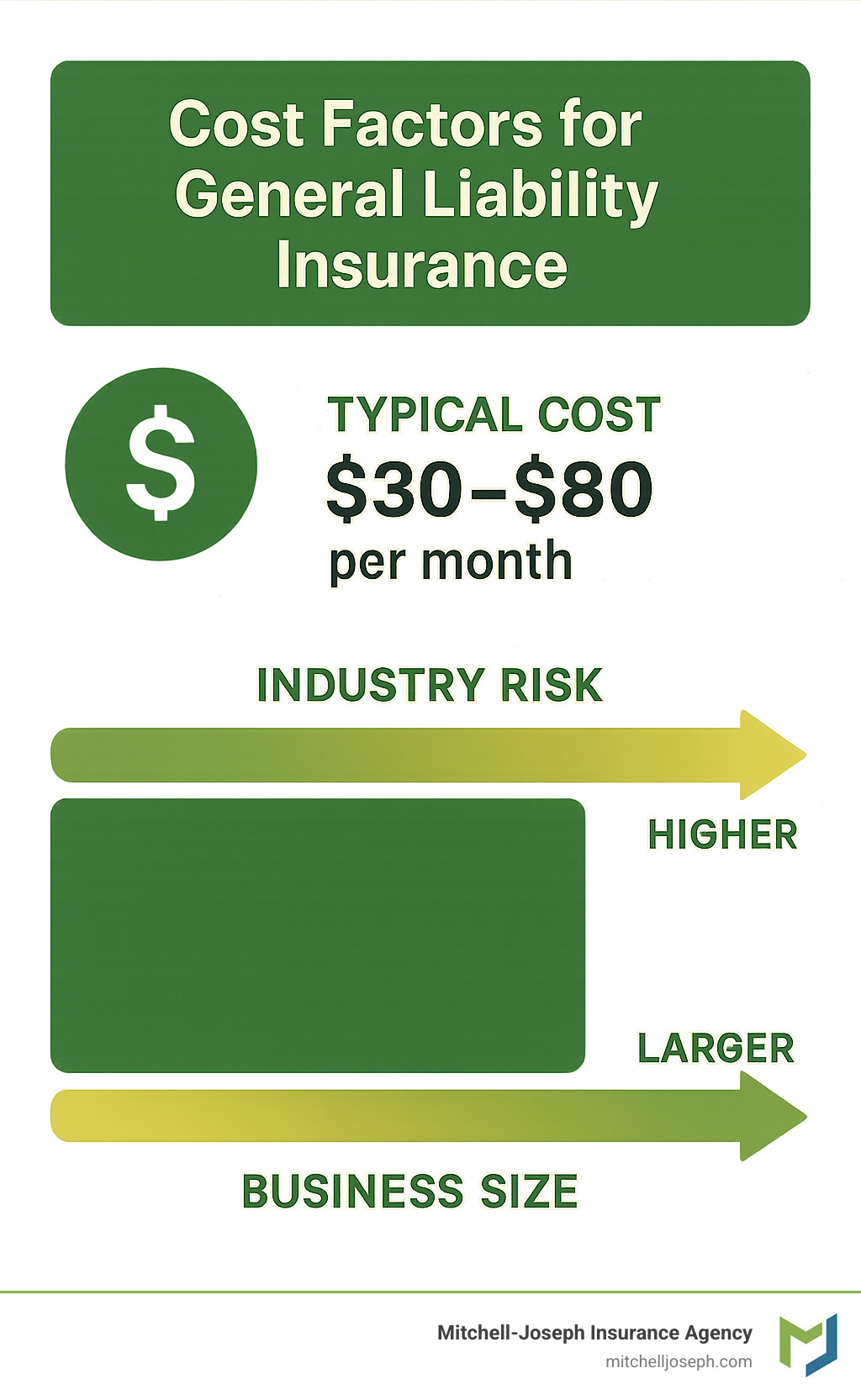
Small businesses typically pay between $30 and $80 per month for general liability insurance, with most paying around $42 monthly (about $500 annually). That said, your actual premium could be quite different depending on your specific situation.
Think of your premium as being influenced by a unique recipe of risk factors. Industry risk plays a major role – our construction clients generally pay more than our consulting clients due to the higher likelihood of accidents and property damage. Business size matters too; as your revenue and employee count grow, so typically do your premiums.
Standard coverage limits usually offer $1 million per occurrence and $2 million aggregate protection. While you can choose higher limits for more protection, your premium will increase accordingly. Your location affects rates as well – businesses in Rochester often pay different rates than those in smaller Finger Lakes communities due to different claim frequencies and costs.
Your claims history tells insurers a story about your risk management practices. A clean record helps keep premiums lower, while previous claims can push them higher. And don’t forget about your deductible choice – opting for a higher deductible means lower premiums but more out-of-pocket expense if a claim occurs. It’s a balancing act we help our clients steer every day.
Here’s what typical annual premiums look like across different industries:
| Industry | Average Annual Premium |
|---|---|
| Retail | $500-$1,000 |
| Consulting | $300-$700 |
| Construction | $1,500-$5,000 |
| Restaurants | $750-$2,000 |
| IT Services | $400-$900 |
These are just general ranges. At Mitchell-Joseph Insurance Agency, we leverage our relationships with 24 different insurance companies to find the most competitive rates custom to your specific business needs. We’ve helped hundreds of business owners throughout the Finger Lakes region find affordable coverage that doesn’t sacrifice protection.
There’s good news for your bottom line too – according to the IRS, business insurance premiums are generally tax-deductible as ordinary and necessary business expenses. For more details, check out the Scientific research on business expense deductions.
How Much General Liability Insurance for Businesses Do You Need?
Finding your “just right” coverage amount isn’t one-size-fits-all. It’s more like finding the right prescription for glasses – what works perfectly for one business might leave another vulnerable.
Start by checking your contract requirements. Many clients and landlords specify minimum coverage amounts (typically $1 million per occurrence and $2 million aggregate) in their agreements. Meeting these requirements isn’t just about compliance – it’s about keeping valuable business relationships intact.
Next, consider your risk exposure. A home-based consultant has very different liability needs than a contractor working on luxury properties or a retailer with hundreds of daily visitors. The more public interaction your business has, the higher your coverage limits should generally be.
Don’t forget about asset protection either. Your coverage should be sufficient to shield your business assets if a significant claim occurs. I’ve seen too many business owners underestimate their exposure only to regret it later when facing a substantial claim.
For growing businesses, consider your growth projections too. If you’re expanding operations, hiring more employees, or increasing revenue significantly, you may need to increase coverage to accommodate the additional risk exposure.
For businesses with substantial risk or valuable assets to protect, we often recommend adding commercial umbrella insurance. This extends your liability protection beyond your general liability limits – think of it as an extra safety net for those “what if” scenarios that keep business owners up at night.
For more detailed information about coverage options and limit considerations, visit our General Liability Policy page.
Is General Liability Insurance Tax Deductible?
Yes! General liability insurance for businesses is typically tax deductible, which helps soften the impact on your bottom line. The IRS classifies insurance premiums as “ordinary and necessary business expenses” when they’re directly related to your business operations.
To make the most of this deduction, keep detailed records of all premium payments throughout the year. If you have both personal and business insurance, be sure to clearly separate these costs in your accounting. Also maintain documentation showing the business purpose of the insurance – your policy declarations page and invoice should suffice.
While we’re insurance experts rather than tax professionals, we’ve helped many clients understand how their insurance costs fit into their overall business expense picture. That said, we always recommend consulting with a tax professional to ensure compliance with current tax laws and to optimize your business deductions. Tax laws can change, and your specific circumstances may affect deductibility in ways unique to your business.
Buying, Bundling & Managing Your Policy
Navigating general liability insurance for businesses doesn’t have to be complicated. In fact, finding the right coverage can be surprisingly straightforward when you know the steps to take.
First, take some time to assess what your business truly needs. Think about the specific risks you face daily, what your clients or landlords might require, and what your budget can handle. This foundation helps ensure you get protection that actually fits your business—not just a generic policy.
When you’re ready to shop around, don’t settle for the first quote you receive. Insurance premiums can vary significantly between providers, even for identical coverage. At Mitchell-Joseph Insurance Agency, we make this easy by gathering quotes from 24 different insurance companies, saving you the legwork while ensuring you get competitive rates.
Before signing anything, carefully review the policy details. Pay special attention to coverage limits (are they enough?), exclusions (what isn’t covered?), and any endorsements (special additions) that might be relevant to your business. The fine print matters!
How to Get a Certificate of Insurance (COI)
That Certificate of Insurance (COI) is more than just another piece of paperwork—it’s your golden ticket to new business opportunities. Many clients won’t sign contracts without seeing this proof of coverage first.
Getting your COI is simple. You can contact us directly, and we’ll prepare your certificate the same day—perfect for those last-minute contract opportunities. Many of our carriers also offer convenient self-service portals where you can generate and download certificates anytime, even at midnight before a big proposal.
When requesting your certificate, be sure to mention if your client needs to be listed as an “additional insured.” This common requirement gives them certain protections under your policy. And always double-check that all information is accurate—incorrect details could cause headaches down the road.
We maintain digital copies of all our clients’ certificates, so even if you misplace yours before a big meeting, we’re just a phone call away from sending a fresh copy.
Business Owner’s Policy (BOP) & Other Bundles
Why buy several policies when you can bundle them together? For many of our clients, a Business Owner’s Policy (BOP) offers the perfect combination of protection and value.
Think of a BOP as a package deal that wraps general liability insurance for businesses together with commercial property coverage and business income protection. It’s like the combo meal of the insurance world—more complete and typically less expensive than ordering à la carte.
Beyond the standard BOP, you can customize your protection by adding specialized coverages that address your specific risks. Equipment coverage protects those expensive tools you rely on daily. Cyber liability steps in if you experience a data breach. Professional liability (also called E&O) covers claims that your professional advice or service caused financial harm.
The best part? Bundling these coverages typically saves you 10-15% compared to buying separate policies. That’s money you can reinvest in growing your business. For a deeper dive into comprehensive coverage options, check out our Insurance Coverage: Business Insurance page.
Filing a Claim Step-by-Step
Even with the best prevention, accidents happen. When they do, knowing how to steer the claims process can make all the difference.
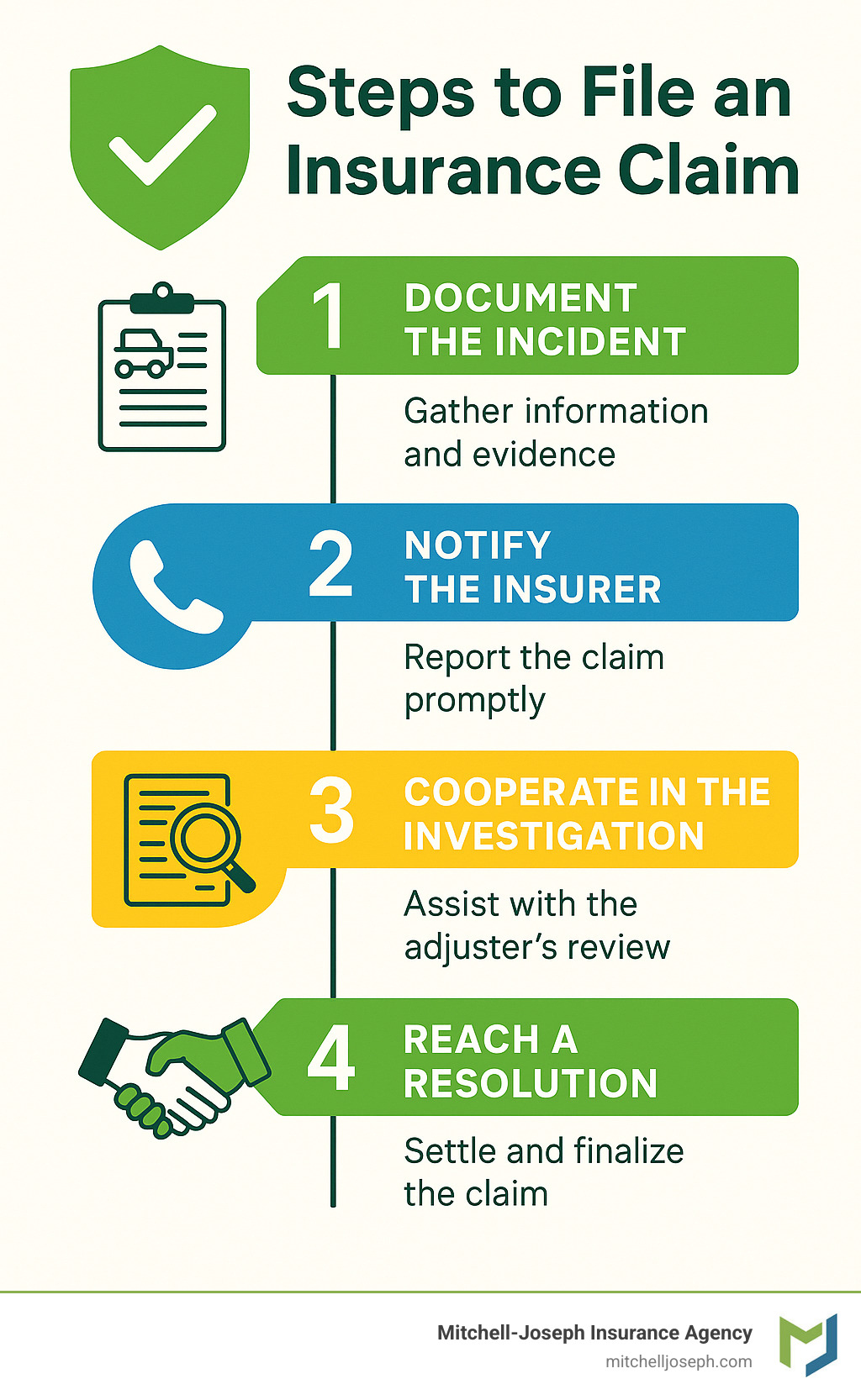
The moment an incident occurs, grab your phone and start documenting everything. Take photos from multiple angles, collect contact information from witnesses, and make detailed notes while the event is fresh in your mind. These simple steps can significantly strengthen your claim.
Don’t wait to report the incident to your insurance company. Even if you’re not sure a claim will materialize, prompt reporting gives your insurer the best chance to investigate properly. With Mitchell-Joseph, you’ll never face that frustrating automated phone tree—you’ll speak directly with a real person who knows your business.
As the claim progresses, your insurer will need specific information about what happened. Be prepared to share details about when and where the incident occurred, who was involved, and the nature of any injuries or damages. The more thorough your information, the smoother the process will be.
Throughout the investigation, your insurance company will be your partner. The assigned adjuster might request additional documentation or statements—responding promptly keeps everything moving forward. And don’t hesitate to check in periodically for updates on your claim status.
At Mitchell-Joseph Insurance Agency, we don’t just sell you a policy and disappear. We stand beside you throughout the claims process, advocating for fair treatment and prompt resolution. Our team knows the ins and outs of claims handling, and we’re always just a call away when you need guidance or support.
Common Claims & Risk-Reduction Strategies
Let’s talk about the claims we see most often with general liability insurance for businesses. Understanding these common scenarios can help you take smart steps to protect your company before problems occur.
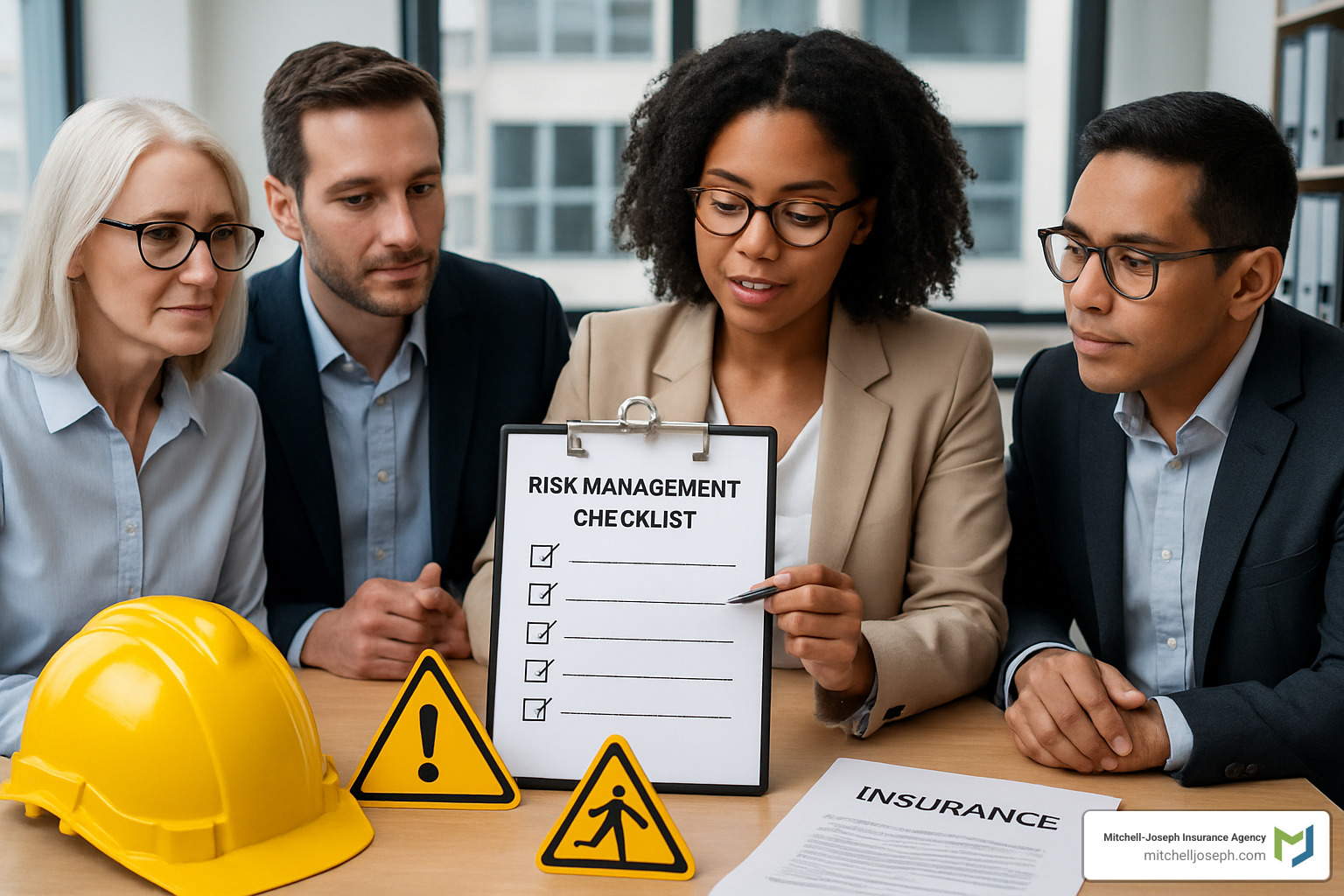
We’ve all heard the stories—a customer slips on a wet floor and breaks their wrist, or a business gets sued because their marketing materials accidentally used copyrighted images. These aren’t just cautionary tales; they represent the most frequent claims we handle at Mitchell-Joseph Insurance Agency.
The number one claim we see? Slips, trips, and falls. These account for over 30% of all general liability claims and can happen in virtually any business setting. Just last month, one of our clients, a small café in Canandaigua, faced a claim when a customer tripped over an uneven threshold at their entrance.
Product defects make up another significant portion of claims. Even if you’re not manufacturing products, you could be liable for items you sell or distribute. A Rochester retailer we insure faced a $12,000 claim when a product they sold malfunctioned and damaged a customer’s home.
Advertising injury suits might sound unlikely, but they’re surprisingly common. These include claims of copyright infringement, libel, or slander. It’s easier than ever to accidentally use someone else’s intellectual property in your marketing materials.
Finally, contractual liability claims can arise when your business is perceived to have failed to fulfill its obligations. These often come from misunderstandings about what was promised versus what was delivered.
Effective Risk-Reduction Strategies
The good news is that many liability risks can be significantly reduced with some thoughtful prevention. I always tell my clients that the best insurance claim is the one that never happens.
Maintaining safe premises is your first line of defense. This means regular property inspections, prompt cleaning of spills, removing obstacles from walkways, and using proper signage when hazards exist. Good lighting is also essential—many claims occur simply because someone couldn’t see a step or uneven surface.
For businesses that sell or distribute products, implementing quality control procedures is crucial. Test products thoroughly, provide clear usage instructions, and maintain documentation of your quality control process. This not only reduces claim risk but can also serve as evidence of your diligence if a claim does occur.
When it comes to your marketing materials, a little caution goes a long way. Verify the accuracy of all advertising claims and obtain proper permissions for using images or content. When in doubt, have legal review your materials—it’s much cheaper than defending against an infringement claim.
Perhaps most importantly, document everything. Keep detailed records of safety procedures, customer interactions (especially complaints), and maintain incident reports for any accidents, no matter how minor they seem at the time. These records can be invaluable if you need to defend against a claim later.
Proactive Risk Management to Lower Premiums
Here’s something many business owners don’t realize: taking steps to reduce risks can actually lower your insurance premiums. Insurance companies love businesses that take safety seriously!
Regular employee training makes a huge difference. When your team knows how to prevent accidents and respond appropriately when they do happen, claim frequency drops dramatically. One of our manufacturing clients in Rochester implemented monthly safety training and saw their premiums decrease by 15% at renewal.
Security upgrades like better lighting, security cameras, and alarm systems not only deter theft but also reduce liability exposure by creating a safer environment. These investments often pay for themselves through lower insurance costs.
Developing written procedures for safety protocols demonstrates your commitment to risk management. It’s not just about having rules—it’s about showing that safety is a priority in your business culture.
Finally, annual insurance reviews ensure you’re properly protected as your business evolves. As your business grows and changes, so do your risks. At Mitchell-Joseph Insurance Agency, we provide complimentary annual reviews to all our clients to make sure their coverage keeps pace with their business.
Many of our clients are surprised to learn that their insurance company offers specific premium discounts for implementing certain risk management practices. We help identify these opportunities to both improve safety and reduce costs—a win-win situation.
For more comprehensive information about protecting your business through risk management, visit our Importance of Business Insurance page.
Frequently Asked Questions about General Liability Insurance
Is general liability insurance required by law?
While general liability insurance for businesses isn’t typically mandated by state law in New York or most other states, there are several situations where you’ll find it’s essentially required.
For instance, you might need coverage to obtain certain professional licenses, secure specific business permits, qualify for government contracts, or engage in activities considered high-risk. One of our clients in the construction industry found this when bidding on their first municipal project – the contract wouldn’t proceed without proof of adequate liability coverage.
Even when not legally required, you’ll quickly find that general liability insurance for businesses becomes a practical necessity. Commercial landlords won’t hand over keys without it. Clients increasingly include insurance requirements in their contracts. Lenders view it as a sign of business stability. Even vendors and partners may require it before working with you.
The reality is sobering – without proper coverage, you personally could face financial ruin from a single claim. I’ve seen small business owners face this harsh reality, and it’s why we’re so passionate about helping protect our clients.
What’s the difference between general liability and professional liability?
This is one of the most common questions we hear at Mitchell-Joseph, and it’s an important distinction to understand.
Think of general liability insurance for businesses as protection against physical mishaps and tangible damages. It covers situations like a customer slipping on your wet floor, your employee accidentally damaging a client’s property, or advertising that inadvertently infringes on someone’s copyright.
Professional liability insurance (also called Errors & Omissions) is quite different. It protects against claims related to your professional expertise and services. This includes allegations of negligence, mistakes in your work, or failure to deliver promised results. It focuses primarily on financial losses stemming from your professional advice or services.
Many of our clients need both types of coverage. Take one of our architect clients as an example – their general liability insurance for businesses protected them when a prospective client tripped over a chair leg in their office, while their professional liability coverage was essential when facing a claim about a design specification issue that caused project delays.
Can I bundle general liability with other coverages?
Absolutely – and in most cases, bundling makes perfect sense both financially and practically.
The most popular bundle we recommend is a Business Owner’s Policy (BOP), which typically combines general liability insurance for businesses with commercial property insurance and business income coverage. It’s like the Swiss Army knife of business insurance – handling multiple essential protections in one policy.
Beyond the standard BOP, we can customize your insurance package with additional coverages like professional liability, cyber liability, employment practices liability, and commercial auto. While workers’ compensation is usually written as a separate policy due to state regulations, we ensure it coordinates seamlessly with your other coverages.
The advantages of bundling are compelling: premium discounts often ranging from 10-15% (who doesn’t like saving money?), simpler administration (fewer policies to manage), fewer coverage gaps (reducing your risk exposure), and coordinated policy periods (no more juggling different renewal dates).
At Mitchell-Joseph Insurance Agency, we take the time to understand your specific business operations before recommending any bundling options. Our goal is always to find the sweet spot between comprehensive protection and cost-effectiveness. After all, insurance shouldn’t break the bank – it should give you peace of mind to focus on growing your business.
For more information about New York-specific coverage options, visit our More info about NY general liability coverage page.
Conclusion
Let’s face it – running a business comes with enough challenges. The last thing you need is to lose everything you’ve worked for because of an unexpected accident or lawsuit. That’s where general liability insurance for businesses comes in, serving as your financial safety net when the unexpected happens.
Throughout this guide, we’ve explored how this essential coverage protects your business from the financial fallout of accidents, property damage claims, and even advertising mishaps. Without it, you’d be facing those potential costs alone – a risk few businesses can afford to take.
Remember those key points we covered? General liability insurance for businesses typically costs between $30-$80 monthly for most small operations (with that median $42 monthly premium we mentioned). While that might seem like just another expense, think of it as buying peace of mind. For the price of a few business lunches each month, you’re protecting everything you’ve built.
This protection becomes even more crucial if your business welcomes customers to your location, sends employees to work at client sites, or sells products that could potentially cause harm. One slip-and-fall or one product mishap could trigger a claim that dwarfs years of premium payments.
Many of our clients at Mitchell-Joseph have found that bundling their general liability with other coverages through a Business Owner’s Policy offers both better protection and significant savings. It’s like getting the complete protection package at a discount – something our team is always happy to help arrange.
We’ve also seen how implementing smart risk management practices not only prevents claims but often leads to lower premiums. Simple steps like regular safety training, proper signage, and documented procedures can make a meaningful difference to both safety and your bottom line.
As a family-owned independent agency with deep roots in the Finger Lakes region, we bring over 200 years of combined experience to helping local businesses find the right coverage at competitive rates. Our relationships with 24 different insurance companies allow us to shop around for you, comparing options to find the perfect balance of protection and affordability.
Whether you’re running a construction company in Rochester, a boutique shop in Canandaigua, or providing professional services in Victor, we understand the unique challenges businesses face in our community. That’s why we take the time to understand your specific operation before recommending coverage options.
For more details about New York-specific general liability coverage, visit our More info about NY general liability coverage page or simply give us a call. We’re always happy to answer questions and provide guidance – no pressure, just helpful advice.
At the end of the day, having the right general liability insurance for businesses isn’t just about checking a box for contracts or regulations. It’s about protecting what you’ve built and giving yourself the freedom to focus on growing your business, not worrying about what might go wrong. Because when you’re properly protected, you can pour your energy into what matters most – making your business thrive.

