

Flood insurance coverage limits play a crucial role in protecting your home or business from the financial devastation caused by unexpected flooding events. These limits define the maximum amount an insurance policy will pay out for covered flood damage. In the United States, the National Flood Insurance Program (NFIP) is a key player in providing flood insurance, offering coverage up to $250,000 for residential buildings and $100,000 for personal contents. For commercial properties, NFIP policies can cover up to $500,000. Private flood insurance, meanwhile, can offer more flexible options, often with higher limits.
Now, let’s simplify this complex topic:
- Residential Building Coverage: Up to $250,000
- Residential Contents Coverage: Up to $100,000
- Commercial Building Coverage: Up to $500,000
- Commercial Contents Coverage: Check with private insurers for higher limit options
As someone who has been deeply engaged in insurance services since 1999, I’m Jeffrey Joseph. With my role at Mitchell-Joseph Insurance Agency, I have helped clients steer the intricacies of flood insurance coverage limits, ensuring their peace of mind in various locations across upstate New York.
Now that we understand the basics, let’s dig further into how these limits function and what they mean for your specific situation.

Understanding Flood Insurance Coverage Limits
Flood insurance is a crucial safeguard for both homeowners and business owners. It helps cover the costs of repairs and replacements in the unfortunate event of a flood. Let’s break down the flood insurance coverage limits for both residential and commercial properties.
Residential Coverage
For residential properties, the National Flood Insurance Program (NFIP) sets specific limits to protect homeowners from flood-related damages:
-
Building Coverage: The NFIP provides coverage up to $250,000 for the physical structure of a residential property. This includes the foundation, electrical systems, and central air conditioning units.
-
Contents Coverage: Homeowners can also secure up to $100,000 in coverage for personal belongings such as furniture, clothing, and appliances inside the home.
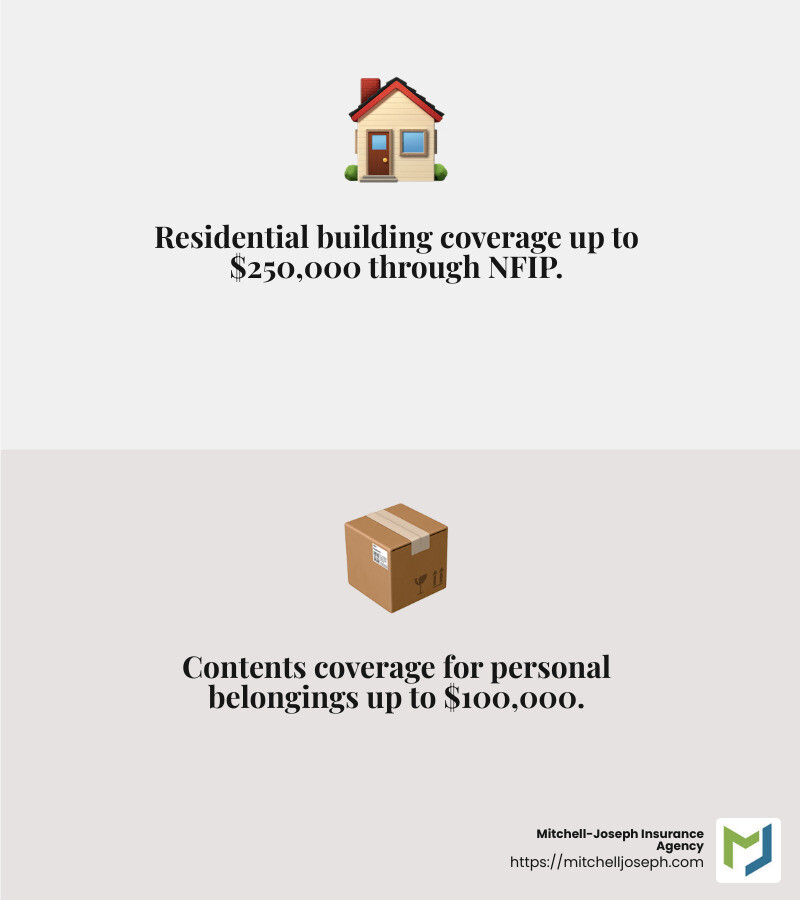
These limits ensure that the core structure and essential contents of a home are financially protected in the event of a flood. However, it’s important to note that these limits might not cover the full replacement cost for high-value homes. In such cases, homeowners might consider purchasing additional coverage from private insurers to fill in the gaps.
Commercial Coverage
Commercial properties have different coverage needs due to their larger scale and potential business-related contents. The NFIP addresses these needs with higher limits:
-
Building Coverage: For commercial buildings, the NFIP offers coverage up to $500,000. This is designed to protect the structure itself, including walls, floors, and essential systems like plumbing and electrical.
-
Contents Coverage: Business owners can also insure up to $500,000 for contents within the commercial property. This includes inventory, machinery, and office equipment.

These limits are generally sufficient for many businesses, but like residential properties, they may not cover everything. Businesses with higher-value assets or those in high-risk flood zones should consider additional coverage options through private flood insurance providers.
In summary, understanding these coverage limits is key to ensuring adequate protection for both residential and commercial properties. Whether through the NFIP or private insurers, assess your specific needs and risks to determine the best coverage plan.
Next, we’ll explore the different types of flood insurance available and how they can be custom to suit your specific requirements.
Types of Flood Insurance
When it comes to protecting your home or business from flooding, there are two main types of flood insurance to consider: NFIP Coverage and Private Flood Insurance. Each has its unique features, benefits, and limitations, so understanding the differences can help you choose the right coverage for your needs.
NFIP Coverage
The National Flood Insurance Program (NFIP) is a federal program managed by FEMA. It offers a standardized flood insurance policy for properties in participating communities. Here are the key points about NFIP coverage:
-
Standard Limits: For residential properties, the NFIP provides up to $250,000 for building coverage and $100,000 for contents coverage. For commercial properties, the limits are up to $500,000 for both building and contents coverage.
-
Policy Restrictions: NFIP policies do not cover everything. Items like decks, fences, swimming pools, and temporary living expenses are excluded. Also, secondary homes receive actual cash value coverage, which is often less than replacement cost due to depreciation.
-
Availability: To purchase an NFIP policy, your community must participate in the program. You can check if your community is eligible by visiting FEMA’s Community Status Book.
NFIP coverage is often a good starting point for homeowners and business owners, especially those in high-risk flood areas. However, its limitations mean it might not be enough for everyone.
Private Flood Insurance
In recent years, private flood insurance has become an attractive alternative or supplement to NFIP policies. Here’s why:
-
Flexibility: Private insurers can offer more flexible coverage options than the NFIP. They might include additional coverage for items like temporary living expenses or loss of rental income.
-
Higher Limits: Unlike the NFIP, private flood insurance can provide higher coverage limits, which can be crucial for high-value homes or businesses. Policies with $1,000,000 or more in coverage are available, eliminating the need for excess policies.
-
Additional Coverage Options: Some private insurers offer replacement cost valuation for contents, exceeding the NFIP’s $100,000 limit. They might also cover more types of flood-related damages, providing peace of mind for property owners.
Pricing for private flood insurance can vary, and in some cases, it might be more cost-effective than NFIP policies. It’s essential to compare quotes and coverage details to find the best fit for your specific needs.
In summary, both NFIP and private flood insurance have their place, depending on your property’s value, location, and specific risk factors. Next, we’ll dive into the factors affecting flood insurance coverage limits and how they impact your policy choices.
Factors Affecting Coverage Limits
When considering flood insurance, understanding the factors that affect flood insurance coverage limits is crucial. These factors include risk assessment and property value considerations, which help determine the amount of coverage you might need.
Risk Assessment
Flood Zones and FEMA Maps
Flood zones are areas identified by FEMA as having varying levels of flood risk. These zones are mapped out in FEMA’s Flood Insurance Rate Maps (FIRMs). Knowing your property’s flood zone is key to assessing your flood risk. Homes in high-risk areas, known as Special Flood Hazard Areas (SFHAs), have a higher likelihood of flooding and may require flood insurance, especially if you have a federally backed mortgage.
High-Risk Areas
Living in a high-risk area affects your insurance premiums and coverage limits. More than 25% of flood claims come from outside high-risk areas, according to FEMA. This surprising statistic highlights that even properties in moderate-to-low risk areas should consider flood insurance, as floods can happen anywhere it rains.
Property Value Considerations
Replacement Cost vs. Coverage Limits
When determining your coverage limits, consider the replacement cost of your home. This is the cost to rebuild your home in the event of a total loss. The NFIP provides a maximum of $250,000 for building coverage and $100,000 for contents coverage for residential properties. If your home’s replacement cost exceeds these limits, you may need excess coverage through private flood insurance.
Mortgage Requirements
Lenders often require flood insurance for homes in SFHAs to protect their investment. The coverage amount should at least equal the outstanding principal balance of the mortgage or the maximum amount available under the NFIP, whichever is less. For high-value homes, additional coverage might be necessary to fully protect your property.
Excess Coverage
If the standard NFIP limits are insufficient, consider excess flood insurance. This additional coverage provides protection beyond the NFIP’s maximum limits, ensuring that your property is fully covered. Private insurers often offer these policies, which can be customized to meet your specific needs.
Understanding these factors will help you make informed decisions about your flood insurance coverage. Next, we’ll address some frequently asked questions about flood insurance coverage limits.
Frequently Asked Questions about Flood Insurance Coverage Limits
What are the maximum coverage limits for residential properties?
For residential properties, the National Flood Insurance Program (NFIP) sets specific flood insurance coverage limits. These limits are up to $250,000 for the building and $100,000 for the contents. This means that if your home is damaged by a flood, the NFIP policy will cover up to these amounts for repairs and replacement of your belongings. However, if the cost to rebuild or replace exceeds these limits, you might need additional coverage, such as excess flood insurance, to cover the gap.
How does the waiting period affect coverage?
When you purchase flood insurance, there is typically a 30-day waiting period before the coverage takes effect. This means that if a flood occurs within this waiting period, you may not be covered. However, there are some exceptions:
- No waiting period if you buy flood insurance when making, increasing, extending, or renewing your mortgage loan.
- One-day waiting period if your home is newly designated as being in a high-risk flood area and you purchase flood insurance within 13 months following a map update.
Understanding these waiting periods is crucial, especially if your property is at risk of flooding. Planning ahead can ensure you have the coverage when you need it.
Can renters purchase flood insurance?
Yes, renters can purchase flood insurance to protect their belongings. Through the NFIP, renters can obtain contents coverage up to $100,000. This coverage is specifically for personal property within the rental unit, such as furniture, electronics, and clothing. It’s important for renters to consider this option, as the landlord’s insurance typically does not cover the tenant’s personal belongings. Renters should check their eligibility and consult with an insurance agent to ensure they have adequate protection against flood damage.
Conclusion
At Mitchell-Joseph Insurance Agency, we understand that no two homes or businesses are alike. That’s why we offer personalized service to help you steer the complexities of flood insurance. Our experienced team is here to ensure that you have the right coverage custom to your specific needs.
Whether you’re a homeowner, business owner, or renter, having the proper flood insurance coverage is crucial. With over 200 years of combined experience, our agents are well-equipped to guide you through the process of selecting the most suitable policy. We work with 24 different insurance companies, providing competitive quotes and options that best fit your situation.
We know that understanding flood insurance coverage limits can be overwhelming. Our team is committed to simplifying the process and answering any questions you might have. We believe in empowering our clients with knowledge, so you can make informed decisions about protecting your property.
If you’re ready to explore your flood insurance options or need help determining the right coverage for your needs, visit our flood insurance page for more information. Let us help you secure peace of mind with custom coverage that fits your life. Reach out today and experience the Mitchell-Joseph difference.

