Why Farm Revenue Protection Insurance Matters for Your Operation
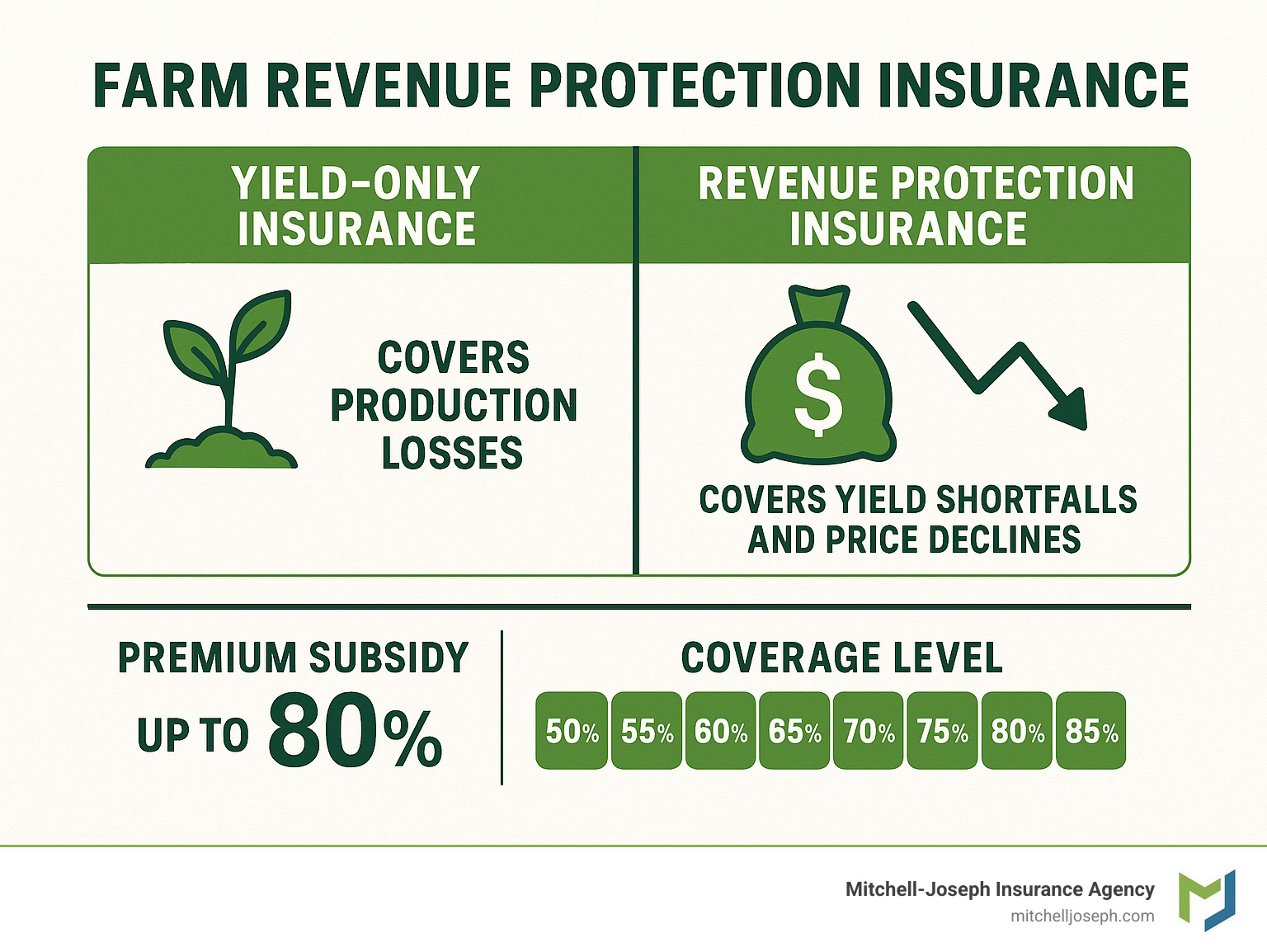
Farm revenue protection insurance is a federal crop insurance program that protects farmers against both yield losses and price declines by guaranteeing a minimum revenue level for their crops. Unlike traditional yield-only insurance, this coverage protects your farm’s income even when prices drop significantly.
Key Types of Farm Revenue Protection Insurance:
- Revenue Protection (RP) – Covers individual crops like corn, soybeans, wheat with 50-85% coverage levels
- Whole-Farm Revenue Protection (WFRP) – Insures all farm commodities under one policy up to $17 million in revenue
- Micro Farm – Simplified coverage for farms with up to $350,000 in revenue, ideal for direct-market operations
- Revenue Protection with Harvest Price Exclusion (RP-HPE) – Lower premium option that locks in projected prices
More than 75% of federal crop insurance policies sold today include some form of revenue protection. The program provides premium subsidies up to 80% for diversified operations, with the government paying the majority of your insurance costs.
I’m Jeffrey Joseph, owner of Mitchell-Joseph Insurance Agency, and I’ve been helping Finger Lakes region farmers steer farm revenue protection insurance options since 1999. Our team specializes in explaining complex agricultural insurance programs in simple terms.
Glossary for Farm revenue protection insurance:
– Commercial farm insurance NY
– Farm equipment insurance coverage
– Farm flood insurance coverage
What Is Farm Revenue Protection Insurance?
Farm revenue protection insurance is like having a financial safety net that catches your farm when things go wrong – whether that’s Mother Nature throwing you a curveball or market prices taking a nosedive. Unlike traditional crop insurance that only pays when your yields tank, this federal program protects your actual farm income by covering both production losses and price drops.
The program establishes a revenue guarantee based on your farm’s historical yields and current market prices. When your actual revenue falls below this guaranteed level due to covered disasters, you receive an indemnity payment to bridge the gap.
Farm revenue protection insurance explained
The formula is straightforward:
Revenue Guarantee = Approved Yield × Coverage Level × Price
Your approved yield comes from your farm’s historical average production over 4-10 years. The coverage level is the percentage of revenue you choose to insure, ranging from 50% to 85%. The price component uses either the projected price set in February or the harvest price determined in October, whichever puts more money in your pocket.
Example: If your corn APH is 175 bushels per acre, you select 80% coverage, and the price is $4.00 per bushel, your revenue guarantee would be $560 per acre (175 × 0.80 × $4.00).
If drought cuts your yield to 140 bushels and prices drop to $3.50, your actual revenue becomes $490 (140 × $3.50), triggering a $70 payment since you fall short of your $560 guarantee.
| Coverage Type | What’s Protected | Price Used | Best For |
|---|---|---|---|
| Yield Protection | Production losses only | Fixed price | Farms with stable markets |
| Revenue Protection | Yield + Price losses | Higher of projected/harvest | Most operations |
| RP-HPE | Yield + Price declines | Projected price only | Cost-conscious farmers |
How Farm revenue protection insurance differs from yield-only crop insurance
Traditional yield-only crop insurance pays when your production tanks, but completely ignores price risk. I’ve watched farmers harvest 90% of their expected crop only to find that market prices wouldn’t cover their costs.
Revenue protection includes price coverage that acknowledges real-world farming. The upside price factor uses whichever price benefits you more – the projected price set in February or the harvest price determined in October. If corn jumps from $4.00 to $5.00 during the growing season, your guarantee climbs with it.
This income stability smooths out wild year-to-year swings that can wreck cash flow. The harvest price can’t exceed 200% of the projected price, preventing extreme guarantee adjustments while maintaining meaningful protection.
Types of Policies & Which One Fits Your Farm
Choosing the right farm revenue protection insurance doesn’t have to be overwhelming. Each program serves different farm types and situations. Let me walk you through your main options.
Revenue Protection (RP) & RP-Harvest Price Exclusion
If you’re growing row crops like corn, soybeans, wheat, or barley, Revenue Protection is your go-to option. This program covers major commodities with straightforward coverage.
Standard Revenue Protection (RP) gives you full benefit when prices move in your favor. Your guarantee uses whichever price is higher – the projected price set in February or the harvest price determined in October.
RP with Harvest Price Exclusion (RP-HPE) is the budget-friendly option. You lock in that February projected price and give up upside potential, but pay lower premiums. This makes sense if you’re forward-contracting crops or keeping insurance costs manageable.
Both versions offer coverage levels from 50% to 85% of your expected revenue. You can structure coverage through basic units (combining all acres of the same crop in the county) or optional units (separating by individual farms). Enterprise units provide premium discounts by combining acres across multiple counties.
Whole-Farm Revenue Protection (WFRP)
Whole-Farm Revenue Protection is the Swiss Army knife of farm revenue protection insurance – it covers virtually everything you produce under one policy. This program insures your entire farm’s revenue, whether you’re growing specialty vegetables, raising livestock, or running diversified operations.
WFRP covers up to $17 million in total revenue, with sub-limits of $2 million each for animal production and greenhouse operations. The program rewards diversification with up to 80% government premium subsidies. The more diverse your operation, the better your subsidy rate.
The trade-off is more detailed record-keeping than traditional crop insurance. You’ll need to track inventory, accounts receivable, and accounts payable using accrual accounting methods.
For comprehensive information about protecting your entire operation, check out our farm insurance policy resources.
Micro Farm Program
Small-scale and beginning farmers often feel left out of traditional insurance programs, but the Micro Farm program changes that. If your operation brings in up to $350,000 in revenue, this simplified program cuts through red tape.
Instead of needing five years of production records, you only need three. Beginning and veteran farmers can borrow production records from similar operations to get started. All Micro Farm policies automatically qualify for whole-farm premium subsidies, providing significant cost savings for farmers market vendors, CSA operators, and farm stand businesses.
Recent 2025 updates have expanded eligibility and improved record-sharing provisions. Check out this 2025 WFRP and Micro Farm Update video for the latest details.
The key is matching your farm’s reality to the right program. A 2,000-acre corn operation needs different protection than a 50-acre diversified vegetable farm selling at farmers markets.
Eligibility, Coverage Levels & Premium Costs
Understanding who qualifies for farm revenue protection insurance and what it costs is crucial for making the best decision for your operation. The federal government makes this protection surprisingly affordable through generous subsidies.

Who qualifies & what’s required
Revenue Protection (RP) keeps things straightforward – you need to be eligible for federal benefits, have a Social Security number or tax ID, and provide production records going back 4-10 years.
Whole-Farm Revenue Protection (WFRP) requires five consecutive years of Schedule F tax forms to establish revenue history. Your total insurable revenue can’t exceed $17 million, with $2 million sub-limits for animal production and greenhouse operations.
The diversification test is crucial for higher WFRP coverage levels. To qualify for 80% or 85% coverage, you need at least three different commodities meeting minimum revenue thresholds.
Micro Farm programs simplify requirements for smaller operations. You only need three years of tax records, and your approved revenue must stay under $350,000. Beginning and veteran farmers can borrow production records from other operations.
Determining insured revenue & coverage levels
For Revenue Protection, it’s your historical average yield times your chosen coverage level times the applicable price. You can select coverage levels from 50% to 85% in 5% increments.
WFRP calculations use the lower of either your expected current-year revenue or your five-year historic average, adjusted for growth trends. The program includes an expansion adjustment allowing up to 35% revenue increases for growing operations.
Most clients choose 70-80% coverage levels as the sweet spot between protection and cost. Your optimal level depends on risk tolerance, cash flow needs, and premium comfort level.
Premium calculation & available subsidies
The federal government pays the majority of your premium through subsidies. At 50% coverage, the government pays 67% of your premium. Even at 80% coverage, the government covers 48% of costs.
WFRP offers even better subsidies for diversified operations – up to 80% government premium subsidies for farms with multiple commodities. Beginning farmers get an additional 10% premium discount across all programs.
The diversification discount considers how many qualifying commodities you produce and their contribution to total revenue. Each commodity must represent at least one-third of its equal revenue share to count separately.
For detailed WFRP information, check the official WFRP Fact Sheet from USDA Risk Management Agency.
Application, Record-Keeping & Key Deadlines
Successfully navigating farm revenue protection insurance requires understanding critical deadlines and maintaining proper documentation. Missing key dates can leave your farm unprotected when you need coverage most.
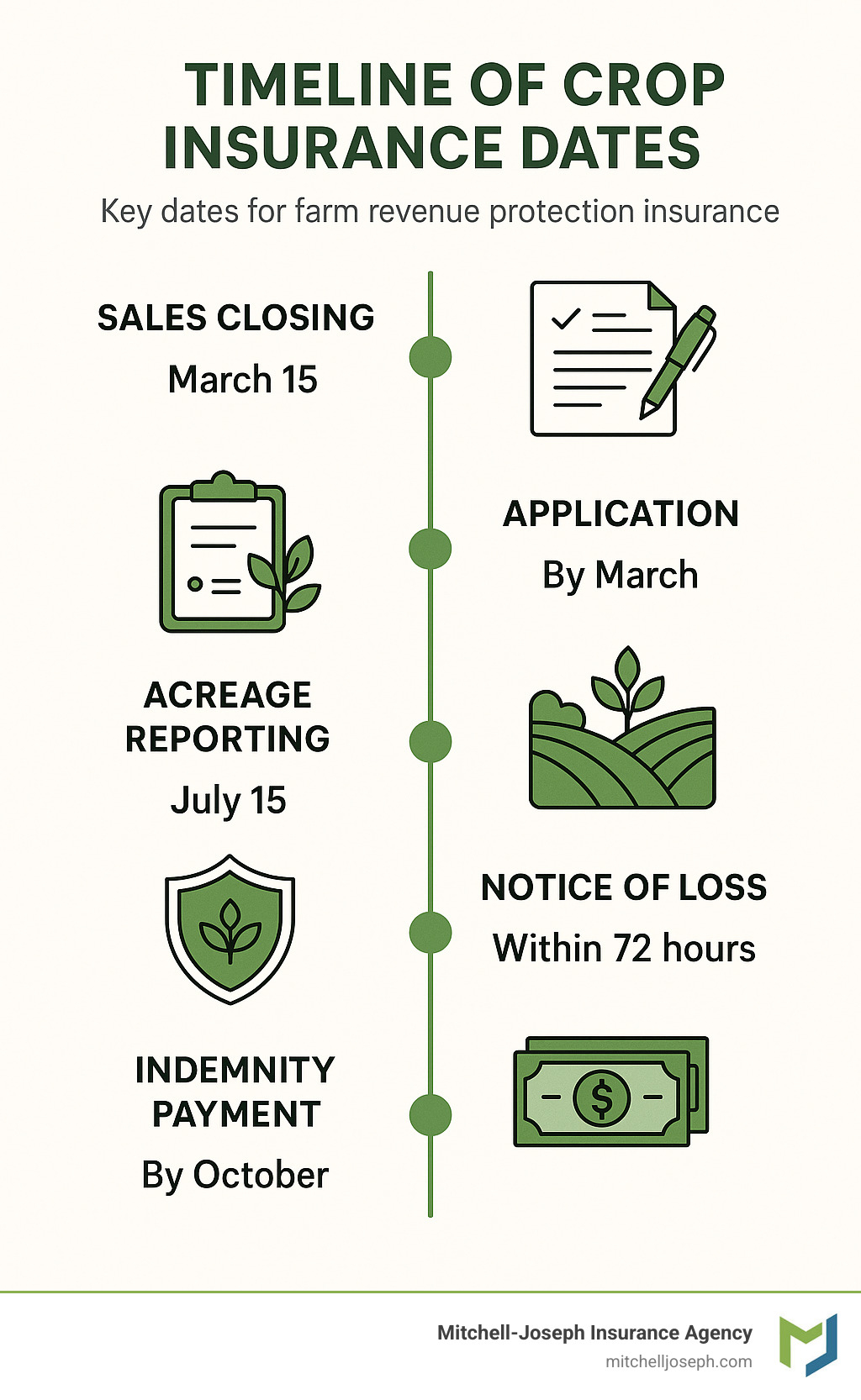
March 15 marks the sales closing date for most RP policies – your last chance to buy or modify coverage. July 15 is the acreage reporting deadline. If you find potential losses, you have 72 hours to file a notice of loss. You have 60 days after filing tax returns to submit your actual claim.
These deadlines aren’t suggestions – missing them can cost you substantial indemnity payments.
Required documentation & best practices
Proper record-keeping forms the backbone of successful crop insurance. For Revenue Protection, you need APH yield records spanning 4-10 years, detailed acreage reports, and production evidence like scale tickets.
WFRP documentation requires five consecutive years of Schedule F tax forms, detailed Whole-Farm History Reports, and current inventory reports. The Farm Operation Report outlining expected production and revenue is particularly important.
Micro Farm operations need only three years of tax records plus basic Expected Value and Yield Certification worksheets.
The golden rule: document everything as it happens. Take photos of damaged crops before cleanup. Keep detailed marketing records including contracts and receipts. Store copies in multiple locations.
Poor documentation can result in reduced settlements or denied claims. Quality records directly impact your ability to receive full indemnity payments.
Combining revenue protection with other risk tools
Farm revenue protection insurance works best as part of a broader risk management strategy. Federal programs like Noninsured Crop Disaster Assistance Program (NAP) cover crops not eligible for federal crop insurance, while Supplemental Coverage Option (SCO) provides area-based coverage.
Private insurance fills important gaps. Hail and wind coverage protects against specific weather perils. Your farm equipment needs separate protection through specialized coverage.
Financial tools complement insurance coverage. Forward contracting locks in prices for expected production, while futures and options help hedge price risk. Combined with revenue protection covering yield risk, you create comprehensive protection.
For information about protecting farm machinery, explore our Farm Equipment Insurance Coverage options.
Losses, Claims & How Prices Affect Payouts
When disaster strikes, knowing how farm revenue protection insurance handles losses and claims ensures you receive every dollar you’re entitled to under your policy.
Causes of loss & what’s NOT covered
Farm revenue protection insurance covers most of Mother Nature’s unwelcome visits. Covered perils include drought, excessive moisture, hail, damaging winds, killing frosts, insect infestations, plant diseases, fire, lightning, and wildlife damage.
One valuable aspect is price decline coverage. Even with decent yields, you’re protected when market prices crash below projected levels.
Prevented planting coverage kicks in when weather makes planting impossible by the final planting date, typically providing 50-60% of your full coverage guarantee.
However, the program excludes losses from negligent farming practices, failure to follow accepted methods, intentional crop destruction, post-harvest value-added activities, war, or nuclear hazards.
From shortfall to indemnity: the claims process
Filing successful claims requires following specific procedures and meeting critical deadlines.

The 72-hour notice requirement starts your claim process. Contact your insurance provider within 72 hours of finding that revenue may fall below the insured level, whether from production losses or market conditions.
Documentation and appraisal follow, with adjusters inspecting damaged crops. Leave representative samples unharvested until after inspection. For WFRP claims, detailed revenue calculations become crucial.
Tax filing creates unique requirements for WFRP policies. Complete and file farm tax returns before submitting claims, ensuring settlements use actual income rather than estimates.
Claim submission deadlines give you 60 days after filing tax returns to submit complete claims with detailed revenue calculations and supporting documentation.
Settlement calculations vary by policy type. For RP policies, indemnity equals guarantee minus actual production multiplied by harvest price. WFRP settlements compare insured revenue against revenue-to-count, including cash receipts, inventory values, and accounts receivable.
Payment timing requires insurance companies to pay valid claims within 30 days of loss determination, with interest on late payments. This helps maintain cash flow during challenging periods.
Frequently Asked Questions about Farm Revenue Protection Insurance
After helping Finger Lakes farmers steer farm revenue protection insurance for over two decades, here are the questions that come up most often.
What commodities can I insure under WFRP or Micro Farm?
WFRP and Micro Farm programs offer incredible flexibility. You can insure practically everything you grow or raise – from field corn and hay to specialty vegetables sold at farmers markets. We’ve helped clients cover organic lettuce, heirloom tomatoes, grass-fed beef, free-range eggs, greenhouse operations, nursery crops, fruits, berries, and honey production.
The program excludes timber and forest products, plus animals kept for sport, show, or pets. Beyond those exclusions, if you’re producing it for market, you can likely insure it.
This flexibility makes WFRP ideal for diversified operations. Instead of juggling multiple policies, you get comprehensive coverage under one umbrella.
How are diversification discounts calculated?
The government rewards meaningful diversification, not just token production. Each commodity must contribute at least one-third of what would be an equal revenue share to count separately.
With two commodities, each needs at least 16.7% of total farm revenue. Three commodities drops the threshold to 11.1% each. Four commodities means 8.3% each. Six commodities only requires about 5.6% each.
You can group smaller enterprises together to meet requirements. We’ve helped farmers combine small fruit production with vegetable sales to create qualifying commodity categories.
The reward is substantial – up to 80% government premium subsidies compared to much lower rates for single-commodity operations.
When should I file a notice of loss?
The 72-hour notice deadline causes more concern than any other aspect. When in doubt, make the call.
Notify your provider within 72 hours of finding crops damaged beyond economic repair, yields significantly below normal, or total farm revenue falling short of insured levels. For WFRP, this includes market price crashes even with decent production.
Think of “finding” as the moment you realize you might have a claim, not when you’re certain. Found hail damage? Call within 72 hours. Disease problems in tomatoes? Better to call now than wait.
Missing this deadline is the most common reason claims get denied, with usually no appeal process. We’d rather help you file unnecessary notices than miss one legitimate claim.
Conclusion
Farm revenue protection insurance has become the cornerstone of smart farming in America. When three out of four farmers choose revenue protection over traditional yield insurance, they’re recognizing that protecting farm income matters more than just protecting production.
You can grow a decent crop and still lose money if prices tank. Revenue protection prevents that scenario by covering both yield losses and price declines.
The programs offer real flexibility. Revenue Protection (RP) gives row crop farmers solid coverage with price upside participation. Whole-Farm Revenue Protection (WFRP) wraps diversified operations in comprehensive coverage, rewarding diversification. Micro Farm makes coverage accessible for smaller operations without excessive paperwork.
With premium subsidies reaching 80% for diversified farms, you get professional-grade protection at a fraction of the cost. Beginning farmers receive an extra 10% discount.
I’ve seen how farm revenue protection insurance saves operations during tough years – the vegetable grower who weathered drought because WFRP covered yield losses and market disruption, the grain farmer who stayed profitable despite COVID-19 price volatility.
The key is getting the right coverage for your specific operation. At Mitchell-Joseph Insurance Agency, we take time to understand your operation, risks, and budget, then design coverage that protects what matters most to your farm’s success.
Don’t wait until you’re facing damaged crops or crashed prices. The best time to fix the roof is when the sun is shining.
Our Honeoye Falls team has helped hundreds of Finger Lakes region farmers find the right coverage. We work with multiple insurance companies for competitive rates and speak plain English – no jargon required.
For comprehensive information about all your farm protection options, check out our More info about Insurance Coverage: Farm Insurance page.
Remember: successful farming isn’t just about growing great crops. It’s about managing risks that could wipe out years of hard work. Revenue protection gives you the tools to farm with confidence, knowing your income has a solid safety net underneath it.