Understanding Farm Insurance Policy Fundamentals
A farm insurance policy is a specialized insurance product that protects agricultural businesses from financial losses due to property damage, liability claims, and other risks specific to farming operations. Unlike standard homeowners insurance, farm policies provide comprehensive coverage custom to agricultural needs.
What a Farm Insurance Policy Typically Covers:
– Farm dwelling and personal property
– Outbuildings, barns, and structures
– Farm equipment and machinery
– Livestock mortality and injury
– Crop damage (through separate or integrated policies)
– Liability for farm operations and visitors
– Business interruption coverage
Farm insurance fills critical gaps that homeowners policies don’t address. While a standard homeowners policy might cover your residence, it explicitly excludes farm operations, equipment, and outbuildings used for business purposes. For farmers, this means potentially devastating financial exposure without proper coverage.
The cost of farm insurance varies widely based on your operation’s size and type, typically starting around $1,500 annually for small farms while larger operations require more substantial investment. Your premium will depend on factors including:
- Farm size and location
- Types of structures and their values
- Equipment and machinery inventory
- Livestock numbers and values
- Coverage limits and deductibles selected
- Previous claims history
A properly structured farm insurance policy protects not just your physical assets but your livelihood and family’s financial security. Whether you’re running a large production farm, a small hobby operation, or something in between, customized coverage ensures you’re protected against the unique risks your farm faces.
I’m Jeffrey Joseph, and I’ve been helping farmers across the Finger Lakes region find the right farm insurance policy solutions since 1999. As the owner of Mitchell-Joseph Insurance Agency with experience in agricultural coverage, I understand the unique risks New York farmers face and how to protect against them.
Farm Insurance vs. Homeowners Insurance: Know the Difference
When you’re running a farm—whether it’s a sprawling operation or a small hobby farm—having the right insurance coverage isn’t just smart, it’s essential. Many farmers make a costly mistake: assuming their regular homeowners policy has them covered. Let me walk you through why that thinking could leave you vulnerable.
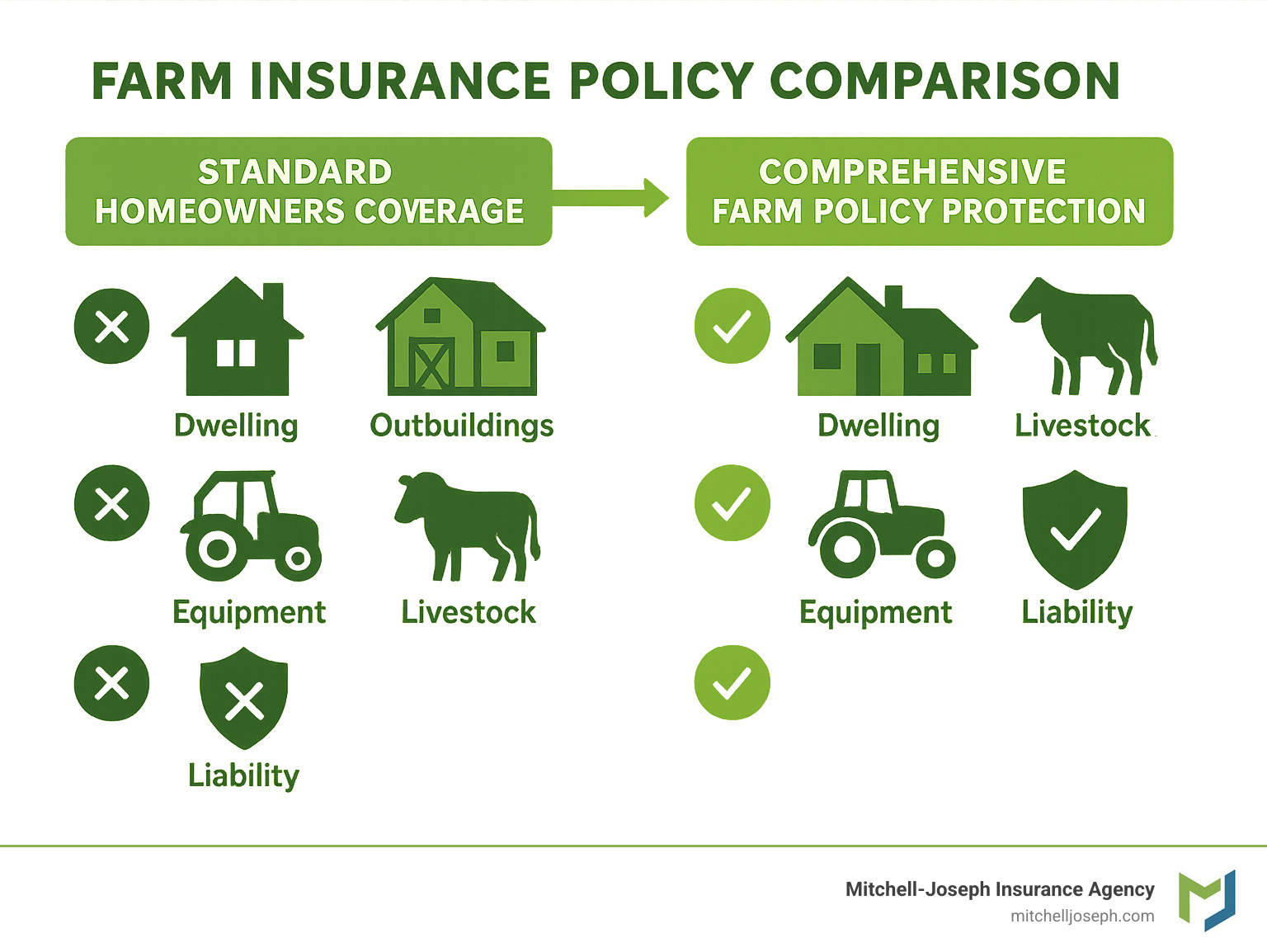
A farm insurance policy works differently than standard homeowners insurance because it recognizes the unique reality of farm life: your home and business often share the same address. Think of it as a special hybrid policy that bridges personal and commercial insurance needs under one roof.
| Coverage Type | Standard Homeowners Policy | Farm Insurance Policy |
|---|---|---|
| Main Dwelling | ✓ | ✓ |
| Personal Belongings | ✓ | ✓ |
| Detached Garage (personal use) | ✓ | ✓ |
| Farm Outbuildings | ✗ | ✓ |
| Farm Equipment & Machinery | ✗ | ✓ |
| Livestock | ✗ | ✓ |
| Farm Liability | ✗ | ✓ |
| Business Interruption | ✗ | ✓ |
| Crop Protection | ✗ | Optional |
| Vacant Land Liability | Limited | ✓ |
As you can see, standard homeowners policies simply weren’t designed with farmers in mind. They typically exclude those critical farm structures, equipment, and business activities that make your operation tick. Even the land itself becomes an issue—most homeowners policies have strict acreage limits (often between 5-10 acres). Exceed that, and you might need farm coverage regardless of whether you’re actively farming.
Why a Farm Insurance Policy Is Non-Negotiable
I’ve seen it happen too many times—a farmer thinks they’re fully covered, then disaster strikes, and they find their homeowners policy won’t help. A farm insurance policy isn’t just nice to have; it’s essential protection for your livelihood.
Your farm represents a significant investment. Those tractors, specialized buildings, and equipment are expensive to replace—and completely excluded under standard homeowners coverage. If someone gets injured on your property while visiting your farm stand or picking up a CSA share, farm liability coverage helps shield your assets from potentially devastating lawsuits.
When unexpected events like storms or fires interrupt your operation, business continuity coverage helps keep money flowing while you rebuild. And farming comes with unique risks—chemical drift concerns, pollution incidents, equipment breakdowns—that require specialized protection.
Here at Mitchell-Joseph Insurance Agency, we often remind our clients that your farm isn’t just where you work—it’s your heritage, your home, and your future. Protecting it properly isn’t optional; it’s necessary.
Can Hobby or Small Farms Rely on Homeowners Insurance?
If you have a small hobby farm, you might be wondering if you really need specialized coverage. The answer depends on several key factors.
Your homeowners insurance might be sufficient if farming is purely a personal hobby with no income generation, your equipment is minimal (valued under $5,000), your property is smaller than your insurer’s acreage limit (typically 5-10 acres), you don’t have farm employees or regular visitors, and you don’t sell any products.
However, you likely need a farm insurance policy if you make any income from farm activities (even selling eggs to neighbors), own specialized equipment like tractors, exceed your insurer’s acreage limitations, have farm structures like barns or greenhouses, sell products at farmers markets or from your property, or keep livestock beyond a few personal pets.
Even modest hobby farms typically benefit from proper farm coverage. Imagine your tractor gets stolen or your barn collapses under heavy snow—a standard homeowners policy would leave you completely unprotected for these significant losses.
The peace of mind that comes with knowing you’re properly covered allows you to focus on what you love—working your land—rather than worrying about financial exposure.
For more detailed information about specific coverage scenarios, check out our Farm Insurance 101: Frequently Asked Questions.
Core Coverages Inside a Farm Insurance Policy
When you’re investing in a farm insurance policy, you’re really buying peace of mind through a package of protections custom to agricultural life. Think of these coverages (often labeled A through G) as the building blocks that shield everything from your family home to your livelihood-supporting equipment.

Dwelling & Private Structures
Just like your neighbors with standard homeowners insurance, your farm insurance policy starts with protecting where you live. Your farmhouse (Coverage A) gets shielded against fire, wind, hail, and other covered disasters at replacement cost value—meaning if disaster strikes, you’ll be able to rebuild without emptying your savings.
What happens if a fire makes your home temporarily unlivable? Your policy has you covered there too. Additional Living Expenses coverage helps with hotel bills and extra costs while repairs happen, so your family’s life can continue with minimal disruption.
Beyond your main house, those personal-use structures like your detached garage for family vehicles or garden shed (Coverage B) typically receive automatic protection at about 10% of your dwelling coverage. And if your farm includes housing for workers or family members, we can specifically list those on your policy with appropriate limits.
The beauty of farm dwelling coverage? It’s woven seamlessly into your broader farm protection, often with more flexibility and better rates than if you purchased separate policies.
Farm Personal Property & Equipment
The tools that power your operation deserve serious protection. After all, without your equipment, your farm simply can’t function.
Your farm insurance policy safeguards tractors, combines, irrigation systems, and farm ATVs against threats ranging from fire and theft to collisions. That protection extends to the smaller but essential items too—your hand tools, power tools, spare parts, and supplies that keep operations running smoothly.
What about that tiller you borrowed from your neighbor? Many policies include limited coverage for borrowed equipment, though higher-value items might need special attention on your policy.
One of my favorite features to point out to clients is the automatic 30-day coverage (usually up to $50,000) for newly purchased equipment. This gives you breathing room to formally add items to your policy after bringing them home.
For modern farms with sophisticated equipment, equipment breakdown coverage is particularly valuable. It goes beyond external damage to cover those frustrating mechanical and electrical failures that standard coverage might exclude—essential protection for today’s high-tech farm machinery with complex electronics and hydraulics.
Want to dig deeper into equipment protection? Check out our Farm Equipment Insurance Coverage page for specialized options.
Livestock Insurance Deep Dive
For many of our farm clients, livestock represents both their heart and their wallet—a significant investment that deserves thoughtful protection. Your farm insurance policy typically shields your animals against multiple threats.
Mortality coverage protects against death from specific perils including fire, lightning, windstorms, theft, and accidental shooting. Transit protection kicks in during those vulnerable loading, unloading, and transportation periods. Weather-related perils like blizzards and floods, along with protection against attacks by dogs or wild animals, round out the core protections.
These coverages matter more than you might think. Statistics show roughly 12% of cattle deaths come from weather events, with another 12% from calving complications—making comprehensive coverage not just a nice-to-have but essential.
You’ve got options in how you structure this protection. Blanket coverage sets a single limit for all animals of a certain type, giving you flexibility as your herd changes. For those special animals—prize breeding stock or show animals—individual coverage lets you schedule them with specific values.
For farms with significant livestock operations, your basic farm insurance policy can work alongside specialized USDA plans like Livestock Risk Protection (LRP) and Livestock Gross Margin (LGM) that protect against market price declines. Learn more from the Latest research on USDA livestock plans.
Scheduled vs. Blanket Coverage—Which Works for You?
One of the biggest decisions when structuring your farm insurance policy is choosing between scheduled and blanket coverage for your property. I like to explain it this way: scheduled coverage is like making a detailed shopping list before going to the store, while blanket coverage is more like setting an overall budget for the trip.
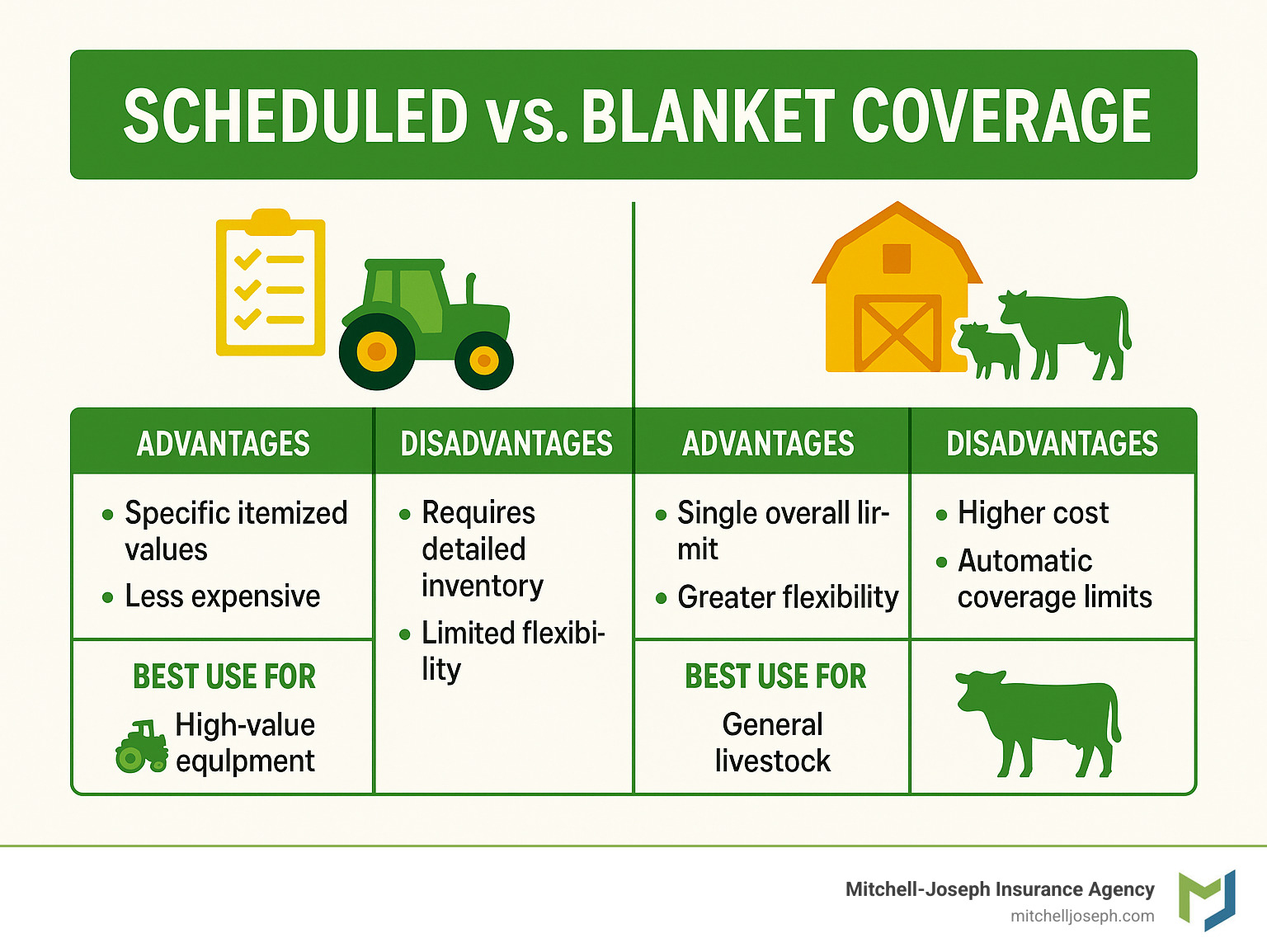
With scheduled coverage, you’re listing specific items with individual values. It’s generally less expensive for well-defined inventories and gives you certainty about coverage for high-value items. The trade-off? You’ll need to maintain detailed inventory records and update your policy as things change.
Blanket coverage sets a single limit for a category of property. While typically costing more, it offers wonderful flexibility as your property changes or rotates throughout the seasons, and automatically covers newly acquired items within limits.
At Mitchell-Joseph Insurance Agency, we find most farms do best with a thoughtful hybrid approach. You might use scheduled coverage for those expensive tractors and combines, blanket coverage for general farm tools and supplies, and individual scheduling for prize livestock with blanket coverage for the general herd.
Here’s a real-world example: Imagine a dairy farmer with a $50,000 blanket limit on farm equipment who loses their $25,000 tractor to irreparable damage. Even though replacement costs have risen to $30,000 since purchase, the blanket policy would cover the full replacement because it falls within the overall limit. With scheduled coverage, they might have been limited to the specific listed value unless they’d regularly updated their policy.
Liability & Specialized Endorsements
If there’s one part of your farm insurance policy you hope never to use but absolutely shouldn’t skimp on, it’s liability coverage. This protection shields your assets if someone sues you—potentially saving your entire operation from a devastating claim.
Standard farm liability typically protects you in three key areas: premises liability for injuries to visitors on your property, operations liability for claims arising from your farming activities, and products liability for issues related to items you sell (like at farmers markets or roadside stands).
Most farms start with at least $1 million in liability protection, though many operations benefit from higher limits or umbrella policies that provide extra layers of security.
Beyond standard liability, your farm might need specialized endorsements to address unique risks. If you welcome visitors for tours, U-pick experiences, or farm stays, an agritourism endorsement is essential. Farms that apply chemicals should consider chemical drift liability to cover damage to neighboring properties. If you perform agricultural services for others, a custom farming endorsement provides crucial protection.
Other important options include pollution liability for cleanup costs and third-party claims, and workers’ compensation if you have employees (required in most states).
For farms in flood-prone areas, don’t forget that standard policies exclude flood damage—making specialized coverage crucial. Learn more about Farm Flood Insurance Coverage to protect your investment from rising waters.
Building the Right Farm Insurance Policy Checklist
Creating a comprehensive farm insurance policy isn’t just about checking boxes—it’s about protecting your livelihood, your family’s future, and everything you’ve worked so hard to build. Let’s walk through what you need to consider when building the right coverage for your farm.

Start with a thorough risk assessment of your entire operation. What keeps you up at night? Is it the threat of a severe storm damaging your barns? A visitor getting injured during a farm tour? Or perhaps equipment breakdowns during harvest season? Understanding your specific risks helps us tailor protection that addresses your actual concerns, not generic coverage that misses what matters most to you.
Next, take time to inventory all your assets. I know it sounds tedious (and it can be!), but this step pays dividends if you ever need to file a claim. Document your buildings, noting construction type and use. List equipment with makes, models, and serial numbers. Count and categorize your livestock. And please, take photos of everything significant—they’re worth their weight in gold during claims time.
When determining coverage limits, think replacement cost, not what you paid years ago. Construction costs have skyrocketed in recent years, and that pole barn that cost $50,000 to build in 2010 might require $85,000 to replace today. The same goes for equipment—new tractors aren’t getting any cheaper! Be realistic about what it would take to get back up and running after a loss.
Deductibles deserve careful consideration too. They’re not just about saving a few bucks on premiums. Higher deductibles make sense for risks that would cause catastrophic damage (like a fire) but might be impractical for more frequent, smaller claims. We can help you find that sweet spot where your premium is manageable without leaving you exposed to financial strain.
Don’t overlook coinsurance requirements in your policy. Many farm policies require you to insure your property to at least 80% of its replacement value. Fall short of that, and you might face a penalty when filing a claim—even if the claim amount is less than your coverage limit. We can explain how this works and help you avoid this common pitfall.
Good record-keeping makes everything easier. Keep receipts for major purchases, maintenance records for equipment, and breeding records for livestock. Store copies in multiple places—including off-site or digitally—so you don’t lose everything in a disaster. These records prove invaluable not just for insurance claims but also for tax purposes and farm management.
Factors That Influence Premiums
Your farm insurance policy premium isn’t pulled from thin air—it’s calculated based on specific factors, many of which you can influence.
Location plays a huge role in your premium costs. Farms near fire stations typically pay less than those in remote areas. Weather patterns matter too—if your county has seen three major hailstorms in five years, that risk will be reflected in rates. Even local crime statistics and your property’s layout can affect what you pay.
The nature of your operation significantly impacts your premium. Dairy farms face different risks than vineyards. Large commercial operations have different exposure than small hobby farms. Some farming activities are simply riskier than others—raising livestock generally presents more liability concerns than growing hay, for instance.
Your claims history tells insurers a story about your operation. Multiple claims might suggest underlying issues with maintenance or safety practices. But don’t be afraid to use your insurance when you truly need it—that’s why you have it! At Mitchell-Joseph Insurance Agency, we can help you understand when it makes sense to file a claim versus handling a loss out-of-pocket.
Safety programs and risk management practices can earn you discounts. Simple improvements like installing security lighting, maintaining fire extinguishers, or implementing regular equipment maintenance schedules can lower your premiums while making your farm safer. Ask us about specific programs that might qualify you for reduced rates.
Multi-Location & Diversified Operations
Today’s farms rarely fit the simple model of yesteryear. If your operation spans multiple parcels or includes diverse business activities, your farm insurance policy needs to reflect this complexity.
For farms with multiple locations, we can typically structure a single policy that covers all your properties, even if they’re not adjacent to each other. This includes land you own and land you lease for farming. Your equipment remains covered as it moves between these locations, and liability protection follows your farming activities wherever they occur.
Diversified farm businesses need specialized coverage considerations. That roadside stand where you sell produce? It needs retail liability coverage. Offering farm tours or pumpkin patches? You’ll need agritourism endorsements. Making cheese or wine from your farm products? That’s a manufacturing exposure requiring specific coverage. Even CSA pickup sites, whether on your property or elsewhere, present unique liability concerns.
The beauty of working with an independent agency like Mitchell-Joseph is that we can build a single, comprehensive policy addressing all these elements. This approach not only simplifies administration (one policy to track instead of several) but often saves money compared to piecing together multiple separate policies.
How to Determine Adequate Coverage Amounts
Setting appropriate limits for your farm insurance policy requires balancing protection against cost. Here’s how to get it right:
For buildings and structures, focus on replacement cost, not market value or what you originally paid. Construction costs have increased dramatically in recent years, and that barn built for $100,000 fifteen years ago might cost $175,000 to rebuild today. Consider local construction costs, special features like custom equipment installations, and potential code upgrades that might be required if you need to rebuild.
When insuring equipment and machinery, newer items should generally be covered at replacement cost. For older equipment, consider whether actual cash value coverage makes more sense—particularly if you’d likely buy used replacements rather than new. For specialized or custom equipment that would be difficult to replace, make sure your coverage reflects this reality.
Livestock coverage needs to account for market fluctuations. Breeding stock typically commands premium values compared to market animals. Registered or show animals may have significantly higher values that should be documented and specifically scheduled. For production animals like dairy cows, consider their income-generating value beyond mere market price.
Don’t forget about business income protection. If a fire destroyed your main barn, how long would rebuilding take? What expenses would continue during that time? How would seasonal patterns affect your loss? Having adequate income protection can be the difference between weathering a disaster and facing financial ruin.
We strongly recommend an inflation guard endorsement that automatically increases your coverage limits to help keep pace with rising costs. For operations with seasonal inventory fluctuations—like grain storage after harvest—peak season endorsements can temporarily increase your limits during high-value periods.
At Mitchell-Joseph Insurance Agency, we understand that every farm is unique. We’re here to help you steer these complex decisions and build a farm insurance policy that truly protects what matters most to you.
Getting, Reviewing & Updating Your Farm Insurance Policy
Finding the right farm insurance policy shouldn’t feel overwhelming. Think of it as building a relationship that protects your livelihood—one that grows and changes along with your farm.
Steps to Secure a Farm Insurance Policy
The journey to proper farm coverage starts with good preparation. Before you make that first call, take some time to walk your property with fresh eyes. What would it cost to rebuild that barn your grandfather raised? How much has that tractor’s value increased since you bought it?
At Mitchell-Joseph Insurance Agency, we’ve guided hundreds of farmers through this process. Start by gathering documentation about your operation—your asset inventory, any existing policies, and notes about what keeps you up at night regarding your farm’s risks.
Choosing the right agent makes all the difference. Look for someone who speaks your language—someone who knows the difference between a heifer and a hog, and understands the unique challenges of farming in the Finger Lakes region. Farm-certified representatives bring specialized knowledge that general insurance agents simply can’t match.
When you meet with your agent (preferably walking your property together), be candid about your operation. The more your agent understands about your specific situation, the better they can tailor coverage to your needs. This isn’t just about checking boxes—it’s about protecting your legacy.
After your consultation, you’ll likely receive proposals from several insurance carriers. Take time to compare not just prices, but coverage details. The cheapest policy isn’t always the best if it leaves critical gaps in your protection. Look beyond the premium to consider company strength, claims reputation, and policy exclusions.
Once you’ve selected your coverage, the implementation process begins. Your agent should walk you through the paperwork, explain payment options, and ensure you understand exactly what you’re getting. When your policy documents arrive, read them carefully—or better yet, review them with your agent to clarify any questions.
What to Bring to Your Agent Meeting
When it’s time to sit down with your insurance agent, being prepared makes the conversation much more productive. Think of it as gathering ingredients before cooking a meal—having everything ready leads to better results.
Asset documentation forms the foundation of your farm policy. Bring your building list with construction details, equipment inventory showing make and model information, and livestock records. Recent appraisals for high-value items are particularly helpful in ensuring adequate coverage.
Your operational information helps your agent understand exposure levels. Be ready to describe your farming activities, revenue figures, and seasonal patterns. Does your operation swell with temporary workers during harvest? Do you process any products on-site? These details matter.
Property details provide context for risk assessment. Legal descriptions, acreage information, and property maps help your agent visualize your operation. Information about water sources and fire protection can impact your premium, as can security measures you’ve implemented.
Finally, bring your historical information including current policies and claims history. This background helps your agent identify patterns and suggest appropriate coverage adjustments.
Photos are worth a thousand words—and potentially thousands of dollars in proper coverage. A quick smartphone tour of your buildings, equipment, and livestock can dramatically improve the accuracy of your policy.
For more detailed information about available coverage options, visit our More info about insurance coverage: Farm Insurance page.
At Mitchell-Joseph Insurance Agency, we’ve simplified this process for farmers throughout our region. With access to 24 different insurance companies, we can shop around for you, finding the right blend of coverage and value. We’re not just selling policies—we’re protecting your way of life, your family’s future, and the farm you’ve worked so hard to build.
Frequently Asked Questions About Farm Insurance Policies
What are the most common exclusions I should watch for?
When reviewing your farm insurance policy, keep an eye out for these common exclusions that might leave you unexpectedly exposed:
Flooding is perhaps the most significant gap in standard coverage. I remember helping a client whose apple orchard was damaged when a nearby creek overflowed—unfortunately, his standard policy didn’t help. You’ll need separate coverage through the National Flood Insurance Program or specialized endorsements to protect against flood damage.
Earth movement presents another major exclusion. Whether it’s an earthquake, landslide, or sinkhole, these events typically aren’t covered unless you’ve specifically added this protection. In our hilly Finger Lakes region, this is something worth considering.
The gradual enemies of farm property—wear and tear, deterioration, rust, and rot—won’t trigger coverage either. Insurance is designed for sudden, accidental damage, not the inevitable effects of time and weather.
For livestock producers, be particularly careful about coverage limitations. Many basic policies exclude disease, sickness, and certain types of animal mortality. I’ve seen heartbreaking situations where farmers assumed these were covered, only to find otherwise when facing a significant loss.
Pollution cleanup costs often catch farmers by surprise. Unless the pollution was caused by a covered peril (like a fire), standard policies typically exclude these expenses. Given the environmental regulations farmers face today, specialized environmental impairment liability coverage might be worth considering.
Other common exclusions include market value fluctuations (when crops or livestock lose value due to market conditions rather than physical damage), intentional acts, and government-ordered seizures or destruction of property.
I always encourage my farm clients to brew a pot of coffee and carefully read through their policy’s exclusions section. Many of these gaps can be filled with the right endorsements or supplemental policies—just ask!
Can one policy cover multiple farm locations and my home?
Yes! One of the beautiful things about a comprehensive farm insurance policy is its ability to bring everything under one roof—your home, multiple farm locations (even non-adjacent ones), leased land you farm, structures and equipment at all sites, and liability arising from operations at any covered location.
I work with a dairy farmer outside Canandaigua who owns his home farm plus two separate parcels about five miles away. Rather than juggling multiple policies, we created a single farm package that covers everything—significantly simplifying his life and actually saving him money through package discounts.
This consolidated approach offers several advantages beyond just convenience. You’ll enjoy consistent coverage terms across all locations, eliminate potential coverage gaps between separate policies, and benefit from a single liability limit that follows your operations wherever they go.
When we’re setting up multi-location coverage, I’ll need some specific details about each property: exact addresses and legal descriptions, the distance between locations, what activities happen at each site, the values of buildings and contents, and what security measures you have at remote sites.
This information helps us craft a policy that accurately reflects your operation’s full scope and ensures you’re properly protected everywhere you farm. At Mitchell-Joseph Insurance Agency, we’ve become quite adept at creating these custom multi-location policies for farms throughout the Finger Lakes region.
How does crop insurance integrate with my farm package?
Crop insurance has its own personality compared to the rest of your farm insurance policy. While your main farm policy covers buildings, equipment, and liability, crop insurance specifically protects your harvests and the revenue they generate.
Most farmers find that crop insurance operates as a separate but complementary policy alongside their main farm coverage. One key difference: crop insurance is typically federally subsidized and regulated through the USDA Risk Management Agency, though private insurers like us sell and service the policies.
You’ll generally encounter two main types of crop coverage. Multi-Peril Crop Insurance (MPCI) protects against yield losses from various natural causes, while Crop-Hail Insurance specifically covers hail damage—which, as any farmer knows, can destroy months of work in minutes.
When it comes to protection options, you can choose Yield Protection (guaranteeing a percentage of your historical yield), Revenue Protection (covering both yield loss and price decline), or Whole-Farm Revenue Protection (which covers revenue from all commodities on your farm).
I always remind my clients about the strict enrollment deadlines for crop insurance. Unlike your main farm policy that renews annually, crop insurance has specific sign-up periods that vary by crop and region. Miss the deadline, and you’ll have to wait until next year.
The claims process works differently too. Crop insurance follows specific procedures and timelines that differ from standard property claims, often requiring pre-harvest assessments or yield comparisons.
When we sit down to review your farm risk management strategy at Mitchell-Joseph Insurance Agency, we’ll discuss both your standard farm policy and crop insurance needs together. This comprehensive approach ensures you don’t have costly gaps or unnecessary overlaps in your protection. After all, farming is challenging enough without insurance worries!
Conclusion
Securing a comprehensive farm insurance policy isn’t just about checking a box on your to-do list—it’s about protecting generations of hard work and ensuring your agricultural legacy continues despite whatever challenges come your way. Throughout this guide, we’ve explored how these specialized policies safeguard everything from your home to your equipment, livestock, and livelihood.
When properly structured, your farm insurance policy delivers something truly invaluable: peace of mind. Knowing that a single storm, accident, or lawsuit won’t financially devastate your operation allows you to focus on what you do best—farming. That security means being able to sleep at night even when severe weather is in the forecast or markets are volatile.
Here at Mitchell-Joseph Insurance Agency, we’ve walked alongside Finger Lakes farmers for decades, seeing how the right coverage has helped operations recover and thrive after losses. Our deep roots in the local agricultural community give us a unique understanding of the challenges New York farmers face, from harsh winters to evolving regulations and market pressures.
We recognize that your operation is unlike any other. The vineyard on the hillside, the multi-generation dairy farm, the expanding organic vegetable operation—each has distinct insurance needs that deserve personalized attention. With over 200 years of combined experience and relationships with 24 different insurance companies, we have the expertise and options to tailor protection that fits your specific situation and budget.
Our local presence across Honeoye Falls, Pittsford, Naples, Rushville, and throughout the region means we’re not just insurance providers—we’re your neighbors. We understand the unique regional challenges because we live with them too. When you call us, you’re speaking with someone who knows what farming in the Finger Lakes really means.
Don’t wait until after a loss to find gaps in your coverage. Let’s sit down together to review your operation and ensure your farm insurance policy truly protects what matters most—your farm, your family, and your future. The agricultural legacy you’ve built deserves nothing less than complete protection.
For more information about how we can help safeguard your farm operation, visit More info about farm insurance services.