Why Farm Flood Insurance Coverage is Critical for Agricultural Operations
Farm flood insurance coverage protects agricultural properties from devastating water damage that standard farm policies typically exclude. Here’s what you need to know:
Key Coverage Areas:
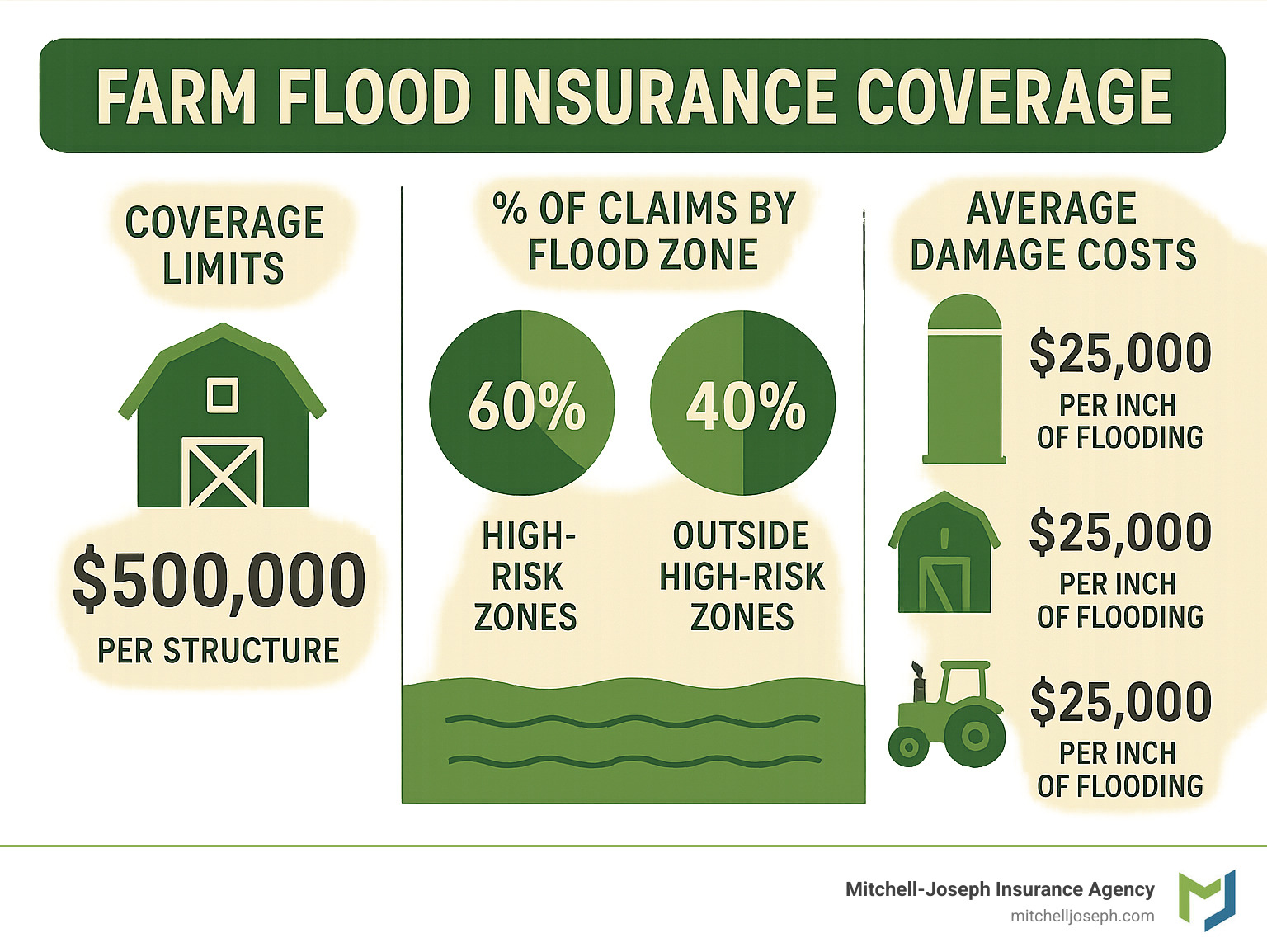
• Buildings – Barns, grain bins, machinery sheds ($500,000 max per structure)
• Contents – Equipment, harvested crops stored inside buildings ($500,000 max)
• Exclusions – Livestock, growing crops, fencing (unless added via endorsements)
• Requirements – Mandatory for high-risk flood zones with federally-backed mortgages
Policy Options:
• NFIP (National Flood Insurance Program) – Government-backed, standardized rates
• Private flood insurance – Higher limits, more flexible coverage options
• One building per policy rule – Separate policies needed for each structure
According to FEMA, just one inch of floodwater can cause up to $25,000 in damage. With 99% of U.S. counties experiencing flooding between 1996 and 2019, and over 40% of flood insurance claims coming from outside high-risk zones, no farm is truly safe from flood risk.
As farmers face increasingly unpredictable weather patterns, protecting your agricultural investment becomes more critical than ever. Whether you’re operating a small hobby farm or a large commercial operation, understanding your flood insurance options can mean the difference between recovery and financial ruin after a flood event.
I’m Jeffrey Joseph, and I’ve been helping farmers and agricultural businesses in the Finger Lakes region secure comprehensive insurance protection since 1999. Through Mitchell-Joseph Insurance Agency, I’ve guided countless clients through the complexities of farm flood insurance coverage to ensure their operations remain protected against nature’s unpredictability. Let me walk you through everything you need to know about safeguarding your farm against flood damage.
Quick Farm flood insurance coverage definitions:
– Commercial farm insurance NY
– Farm equipment insurance coverage
– farm insurance companies
Flood Risk & Regulations for Farms
Here’s a statistic that might surprise you: between 2014 and 2018, over 40% of flood insurance claims came from properties outside high-risk flood zones. As someone who’s worked with farmers across the Finger Lakes region for over two decades, I can tell you this isn’t just a number—it represents real families and businesses who thought they were safe from flooding.
The truth is, flood risk exists anywhere it rains. While we often think of flooding as something that happens “to other people” in designated flood plains, the reality is far different. Thirty-two percent of all flood insurance claims originate outside high-risk areas, proving that no farm is truly immune to water damage.
FEMA flood zones act like a risk report card for your property. High-risk zones get A and V designations, while moderate-to-low risk areas receive B, C, or X ratings. But here’s what many farmers don’t realize: even those “safer” zones still experience significant flooding. I’ve seen too many clients learn this lesson the hard way.
If you have a federally-backed mortgage on property in a high-risk zone, farm flood insurance coverage isn’t a choice—it’s required by law. Your lender will use something called the Standard Flood Hazard Determination Form to check whether your property needs coverage. This applies to any structure with two or more permanent walls fixed to the ground.
Skip this requirement, and you’ll face force-placed coverage at your expense. These policies typically cost three to four times more than if you’d purchased the insurance yourself. Trust me, it’s much better to be proactive about this.
Finding Your Flood Zone
Finding your farm’s flood zone starts with a simple online search at FEMA’s Map Service Center. Just type in your property address, and you’ll see exactly where you stand risk-wise. The maps now use Risk Rating 2.0, which is much smarter than the old system.
This newer approach looks at your specific property characteristics, not just general area risk. It considers how far you are from water sources, your elevation and grade, local drainage patterns, and historical flood data. It’s like getting a personalized risk assessment instead of a one-size-fits-all rating.
Your community must participate in the National Flood Insurance Program for you to buy NFIP coverage. Over 23,000 communities currently participate, but it’s worth double-checking your area’s status. Participating communities agree to enforce floodplain management rules, which can affect any new construction you’re planning.
An elevation certificate can be your secret weapon for lower rates. This survey document shows exactly how high your buildings sit compared to expected flood levels. If your structures are liftd above the Base Flood Elevation, you could see significant premium savings. It’s worth the investment to find out.
Who Must Buy Flood Insurance?
Flood insurance becomes mandatory when you have a federally-backed mortgage in high-risk zones (A or V areas). This requirement kicks in for new mortgages, refinancing, home equity loans, or any increase in your loan amount.
However, some exemptions exist. Loans under $5,000 with terms of one year or less don’t require flood coverage. State-owned properties with adequate self-insurance and detached non-residential structures on residential property (that aren’t used as residences) also get a pass.
Even if you’re not required to carry flood insurance, I strongly recommend it anyway. Latest research on U.S. flood zones shows that properties in low-to-moderate risk areas are five times more likely to experience flood damage than fire damage over a 30-year period.
Think about it this way: you wouldn’t drive without car insurance, even if you’re a careful driver. The same logic applies to farm flood insurance coverage—it’s protection against the unexpected that can save your operation when nature doesn’t cooperate.
Farm Flood Insurance Coverage
When it comes to farm flood insurance coverage, you’re dealing with something completely different from protecting a typical home. Your agricultural operation has unique challenges—multiple buildings scattered across your property, expensive specialized equipment, and stored products that represent months of hard work and investment.
The National Flood Insurance Program (NFIP) has been the backbone of flood protection since 1968. It defines a flood as “a general and temporary condition where two or more acres of normally dry land get covered by water from overflow, unusual runoff, or mudflow.” That sounds technical, but basically it means water where it shouldn’t be, affecting a significant area.
Here’s something that surprises many farm owners: the one-building-per-policy rule. If you have a house, barn, grain bin, and machinery shed, you need four separate NFIP policies. It’s not like your regular farm insurance where everything gets bundled together. This rule can really add up cost-wise, so planning ahead becomes crucial.
NFIP policies work with two types of protection. Building coverage handles the structure itself and anything permanently attached to it. Contents coverage protects the movable stuff inside—your equipment, harvested grain in storage, and other inventory. For farmers, this distinction matters a lot when you’re thinking about that expensive combine in the barn or the grain you’ve got stored up.
The good news is that private flood insurance has really expanded lately. These companies can offer higher coverage limits and more flexible terms than NFIP. Sometimes they even beat NFIP rates for lower-risk properties. But every private policy is different, so you need someone who really understands agricultural risks to help you steer the options.
What Does Farm Flood Insurance Coverage Include?
Farm flood insurance coverage protects the heart of your operation, starting with your dwellings and farm structures. This includes your main residence, barns and livestock facilities, grain storage buildings, equipment storage sheds, and any processing facilities you might have.
When it comes to farm equipment and contents, you’re covered for tractors and machinery stored inside insured buildings, harvested crops in storage, feed and seed inventory, fuel tanks and irrigation equipment, plus all your tools and maintenance equipment. The key word here is “inside”—outdoor equipment faces different rules.
Your infrastructure elements get protection too. Well water systems and pumps, electrical systems and generators, heating and cooling systems, and concrete floors and foundations all fall under coverage. These systems might not seem glamorous, but replacing them after flood damage gets expensive fast.
But here’s where it gets tricky. Standard flood policies have some big gaps for farms. Fencing—which can represent a huge investment on livestock operations—typically gets excluded unless you specifically add it through endorsements. Outdoor equipment, vehicles with license plates, and anything stored in basements generally won’t be covered either.
Most farms need to supplement their basic flood coverage with additional endorsements to get truly comprehensive protection. More info about x services can help you understand how equipment coverage works alongside flood protection.
Farm Flood Insurance Coverage Limits & Exclusions
NFIP sets specific limits for non-residential buildings, which includes most farm structures. You can get up to $500,000 in building coverage per structure and up to $500,000 in contents coverage per structure. While that might sound like a lot, it can fall short for large agricultural operations.
Think about it—a modern dairy barn with automated milking systems can easily cost more than $500,000 to replace, and that’s before you count the contents. This is exactly where private flood insurance becomes valuable, offering much higher limits when you need them.
The major exclusions under NFIP include some things that really matter to farms. Livestock and poultry aren’t covered, nor are growing crops and standing timber. Fencing, landscaping, and outdoor equipment get excluded, along with currency, precious metals, and valuable papers. Vehicles licensed for road use and property in basements (with very limited exceptions) are also out. Plus, you won’t get business interruption or loss of use coverage.
Here’s something important about how claims get paid. NFIP typically provides actual cash value coverage, which means they factor in depreciation. For expensive farm machinery, this can leave you with substantial out-of-pocket costs when you need to replace equipment.
You can choose deductibles ranging from $1,000 to $50,000 for non-residential properties. Higher deductibles lower your premiums but increase what you pay out of pocket during a claim. We usually help farmers balance this based on their cash flow and comfort level with risk.
More info about flood insurance limits gives you additional details on making the most of your coverage within NFIP’s framework.
Bridging the Gaps with Endorsements
Smart farm owners use endorsements to fill the holes that standard flood policies leave behind. These add-ons can make the difference between adequate protection and real peace of mind.
Scheduled equipment coverage lets you list specific high-value machinery with guaranteed replacement values. Refrigeration coverage becomes critical for dairy operations, protecting against spoilage when power goes out after flood damage. Business income protection covers the revenue you lose when flood damage shuts down operations—and that recovery period can stretch for weeks or months.
Fencing riders are essential if you run livestock operations with significant fence investments. Sewer and drain backup coverage handles damage when drainage systems get overwhelmed during heavy rains. Through private insurers, you can even get livestock mortality coverage to protect against animal losses and crop hail insurance to complement your flood protection for growing crops.
You’ll face a choice between scheduled and blanket coverage approaches. Scheduled coverage lists individual items with specific values, giving you guaranteed replacement cost but requiring detailed record-keeping. Blanket coverage provides a single dollar limit you can apply flexibly across different items—more convenient, but potentially limiting for high-value equipment.
For dairy operations, refrigeration endorsements become absolutely critical. When flood damage knocks out power, you can lose thousands of dollars in spoiled milk and damaged equipment. Business income endorsements help replace lost revenue during recovery, which often takes much longer than farmers expect.

Buying, Costs & Claims Management
The 30-day waiting period for NFIP policies is one of the most important timing considerations in flood insurance. Coverage typically doesn’t begin until 30 days after purchase, unless you’re buying at mortgage closing or due to a flood map change. This waiting period has caught many farmers off guard when they try to purchase coverage as storms approach.
Premium costs depend on multiple risk factors:
– Property location and flood zone
– Building elevation relative to Base Flood Elevation
– Construction type and age
– Coverage amounts and deductible levels
– Claims history
Risk Rating 2.0 has changed how NFIP calculates premiums, moving away from simple flood zone designations to property-specific risk factors. This means two farms in the same flood zone might pay significantly different premiums based on their individual characteristics.
Elevation and mitigation discounts can substantially reduce premiums. Farms that lift utilities above the Base Flood Elevation, install flood vents, or implement other approved mitigation measures may qualify for significant premium reductions. An elevation certificate documenting these improvements is essential for securing these discounts.
Multi-policy strategies can also reduce overall insurance costs. Many insurers offer discounts when you bundle flood coverage with your existing farm insurance policies. At Mitchell-Joseph Insurance Agency, we work with 24 different insurance companies to find the best combination of coverage and pricing for each client’s unique situation.
Proper claim documentation starts before the flood occurs. We recommend that all our farm clients maintain detailed photo inventories of their buildings, equipment, and stored products. Digital records stored in cloud-based systems ensure documentation survives flood damage and speeds the claims process.
The NFIP claim timeline requires prompt action. You must notify your insurance company as soon as possible after flood damage occurs, and you have 60 days to submit a signed, sworn proof of loss statement. Delays in this process can jeopardize your claim payment.
More info about flood insurance and Flood Insurance Claim Process provide comprehensive guidance on managing the insurance and claims process effectively.
NFIP vs Private: Choosing a Policy
The choice between NFIP and private flood insurance depends on your specific needs and risk profile. NFIP operates through the Write-Your-Own (WYO) program, where private insurers sell and service policies using standardized NFIP forms and rates. This means you’ll pay the same premium for NFIP coverage regardless of which company you choose.
NFIP Advantages:
– Standardized, government-backed coverage
– Available in all participating communities
– Consistent pricing across all providers
– Established claims process
Private Insurance Advantages:
– Higher coverage limits (often $10 million or more)
– More flexible policy terms
– Potential for lower rates on good risks
– Additional coverage options (business interruption, etc.)
– No waiting period restrictions
Private flood insurance underwriting varies significantly between companies. Some focus on preferred risks in lower flood zones, while others specialize in high-risk properties that need coverage above NFIP limits. Working with an independent agency like ours gives you access to multiple private flood options alongside NFIP coverage.
For large agricultural operations, private insurance often provides better value despite potentially higher premiums. The ability to secure adequate limits for expensive farm buildings and equipment can justify the additional cost, especially when combined with broader coverage options.
Financial institutions like Farm Bureau Bank often have relationships with specific flood insurance providers, but you’re not required to use their recommended insurers. Shopping around through an independent agent ensures you see all available options.
Filing a Successful Claim

Successful flood insurance claims start with proper preparation and prompt action. Here’s our recommended process:
Pre-Loss Preparation:
– Maintain detailed photo inventories of all insured property
– Keep receipts and documentation for equipment purchases
– Store important documents in waterproof, accessible locations
– Understand your policy coverage and limits
Immediate Post-Loss Actions:
– Ensure safety first—don’t enter flooded buildings until authorities confirm it’s safe
– Contact your insurance company or agent immediately
– Document damage with photos and videos before cleanup
– Separate damaged property from undamaged items
– Keep receipts for emergency repairs and living expenses
Claims Process Management:
– Cooperate fully with the insurance adjuster
– Provide requested documentation promptly
– Submit your sworn proof of loss within 60 days
– Keep detailed records of all claim-related communications
The proof-of-loss 60-day rule is strictly enforced. This sworn statement must include detailed information about damaged property, repair estimates, and supporting documentation. Missing this deadline can result in claim denial, regardless of the validity of your loss.
Debris removal coverage under NFIP is limited but can be improved through endorsements. Farm operations often generate substantial debris during floods, from damaged feed to destroyed equipment. Understanding these limits helps you budget for cleanup costs.
FEMA mitigation grants may be available after presidentially declared disasters. These grants can fund improvements that reduce future flood risk, such as elevating buildings or installing flood-resistant materials. The grants require matching funds but can significantly improve your property’s resilience.
Frequently Asked Questions about Farm Flood Insurance Coverage
Do standard farm or homeowners policies pay for flood damage?
This is probably the most common misconception we encounter at Mitchell-Joseph Insurance Agency. Standard farm and homeowners insurance policies absolutely do not cover flood damage. This exclusion is written into every single policy across the insurance industry, and there are no exceptions.
The confusion often comes from the difference between water damage from internal sources versus external flooding. If a pipe bursts in your barn, that’s covered. If the creek behind your property overflows and floods your barn, that’s not covered without separate farm flood insurance coverage.
We’ve seen too many farmers find this the hard way after a flood event. Don’t let this be you – flood coverage requires a separate policy, period.
How can I tell if my hay barn needs a separate flood policy?
Here’s where that one-building-per-policy rule really matters. Every structure you want to protect needs its own flood policy, including your hay barn. The real question isn’t whether you can get coverage – it’s whether you should.
Think about what you’d lose if floodwater destroyed your hay barn tomorrow. The structure itself might be worth $75,000 to rebuild. Add in the hay stored inside – maybe another $40,000 during peak season. Then consider the equipment you keep there: balers, mowers, and other machinery.
Now compare that potential loss to the annual premium. For most hay barns, flood insurance runs between $400 and $1,500 per year depending on your location. When you’re looking at protecting $100,000+ in assets, that premium often makes perfect sense.
The farms that skip hay barn coverage usually regret it later. Hay burns easily and floods completely – it’s often a total loss when water gets in.
Are livestock or standing crops ever covered under flood insurance?
NFIP flood policies specifically exclude both livestock and growing crops. This catches many new farmers off guard, especially those coming from other industries where “comprehensive” coverage actually means comprehensive.
But you’re not completely out of luck. Livestock mortality insurance can cover animals that die from drowning, though you’ll need to shop the private market for this coverage. These policies vary widely, so work with an experienced agent who understands agricultural risks.
For growing crops, federal crop insurance through the USDA’s Risk Management Agency often includes flood damage to standing crops. This is completely separate from property flood insurance, but it can protect your investment in planted fields.
Here’s what flood insurance will cover: harvested crops stored inside insured buildings count as contents. That grain in your bins or hay in your barn gets covered up to your contents limit. Feed stored in silos or processing equipment used for crops also qualifies for contents coverage.
The key is understanding that flood insurance protects buildings and what’s stored inside them. For everything else on your farm, you need specialized agricultural coverage that goes beyond basic flood protection.

Conclusion
After decades of helping farmers across the Finger Lakes region, I’ve learned that farm flood insurance coverage isn’t just another policy—it’s peace of mind wrapped in a contract. When a client calls me after a flood, devastated but protected, I’m reminded why this coverage matters so much.
The numbers tell a sobering story. With 99% of U.S. counties experiencing flooding between 1996 and 2019, and just one inch of water capable of causing $25,000 in damage, flood risk touches every agricultural operation in America. Yet many farmers still operate without adequate protection, either because they don’t understand their risk or they’re overwhelmed by the complexity of flood insurance.
Agricultural flood insurance is genuinely complex. The one-building-per-policy rule catches people off guard. The difference between NFIP and private coverage confuses even experienced farm owners. Understanding which endorsements you need and which exclusions might hurt you requires someone who speaks both insurance and agriculture fluently.
That’s where our 200+ years of combined experience at Mitchell-Joseph Insurance Agency makes a real difference. We’ve walked through flooded barns with clients, helped them steer claims, and celebrated when their coverage worked exactly as intended. Our relationships with 24 insurance companies mean we can find solutions whether you need basic NFIP coverage for a small hay barn or million-dollar private policies for a large dairy operation.
Being an independent agency changes everything. We’re not tied to one insurance company’s products or limitations. If NFIP coverage limits aren’t enough for your operation, we have private flood options. If you need specialized endorsements for livestock mortality or business income, we can find carriers who understand agricultural risks.
Whether you’re farming 50 acres in Victor or running a commercial operation in Canandaigua, flood risk doesn’t discriminate. The question isn’t whether flooding might affect your area—it’s whether you’ll be financially prepared when it happens.
Farm flood insurance coverage represents more than protection for buildings and equipment. It’s protection for your family’s livelihood, your community’s food supply, and the agricultural heritage that defines our region. The investment you make today in proper coverage will pay dividends for generations.
Don’t wait for the next weather forecast to start worrying about flood protection. Contact us today for a comprehensive review of your current situation. We’ll explain your options clearly, help you understand what you really need, and build a protection strategy that fits your operation and budget.
Your farm deserves the same level of care and attention you give your crops and livestock. Let us help you protect it all.
More info about Farm Insurance to explore additional coverage options that complement your flood protection strategy.