

Why Healthcare Practices Need Protection from Rising Cyber Threats
Cyber insurance for medical practices has become critical protection as healthcare faces the highest average data breach costs of any industry – reaching $10 million per incident. With stolen health records worth 10 times more than credit card data on the dark web, medical practices are prime targets for cybercriminals.
Key Coverage Areas:
- First-Party Coverage: Breach response, forensic investigation, patient notification, credit monitoring, data restoration, business interruption
- Third-Party Coverage: Regulatory defense (HIPAA violations), patient lawsuits, liability claims
- Cyber Extortion: Ransomware payments, negotiation services, system restoration
- Regulatory Fines: HIPAA penalties up to $50,000 per violation, maximum $1.5 million annually
Average Costs & Claims:
- Healthcare cyber claims average $161,000
- Ransomware losses average $265,000
- 40% of attacks originate from email inboxes
- Human error and rogue employees cause 58% of incidents
Healthcare organizations made up 38% of all cyber insurance claims over the past decade, with ransomware accounting for 33% of all attacks. Unlike general liability or malpractice coverage, cyber insurance specifically addresses digital risks including electronic health record breaches, system downtime, and regulatory compliance costs.
I’m Jeffrey Joseph from Mitchell-Joseph Insurance Agency, and I’ve been helping healthcare practices across the Finger Lakes region secure comprehensive insurance protection since 1999. Through our experience with cyber insurance for medical practices, we’ve seen how proper coverage prevents financial devastation when cyberattacks disrupt patient care and trigger regulatory penalties.
Why Medical Practices Are Prime Targets
Medical practices offer everything a hacker could want: valuable data, busy staff, and complex systems that are often vulnerable to attack.
Protected Health Information (PHI) is digital gold to cybercriminals. Patient records contain Social Security numbers, birthdates, addresses, insurance information, and detailed medical histories. This information sells for ten times more than stolen credit card data on the dark web because it can be used for identity theft, insurance fraud, and medical fraud for years.
Most cyber incidents come from inside your practice. Research shows that human errors and rogue employees combined account for 58% of all healthcare cyber incidents, while only 9% result from external hacks. This doesn’t mean your staff are bad people – it means they’re human, and humans make mistakes.
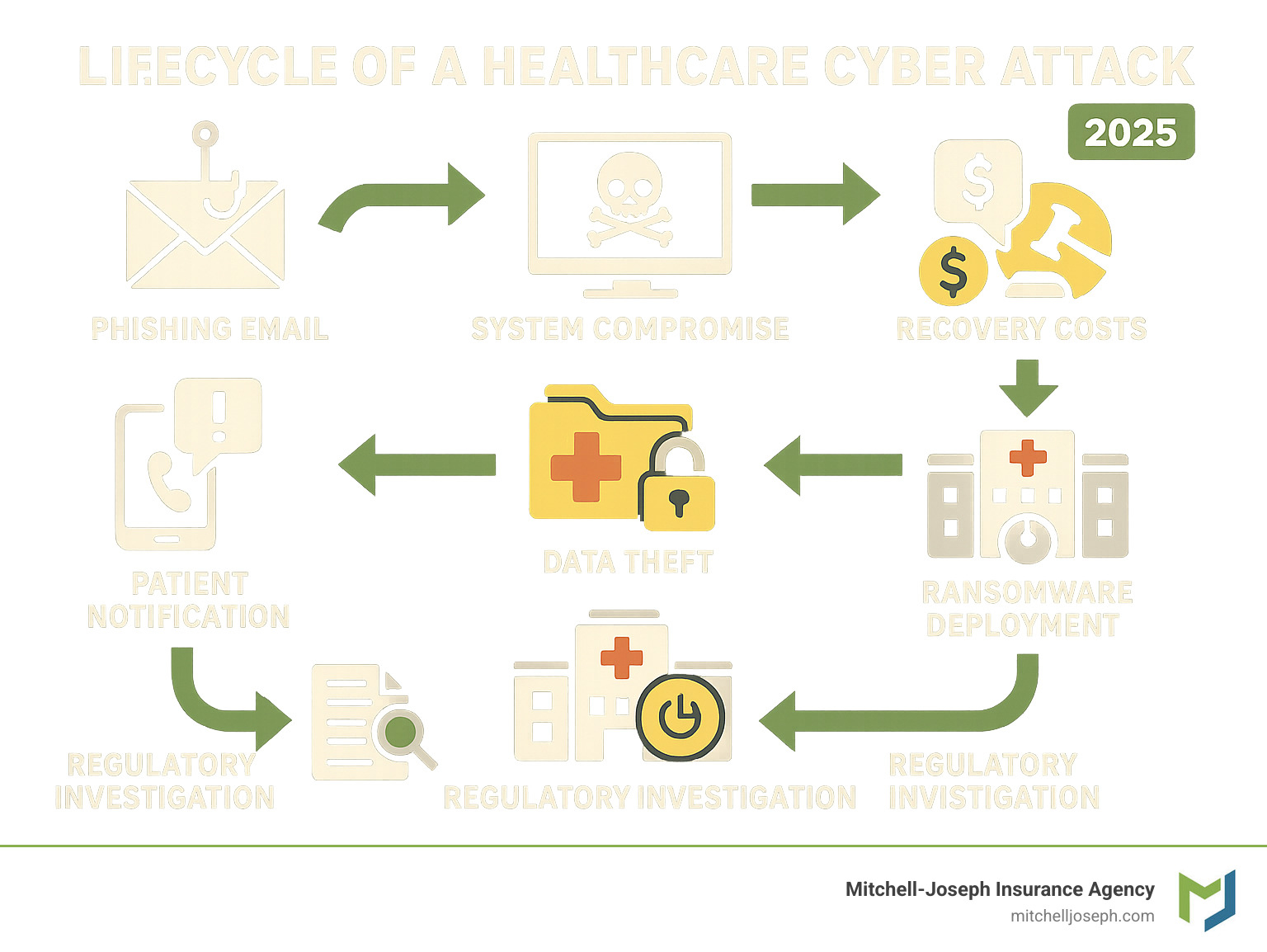
Email remains the highway for cyberattacks, with 40% of attacks on healthcare businesses starting in someone’s inbox. Today’s phishing emails look incredibly legitimate, impersonating everything from your EHR vendor to the Department of Health.
The explosion of connected medical devices adds another layer of risk. Studies reveal that 79% of medical devices are used regularly but 53% contain critical vulnerabilities. Every connected device creates another potential entry point for attackers.
The regulatory environment makes things worse. HIPAA violations can result in fines up to $50,000 per violation, with maximum annual penalties reaching $1.5 million. According to IBM’s research on data breach costs, healthcare consistently faces the highest average breach costs of any industry.
Anatomy of a Healthcare Breach
Human error incidents are heartbreakingly common. An employee accidentally emails patient information to the wrong person, or someone loses a laptop containing PHI. One case involved a practice that accidentally mailed tax forms to the wrong addresses, exposing hundreds of patients’ personal information.
Rogue employee actions create some of the most damaging breaches. When staff members have legitimate access to patient records, they can cause enormous damage if they choose to misuse that access.
Ransomware attacks typically start with an innocent-looking email but quickly escalate to lock down entire systems. One podiatry practice lost access to 20 servers and 95 workstations, racking up $165,100 in forensics, business interruption, data recovery, and ransom costs.
Supply chain compromises happen when vendors with access to your systems get hacked. When a service provider’s laptop containing 800,000 client records was stolen, the resulting breach cost $5 million. Courts consistently hold the original healthcare provider – not the vendor – primarily responsible for breach liabilities.
Operational & Financial Fallout
When cyberattacks hit medical practices, the immediate chaos disrupts everything – patient records become unreachable, appointments get cancelled, and staff scramble to provide care using paper charts they may not have touched in years.
Patient care suffers immediately. Critical medical information becomes inaccessible exactly when you need it most. Some practices have had to redirect patients to other facilities because their systems were completely down.
The financial hit compounds quickly. Beyond forensic investigation and system restoration costs, practices face lost revenue from cancelled appointments and dramatically reduced efficiency. Some practices report operating at 50% capacity for weeks while systems are rebuilt.
Reputational damage often proves the most lasting consequence. Patients lose trust when their personal health information is compromised, leading to patient attrition that can take years to recover from.
The average cost of a healthcare data breach reaches $10 million when all direct and indirect costs are calculated. That’s why cyber insurance for medical practices has become essential protection rather than optional coverage.
Essential Coverages in a Cyber Policy
When you’re shopping for cyber insurance for medical practices, you’ll find that coverage splits into two main categories that work together to protect your practice from every angle of a cyber incident.
First-party coverage handles all the direct expenses your practice faces when dealing with a breach – the forensic investigators, patient notifications, credit monitoring services, and lost revenue while your systems are down.
Third-party coverage protects you from legal claims and regulatory actions that others bring against your practice. This includes HIPAA fines, patient lawsuits, and regulatory defense costs.
| Coverage Type | What It Covers | Example Costs |
|---|---|---|
| First-Party | Your direct expenses from a breach | Forensics: $50,000-$150,000 |
| Patient notification: $5-$15 per person | ||
| Credit monitoring: $20-$30 per person | ||
| Business interruption: $5,000-$50,000/day | ||
| Third-Party | Legal claims others make against you | HIPAA fines: Up to $50,000 per violation |
| Patient lawsuits: $100,000-$1,000,000+ | ||
| Regulatory defense: $25,000-$200,000 |
First-Party Protections for Cyber Insurance for Medical Practices
When a cyber incident hits your practice, first-party coverage kicks in immediately to handle urgent expenses.
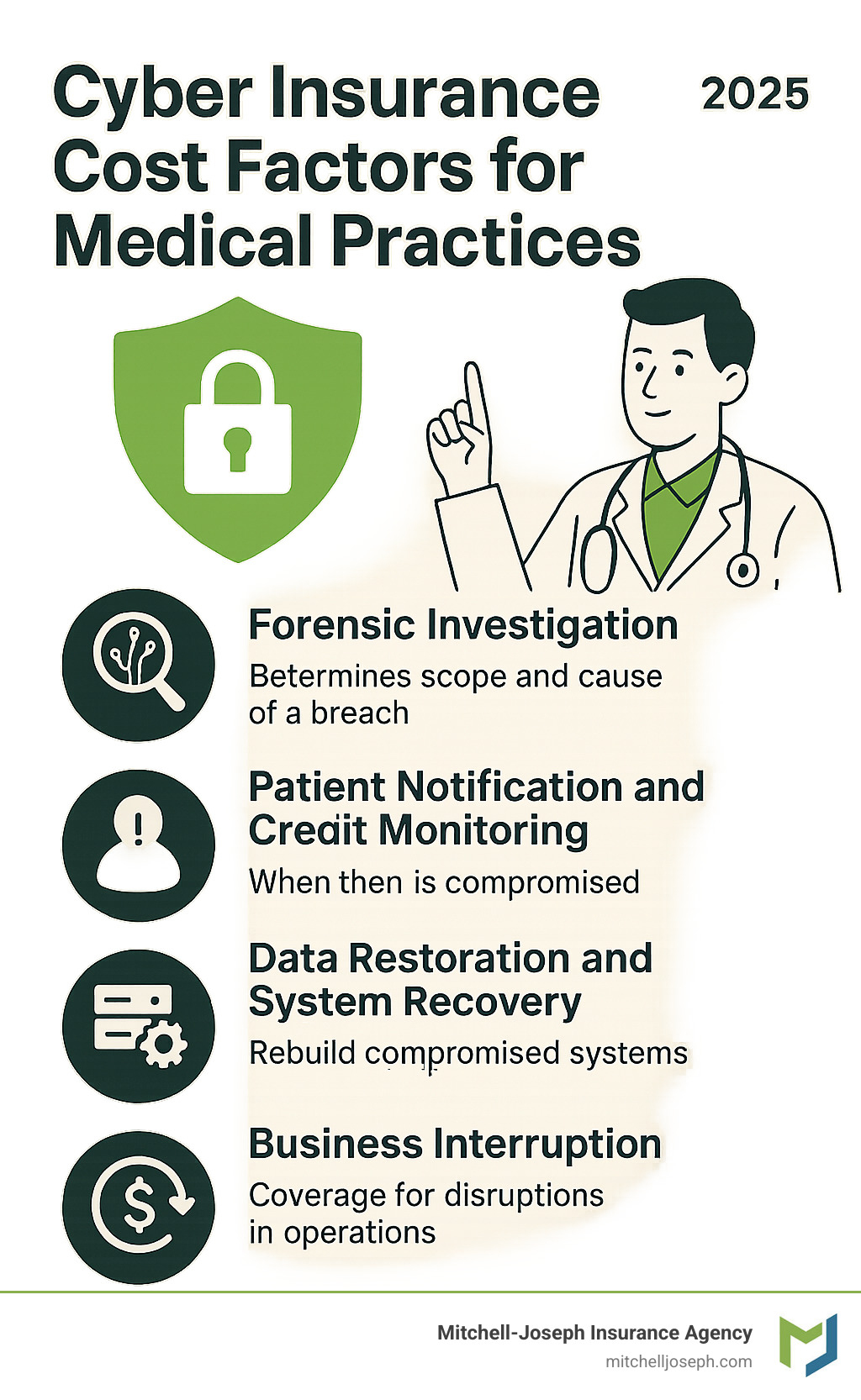
Forensic investigation services are usually your first call after finding a breach. These cybersecurity experts figure out what happened, how it happened, and what data was compromised. Expect to pay between $50,000 and $150,000 for a thorough investigation.
Patient notification and credit monitoring costs add up fast. HIPAA gives you 60 days to notify affected patients. Each notification letter costs $5 to $15 per person, while credit monitoring services run $20 to $30 per person annually. If you have 10,000 patient records, you’re looking at over $350,000 just for these basic requirements.
Data restoration and system recovery involves removing malware, rebuilding servers, and restoring your data from backups. One hospital spent $700,000 on forensics, data recovery, business interruption, and crisis management after ransomware shut down their entire operation.
Public relations and crisis management helps maintain patient trust through professional communication with patients, media, and regulators.
Business interruption coverage replaces the income you lose when cyber incidents disrupt your normal operations.
Third-Party Liabilities for Cyber Insurance for Medical Practices
While you’re handling immediate fires, third-party coverage protects you from legal and regulatory consequences that often emerge weeks or months after a breach.
Regulatory defense and penalties coverage becomes your lifeline when government agencies start investigations. HIPAA violations can cost up to $50,000 per incident, with annual maximums reaching $1.5 million. One in-home care provider recently paid $239,800 in OCR penalties for mishandling protected health information.
Patient lawsuits and privacy claims are becoming more common as patients become more aware of their rights. Legal defense costs alone often exceed $100,000, even when practices ultimately win their cases.
PCI DSS fines and penalties apply when your practice accepts credit card payments and experiences breaches involving payment card data.
Multimedia liability covers risks from your online presence, email communications, and social media activities.
For more detailed information about coverage options, visit our cyber insurance coverage limits guide.
Cost, Underwriting & Premium-Reduction Strategies
Understanding the cost of cyber insurance for medical practices helps you budget wisely. Most small to medium practices pay between $1,700 and $3,000 per provider annually for $1 million in cyber coverage combined with regulatory protection. That’s less than many practices spend on their monthly coffee budget, yet it protects against catastrophic losses.
Coverage limits drive the biggest cost differences. Most practices start with $500,000 to $1 million in coverage, though larger practices often need $5-10 million. Cost per dollar of coverage actually decreases at higher limits, making comprehensive protection more affordable than piecemeal coverage.
What Influences Price?
Your practice size and revenue form the foundation of premium calculations. Larger practices naturally face higher premiums because they handle more patient records and generate more revenue. However, larger practices often achieve better per-provider pricing due to economies of scale.
Employee count and remote access significantly impact your risk profile. Each person with system access represents a potential vulnerability, especially if they work remotely or access systems from multiple locations.
The security controls and certifications your practice implements can dramatically reduce premiums. Multi-factor authentication, regular employee training, vulnerability assessments, and documented incident response plans often qualify practices for 20-40% discounts. Achieving HITRUST certification or SOC 2 compliance can provide even greater savings.
Your Electronic Health Record system choice influences pricing based on vendor security reputations. Cloud-based EHR systems from established vendors with strong security track records typically result in lower premiums.
Claims history affects both your individual practice and the broader healthcare sector. Your geographic location also plays a role – practices in major metropolitan areas may face higher premiums.
How to Qualify & Save on Premiums
The same controls that protect your practice also qualify you for significant premium discounts.
Conducting regular risk assessments with qualified third-party assessors demonstrates proactive risk management. Insurers love seeing documented vulnerability assessments because it shows you’re serious about cybersecurity.
Implementing multi-factor authentication for all system access, especially email and remote connections, represents one of the most impactful controls you can deploy. This single step can reduce breach risk by over 99% and typically qualifies practices for immediate premium discounts.
Establishing comprehensive staff training programs that address phishing recognition, password hygiene, and incident reporting tackles the biggest risk factor head-on. Since human error causes 58% of healthcare cyber incidents, employee training represents one of your most effective risk reduction strategies.
Maintaining current software and security patches across all systems shows insurers you’re addressing known vulnerabilities proactively.
Developing and testing incident response plans that specify roles, responsibilities, and procedures for cyber incidents impresses underwriters.
Implementing data encryption for data at rest and in transit provides double protection. Encrypted data that’s stolen often doesn’t trigger notification requirements, significantly reducing breach costs.
Maintaining tested backup systems with offline or immutable backups that ransomware cannot encrypt shows you’re prepared for the worst-case scenario.
For detailed guidance on what underwriters look for during the application process, review our cyber insurance underwriting process information.
Buying & Using a Policy: Step-by-Step Guide
Getting the right cyber insurance for medical practices isn’t just about finding the cheapest premium – it’s about finding coverage that actually works when you need it most. After helping healthcare practices steer cyber incidents for over two decades, I’ve learned that the best policies combine comprehensive coverage with insurers who truly understand healthcare operations.
At Mitchell-Joseph Insurance Agency, we work with 24 different insurance companies, which gives us the flexibility to find coverage that fits your practice’s unique needs and budget. Being independent means we can objectively compare options and recommend the coverage that makes the most sense for your situation.
The key is finding an insurer with proven healthcare expertise and 24/7 incident response capabilities. When systems go down at 2 AM on a Saturday, you need a carrier that can connect you with forensic experts immediately.
Pre-Purchase Checklist
Before we start shopping for your cyber coverage, there are several steps that will help us secure better coverage options and potentially reduce your premiums.
Start with a complete asset inventory that identifies every system containing patient information. This includes servers, workstations, tablets, smartphones, cloud services, and even that old laptop in storage. Understanding your full digital footprint helps us determine appropriate coverage limits.
Conduct a gap analysis comparing your current security setup against industry best practices. We can help you identify areas where simple improvements could qualify for premium discounts.
Test your backup systems before you need them. Document these tests because insurers want proof that your backups actually work.
Document your security policies and procedures, including incident response plans and employee training records. Well-organized documentation shows insurers that you take cybersecurity seriously.
Most insurers require certain minimum security controls including multi-factor authentication for email and remote access, regular software updates, employee cybersecurity training, documented incident response procedures, tested data backups, and basic network security like firewalls and antivirus software.
Immediate Actions After a Breach

When a cyber incident hits your practice, the first hour is critical. Quick, appropriate action can minimize damage and ensure your insurance coverage responds properly.
Your first priority is containment without destruction. Isolate affected systems to prevent malware from spreading, but resist the urge to power everything down. Forensic investigators often need to examine systems in their current state.
Call your insurance carrier’s incident response hotline immediately. Don’t wait until Monday morning. These hotlines are staffed by experts who can guide you through the critical first steps.
Preserve evidence by avoiding changes to affected systems and documenting what you observe. Take photos of error messages, note which systems are affected, and keep a timeline of events.
Within the first 24 to 48 hours, engage forensic investigators recommended by your insurer, work with legal counsel to handle regulatory and liability issues properly, begin containment efforts to stop ongoing damage, and coordinate public relations to manage communications.
The recovery phase can take weeks or months. You’ll need to comply with notification requirements, implement system restoration and improved security controls, and document everything for insurance claims and regulatory compliance.
Cyber incidents are stressful, but you don’t have to handle them alone. Your cyber insurance policy provides access to experts who specialize in healthcare cyber incidents.
For real-world examples of how cyber insurance responds to various incidents, explore our cyber insurance claims examples.
Frequently Asked Questions about Cyber Insurance for Medical Practices
What does cyber insurance cover that malpractice doesn’t?
This is one of the most common questions we hear, and it’s an important distinction. Your malpractice insurance protects you when something goes wrong with patient care or medical decisions. Cyber insurance for medical practices kicks in when technology problems or data breaches create different kinds of problems entirely.
If a patient claims you made a medical error, that’s malpractice territory. But if hackers steal your patient database or ransomware locks up your computer systems, malpractice insurance won’t help you at all.
Cyber insurance covers the digital disasters that keep practice owners awake at night. When your systems get hacked, you’ll need computer forensics experts to figure out what happened – that can cost $50,000 or more. You’ll need to notify every affected patient, which runs about $5-15 per person. Credit monitoring for those patients adds another $20-30 each. If regulators come knocking with HIPAA violation fines, those can reach $50,000 per incident.
None of these costs fall under malpractice coverage because they’re not about medical care – they’re about protecting and managing patient information in our digital world.
How much does a typical small practice pay per year?
Most small practices pay between $1,200 and $4,000 annually for solid cyber protection, with the sweet spot around $2,000-3,000 for comprehensive coverage.
Solo practitioners often start around $1,200-2,000 per year for basic protection. Practices with 5-10 providers typically invest $3,000-6,000 total, which works out to roughly $600-800 per provider annually. When you consider that a single breach averages $161,000 in costs, that annual premium looks pretty reasonable.
Bigger coverage limits don’t cost proportionally more. A $1 million policy might cost only 30-40% more than a $500,000 policy, giving you much better protection for a modest increase in premium.
Practices with strong security measures can slash their premiums by 20-40%. Multi-factor authentication, regular employee training, and documented security procedures all qualify for significant discounts. At Mitchell-Joseph Insurance Agency, we help practices identify these cost-saving opportunities across our 24 carrier partnerships.
Will outsourcing IT shift my cyber liability?
I wish I could tell you that hiring an IT company transfers all your cyber risk to them, but that’s not how it works. You still own the primary responsibility for protecting patient data, regardless of who manages your computer systems.
Courts have been clear about this: when patient information gets compromised, they look to the medical practice first. You’re the one with the relationship with patients, you’re the one bound by HIPAA, and you’re the one patients will hold accountable.
But outsourcing isn’t necessarily bad for your risk profile. Good IT service providers often implement stronger security than small practices can manage alone. They provide 24/7 monitoring, handle security updates promptly, and have incident response capabilities that would be impossible for a small practice to maintain internally.
The flip side is that you’re now dependent on someone else’s security practices. If your IT vendor gets breached and that affects your systems, you’re still on the hook for notification costs, regulatory fines, and patient lawsuits.
Smart contract language can help by requiring your IT vendor to carry adequate insurance and agree to indemnify you for certain types of incidents. However, these contractual protections don’t eliminate your primary liability.
The key is making sure your cyber insurance for medical practices covers incidents regardless of their source. Whether the breach starts in your office or at your vendor’s facility, your policy should respond with the same comprehensive coverage.
Conclusion

When I started helping healthcare practices with insurance protection over two decades ago, cyber threats were barely on anyone’s radar. Today, cyber insurance for medical practices stands as one of the most crucial safeguards against financial ruin.
The numbers are stark. Healthcare practices face breach costs averaging $10 million per incident, with stolen patient records worth ten times more than credit card data on the dark web. When 38% of all cyber insurance claims come from healthcare businesses, and HIPAA fines can reach $50,000 per violation, we’re talking about risks that can literally close your doors overnight.
But here’s what gives me hope: the practices that take cyber security seriously and invest in proper coverage don’t just survive these incidents – they bounce back stronger. I’ve watched clients turn what could have been practice-ending disasters into manageable bumps in the road, all because they had the right protection in place when trouble struck.
Risk transfer through comprehensive cyber insurance allows you to focus on what you do best – caring for patients – while knowing that if the worst happens, you’ve got a team of experts ready to help. When ransomware hits at 2 AM, you’re not scrambling to figure out who to call. Your insurer’s 24/7 hotline connects you immediately with forensic specialists, legal experts, and crisis management professionals.
Patient trust remains the cornerstone of every successful medical practice. When patients know you’ve taken every reasonable precaution to protect their information, including securing comprehensive cyber insurance, they feel more confident choosing your practice.
At Mitchell-Joseph Insurance Agency, we’ve built our reputation over more than two centuries of combined experience by understanding that every practice faces unique challenges. Our independent status means we can shop your coverage across 24 different insurance companies, finding the perfect balance of comprehensive protection and affordable premiums.
The healthcare landscape keeps evolving, with new technologies bringing both opportunities and risks. Telemedicine, connected medical devices, and cloud-based systems aren’t going anywhere – they’re becoming more central to patient care every day. Practices that get ahead of these changes with proper cyber insurance for medical practices and strong security controls position themselves to thrive, not just survive.
Don’t let cybercriminals give you sleepless nights. Contact our team today to discuss how we can protect your practice with coverage that actually makes sense for your situation and budget. With offices throughout the Finger Lakes region, we’re never far away when you need us most.
For more information about our comprehensive protection options, visit our insurance coverage page, or stop by any of our convenient locations in Honeoye Falls, Pittsford, Naples, Rushville, Avon, and beyond. Your patients trust you with their health – let us help you protect that trust with the right cyber insurance coverage.

