

Why Getting Your Coverage Limits Right Could Save Your Business
Cyber insurance coverage limits determine how much financial protection you have when hackers strike your business. With data breaches costing an average of $3.86 million and ransomware events up over 300% since 2020, choosing the wrong limits could leave you facing bankruptcy.
Quick Coverage Limit Guidelines:
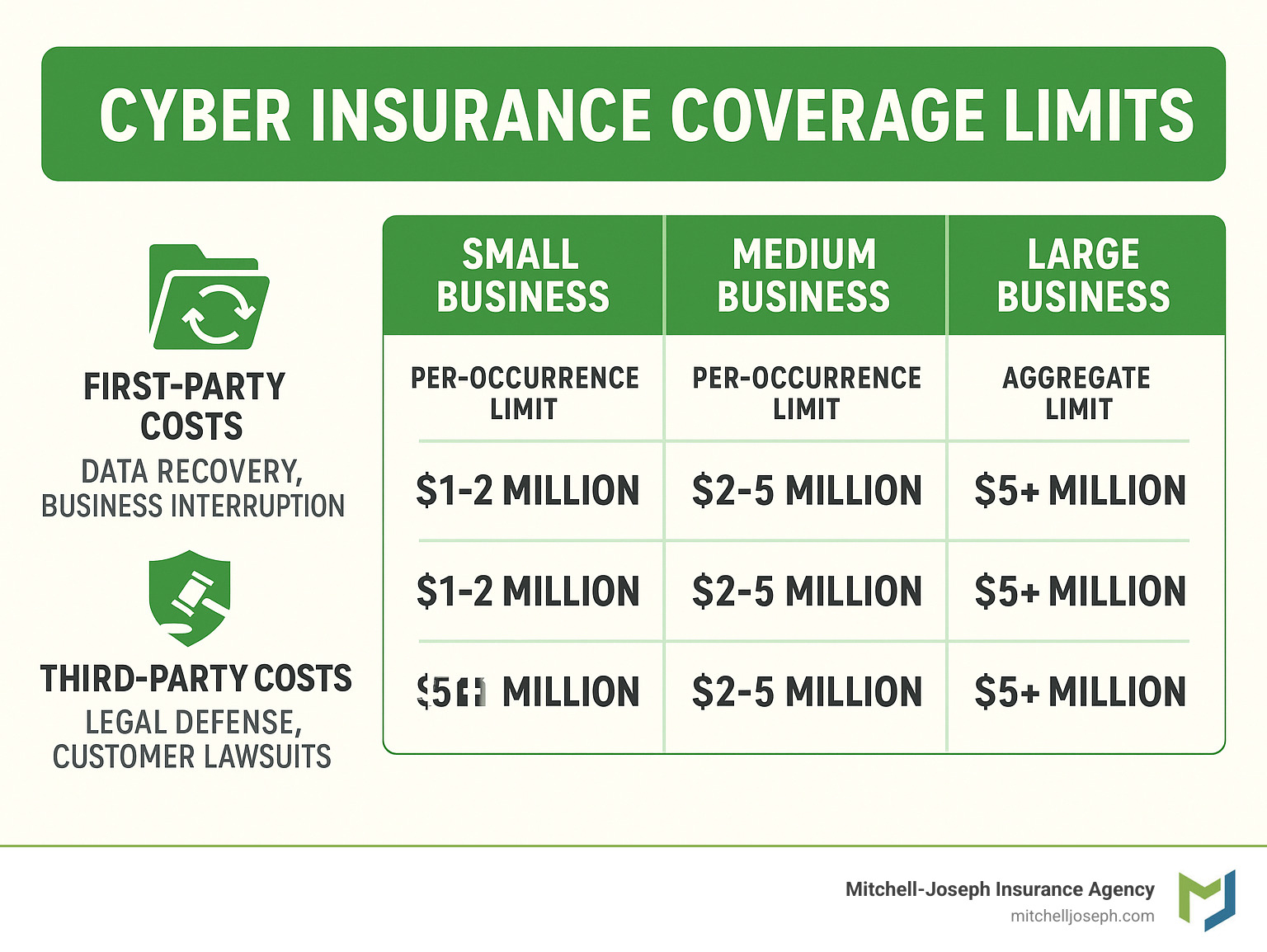
– Small businesses (under 50 employees): $1-2 million per occurrence
– Mid-size companies (50-249 employees): $2-5 million (average incident cost: $184,000)
– Larger businesses (250+ employees): $5+ million (average incident cost: $715,000)
– Per-occurrence limit: Maximum payout for a single cyber incident
– Aggregate limit: Total maximum payout across all claims in one year
The cyber threat landscape has exploded. Data breach events increased by over 78% from 2022 to 2023, while most small businesses still carry only $1 million in coverage. That’s barely enough to cover notification costs for a few thousand compromised customer records at $180 per record.
Your coverage limits need to protect against both first-party costs (your direct losses like data recovery and business interruption) and third-party liability (lawsuits from customers whose data was breached). Many businesses also face contractual requirements from clients demanding specific minimum coverage amounts.
I’m Jeffrey Joseph, and I’ve been helping Finger Lakes businesses steer complex insurance decisions since 1999 at Mitchell-Joseph Insurance Agency. Throughout my career, I’ve seen too many companies find their cyber insurance coverage limits were inadequate only after a breach occurred.
Cyber insurance coverage limits terms to remember:
– Cyber insurance claims examples
– Cyber insurance cost calculator
Cyber Insurance 101: Coverage Types & Why Limits Matter
Let’s break down cyber insurance in plain terms. Think of it like car insurance—you need coverage for damage to your own vehicle and protection when someone else gets hurt. Cyber insurance coverage limits work the same way, just with computers instead of cars.
At Mitchell-Joseph Insurance Agency, we’ve spent over two decades helping businesses across Rochester, Canandaigua, and the Finger Lakes region understand these crucial differences. And trust me, getting this wrong can be expensive.
First-party coverage is all about what happens directly to your business when hackers strike. This covers your immediate headaches: paying for computer experts to figure out what happened, rebuilding your network, covering lost income while you’re down, and sending those dreaded “your data may have been compromised” letters to customers. It’s also there for ransomware payments (though we hope you never need that) and regulatory fines that come your way.
Third-party coverage kicks in when other people come after you with lawsuits. Think angry customers, frustrated business partners, or vendors claiming your security failure hurt them. This coverage handles legal defense costs, settlements, and court judgments. It’s your shield when everyone else points fingers at your business.
Here’s the sobering reality: companies with 50 to 249 employees face average cyber incident costs of $184,000, while businesses with 250 to 999 employees see bills averaging $715,000. We’ve watched clients across our service areas from Honeoye Falls to Victor deal with these exact scenarios.
First-Party vs Third-Party Snapshot
When a cyber incident hits, first-party costs show up immediately like uninvited guests. You’re looking at data breach response teams, forensic investigators digging through your systems, and network restoration work that can take weeks. Then come customer notification expenses, business interruption losses while you’re offline, and regulatory fines from agencies like HIPAA or PCI compliance boards. Don’t forget the public relations work to salvage your reputation.
Third-party liability tends to arrive later, often months after the initial incident. Customer lawsuits start rolling in, each requiring legal defense. Settlement payments to affected parties can add up quickly. Professional liability claims from clients who trusted you with their data become another headache. Even media liability issues can emerge if your online content played any role in the incident.
We’ve seen businesses in Pittsford and Naples get hit with both types of costs at once. One healthcare practice spent $50,000 on immediate breach response, then faced $200,000 in patient lawsuits six months later. The stress was almost worse than the financial hit.
Why Businesses Can’t Ignore Coverage Limits
The numbers don’t lie—data breaches jumped 78% from 2022 to 2023. Cyber incidents aren’t a matter of “if” anymore; they’re a matter of “when.” At $180 per compromised customer record, a breach affecting just 5,000 customers generates $900,000 in notification costs alone. That nearly wipes out a typical $1 million policy before you even start dealing with lawsuits.
Vendor mandates are pushing minimum coverage requirements higher every year. We regularly see contracts demanding $5 million in cyber coverage for IT consultants working with universities or healthcare systems. Businesses in Bloomfield and Bristol often find these requirements during contract negotiations, sometimes forcing them to scramble for higher limits.
Supply-chain risks create a domino effect that multiplies your exposure. When your vendor suffers a breach that affects your customers, you might face liability even though the incident wasn’t your fault. This contingent business interruption can trigger both your first-party and third-party coverage simultaneously, eating through your cyber insurance coverage limits faster than you’d expect.
The bottom line? Those uninsured gaps between what you thought you needed and what you actually need can sink a business. We’ve seen it happen, and it’s not pretty.

Determining Your Cyber Insurance Coverage Limits
Setting the right cyber insurance coverage limits isn’t a guessing game—it’s about understanding your unique business risks and building protection that actually works when you need it. After helping hundreds of businesses across the Finger Lakes region steer these decisions, I’ve learned that the most successful approach combines hard data with real-world experience.
Think of determining your coverage limits like planning for a major storm. You wouldn’t just guess how much damage might occur—you’d look at your property value, consider worst-case scenarios, and factor in your ability to handle unexpected costs. Cyber insurance works the same way.
Your risk assessment forms the foundation. This means taking an honest look at your industry regulations, annual revenue, the volume of sensitive data you handle, your current security measures, and any past incidents. A dental practice in Canandaigua dealing with patient health records faces completely different exposures than a machine shop in Rush, even if both businesses have similar revenue.
Industry regulations often set the floor, not the ceiling. Healthcare businesses operating under HIPAA can face penalties ranging from $100 to $50,000 per compromised record. Retailers handling credit card data must meet PCI DSS requirements or risk monthly fines between $5,000 and $100,000. Financial services companies face even stricter oversight. These aren’t theoretical numbers—they’re real costs that can devastate unprepared businesses.
Revenue provides a practical starting point for calculations. Many design firms and professional services companies use 1-3% of gross revenue to estimate potential ransom demands. Business interruption costs typically run 4-5% of annual revenue during a 2-3 week outage. So a company generating $10 million annually might need $200,000-$500,000 just to cover ransom payments and basic restoration costs—before considering legal fees, customer notification, or regulatory penalties.
Our Cyber Insurance Cost Calculator helps you run these numbers for your specific situation. For deeper industry benchmarking, the IBM and the Ponemon Institute study offers valuable insights into how costs vary by sector and company size.
Key Factors That Shape Cyber Insurance Coverage Limits
Company size gives us a starting point, but it’s not the whole story. Micro-businesses under 50 employees typically begin with $1-2 million in cyber insurance coverage limits, while enterprises over 1,000 employees often carry $10 million or more. But here’s where it gets interesting—a 20-person law firm in Victor handling sensitive client data might need higher limits than a 100-person manufacturer in Avon with minimal digital exposure.
The type of data you handle dramatically affects your risk profile. Personally identifiable information, protected health information, and payment card data each carry different price tags when compromised. Social security numbers cost more to remediate than email addresses. Medical records trigger stricter notification requirements than general customer contact information. Credit card data brings PCI compliance penalties into the mix.
Compliance requirements often dictate minimum coverage levels. HIPAA violations can cost $100-$50,000 per record, while PCI DSS non-compliance may trigger $5,000-$100,000 monthly fines until you’re back in compliance. I’ve worked with businesses in Fishers and Gorham who finded these requirements during contract negotiations with healthcare or retail clients.
Client contracts frequently mandate specific minimums. IT service providers working with universities often need $5 million per wrongful act coverage, complete with additional insured endorsements. These requirements aren’t suggestions—they’re deal-breakers if you can’t meet them.
Cloud dependency creates hidden exposures. When your cloud provider suffers an outage or breach, your business feels the impact even though you weren’t directly attacked. This contingent business interruption coverage becomes crucial for businesses heavily reliant on external technology services.
Your incident history matters more than you might think. A clean track record can help secure better rates and higher available limits. Previous incidents, even small ones, signal higher risk to insurers and may affect both pricing and coverage options.
Calculating Cyber Insurance Coverage Limits for Your Business
Revenue-based calculations provide a practical foundation. For professional services and design firms, I typically recommend starting with 15-23% of gross revenue for total cyber limits. A $5 million revenue architecture firm in Honeoye might need $750,000-$1.15 million in coverage, which we’d typically round to $1 million for practical purposes.
Worst-case scenario modeling helps stress-test your numbers. Picture this: ransomware locks your systems for three weeks while you simultaneously face customer lawsuits and a regulatory investigation. Add up the ransom payment, system restoration costs, lost revenue, legal defense fees, potential settlements, and regulatory penalties. That total gives you a realistic sense of your maximum exposure.
The relationship between per-occurrence and aggregate limits requires careful thought. Your per-occurrence limit handles individual incidents, while the aggregate limit caps total annual payouts. Most small businesses start with matching limits—$1 million per occurrence, $1 million aggregate. But if you face higher risk of multiple incidents in one year, you might need a higher aggregate limit.
Step-up strategies let you grow without coverage gaps. Start with baseline protection and increase limits in $1 million increments as your business expands. This prevents over-insuring when you’re small while ensuring adequate protection as your exposure grows. It’s like buying a house—you don’t need a mansion when you’re starting out, but you want room to grow.
Layered coverage programs offer cost-effective high limits. Large businesses often use primary coverage for the first $5-10 million, then add excess layers for additional protection. This structure provides broader coverage at lower total cost than a single high-limit policy. Think of it as building a pyramid of protection.
Professional guidance ensures you don’t miss critical details. At Mitchell-Joseph Insurance Agency, we analyze your specific exposures and benchmark against similar businesses in your industry and region. Our independent status means we can compare options from 24 different insurance companies to find the best fit for your needs and budget.
Market Benchmarks, Costs & Real-World Claims
The cyber insurance market has become a whole different animal over the past few years. At Mitchell-Joseph Insurance Agency, we’ve watched premiums climb 50-100% year-over-year while insurers get pickier about who they’ll cover and for how much. It’s not the insurance market any of us grew up with, but understanding these realities helps you make smarter decisions about your cyber insurance coverage limits.
Most small businesses we work with in Honeoye Falls and the surrounding Finger Lakes region start with $1 million per occurrence and $1 million aggregate limits. This baseline costs around $145 monthly—about $1,740 per year—and covers basic exposures reasonably well. But here’s the catch: if you’re handling lots of customer data or working with clients who have specific requirements, this might not be enough protection.
Mid-market companies typically need $3-5 million in coverage, and for good reason. When businesses with 50-249 employees get hit, the average damage runs $184,000. But we’ve seen worst-case scenarios blow past $1 million easily when you add up business interruption, legal fees, and regulatory penalties. You’re looking at $5,000-$15,000 annually for adequate coverage at this level.
Large enterprises often carry $10 million or more—sometimes much more. Companies with billion-dollar revenues averaged $28.2 million in cyber coverage limits in recent studies. Financial institutions? They’re averaging $53.2 million because regulators watch them like hawks.
The ransomware explosion tells the real story here. With attacks up over 300% since early 2020, we’re seeing bigger and more frequent claims. Ransom payments typically end up around 1% of gross revenue after negotiation, while getting your network back online costs 4-5% of annual revenue for a 2-3 week outage.
Here’s a real-world example: design firms under $10 million in revenue usually carry $1-2 million in cyber insurance coverage limits—about 15-23% of their gross revenue. So a $6 million architecture firm might have $1.5 million in cyber coverage, compared to $3-5 million in professional liability coverage.
Want to see how these limits play out in actual claims? Check our Cyber Insurance Claims Examples for detailed scenarios. The 38% increase in cyberattacks shows why getting your limits right matters more than ever.
Coverage Limits by Business Size
Micro-businesses under 50 employees usually do fine with $1-2 million in coverage. Think about a small retail shop in Rushville or a boutique in Wayland—they need basic data breach response and customer notification coverage. You’re looking at $1,000-$3,000 annually for this protection.
Small businesses with 50-249 employees often bump up to $2-3 million limits because their average incident costs hit $184,000. But you need wiggle room for multiple problems hitting at once. A medical practice in Canadice or a law firm in Lima might need $2 million per occurrence with higher aggregate limits for multiple potential incidents throughout the year.
Medium businesses with 250-999 employees frequently need $3-5 million coverage, and the math makes sense. When average incident costs reach $715,000, you need substantial limits—especially considering potential business interruption during extended outages. Manufacturing companies in Bristol or professional services firms in Mendon often fall into this sweet spot.
Large enterprises with 1,000+ employees typically start with $5 million in primary coverage and layer additional coverage on top. These businesses face the biggest regulatory scrutiny and the largest potential class-action lawsuits. Technology companies or healthcare systems serving the greater Rochester area frequently need layered programs totaling $25 million or more.
Industry makes a huge difference regardless of size. Healthcare businesses need higher limits because HIPAA penalties can be brutal. Financial services face additional regulatory requirements. Technology companies often need higher limits because their client contracts demand it, plus their potential liability exposure runs higher.
Cost Drivers & Savings Tips
Your cybersecurity setup dramatically affects both your premiums and the cyber insurance coverage limits insurers will offer you. These days, multi-factor authentication, endpoint detection and response, and regular security training aren’t nice-to-haves—they’re requirements. Show insurers you’re serious about security, and they’ll reward you with higher limits and lower premiums.
Multi-factor authentication alone often saves 10-20% on premiums. This one simple step stops most phishing attacks and shows underwriters you’re thinking proactively. We’ve helped clients in Middlesex and Potter qualify for significant discounts just by implementing MFA across all their systems.
Regular backups and tested restoration procedures make insurers much happier because they reduce business interruption exposure. If you can prove you’ll bounce back quickly from an attack, insurers offer better terms. Air-gapped backups—where hackers can’t reach your backup files—provide even better premium benefits.
Employee training programs show real, measurable risk reduction. Regular phishing simulations and security awareness training can cut successful social engineering attacks by 70% or more. Insurers see this risk reduction and respond with lower premiums and higher available limits.
Here’s the beautiful part: premium credits for comprehensive security programs can actually offset the cost of increased limits. The difference between $1 million and $2 million in coverage might only be $500-$1,000 annually. Strong security controls can make that higher limit cost-neutral or even save you money.
Some businesses choose higher retentions (think bigger deductibles) to access lower premiums while keeping high limits for catastrophic events. This works well if you have strong cash flow and good risk management. You handle the smaller stuff yourself and let insurance cover the big disasters.
Avoiding Gaps: Sublimits, Exclusions & Policy Forms
Here’s where things get tricky with cyber insurance coverage limits—the devil really is in the details. You might think you have $2 million in protection, but sublimits, exclusions, and policy language can shrink that coverage when you need it most.
Sublimits act like speed bumps within your main coverage. Think of them as separate, smaller buckets of money for specific types of losses. Your $2 million policy might only offer $100,000 for social engineering fraud or $250,000 for PCI fines. These restrictions can leave you scrambling to cover the difference when a claim hits.
Policy exclusions completely eliminate coverage for certain scenarios. War exclusions might wipe out protection for nation-state attacks, while betterment exclusions prevent you from upgrading systems during restoration. It’s like having health insurance that doesn’t cover broken bones—frustrating when you need it most.
Claims-made policy forms create timing challenges that occurrence-based policies don’t have. With claims-made coverage, you must report incidents during your active policy period. Miss that window, and you might lose coverage entirely, even for legitimate claims.
At Mitchell-Joseph Insurance Agency, we’ve seen businesses across the Finger Lakes region get caught off-guard by these policy nuances. The Insurance Circular Letter No. 2 provides helpful regulatory guidance, while business interruption coverage has become critical as ransomware attacks cause longer outages.
Common Sublimits That Shrink Your Protection
Social engineering and funds transfer fraud sublimits often surprise business owners in Rush and Honeoye Falls. Your $2 million policy might cap wire fraud losses at just $100,000-$250,000. When scammers trick your accounting team into wiring $300,000 to a fake vendor, that sublimit leaves you responsible for the overage.
Contingent business interruption sublimits can devastate cloud-dependent businesses. When your critical software provider goes down for a week, you might find only $500,000 in coverage for your resulting losses, even with a $5 million policy. For businesses in Victor and Canandaigua that rely heavily on external technology services, this gap can be devastating.
PCI fines and penalties carry surprisingly low sublimits for such expensive violations. Restaurants and retailers often find just $100,000-$500,000 available for PCI DSS violations. Since these fines can reach $100,000 monthly, the sublimit gets exhausted quickly while violations continue.
Bricking coverage for destroyed hardware typically offers modest protection relative to replacement costs. When sophisticated malware permanently destroys your equipment, you might find only $50,000-$100,000 available for replacements. Manufacturing businesses with expensive specialized equipment need to pay close attention to these restrictions.
Cryptojacking and cryptocurrency theft represent emerging exposures with inconsistent coverage. Some policies exclude cryptocurrency-related losses entirely, while others provide limited sublimits. As these attacks become more common, businesses need clear understanding of their protection.
Exclusions That Surprise Insureds
Nation-state attack exclusions have expanded dramatically since the Ukraine conflict began. Many insurers now exclude coverage for attacks attributed to foreign governments, creating massive gaps for businesses targeted by sophisticated threat actors. Ironically, these exclusions eliminate coverage for some of the most damaging cyber incidents possible.
Prior-known incident exclusions create timing nightmares for policyholders. If you find a breach after your policy expires but before reporting it, coverage may be denied if the insurer believes you should have known about the incident earlier. This exclusion punishes businesses for thorough investigations that uncover older incidents.
Contractual liability exclusions can eliminate coverage for vendor agreements and client contracts. When your IT service contract requires indemnifying clients for cyber incidents, your policy might exclude coverage for these assumed liabilities. This gap particularly affects consultants and service providers working with larger clients.
Betterment exclusions prevent system improvements during restoration. After ransomware destroys your outdated network, insurers may only pay to restore equivalent old technology rather than funding necessary upgrades. This leaves businesses choosing between inadequate restored systems or paying upgrade costs out-of-pocket.
Claims-Made Pitfalls & How to Avoid Them
Reporting deadlines create the biggest coverage traps in claims-made policies. Most require reporting incidents “as soon as practicable” or within specific timeframes. Miss these deadlines, and coverage disappears even for otherwise legitimate claims. Businesses need clear incident response procedures ensuring prompt notification to their insurance carrier.
Retroactive dates limit coverage for older incidents that surface during your policy period. Your policy only covers incidents occurring after the retroactive date, which might be months or years after your policy started. Understanding this date prevents nasty surprises when investigating security incidents uncovers older breaches.
Extended reporting periods provide crucial gap protection when changing insurers or canceling coverage. This ERP allows additional time to report incidents that occurred during your policy period but weren’t finded until later. The protection typically costs 100-200% of annual premium but prevents expensive coverage gaps.
Defense within limits clauses reduce settlement funds available for actual damages. When legal defense costs count against your total cyber insurance coverage limits, a $1 million policy might provide only $600,000 for settlements after $400,000 in legal fees. This structure makes adequate limit selection even more critical.
FAQs on Cyber Insurance Coverage Limits
How often should I review my limits?
We recommend annual reviews at renewal, plus additional reviews when your business changes significantly. Major client acquisitions, new compliance requirements, technology upgrades, or revenue growth all warrant coverage reviews. Don’t wait for renewal if your risk profile changes substantially.
What happens if costs exceed my aggregate limit?
Once you exhaust your aggregate limit, you’re on your own for additional costs until the policy renews. This makes aggregate limit selection crucial for businesses facing multiple potential incidents. Consider whether your aggregate should exceed your per-occurrence limit based on your risk profile.
Can improving cybersecurity increase my available limits?
Absolutely. Strong security controls often open up higher limits and better pricing. Insurers favor businesses with multi-factor authentication, endpoint detection, security training, and documented incident response plans. Some carriers offer premium credits of 10-30% for comprehensive security programs.
Should my cyber limits match my professional liability limits?
Not necessarily. While some firms use professional liability as a benchmark—typically 20-40% of professional liability limits for cyber coverage—your actual exposure depends on data volume, regulatory requirements, and client contracts rather than professional liability exposure.
How do I handle client contract requirements for specific limits?
Review contracts carefully for minimum coverage requirements, additional insured endorsements, and waiver of subrogation clauses. Some contracts demand $5+ million in coverage with specific carrier ratings. Plan for these requirements during coverage procurement rather than finding them during contract negotiations.
Conclusion
Getting your cyber insurance coverage limits right isn’t just about picking a number—it’s about protecting everything you’ve worked to build. With cyber incidents affecting businesses of all sizes across the Finger Lakes region, having adequate coverage has become as essential as locking your doors at night.
The math is simple but sobering. A single data breach affecting 5,000 customer records costs $900,000 in notification expenses alone. Add business interruption, legal defense, and potential settlements, and you’re looking at costs that can easily exceed $2 million. That’s why the old “one-size-fits-all” approach to cyber coverage simply doesn’t work anymore.
At Mitchell-Joseph Insurance Agency, we’ve seen the cyber threat landscape evolve dramatically over our 200+ years of combined experience. What started as occasional nuisance attacks has become a sophisticated criminal enterprise targeting businesses from Canandaigua to Rush. The good news? You don’t have to face these risks alone.
Finding the right coverage starts with understanding your unique exposures. A medical practice in Victor handling patient records faces different risks than a manufacturing company in Avon. Your industry regulations, data volume, client contracts, and security measures all influence what coverage limits make sense for your business.
The investment in adequate cyber insurance represents remarkable value. Most businesses spend less than 3% of their total insurance budget on cyber coverage, yet this protection can prevent bankruptcy-level losses. It’s like having a financial fire department—you hope you’ll never need it, but you’ll be grateful it’s there when disaster strikes.
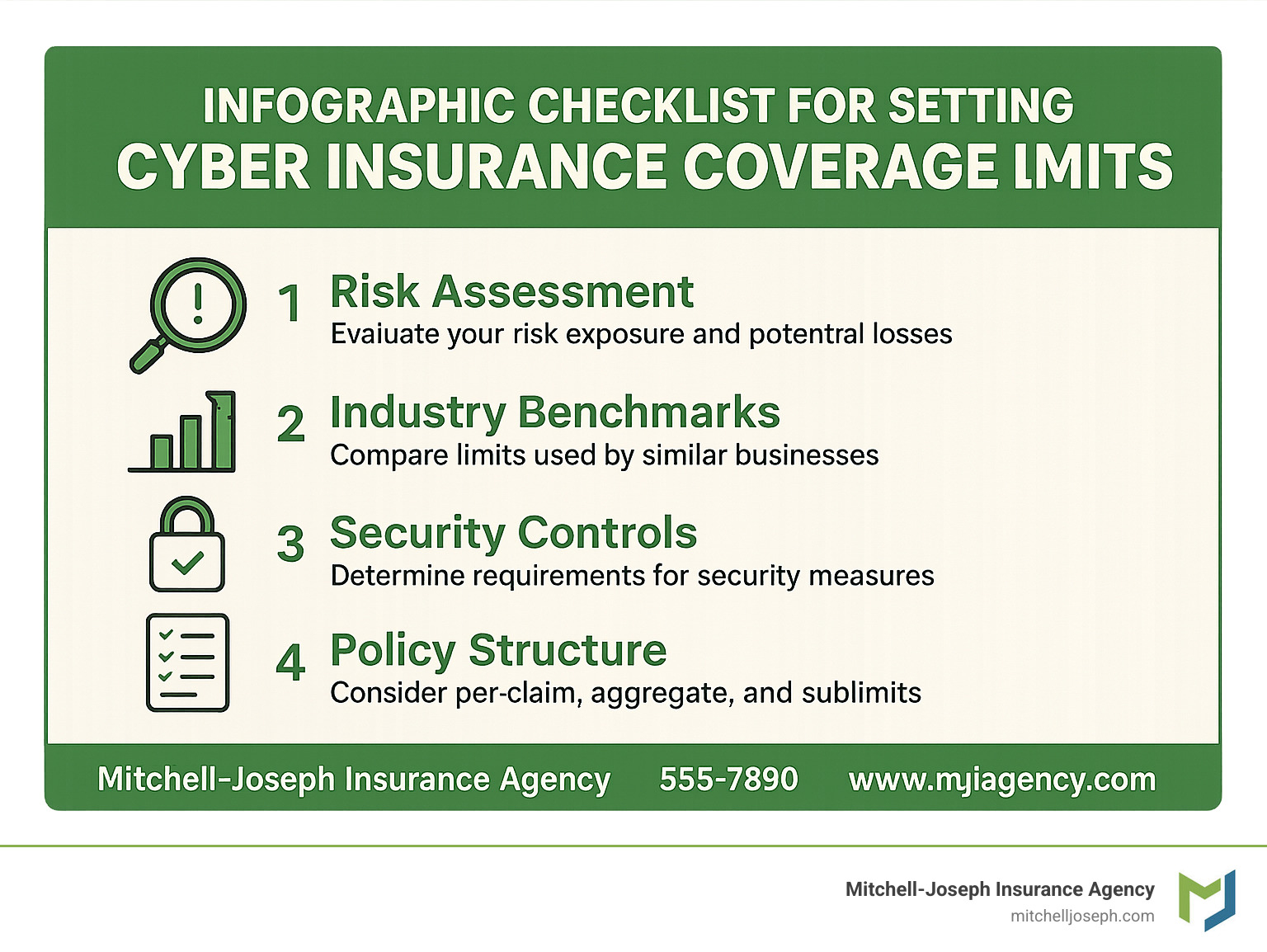
We recommend conducting a comprehensive risk assessment to understand your specific exposures, then benchmarking against industry peers while adjusting for your unique circumstances. Don’t forget to review your coverage annually as your business grows and the threat landscape evolves.
Implementing strong security controls not only reduces your risk but often open ups better coverage terms and higher available limits. Simple measures like multi-factor authentication can provide 10-20% premium credits while significantly improving your security posture.
The cyber insurance market will continue evolving, but one thing remains constant: businesses with adequate cyber insurance coverage limits survive cyber incidents, while those without proper protection often don’t. Don’t let your business become another cautionary tale.
Ready to ensure your coverage matches your risks? Contact us today to review your current limits and explore options from our 24 insurance company partners. Whether you’re in Honeoye Falls, Pittsford, or anywhere across our service area, we’re here to help protect what matters most to you.
For comprehensive business protection beyond cyber insurance, explore our Business Insurance offerings. Because when it comes to protecting your business, adequate coverage isn’t just smart—it’s essential.

