

Why Smart Business Owners Calculate Cyber Insurance Costs First
A cyber insurance cost calculator is your fastest path to understanding what cyber coverage will actually cost your business. Here’s what you need to know:
Quick Calculator Options:
• 3-minute risk assessments – Get instant risk scores and premium estimates
• Revenue-based tools – Input annual revenue for ballpark pricing (average $145/month)
• Detailed calculators – Answer 10+ questions for precise cost projections
• Anonymous options – No contact info required for initial estimates
What They Calculate:
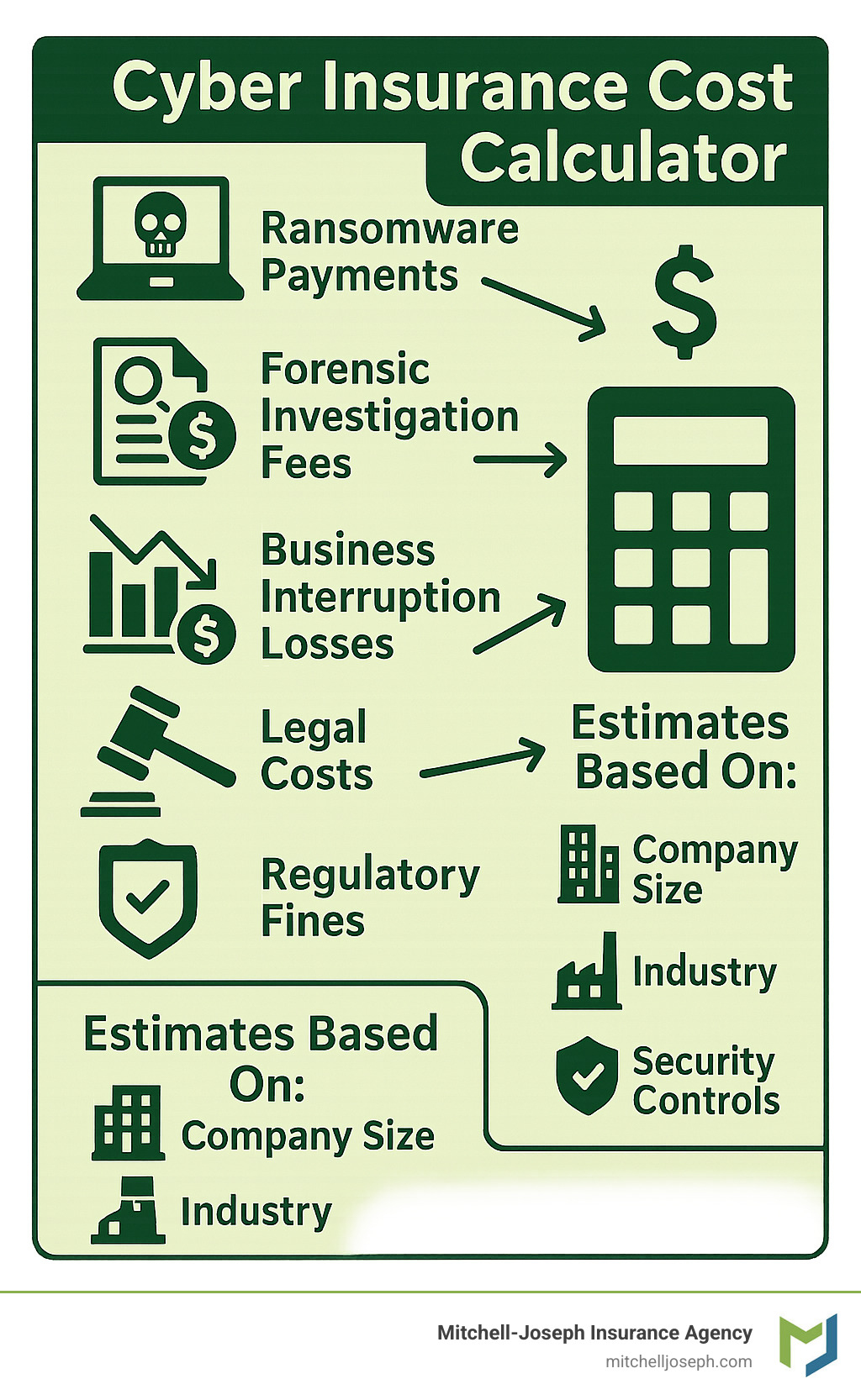
• Ransomware costs (60% of all cyber claims)
• Data breach expenses
• Business interruption losses
• Legal and forensic fees
• Recommended policy limits ($1M-$5M typical)
Ever wondered how much a ransomware attack might set your business back? You’re not alone. With 95% of security incidents involving human error and cyber attacks costing businesses millions in lost revenue, getting accurate cost estimates before you buy coverage isn’t just smart—it’s essential.
The average cyber liability premium runs about $145 per month, but your actual cost depends on factors like industry, revenue, and security measures. That’s where calculators become invaluable. They use real claims data from thousands of cyber incidents to give you realistic cost projections, helping you avoid the common trap where policy limits are less than 10% of actual breach costs.
I’m Jeffrey Joseph, and I’ve been helping Finger Lakes businesses steer insurance decisions since 1999 at Mitchell-Joseph Insurance Agency. A cyber insurance cost calculator is often the first tool I recommend to business owners who want to understand their cyber risk exposure before we discuss coverage options.
Why You Need a Cyber Insurance Cost Calculator
Picture this: You’re running a successful business when suddenly your computer screens go black and a message appears demanding $50,000 in Bitcoin. Sound like a nightmare? For many business owners, it’s becoming reality. Ransomware attacks now make up about 60% of all cyber insurance claims, and here’s the really scary part—95% of these incidents happen because of human error. That innocent-looking email your employee clicked? It just cost you big time.
Now, let’s talk money. The average small to medium business pays around $145 per month for cyber liability insurance. That’s roughly $1,740 per year—not exactly pocket change. But here’s where it gets interesting: many businesses find their policy limits cover less than 10% of what a real cyber attack actually costs. It’s like buying a small Band-Aid for a major wound.
This is exactly why smart business owners turn to a cyber insurance cost calculator before they buy coverage. These tools help you understand the real financial impact of cyber threats, so you’re not just guessing at what coverage you need. It’s the difference between shopping blind and making decisions based on solid data about your actual risk.
Think of it as your financial reality check. The calculator shows you what you’re really protecting against, helps you avoid dangerous coverage gaps, and gives you the confidence to make informed decisions about your cyber insurance investment.
The stakes couldn’t be higher in today’s digital landscape. Small businesses are increasingly targeted because cybercriminals know they often lack sophisticated security measures but still handle valuable data. Whether you’re a medical practice in Canandaigua managing patient records, a manufacturing company in Victor handling proprietary designs, or a financial services firm in Rochester processing sensitive client information, your digital assets make you a target.
What makes cyber threats particularly insidious is their evolving nature. Yesterday’s security measures might not protect against tomorrow’s attack vectors. Cybercriminals constantly adapt their tactics, exploiting new vulnerabilities and social engineering techniques. This dynamic threat landscape makes it challenging for business owners to assess their true risk exposure without professional tools and expertise.
The financial impact extends far beyond the immediate costs of an attack. Consider the ripple effects: lost productivity while systems are down, customer trust erosion, regulatory fines for data breaches, legal costs from affected parties, and the long-term reputation damage that can take years to repair. A cyber insurance cost calculator helps quantify these often-overlooked consequences, giving you a complete picture of your potential exposure.
Cyber insurance cost calculator basics
A cyber insurance cost calculator is like having a crystal ball that actually works—except instead of magic, it uses real data from thousands of cyber attacks to predict what might happen to your business. These digital tools take the guesswork out of cyber insurance by combining your business details with actuarial data from actual claims.
Most calculators work on a freemium model, which means you can get basic estimates without handing over your contact information. The good ones pull from databases of real cyber incidents, industry benchmarks, and the same sophisticated models that insurance companies use when they’re deciding whether to cover you and how much to charge.
The real power lies in their ability to run different loss scenarios. Want to see the difference between a small data breach affecting 1,000 customer records versus a full-blown ransomware attack that shuts down your operations for a week? The calculator can model both situations and show you the dollars-and-cents impact of each.
Behind the scenes, these calculators leverage machine learning algorithms that continuously improve their accuracy as more claims data becomes available. They analyze patterns across industries, company sizes, and attack types to provide increasingly sophisticated risk assessments. This means the estimates you receive today are more accurate than those available just a few years ago.
The technology also incorporates real-time threat intelligence, adjusting risk calculations based on current cyber threat trends. If a new type of ransomware is targeting businesses in your industry, the calculator factors this emerging risk into its calculations. This dynamic approach ensures your risk assessment reflects the current threat landscape, not outdated historical data.
Modern calculators also consider geographic factors that might affect your risk profile. Businesses in certain regions may face higher risks due to local threat actors, regulatory environments, or infrastructure vulnerabilities. For companies operating across multiple locations in the Finger Lakes region, this geographic analysis provides valuable insights into location-specific risks.
Benefits before you buy
Using a calculator before you start shopping for cyber insurance is like checking your credit score before applying for a mortgage—it gives you realistic expectations and puts you in control of the conversation. You’ll end up with better policy fit because you actually understand what coverage limits make sense for your specific situation.
Your budget accuracy improves dramatically when you’re working with data-driven estimates instead of wild guesses. This becomes especially valuable when you need to present insurance costs to your board or partners—you can justify every dollar with concrete risk assessments rather than vague “what-if” scenarios.
The faster underwriting benefit is often overlooked but incredibly valuable. When you walk into an insurance discussion with calculator results in hand, you’ve already done much of the groundwork that underwriters need. This means quicker quotes, fewer back-and-forth questions, and a smoother path to getting the coverage you need.
Perhaps most importantly, calculator results help you avoid the common trap of under-insuring your business. Many companies choose policy limits based on what they can afford rather than what they actually need. This approach can be financially devastating when a major incident occurs. Calculator results show you the true cost of being under-insured, helping you make informed decisions about coverage levels.
The educational value of using a calculator extends beyond just insurance decisions. The process helps you understand your business’s digital vulnerabilities and dependencies. You might find that certain systems or data types represent much higher risks than you realized, prompting important conversations about security investments and business continuity planning.
Calculator results also provide valuable benchmarking data. You can see how your risk profile compares to similar businesses in your industry and region. This competitive intelligence helps you understand whether your current security measures are adequate or if you’re falling behind industry standards.
How Cyber Insurance Calculators Work: Under the Hood

Plug basic details into a cyber insurance cost calculator and, in seconds, it runs the same actuarial models carriers use during underwriting. Here’s the short version of what happens behind the scenes:
• Your industry, annual revenue, and employee count are mapped against thousands of real claims.
• A security “report card” scores controls like multi-factor authentication, email filtering, patch cadence, and backup testing.
• Any prior claims or breaches push risk estimates higher, just as they would in a manual application.
• You choose a deductible and the model shows how that shifts your premium versus out-of-pocket risk.
Modern tools constantly improve by feeding the outcomes of new attacks back into the algorithm and by referencing live threat-intelligence feeds. If ransomware suddenly spikes in manufacturing, estimates for that sector update automatically.
| Quoting Method | Time | Typical Accuracy* |
|---|---|---|
| Manual application | 2–4 weeks | Highest |
| Calculator | 3–15 min | ±20-30 % |
| Broker “back-of-napkin” | 1–3 days | ±30-40 % |
*Based on Mitchell-Joseph client comparisons.
Key data inputs that move the needle most:
- Headcount – more people = more potential clicks on bad links.
- Volume of PII – every extra record raises breach notification costs.
- Remote-desktop exposure – unsecured RDP drives 57 % of break-ins.
- Email security – good gateways cut ransomware risk ~26 %.
- Patch cadence – staying current removes ~13 % of common exploits.
Outputs you’ll see are straightforward: expected loss, recommended policy limit (often $1-5 M for SMBs), deductible options, and a ballpark premium. A link to scientific research on human error’s impact is baked into most tools to show why training matters.
Step-by-Step Guide to Using a Cyber Insurance Cost Calculator
Calculators come in two speeds. Pick the one that fits your day:
1. Quick 5-minute estimate
- Choose your industry from a dropdown.
- Slide to your annual revenue.
- Enter an approximate record count (customers, patients, or employees whose data you store).
- Instantly see a graph with estimated premium, loss range, and suggested limits.
Perfect when you need numbers for an afternoon budget meeting.
2. Deep-dive mode for accuracy
If you have 10–15 minutes, the detailed path asks about:
• Multi-factor authentication coverage
• Backup frequency & testing
• Employee security-training cadence
• Any prior cyber claims
It then produces a downloadable report you can share with partners, board members, or your Mitchell-Joseph agent. Scenario testing shows, for example, how turning on MFA or tightening RDP access lowers both risk score and premium.
Want to see how results translate into real quotes? Check our guide to Business Insurance Quotes NY.
Interpreting Your Results & Lowering the Number
A high estimate isn’t bad news—it’s a to-do list. Focus on the fixes with the biggest payoff.
| Control | Typical Risk Drop* |
|---|---|
| Secure RDP or VPN only | ↓ 57 % |
| Add secure email gateway | ↓ 26 % |
| Tight patch management | ↓ 13 % |
*Based on aggregated carrier data used by most calculators.
Because insurers reward good hygiene, each control often earns a premium credit. Example: $5 K on an email-security platform can slice $2 K off annual premium while slashing the likelihood of ransomware. That math is hard to ignore.
Create a simple roadmap:
- Quick wins (MFA, email filtering, employee phishing training)
- Medium projects (tested backups, documented incident-response plan)
- Long-term (vendor assessments, network segmentation)
Repeat the calculator every quarter or after major improvements to track progress—and share the updated score with your agent when it’s time to renew. Real-world claim stories at Cyber Insurance Claims Examples illustrate why every step matters.
Average Cyber Liability Costs & Benchmarks for SMBs
When business owners ask me about cyber insurance costs, I tell them the median $145 per month is just the starting point of the conversation. That number is like saying the average car costs $30,000—it doesn’t tell you much about what your car will cost.
The reality is much more nuanced and honestly, more encouraging than many business owners expect. 38% of policyholders actually pay under $100 per month for their cyber liability coverage. This shows that solid protection doesn’t have to break the bank, especially if you’ve invested in basic security measures.
Policy limits typically range from $1 million to $5 million for businesses like yours, with most companies starting with a $2,500 deductible on $1 million policies. These aren’t arbitrary numbers—they’re based on actual claims data showing what cyber incidents really cost small and medium businesses.
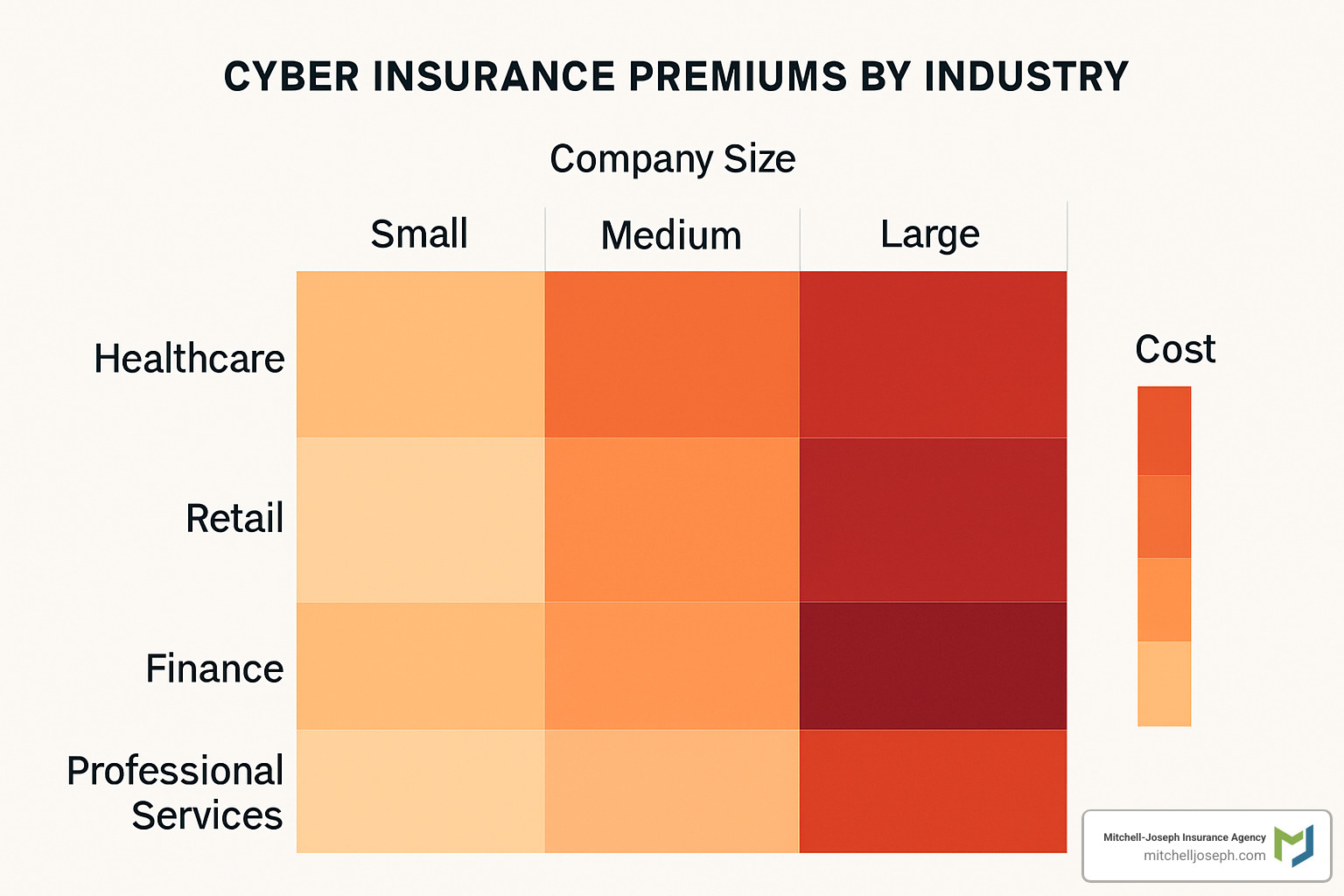
Industry makes a huge difference in your premiums. A healthcare practice handling thousands of patient records faces different risks than a local accounting firm. Manufacturing companies with operational technology have unique exposures compared to retail businesses. This is where a cyber insurance cost calculator becomes invaluable—it factors in these industry-specific risks to give you realistic expectations.
The cost curves for different types of incidents tell an interesting story. Data breaches often involve regulatory fines and notification costs that grow with each affected person. Ransomware attacks hit differently—they bring immediate ransom demands plus business interruption costs that can snowball quickly when your systems are down.
Here’s where smart business owners can save real money. Annual payment discounts typically shave 5-10% off your premiums compared to monthly billing. Bundling cyber coverage with errors and omissions insurance often open ups package discounts that benefit both policies. Most importantly, security improvements directly reduce your risk scores and premiums—meaning your cybersecurity investments pay dividends twice.
I’ve seen businesses cut their premiums significantly by implementing multi-factor authentication, employee training programs, and secure email gateways. The cyber insurance cost calculator shows you exactly how these improvements affect your bottom line, making it easier to justify the investments to your team or board.
Understanding these benchmarks helps you make informed decisions about coverage levels and security investments. More info about Importance of Business Insurance explains how cyber coverage fits into your overall risk management strategy and why getting the numbers right matters for your business’s long-term health.
Frequently Asked Questions about Cyber Insurance Cost Calculators
How accurate are online calculators?
Here’s the honest truth: cyber insurance cost calculators are pretty darn good at giving you realistic estimates. Most come within 20-30% of actual premiums, which is impressive considering they’re working with limited information about your business.
These tools aren’t just throwing darts at a board. They’re built on real claims data from thousands of cyber incidents and use the same mathematical models that insurance companies rely on for underwriting. When you see an estimate, you’re looking at calculations based on what actually happened to businesses similar to yours.
But let’s be clear about what they can’t do. A calculator doesn’t know that your IT manager is a cybersecurity wizard who built Fort Knox-level defenses, or that your employees completed advanced phishing training last month. It can’t assess the subtle details of your security setup or dive deep into your claims history.
Think of calculator results as your starting point for smart conversations with insurance professionals, not your final answer. They give you enough knowledge to ask the right questions and spot unrealistic quotes.
What cyber incidents are usually included in the estimate?
When a cyber insurance cost calculator crunches your numbers, it’s thinking about the full disaster scenario, not just the headline-grabbing ransom payment. The estimates typically include ransom payments, digital forensics and incident response costs, business interruption losses, system restoration expenses, legal fees, and privacy-related costs from data theft.
Ransomware scenarios dominate most calculations because they represent about 60% of all cyber insurance claims. These attacks don’t just encrypt your files—they can shut down your entire operation while you scramble to restore systems and figure out what data was compromised.
Data breach costs tell a different story. The expenses scale with how many people are affected, what type of information was stolen, and which regulations apply to your industry. A healthcare practice dealing with patient records faces different costs than a retail shop handling credit card information.
The business interruption piece often catches people off guard. When your systems go down, the revenue losses can quickly dwarf the direct incident response costs. If your business can’t operate without technology for even a few days, those numbers add up fast.
What’s the next step after I get my numbers?
Once you’ve got your calculator results, you’re armed with the knowledge to have productive conversations with insurance professionals. No more deer-in-headlights moments when someone asks about coverage limits or premium budgets.
Your estimates become a roadmap for security improvements that actually pay for themselves. If the calculator shows that adding multi-factor authentication could reduce your premiums by 15%, you’ve got a compelling business case that goes beyond just “it’s good security practice.”
Insurance is just one piece of your protection puzzle. The calculator results should inform your broader risk management strategy, including security upgrades, employee training programs, and incident response planning.
At Mitchell-Joseph Insurance Agency, we’ve found that clients who come to us with calculator results in hand have much smoother application processes and better outcomes. They understand what they’re protecting against and can make informed decisions about coverage levels that actually make sense for their business.
Conclusion

A cyber insurance cost calculator transforms cyber insurance from a mysterious expense into an understandable business decision. With ransomware accounting for 60% of cyber claims and the average premium running $145 per month, these tools help you steer coverage options with confidence rather than confusion.
The key is using calculator results as a starting point, not an ending point. They provide valuable insights into your risk profile and help identify security improvements that reduce both your actual risk and insurance costs. When 95% of security incidents involve human error, understanding your exposure helps you make better decisions about both coverage and prevention.
At Mitchell-Joseph Insurance Agency, we’ve seen how calculator results improve the entire insurance process. Clients come to us with realistic expectations, appropriate budget ranges, and specific questions about coverage options. This leads to better policy fits and more satisfied customers throughout Rochester, Victor, Canandaigua, and the broader Finger Lakes region.
Your action plan should include:
1. Use a calculator to establish baseline cost estimates and risk understanding
2. Identify security improvements that provide the best risk-reward ratio
3. Align coverage limits with your actual exposure, not arbitrary budget constraints
4. Implement recommended controls to reduce both risk and premiums over time
The goal isn’t just to buy insurance—it’s to protect your business intelligently. A cyber insurance cost calculator helps you do exactly that, turning a complex decision into a manageable process.
Ready to move beyond estimates to actual coverage? More info about Business Insurance can help you translate calculator insights into comprehensive protection for your business.

