

Understanding What It Really Costs to Insure Your RV
The cost to insure a camper varies widely depending on your RV type and how you use it, but most owners can expect to pay the following:
Quick Answer: Average RV Insurance Costs
- Towable RVs (Travel Trailers, Pop-Ups): $180 – $600 per year ($15 – $50/month)
- Motorhomes (Class A, B, C): $504 – $3,000 per year ($42 – $250/month)
- Full-Time RV Living: $1,500 – $4,000 per year
- Recreational Use Only: $300 – $800 per year
- National Average: Around $1,500 annually ($125/month)
Whether you’re a New Yorker dreaming of exploring the Finger Lakes or planning a cross-country trip, understanding insurance costs is essential before you hit the road.
RV insurance isn’t one-size-fits-all. The cost to insure a small pop-up camper is far less than a luxury Class A motorhome used for full-time living. Factors like your driving record, storage location, and even your credit score all influence your premium.
The good news? RV insurance is often more affordable than you might think, especially when you know what factors influence pricing. With the right policy, you can protect your investment without breaking the bank.
I’m Jeffrey Joseph of Mitchell-Joseph Insurance Agency. Since 1999, I’ve helped Finger Lakes families find the right RV coverage. Understanding these costs upfront helps you budget properly, whether you’re a weekend warrior or a full-time RVer.
What Determines the Cost to Insure a Camper?
The cost to insure a camper depends on a variety of factors, much like car insurance. From the type of RV you own to where you park it, several key elements determine your premium. Let’s walk through what really matters when insurers calculate your rate.
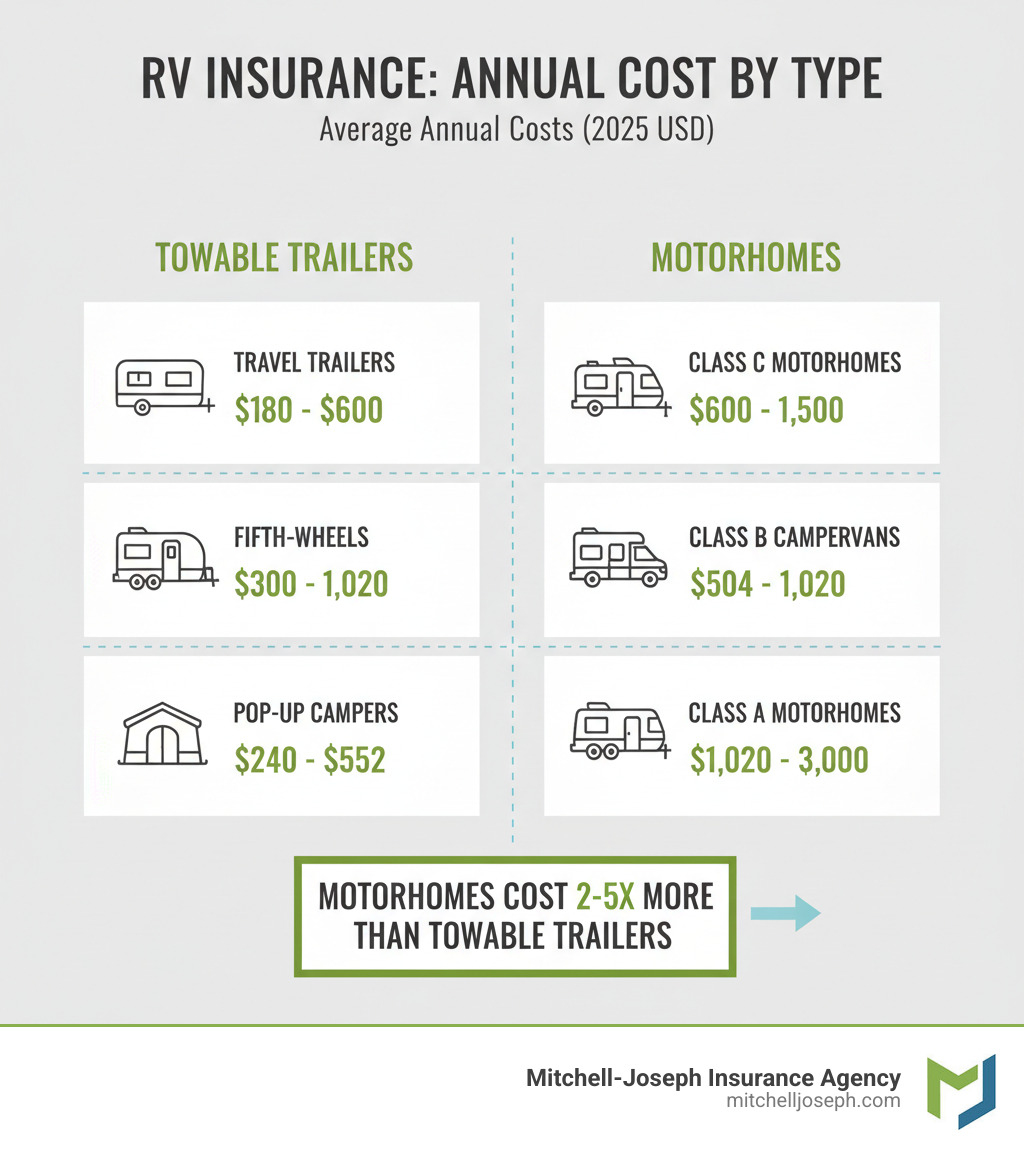
Average Insurance Costs by RV Type
Motorized RVs cost significantly more to insure than towable RVs. This is because motorhomes are drivable vehicles requiring full liability coverage, and they are typically more expensive to purchase and repair.
Towable RVs, on the other hand, are covered by your tow vehicle’s liability when hitched, which usually means lower premiums.
Let’s look at the numbers:
| RV Type | Average Monthly Cost | Average Annual Cost |
|---|---|---|
| Towable RVs | ||
| Travel Trailer | $15 – $50 | $180 – $600 |
| Fifth-Wheel Trailer | $25 – $85 | $300 – $1,020 |
| Teardrop Camper | $12 – $42 | $144 – $504 |
| Pop-Up Camper | $20 – $46 | $240 – $552 |
| Truck Camper | $17 – $67 | $204 – $804 |
| Motorized RVs | ||
| Class A Motorhome | $85 – $250 | $1,020 – $3,000 |
| Class B Campervan | $42 – $85 | $504 – $1,020 |
| Class C Motorhome | $50 – $125 | $600 – $1,500 |
As you can see, a modest travel trailer might cost just $250 to $500 annually, while a luxurious Class A motorhome can run $1,020 to $3,000 or more. Class C motorhomes typically fall in the middle, around $800 to $1,500 per year.
If you’re curious about the different types of RVs, our guide on different RV types breaks it all down.
Key Factors That Influence Your Premium
Beyond your RV type, several other factors influence your quote. Let’s dig into what moves the needle on your premium.
-
Your RV’s age, condition, and value: A new, high-value RV costs more to insure than an older, less expensive model. The higher the replacement value, the higher the premium.
-
How you use your RV: Full-time RV insurance is more comprehensive and expensive ($1,500 – $4,000/year) because it functions like a homeowner’s policy. Recreational users pay much less ($300 – $800/year). If your RV is your primary residence for over six months a year, you need full-time coverage.
-
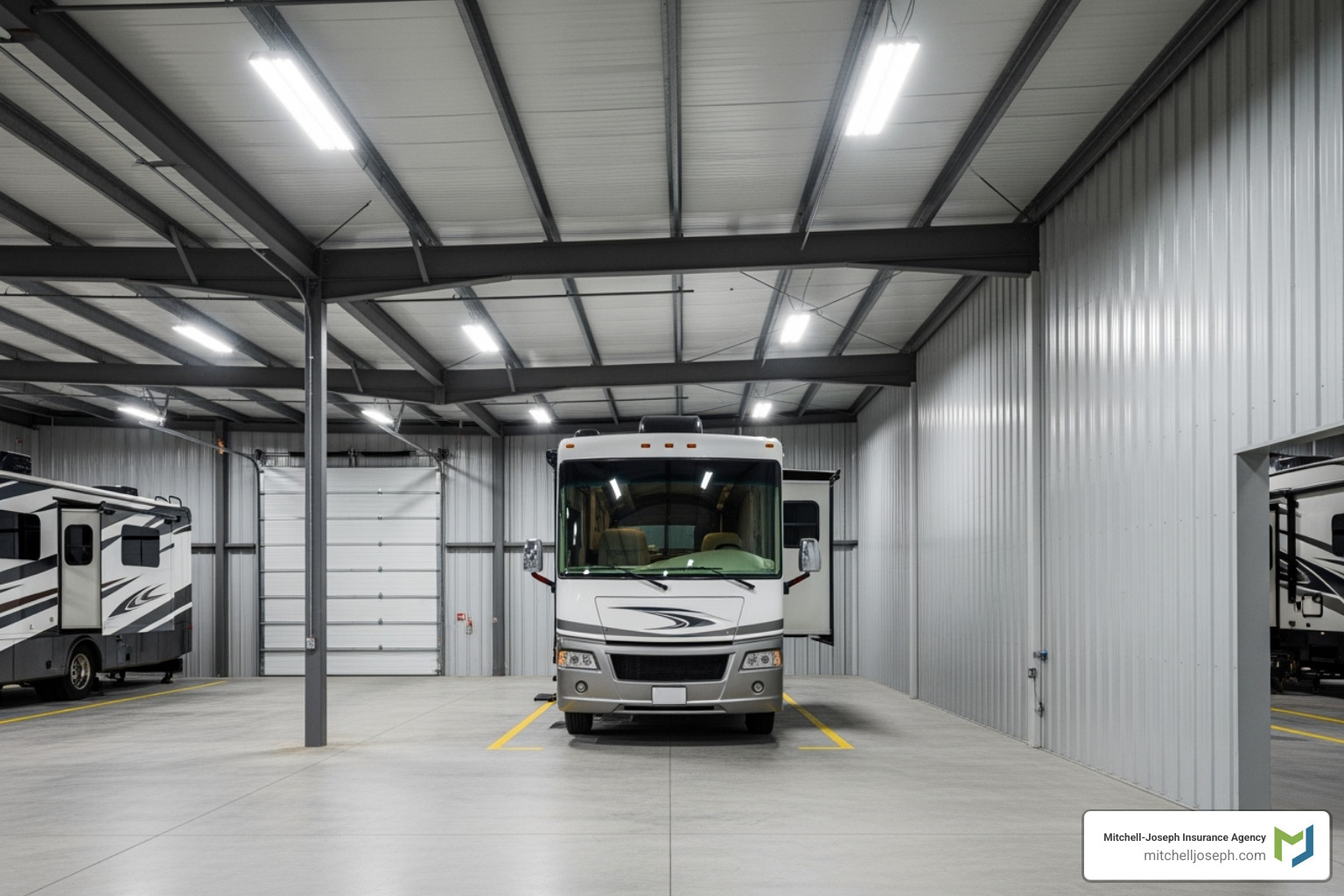
Where you store your RV: Storing your RV in a secure garage or gated facility lowers your premium by reducing theft and weather-related risks. Parking on the street, especially in high-risk areas, will increase your rates.
-
Your driving record and claims history: A clean driving record helps you get better rates. At-fault accidents can increase your premium significantly, sometimes by 42% or more. A history of multiple claims also marks you as a higher risk.
-
Your chosen deductible: Choosing a higher deductible (e.g., $1,000 vs. $250) lowers your monthly premium because you agree to pay more out-of-pocket for a claim. A lower deductible means a higher premium but less to pay if you file a claim.
-
Your credit score: In most states, insurers use a credit-based insurance score to help predict claim likelihood. A higher credit score often translates to lower premiums.
-
Where you live: Costs vary by state. For example, Michigan rates can range from $700 to $4,500 annually, while Florida’s are typically $800 to $1,500. In New York, we help clients steer local requirements to find the best rates.
Understanding Your Coverage Options and Exclusions
Knowing what your policy covers—and what it doesn’t—is essential. RV insurance combines elements of auto and home insurance.
Standard coverages form the foundation of your policy. Liability coverage is required for motorized RVs and protects you financially if you cause an accident. Collision coverage pays for damage to your RV from an accident, while Comprehensive coverage handles non-collision damage like theft, vandalism, fire, or hail. Lenders usually require both. Did you know that nearly 2,000 RV fires occur annually? Other standard options include Uninsured/underinsured motorist and medical payments (PIP).
RV-specific coverages are highly recommended add-ons. Vacation liability protects you when your RV is parked at a campsite. Personal effects coverage insures your belongings inside the RV. Roadside assistance is crucial for towing and on-road issues. Total loss replacement provides a new RV if yours is totaled, and Emergency expense coverage pays for lodging if your RV is unusable after a covered loss. Other options include safety glass replacement and pet injury coverage.
For a comprehensive look at all available protections, check out our guide on RV Insurance Coverage Options.
Common exclusions are just as important to understand. Standard policies typically exclude wear and tear, mold, and rodent damage. Damage from illegal activities, unauthorized drivers, or unapproved modifications is also not covered.
How to Lower the Cost to Insure a Camper
There are plenty of strategies and discounts that can significantly reduce the cost to insure a camper.

Discounts can really add up. One of the easiest ways to save is with a multi-policy or bundling discount by combining your RV insurance with your auto or home policy. Other common discounts include:
- Good driver for a clean record
- Safety features (anti-theft devices, cameras)
- RV club memberships (like Good Sam)
- Paying your premium in full
- Being the original owner
- Remaining claim-free
- Completing an RV safety course
- Seasonal storage during the off-season
Beyond discounts, there are several smart strategies to lower your costs. Increasing your deductible is an effective way to reduce your premium. Shopping around annually is also crucial; we work with 24 insurance companies to compare rates and find you the best deal.
Maintaining a clean driving record is one of the most impactful ways to keep costs down. If you’re still shopping, smaller, lower-value models like those in our Affordable Recreational Vehicles guide almost always cost less to insure. Finally, storing your RV securely reduces risk and can lower your premium.
Securing Your Investment for the Road Ahead
Understanding RV insurance doesn’t have to be complex. Think of us as your guide to finding coverage that fits your needs and budget.
Here’s a quick recap: the cost to insure a camper is not a fixed number. While the national average is around $1,500 annually, your premium is unique. It depends on your RV type, usage (recreational vs. full-time), storage, and driving history. As we’ve seen, motorized RVs cost more than towables, and full-time use ($1,500-$4,000/year) is more expensive than recreational use ($300-$800/year).
Key factors driving your premium include your RV’s value, your usage, storage location, driving record, and chosen deductible. It’s also vital to understand your coverage options, from standard liability to RV-specific add-ons, and common exclusions like wear and tear.
The good news is you can lower your costs. Bundling policies, maintaining a clean driving record, and choosing the right deductible can significantly trim your premium.
To get a personalized quote, we’ll need your RV’s details (including VIN), planned usage, storage location, and driving history. This helps us find the best rate from our network of 24 insurance companies.
At Mitchell-Joseph Insurance Agency, we’ve helped Finger Lakes families protect what matters since 1999. As your neighbors in Honeoye Falls, Pittsford, and beyond, we offer personalized service, not one-size-fits-all policies. With over 200 years of combined experience, we know how to find coverage that truly works for you, whether you’re exploring Canandaigua Lake or heading cross-country.
Your RV represents freedom and adventure. Let’s make sure it’s properly protected so you can focus on the journey ahead.
Get your tailored RV insurance quote today and let’s get you on the road with confidence!

