

Why Understanding Condo Insurance Replacement Cost Can Save You Thousands
Condo insurance replacement cost is the amount your HO-6 policy pays to rebuild or repair your unit’s interior at today’s prices, without deducting for depreciation. This coverage is far different from actual cash value, which factors in wear and tear and can leave you with substantial out-of-pocket expenses after a loss.
Quick Comparison: Replacement Cost vs. Actual Cash Value
- Replacement Cost Value (RCV): Pays the full cost to rebuild or replace at current prices.
- Actual Cash Value (ACV): Pays replacement cost minus depreciation.
- Example: A 5-year-old kitchen is damaged.
- RCV payout: $25,000 (current replacement cost).
- ACV payout: $15,000 (after depreciation).
Most condo owners need replacement cost coverage because:
- HOA master policies only cover common areas and the building exterior.
- Your individual policy must cover interior walls, fixtures, and improvements.
- Construction costs have risen significantly.
- Depreciation can create huge gaps in coverage.
The challenge is determining how much coverage you need, which depends on your condo association’s master policy. Some cover just the “bare walls,” while others include original fixtures.
I’m Jeffrey Joseph, and since 1999, I’ve helped homeowners in the Finger Lakes region steer complex insurance decisions at Mitchell-Joseph Insurance Agency. Through decades of experience with condo insurance replacement cost calculations, I’ve seen too many owners find they’re underinsured only after a disaster.

Understanding the Core Concepts: RCV vs. ACV and Market Value
When shopping for condo insurance, you’ll see three key terms: Replacement Cost Value (RCV), Actual Cash Value (ACV), and Market Value. Understanding them is crucial for making smart decisions about your condo insurance replacement cost coverage.
If disaster strikes, these values determine whether you can afford to rebuild. The biggest difference is depreciation—the reality that items lose value over time. Your five-year-old floors aren’t worth what you paid, even though replacing them today costs more.
Market value includes land and what buyers will pay, but insurance doesn’t cover land, and market prices shouldn’t dictate your rebuilding costs.
| Coverage Type | What It Covers | Depreciation Factor | Your Out-of-Pocket Cost |
|---|---|---|---|
| Replacement Cost Value (RCV) | Full cost to rebuild/replace at today’s prices | No deduction | Lowest |
| Actual Cash Value (ACV) | Replacement cost minus wear and tear | Deducted from payout | Highest |
| Market Value | What your condo would sell for today | Not applicable for insurance | N/A |
For more details about different coverage options, check out our guide on home insurance coverage types.
What is Replacement Cost (RCV) in Condo Insurance?
Replacement Cost Value is your financial safety net. It pays for rebuilding costs at today’s prices. When we talk about condo insurance replacement cost, this is what experts recommend because it covers the full expense of restoring your unit without deducting for depreciation.
RCV focuses on current labor and materials costs, not what you originally paid. If your kitchen was destroyed, RCV would pay to install a new kitchen of like-kind and quality using today’s pricing. For example, if granite countertops you bought for $3,000 five years ago now cost $4,200 to replace, RCV covers the full $4,200. This power of no deduction for depreciation means you can restore your home without using your savings.
This approach is vital as rebuilding costs have skyrocketed due to supply chain issues, labor shortages, and inflation. RCV adapts to these realities, ensuring your coverage isn’t outdated.
How is RCV Different from Actual Cash Value (ACV)?
The difference between RCV and Actual Cash Value can determine your financial recovery. While RCV gives you the full replacement amount, an ACV calculation subtracts for wear and tear, leaving you with the depreciated value.
Here’s how ACV works: the insurer calculates replacement cost, then subtracts depreciation. For eight-year-old hardwood floors, an ACV policy might only pay 60% of today’s replacement cost.
The trade-off is that ACV policies typically have lower premiums, but this savings vanishes when you face a higher out-of-pocket cost during a claim. You might save $200 a year on premiums but face a $15,000 shortfall after a kitchen fire.
Some RCV policies use recoverable depreciation, where you get an initial ACV payment, and the rest is reimbursed after you complete repairs. This ensures you receive full value.
The math is sobering. If a kitchen fire causes $30,000 in damage, an ACV policy might only pay $18,000 after depreciation, leaving you with a $12,000 bill. An RCV policy would cover the full $30,000.
The Master Policy Puzzle: How Your HOA Affects Your Coverage Needs
Many new condo owners are surprised to learn their insurance needs are part of a larger puzzle. Your individual condo insurance replacement cost coverage depends on what your HOA’s master policy already covers.
Your Homeowners Association’s master policy always covers the building exterior and common areas like hallways and lobbies. The tricky part is what it covers inside your unit, which varies dramatically by policy type.
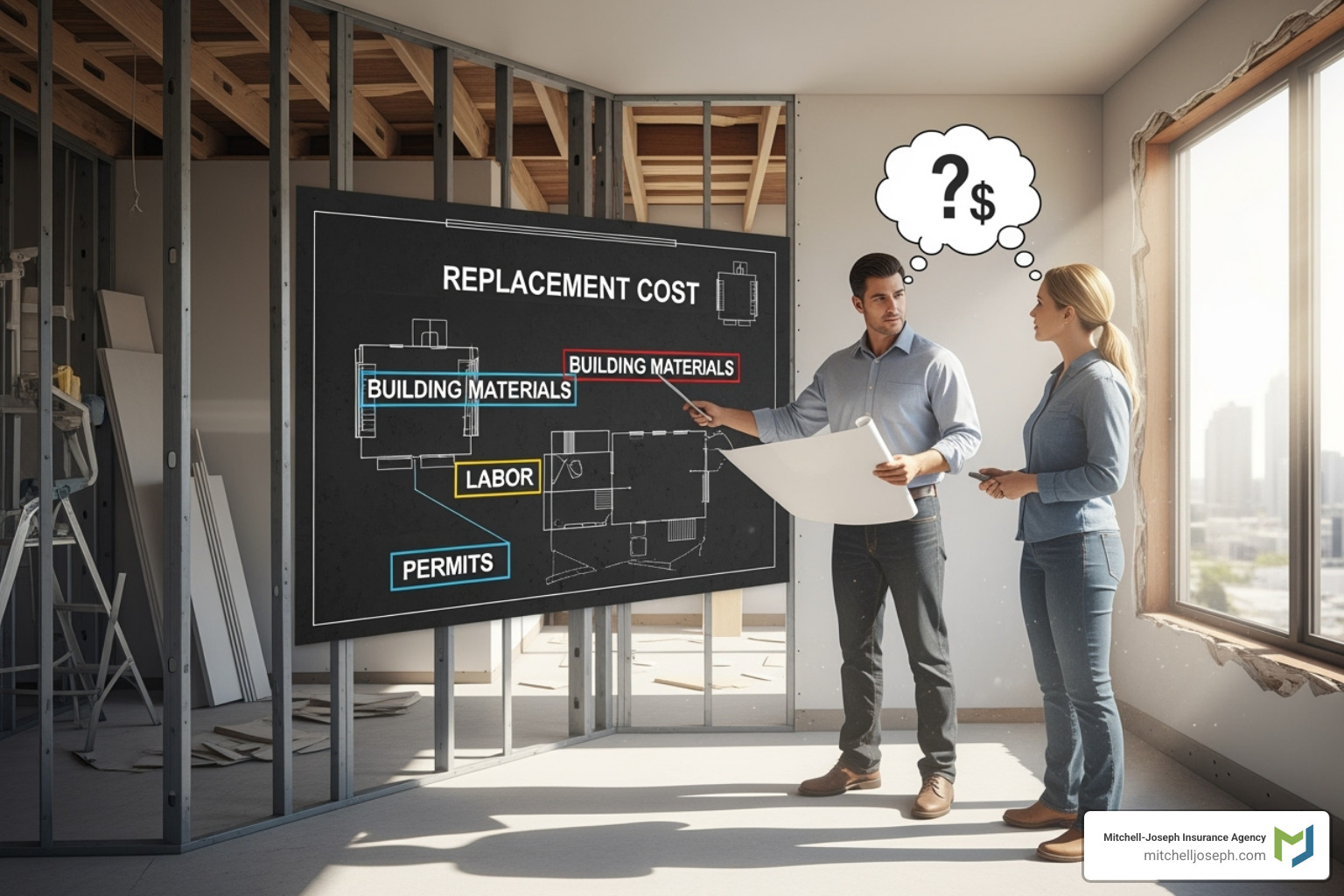
Failing to understand the master policy can be costly. For example, a client once faced a $15,000 bill for new kitchen cabinets after a fire, wrongly assuming their HOA policy would cover them.
Once you understand your HOA’s approach, calculating your coverage needs becomes much clearer. There are two main types of master policies, and knowing which one applies to you is essential. For more details on how these policies work from the association’s side, see our guide on Insurance for Condo Associations.
“All-In” (or All-Inclusive) Policies
An all-in master policy covers the building structure and the original installations inside your unit. This includes the cabinets, flooring, fixtures, and built-in appliances that came with the condo when it was first built.
If your HOA has an all-in policy, your main concern becomes any upgrades and betterments you’ve made. For instance, if you replaced builder-grade carpet with hardwood floors, the master policy would likely only cover the cost of the original carpet. You are responsible for the difference in value for your upgrades.
“Bare Walls-In” (or Walls-In) Policies
A bare walls-in policy is the opposite, covering just the skeleton of your unit. This policy includes the basic structure, plumbing, and electrical systems, but stops there. Everything else is your responsibility.
With a bare walls-in policy, you need significantly higher dwelling coverage on your HO-6 policy. You must insure your drywall, interior finishes, flooring, cabinetry, countertops, and all fixtures. Essentially, if you could theoretically remove it from your unit, you probably need to insure it.
To avoid surprises, don’t guess about your HOA’s master policy. Get a copy and review it carefully, or let us help you understand what gaps you need to fill with your individual coverage.
Calculating Your Condo Insurance Replacement Cost
Calculating your condo insurance replacement cost is critical for your financial recovery. It’s not a guess; it’s a careful estimate of the real-world cost to rebuild your unit’s interior.
Your dwelling coverage (or “building property coverage”) insures everything inside your four walls not already covered by your HOA’s master policy. This is challenging because construction costs are a moving target due to supply chain disruptions, labor shortages, and inflation.

What Parts of Your Condo Unit Need Coverage?
What your individual HO-6 policy needs to cover depends on your HOA’s master policy. Generally, this includes everything permanently attached inside your unit. Key items are flooring, countertops, light fixtures, cabinetry (kitchen and bath), built-in shelving, and bathroom vanities. If you have a “bare walls-in” policy, you’ll also need to cover drywall, paint, and basic fixtures.
Any upgrades or improvements you’ve made beyond the original builder specifications, like a renovated kitchen or bathroom, often represent the biggest part of your replacement cost needs.
How to Estimate Your Condo Insurance Replacement Cost
Calculating your condo insurance replacement cost requires some detective work. Using multiple approaches provides the most reliable estimate.
The square footage method is a good starting point. A common baseline is $100 per square foot, so a 1,200-square-foot condo would need about $120,000 in coverage. However, this is just a baseline; luxury finishes or high labor costs can significantly increase this number.
Your mortgage lender will have requirements, often around 20% of your unit’s total value. For a $500,000 condo, that’s $100,000 in coverage. This protects the lender’s investment and may not be enough for a full rebuild. The question Is Your Home Underinsured? is crucial when lender requirements and actual costs don’t align.
For the most accurate picture, get estimates from local construction professionals. A contractor can give you real-world pricing for your specific situation, factoring in current labor and material costs and the quality of your finishes.
The itemized inventory approach also works well. Walk through your unit, list everything that would need replacement, and research current prices. It’s time-consuming but provides a detailed understanding of your costs.
Today’s prices for materials and labor may be much higher than what you originally paid. Online resources can help you calculate the average rebuild cost, but local professional input is invaluable.
The goal is to insure the like-kind and quality replacement of everything inside your walls, not your condo’s market value. Getting this right is the difference between a smooth recovery and a financial nightmare.
Keeping Your Coverage Current and Complete
Think of your condo insurance replacement cost coverage as a living document. What seemed adequate last year might leave you with unexpected expenses after a loss today. Staying current doesn’t have to be complicated.
Why You Must Review Your Coverage Regularly
An annual insurance review is essential. Key factors like rising construction costs, market fluctuations, recent home renovations, and supply chain issues can quickly make your current coverage inadequate. A regular check-up ensures your policy limits keep pace with these changes.

Avoiding underinsurance is the primary goal. No one wants to face a total loss and find their policy won’t cover the full cost of rebuilding. We work with 24 different insurance companies, giving us the flexibility to find coverage that grows with your needs and budget.
For more answers to common questions, check out our guide: More info on home insurance FAQs.
Are Extended or Guaranteed Replacement Cost Options Available?
Beyond standard replacement cost, many insurers offer endorsements that provide extra protection when costs unexpectedly spiral.
Extended replacement cost coverage acts as a safety net. This endorsement adds a buffer, typically 25% to 50%, on top of your dwelling limit. If your $200,000 policy has a 25% extension, it would cover up to $250,000 in rebuilding costs.
Guaranteed replacement cost coverage is the premium option. This coverage promises to rebuild your condo’s interior completely, even if costs far exceed your policy limits. If rebuilding costs $300,000 but your dwelling coverage is only $250,000, this endorsement picks up the entire $50,000 difference.
Ordinance or law coverage is also important. Building codes change, and after a loss, you might need to pay for expensive code upgrades like new electrical systems. Standard policies don’t cover these costs, but this endorsement does.
The percentage buffer these options provide offers genuine peace of mind for a relatively small increase in your premium. We can walk you through these options to help you decide what makes sense for your situation.
Frequently Asked Questions about Condo Replacement Cost
Over my years helping families throughout the Finger Lakes region, I’ve noticed the same questions come up about condo insurance replacement cost. Here are the answers that matter most.
Why is having replacement cost coverage so important for a condo owner?
Replacement cost coverage is your financial lifeline. It pays the full, current cost to rebuild or replace damaged property without deducting for depreciation. An Actual Cash Value (ACV) policy, in contrast, only pays the depreciated value, which can leave you with a massive out-of-pocket expense.
For example, after a kitchen fire, RCV might pay the full $50,000 to rebuild, while ACV might only pay $25,000, leaving you to cover the difference. RCV is crucial for protecting your investment and financial security.
Does my mortgage lender require a specific amount of dwelling coverage?
Yes, your mortgage lender will require dwelling coverage to protect their investment, often at least 20% of your unit’s value or loan amount. If your condo is worth $400,000, they may demand at least $80,000 in coverage.
However, this minimum may not be sufficient for a full rebuild, especially if your HOA has a “bare walls-in” master policy. It’s vital to ensure your coverage meets both the lender’s requirement and your actual replacement cost needs. We can help you review your lender’s requirements against your actual needs to ensure you are not underinsured.
What’s the difference between dwelling coverage and personal property coverage?
This is a critical distinction in condo insurance. Both are essential, but they protect different things.
Dwelling coverage (also called Coverage A or building property coverage) protects the condo’s structure and permanent fixtures: your interior walls, flooring, kitchen cabinets, bathroom vanities, and countertops. Think of it as covering things that are built-in or attached.
Personal property coverage (also known as Coverage C) protects your movable belongings: your furniture, electronics, clothing, and dishes. These are the items that make your condo feel like home.
For example, after a fire, dwelling coverage rebuilds the kitchen, while personal property coverage replaces your couch and TV. A built-in dishwasher is typically dwelling coverage, while a portable microwave is personal property.
Getting both coverage amounts right is crucial. For a deeper dive into protecting your belongings, check out our guide on Personal Property Condo Insurance.
Conclusion
Understanding condo insurance replacement cost is one of the most important financial decisions you’ll make as a condo owner. Getting it right can save you thousands of dollars and immense stress by ensuring you can rebuild after a disaster without draining your savings.
Here are the key takeaways:
- Always choose Replacement Cost Value (RCV) to avoid large out-of-pocket costs from depreciation.
- Understand your HOA’s master policy (“all-in” vs. “bare walls-in”) to determine your dwelling coverage needs.
- Calculate your costs accurately, considering your specific finishes and local construction prices.
- Review your policy annually to keep up with inflation and any renovations. Consider extended or guaranteed replacement cost options for an extra safety buffer.
At Mitchell-Joseph Insurance Agency, we’ve been helping families in the Finger Lakes region steer these decisions since 1999. Our family-owned business serves communities throughout Honeoye Falls, Pittsford, Naples, Rushville, Avon, Bloomfield, Bristol, Canadice, Canandaigua, Cohocton, Fishers, Gorham, Honeoye, Ionia, Lima, Mendon, Middlesex, Potter, Rochester, Rush, South Bristol, Stanley, Victor, Wayland, and West Bloomfield, NY.
With access to 24 different insurance companies and over 200 years of combined experience, we don’t just sell policies—we build relationships. We take the time to understand your situation, explain your options clearly, and help you make informed decisions about your condo insurance replacement cost needs.
Don’t wait until you file a claim to find gaps in your coverage. Let us help you create a policy that truly protects your investment and gives you peace of mind.
Get a quote for your condo insurance today, and let’s make sure you’re properly protected.

