

Protecting Your Rental Investment
Condo insurance for landlords is specialized coverage designed specifically for property owners who rent out their condominium units. Unlike standard homeowners policies, this insurance protects your investment property and shields you from the unique risks of being a landlord.
Quick Answer: Condo Insurance for Landlords
- What it is: Insurance that covers your condo unit when rented to tenants
- What it covers: Interior structure, landlord’s belongings, liability, loss of rental income
- What it doesn’t cover: Tenant belongings, intentional damage, normal wear and tear
- Cost: Typically 15-25% more than standard homeowners insurance
- Required by: Mortgage lenders (almost always), condo associations (often)
- Key difference: Standard homeowners policies don’t cover rental properties
When you convert your personal condo into a rental property, your insurance needs change dramatically. The standard homeowners policy you’ve had is no longer adequate – it simply wasn’t designed for the business relationship you now have with tenants. Without proper landlord coverage, you risk significant financial exposure if disaster strikes.
Most condo associations carry a master policy that covers the building’s exterior and common areas, but this leaves your unit’s interior finishes, improvements, and your personal liability as a landlord unprotected without specialized coverage.
I’m Jeffrey Joseph, owner of Mitchell-Joseph Insurance Agency, and I’ve helped countless condo owners across the Finger Lakes region steer the complexities of condo insurance for landlords since 1999. My team and I understand the unique challenges facing property investors in upstate New York.

Why This Guide Matters
Investing in a rental condo can provide excellent passive income, but it also comes with significant financial risks. Without proper insurance protection, a single incident could wipe out years of rental profits. Our guide helps you:
- Protect your valuable investment from physical damage
- Shield your personal assets from liability claims
- Ensure compliance with mortgage lender and condo association requirements
- Control costs while maintaining adequate coverage
- Understand the complex interplay between condo association and personal insurance policies
Whether you’re a seasoned landlord or just starting your journey into property investment in Rochester, Canandaigua, or anywhere in the Finger Lakes region, this comprehensive guide will help you steer the sometimes confusing world of condo insurance for landlords.
Condo Insurance for Landlords: Coverage Basics
When you transform your condo into a rental property, your insurance needs change dramatically. You’ll need coverage specifically designed for landlords – typically a modified HO-6 policy that insurance professionals might call a “tenant-occupied condo unitowners policy” or simply “condo insurance for landlords.”
Think of it this way: the moment you hand those keys to a tenant, your risk profile shifts. Your standard owner-occupied policy just won’t cut it anymore. Here’s what makes landlord coverage different:
| Coverage Type | Homeowners Policy | Renters Policy | Condo Landlord Policy |
|---|---|---|---|
| Building Structure | ✓ (entire home) | ✗ | ✓ (unit interior only) |
| Personal Belongings | ✓ (all) | ✓ (tenant’s only) | ✓ (landlord’s only) |
| Liability Protection | ✓ (personal) | ✓ (tenant’s) | ✓ (landlord’s) |
| Loss of Use | ✓ (temporary housing) | ✓ (temporary housing) | ✓ (lost rental income) |
| Medical Payments | ✓ | ✓ | ✓ |
| Tenant Property | ✗ | ✓ | ✗ |
Standard vs. Specialized Policies
One of the most common mistakes we see at Mitchell-Joseph Insurance Agency involves condo owners who forget to update their insurance when they start renting out their unit. This oversight can be costly!
Your standard homeowners policy has serious gaps when it comes to rental activities. It wasn’t built for tenant relationships and may actually exclude coverage for rental use entirely. If you have a claim and your insurer finds undisclosed rental activity, they might deny coverage completely – leaving you financially exposed just when you need protection most.
Meanwhile, your tenant’s renters insurance only covers their personal belongings and their personal liability. It does nothing to protect your investment in the property itself or your liability as the owner.
What makes condo insurance for landlords different is that it recognizes renting property for what it truly is – a business activity. The policy accounts for your absence from the property and includes specific coverages for the unique challenges landlords face, from tenant-related liability to periods of lost rental income.
Primary Keyword Spotlight—condo insurance for landlords
Condo insurance for landlords isn’t just a nice-to-have – it’s essential protection that serves multiple crucial purposes.
First, it protects your property investment by covering damage to your unit’s interior walls, floors, fixtures, and any improvements you’ve made. Second, it provides a vital liability shield if tenants or their guests are injured in your unit – a risk that increases when you’re not personally there to maintain the property.
Beyond physical protection, this coverage safeguards your income stream by replacing lost rent if a covered disaster makes your unit temporarily uninhabitable. Imagine a pipe bursts and your tenant can’t live there for three months during repairs – without proper coverage, that’s three months of lost income.
In our experience at Mitchell-Joseph Insurance Agency, mortgage lenders almost universally require proof of appropriate landlord insurance before financing a rental property. This makes perfect sense – the property is collateral for their loan, and they want assurance it’s properly protected.
Similarly, most condo associations include specific insurance requirements in their bylaws. These rules ensure all owners contribute to maintaining the building’s overall insurability while protecting the community’s collective interests. Having the right policy keeps you in compliance and helps you avoid potential fines or disputes with your association.
What’s Covered—And What’s Not
Let’s pull back the curtain on what your condo insurance for landlords actually protects—and where you might still be exposed. Understanding these boundaries helps you sleep better at night knowing exactly where your safety net is strongest.
Core Protections
When disaster strikes your rental condo, your policy steps in to protect what matters most. Your dwelling coverage wraps its arms around the interior structure of your unit—those walls and ceilings you’ve carefully painted, the floors your tenants walk on daily, and all those built-in appliances that make the space functional. It also covers the electrical and plumbing systems hidden within your walls, plus any special upgrades you’ve invested in over the years.
Beyond the structure itself, your policy protects the personal property you’ve provided for your tenants. That refrigerator humming in the kitchen? Covered. The cozy couch in the living room of your furnished unit? Also covered. Even those stylish window treatments and the maintenance equipment you store on-site fall under your policy’s protection.
Personal liability coverage becomes your financial shield when the unexpected happens. If a tenant slips on a loose tile you failed to repair, or a visitor trips on your doorstep, your policy helps cover their medical bills and your legal defense if things escalate to court. For smaller injuries, medical payments coverage kicks in regardless of who’s at fault—often resolving minor incidents before they grow into major headaches.
Perhaps most valuable for your bottom line is loss of rental income coverage. Imagine a pipe bursts while your tenant is away, flooding the unit and making it uninhabitable for months. This coverage replaces that lost rent check while repairs are underway, typically for up to a full year. It’s like having income insurance for your investment property!
Common Exclusions
Now for the reality check—what your landlord policy won’t cover. First and foremost, your tenant’s personal belongings never fall under your protection. That expensive laptop or cherished family heirlooms? Your tenant needs their own renters insurance for those items.
Normal aging and deterioration—those squeaky hinges, fading paint, or appliances simply wearing out—aren’t covered either. Insurance is designed for sudden, unexpected events, not the predictable march of time.
Mother Nature brings her own exclusions to the table. Standard policies wave the white flag at flood damage from external sources like heavy rainfall or overflowing rivers. For that, you’ll need separate Flood Insurance for Landlords. Similarly, when the earth moves during an earthquake, standard policies typically step aside unless you’ve added specific coverage.
If you’re jumping into the short-term rental game with weekend warriors from Airbnb, beware—standard landlord policies often exclude these arrangements, requiring specialized home-sharing coverage instead.
While accidental damage caused by tenants typically falls under your protection, intentional damage or vandalism by those same tenants might leave you holding the bill. For more detailed information about landlord insurance costs and coverage options, check out this quick guide to landlord insurance from Investopedia.
Secondary Keyword—condo insurance for landlords limits
Every condo insurance for landlords policy comes with financial boundaries you should understand. Your deductible—typically ranging from $500 to $1,000—represents your skin in the game before insurance kicks in. Opting for a higher deductible lowers your premium but means reaching deeper into your pocket when filing a claim.
Liability protection also has its ceiling. While standard policies might include $100,000 to $300,000 in coverage, we’ve seen too many court judgments exceed these amounts. In today’s lawsuit-happy world, higher limits often make sense for serious landlords.
Pay attention to how your property is valued too. Replacement cost coverage gives you today’s retail price for that five-year-old dishwasher, while actual cash value subtracts for all those years of use. The difference can be thousands of dollars when it matters most.
Here at Mitchell-Joseph Insurance Agency, we’ve guided countless condo landlords throughout Rochester and the Finger Lakes region through these coverage decisions. We believe understanding these nuances isn’t just about insurance—it’s about protecting the investment you’ve worked so hard to build. For more comprehensive protection options, check out our Property and Casualty Insurance and General Liability Policy offerings.
The Master Policy Puzzle: HOA & You
Understanding how your individual policy works alongside your condo association’s master policy is often the most puzzling part of condo insurance for landlords. This relationship isn’t just important—avoid costly coverage gaps or unnecessary overlaps.

Association Master Policy Types
When I sit down with condo-owning clients here in the Finger Lakes region, one of the first questions I ask is: “Do you know what type of master policy your association carries?”
Most associations have one of two types of master policies, and the difference matters tremendously for your coverage needs:
A “Bare Walls” master policy is exactly what it sounds like—pretty minimal. It covers only the basic structure, exterior, and common areas. With this type, you’re on the hook for everything inside your unit. That means all interior walls, flooring, ceilings, fixtures, appliances, cabinets, countertops, and even the plumbing and electrical systems within your unit walls.
On the other hand, an “All-In” master policy offers more comprehensive coverage. It includes the basic structure plus standard fixtures and built-ins as originally installed by the developer. With this type, you’re mainly responsible for any upgrades or improvements you’ve made, your personal property, and any additions that weren’t part of the original construction.
Loss Assessment Coverage
Here’s something many condo landlords overlook until it’s too late: loss assessment coverage. This feature of condo insurance for landlords is your financial safety net when the association hits you with a special assessment for:
Your share of damage to common areas that exceeds what the master policy will pay
The master policy’s deductible (which can be surprisingly high)
Your portion of liability claims against the association that exceed their coverage limits
I remember helping a client in Canandaigua after a severe hailstorm damaged their condo building’s roof. The association had a $50,000 deductible on their master policy, which they divided among 20 unit owners. Without loss assessment coverage, each owner would have been on the hook for $2,500 out-of-pocket. Thankfully, my client’s policy covered their share.
Avoiding Coverage Overlap
To properly coordinate your condo insurance for landlords with the master policy, follow these practical steps:
First, get your hands on the governing documents. I can’t stress this enough—obtain and carefully read your condo association’s Declaration of Covenants, Conditions, and Restrictions (CC&Rs), bylaws, and a copy of the master insurance policy. Yes, they’re dry reading, but understanding these documents can save you thousands.
Second, pay special attention to improvements and betterments. These are the upgrades you’ve made to the original unit. That gorgeous kitchen renovation with quartz countertops? The hardwood flooring that replaced the builder-grade carpet? Those custom built-ins in the living room? Make sure your policy specifically covers these investments.
Finally, consider getting a unit appraisal. This helps determine the actual replacement cost of your unit’s interior and improvements, ensuring you have adequate coverage without overpaying.
Here at Mitchell-Joseph Insurance Agency, we regularly help clients throughout Rochester, Victor, and the entire Finger Lakes region review their association documents and coordinate coverage. Our goal is simple: eliminate dangerous gaps while making sure you’re not paying twice for the same protection. After all, insurance should give you peace of mind, not a headache!
Sizing Your Protection & Smart Add-Ons
Finding that sweet spot with your condo insurance for landlords coverage isn’t just about checking boxes—it’s about sleeping well at night knowing your investment is properly protected. Let’s walk through how to right-size your coverage and explore some add-ons that might be worth every penny.
Setting the Right Limits
When we sit down with landlords at our Honeoye Falls office, we often start by talking about dwelling coverage. For most condo units, you’ll want coverage equal to at least 20-30% of your unit’s market value. This isn’t about the purchase price—it’s about what it would cost to rebuild the interior if disaster struck. For a $300,000 condo, that means at least $60,000 in dwelling coverage.
For your personal property—those appliances, maybe some furniture, and those nice window treatments you installed—take a quick inventory. What would it cost to replace everything you own inside the unit? That number is your starting point for personal property coverage.
When it comes to liability protection, I’ve seen too many landlords go with minimum coverage only to regret it later. Given today’s lawsuit-happy world, $250,000 to $500,000 is really the baseline. Consider your overall net worth, how many properties you own, and who your tenants are when setting this number.
And don’t forget about protecting your rental income! If a fire makes your unit uninhabitable for months, those mortgage payments don’t stop. Your loss of rental income coverage should equal about 12 months of rent—giving you breathing room while repairs take place.

Optional Endorsements Worth Considering
Over my years at Mitchell-Joseph Insurance Agency, I’ve found certain add-ons provide exceptional value for condo landlords. Here are the ones worth a serious look:
Umbrella Liability coverage is something I recommend to nearly all our landlord clients. For about $300-500 annually, you can add $1 million in additional liability protection beyond your base policy. If you have significant assets or multiple properties, consider $2-5 million in coverage. It’s surprisingly affordable peace of mind.
Water Backup Coverage might not sound exciting until you’ve dealt with a sewer backup or sump pump failure. This coverage is particularly crucial for ground-floor units where water problems can quickly turn into five-figure nightmares.
Equipment Breakdown Coverage is like having a warranty on all your mechanical systems—HVAC, water heater, major appliances—often at a better value than purchasing individual extended warranties. When that five-year-old water heater suddenly fails, your tenant stays happy and your budget stays intact.
Ordinance or Law Coverage might be the most overlooked protection, especially in older buildings. If your unit suffers damage and current building codes require upgrades during repairs, this coverage handles those extra costs. Without it, you could be on the hook for thousands in unexpected expenses.
Vandalism Coverage is typically included in standard policies, but it’s worth confirming, particularly if your property is in an area with higher crime rates or sits vacant between tenants.
At Mitchell-Joseph Insurance Agency, we’ve helped countless landlords throughout Rochester, Pittsford, and surrounding communities find that perfect balance of protection without overpaying. We know every property is different, which is why we take the time to understand your specific situation rather than offering one-size-fits-all solutions.
Premiums, Discounts & Buying Steps
Understanding how insurers price condo insurance for landlords policies and knowing how to shop effectively can save you hundreds of dollars annually while ensuring proper protection.
How Insurers Price Your Policy
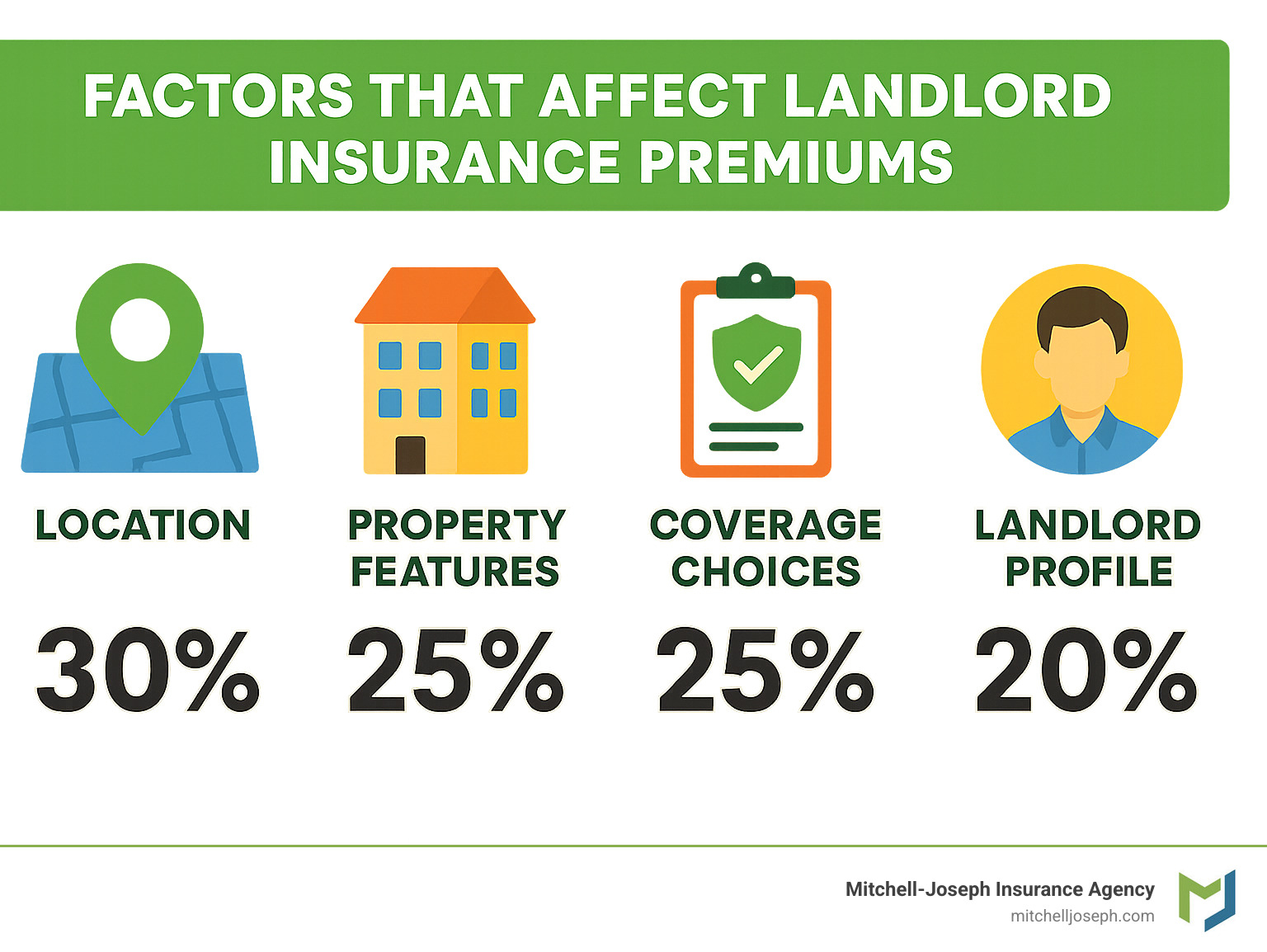
Condo insurance for landlords typically costs about 15-25% more than a comparable homeowners policy for the same property. Key factors affecting your premium include:
Location Factors:
– Local crime rates
– Weather-related risks (proximity to water, storm frequency)
– Fire protection class (distance to fire station, hydrant availability)
– Claims history for the area and building
Property Characteristics:
– Age and condition of the building
– Construction type (frame, masonry, etc.)
– Unit size and features
– Security systems and safety features
Coverage Choices:
– Deductible amount
– Liability limits
– Additional endorsements
– Replacement cost vs. actual cash value
Landlord Profile:
– Claims history
– Credit-based insurance score
– Length of time as a customer
– Other policies with the same company
Step-by-Step Shopping Checklist
Follow these steps to secure the right condo insurance for landlords policy at the best price:
- Gather Information:
- Condo association documents (especially insurance requirements)
- Master policy declaration page
- Unit square footage and features
- Value of improvements and landlord-owned contents
-
Rental income details
-
Review the Master Policy:
- Determine if it’s “bare walls” or “all-in”
- Note the association deductible
-
Identify coverage gaps you need to fill
-
Compare Multiple Quotes:
- Contact at least 3 different insurers
- Ensure each quote includes the same coverages for valid comparison
-
Ask about discount opportunities
-
Consult an Independent Agent:
- At Mitchell-Joseph Insurance Agency, we represent 24 different insurance companies
- We can identify the best coverage options for your specific situation
-
Our experience with local condo associations in Honeoye Falls, Canandaigua, and throughout the Finger Lakes region provides valuable insights
-
Maximize Discounts:
- Multi-Policy Bundle: Combine with auto, umbrella, or other policies (typically 10-15% savings)
- Security Devices: Smart home monitoring, water leak detection, security systems (5-10% savings)
- Claims-Free History: Maintaining a clean record (can save up to 20%)
- Pay-in-Full: Annual payment instead of monthly (often 5-10% discount)
-
Loyalty: Staying with the same insurer (typically 5% after 3-5 years)
-
Lock in Coverage:
- Provide proof of insurance to your mortgage lender
- Submit documentation to your condo association
- Keep digital and physical copies of all policy documents
At Mitchell-Joseph Insurance Agency, we simplify this process by doing the comparison shopping for you across our 24 partner companies, ensuring you get the right coverage at competitive rates.
Short-Term Rentals & Tenant Requirements
The explosion of platforms like Airbnb and VRBO has opened exciting doors for condo owners – but also created some tricky insurance territory. If you’re thinking about short-term rentals, you should know that your standard condo insurance for landlords policy probably won’t have your back. These policies are typically designed for traditional leases of 6+ months, not weekend warriors.
Short-Term Rental Considerations
When I meet with clients considering the short-term rental route, I always explain the insurance landscape first. Your regular landlord policy likely has specific language excluding or severely limiting coverage for those quick turnover situations.
Some insurance companies now offer home-sharing endorsements you can add to your existing policy. These are perfect if you’re just occasionally renting out your place. But if you’re running what essentially amounts to a mini-hotel operation, you’ll probably need to step up to a commercial policy. These provide stronger protection with higher liability limits, business income coverage, and broader property protection – especially important when you’re welcoming new strangers every few days.
Beyond insurance, you’ll need to steer the local regulatory maze. Many cities and towns across New York have implemented specific licensing requirements, occupancy restrictions, and tax obligations for short-term rentals. And don’t forget your condo association! Many have minimum rental period requirements (often 30+ days), guest registration procedures, or even caps on how many units can be rented at all.

Making Tenants Part of Your Risk Plan
Whether you’re renting long-term or short-term, your tenants should be active participants in your risk management strategy. It’s not just about protecting yourself – it’s about creating a safer environment for everyone.
For long-term tenants, I always recommend including specific insurance requirements in your lease. Require renters insurance with at least $100,000 in liability coverage, and make sure they provide proof at move-in and renewal. Your lease should also clarify what activities aren’t allowed (certain pets, business operations) and spell out maintenance responsibilities to prevent claims before they happen.
If you’re hosting short-term guests, create clear house rules about amenity usage and provide easy-to-find safety information and emergency contacts. Many of my clients find that requiring damage deposits provides an extra layer of protection, and don’t overlook the built-in insurance options that platforms like Airbnb sometimes offer.
Documentation is your friend in either scenario. Keep digital copies of tenant insurance certificates with calendar reminders to verify coverage hasn’t lapsed. Document the condition of your unit before and after occupancy (those smartphone photos are worth their weight in gold), and maintain detailed records of all maintenance and repairs.
At Mitchell-Joseph Insurance Agency, we’ve helped countless landlords throughout Rochester, Canandaigua, and the entire Finger Lakes region develop comprehensive risk management strategies that blend solid insurance coverage with smart tenant requirements. We understand the unique challenges of condo ownership in our area and can help you steer both traditional and short-term rental markets with confidence.
Frequently Asked Questions about Condo Insurance for Landlords
Does landlord insurance cover tenant-caused damage?
When your tenant accidentally sets off the smoke alarm with a kitchen mishap or floods the bathroom, you might wonder if you’re financially protected. The good news is that condo insurance for landlords typically covers accidental damage caused by tenants.
Those kitchen fires, overflowing bathtubs, and accidentally broken fixtures from normal use? They’re generally covered. I’ve seen plenty of claims where a tenant accidentally left water running or had a small cooking fire, and the landlord’s policy stepped in to handle repairs.
However, there are important limitations to understand. Your policy won’t cover intentional damage or vandalism caused by your tenants. It also won’t cover normal wear and tear—those scuff marks on the walls and worn carpet spots are considered part of the normal aging process of a rental property.
Your security deposit serves as your first line of defense against tenant damage. If you’re faced with damage that exceeds the deposit amount, you may need to pursue legal action against the tenant to recover the difference. This is why thorough tenant screening is such an important part of being a landlord.
Is landlord insurance legally required?
While New York state doesn’t have laws specifically mandating condo insurance for landlords, don’t interpret this as permission to go without coverage. In practice, you’ll likely be required to carry it anyway.
If you have a mortgage on your condo (as most investors do), your lender will almost certainly require appropriate insurance coverage. They want to protect their investment just as much as you do! Similarly, nearly all condo associations include insurance requirements in their bylaws or CC&Rs, often with specific coverage minimums you must maintain.
If you work with a property management company, they typically require proof of insurance as part of their management agreement. They understand the risks of uninsured properties all too well.
Even if you somehow avoided all these requirements, operating without proper landlord insurance would be like driving without a seatbelt—technically possible, but tremendously risky. The potential financial exposure from a single claim could dwarf years of premium payments.
How much liability coverage should I carry?
“How much liability coverage is enough?” is one of the most common questions we hear at Mitchell-Joseph Insurance Agency. While the standard answer is “it depends,” we generally recommend a minimum of $250,000 to $500,000 for most condo landlords.
Your liability coverage should, at minimum, equal your net worth. After all, this represents what you could potentially lose in a lawsuit. If you have $400,000 in assets but only $100,000 in liability coverage, you’re leaving $300,000 unprotected.
Consider your specific risk factors too. A unit on a busy street with lots of foot traffic might present more liability risk than one in a quiet, secured building. Properties with features like balconies, stairs, or pool access carry additional liability concerns. Even your tenant profile matters—families with children typically present different risk considerations than single professionals.
For most landlords we work with, we recommend supplementing your base liability with an umbrella policy of at least $1 million. This additional layer of protection is especially important if you own multiple rental properties or have significant personal assets to protect.
The good news? Increasing your liability limits is surprisingly affordable. Often, you can double your coverage for just $50-100 more in annual premium. It’s one of the best insurance values available, offering substantial peace of mind for a modest cost.
Conclusion
Properly insuring your rental condo isn’t just smart business—it’s essential peace of mind. Condo insurance for landlords creates a financial safety net that protects the investment you’ve worked so hard to build.
After helping hundreds of condo owners throughout the Finger Lakes region, we’ve seen how the right insurance makes all the difference when unexpected challenges arise. Whether it’s water damage from a tenant’s overflowing bathtub or a liability claim from a visitor’s slip and fall, proper coverage means you can focus on collecting rent rather than draining your savings.
The most important lessons to remember:
Your standard homeowners policy simply wasn’t designed for rental activities. The moment you hand keys to a tenant, your insurance needs fundamentally change—requiring coverage specifically built for the landlord-tenant relationship.
Understanding your condo association’s master policy is crucial. We’ve helped many clients find they were either paying twice for the same coverage or, worse, had dangerous gaps that left them exposed. This “master policy puzzle” is often the trickiest part of condo insurance for landlords, but getting it right means more protection for less money.
Smart landlords improve their protection with carefully selected endorsements. That water backup coverage might seem like an unnecessary expense—until a sewer backup makes your unit uninhabitable and you’re facing both cleanup costs and lost rental income.
Your tenants are actually your partners in risk management. By requiring renters insurance and establishing clear lease terms about property care, you create a first line of defense that protects both their belongings and your investment.
At Mitchell-Joseph Insurance Agency, we believe in the power of independent advice. Rather than being limited to a single company’s offerings, our team can shop across 24 different insurers to find the perfect balance of protection and affordability for your specific situation.
We’ve been helping property owners throughout Rochester, Canandaigua, and the entire Finger Lakes region for decades. Our team knows the local rental market, understands the unique challenges of condo ownership, and can guide you through the sometimes confusing world of condo insurance for landlords.

With offices throughout the region, we’re always available when you need us—whether you’re reviewing your current coverage, adding a new property to your portfolio, or dealing with a claim. Our personalized approach means you’ll never be just a policy number.
Don’t wait until you’re facing a claim to find gaps in your coverage. Contact Mitchell-Joseph Insurance Agency today to review your current policy or get a quote on comprehensive protection for your rental condo.
The right condo insurance for landlords isn’t just about satisfying mortgage requirements or condo association rules—it’s about sleeping well at night knowing your investment is protected while you enjoy the benefits of rental income.

