

Protecting Your Agricultural Legacy in New York
Commercial farm insurance NY is specialized coverage designed for agricultural operations of all sizes that conduct business activities in New York State. Unlike standard homeowners or basic farm policies, commercial farm insurance provides comprehensive protection custom to the unique risks faced by farming businesses.
Quick Guide to Commercial Farm Insurance NY:
| Coverage Type | What It Protects | Typical Cost Range |
|---|---|---|
| Property | Farm structures, equipment, dwellings | $1,500+ annually |
| Liability | Visitor injuries, product claims | Varies by farm size |
| Crop | Harvest loss, revenue protection | Based on acreage/crop type |
| Workers’ Comp | Required when payroll exceeds $1,200 | Based on payroll |
| Pollution | Environmental damage, chemical spills | Add-on coverage |
From the smallest hobby farms to 500-acre dairy operations, commercial farm insurance provides critical protection against the unique risks that threaten your agricultural livelihood. In New York State, where weather extremes, liability concerns, and regulatory requirements create complex risk profiles, having the right coverage isn’t just smart business—it’s essential.
As one client shared after a severe storm damaged their equipment: “Having the right coverage meant we could rent replacement machinery and keep operations running without missing a harvest window. The ‘Extra Expense’ coverage literally saved our season.“
Beyond the basics, commercial farm policies can be customized to address specific needs of different agricultural operations:
- Dairy farms need specialized livestock coverage and milk contamination protection
- Grain producers require equipment breakdown and crop storage coverage
- Fruit & vegetable growers need product liability and food safety protections
- Agritourism operations require improved liability coverage for visitors
The need for proper commercial farm insurance has never been greater. According to recent data, over 80% of planted acres in the U.S. now have crop insurance coverage, highlighting its importance in modern agriculture. Meanwhile, climate-related claims have risen sharply in recent years, making comprehensive protection increasingly vital.
I’m Jeffrey Joseph from Mitchell-Joseph Insurance Agency, where we’ve been helping farmers across New York State mitigate their risks through specialized commercial farm insurance NY solutions since 1984, building our expertise through decades of working directly with operations of all sizes throughout the Finger Lakes Region.

Commercial Farm Insurance NY: Understanding the Basics
When my farmers ask about commercial farm insurance NY, I explain that it’s much more than what a standard homeowners policy covers. Your farm isn’t just where you live—it’s your livelihood, your business, and it faces unique risks that require specialized protection.
“I never realized my homeowners policy excluded all my farm business activities until a tree fell on my tractor,” one of our clients told me last year. “That $20,000 mistake taught me the hard way that understanding farm insurance basics isn’t optional.”
The fundamental difference is how these policies address business exposures. Your homeowners policy covers your house and personal belongings, but explicitly excludes business operations, income-generating equipment, and commercial liability. Even basic farm policies often leave significant gaps in coverage for commercial activities.
For New York farms that welcome visitors—whether for u-pick apples, corn mazes, or farm stays—the Safety in Agritourism Act provides some liability protection, but only if you follow specific requirements like posting proper warning signs. However, this legal protection complements rather than replaces proper insurance.
We’ve noticed concerning trends in New York farm claims recently, including:
– More frequent and severe weather events damaging crops and buildings
– Higher liability claims from farm visitors
– Growing concerns about product contamination
– Stricter environmental regulations
– Skyrocketing equipment replacement costs
Want to dig deeper into farm insurance questions? Our Farm Insurance 101: Frequently Asked Questions guide covers the basics in simple terms.
How “Commercial Farm Insurance NY” differs from a standard farmowners plan
The line between standard farmowners insurance and commercial farm insurance NY comes down to three main factors: scale, complexity, and revenue. Let me break down the differences:
A standard farmowners plan primarily covers your residence and personal property, with limited coverage for small-scale farming activities. It typically offers minimal protection for business income interruption and basic liability coverage for personal exposures.
In contrast, commercial farm insurance NY provides comprehensive coverage for both your home and business assets. The protection scales with your operation’s size and complexity, includes business income and extra expense coverage, and offers improved liability protection for commercial activities. It also provides options for product liability and pollution coverage that standard plans simply don’t include.
Revenue often determines when you need to upgrade. Most insurance companies consider farms with annual gross receipts over $5,000-$10,000 to be commercial operations requiring specialized coverage.
The liability scope is another crucial difference. If you’re selling produce at farmers markets or direct to consumers, the product liability protection in a commercial policy becomes essential rather than optional.
Key terms every “Commercial Farm Insurance NY” policy uses
Understanding the language in your commercial farm insurance NY policy helps ensure you’re properly protected. Here are the essential terms you’ll encounter:
Occurrence Limit refers to the maximum amount your insurer will pay for a single event, like a fire or storm. For commercial farms, these limits should accurately reflect your operation’s full value—not just what you think you might lose.
Replacement Cost coverage pays the full cost to replace damaged property without deduction for depreciation. This is particularly valuable for farm equipment, which can lose book value while remaining essential to your operation. That 15-year-old tractor might be worth little on paper but would cost a fortune to replace.
Blanket Coverage provides a single limit that applies to multiple buildings or types of property, giving you flexibility in how claims are settled. This is especially valuable for farms with multiple structures or seasonal inventory fluctuations.
Coinsurance requires you to insure your property for a specified percentage of its total value (typically 80-90%). If you don’t meet this requirement, you could face penalties during claims—something many farmers find too late.
Agreed Value is a predetermined amount paid in the event of a total loss, often used for specialized equipment or livestock where market values may not reflect true replacement costs.
Business Interruption covers lost income and continuing expenses if your farm operations are suspended due to a covered loss—critical for maintaining cash flow after a disaster.
“The difference between actual cash value and replacement cost can mean tens of thousands of dollars when settling a claim,” explains our senior farm agent. “That’s why we take extra time to review these terms with every farm client who walks through our door.”
Customizing Protection by Farm Type

No two farms are alike, which is why commercial farm insurance NY should never be one-size-fits-all. Your dairy operation in the Finger Lakes faces entirely different risks than your neighbor’s apple orchard or the horse farm down the road. Let’s explore how your specific type of agricultural business shapes the coverage you need.
Dairy Farm Insurance
The rhythm of a dairy farm – from pre-dawn milkings to evening chores – creates unique vulnerabilities. Your livelihood depends not just on your herd’s health but on complex equipment and storage systems.
“When our bulk tank malfunctioned last summer, we lost an entire pickup worth of milk,” shares Tom, a third-generation dairy farmer from Wyoming County. “Our commercial farm insurance NY policy covered not just the tank repair but the value of the milk itself – that made all the difference for our cash flow that month.”
Dairy operations need specialized protection for milk contamination and spoilage, sophisticated milking equipment, livestock mortality, and manure management systems. We particularly emphasize pollution liability coverage for our dairy clients, as a single manure storage failure could lead to cleanup costs exceeding $100,000.
Grain Farm Insurance
For grain producers, timing is everything. A combine breakdown during the narrow harvest window or a grain bin collapse can threaten an entire year’s income. Your commercial farm insurance NY policy needs to address these specific concerns.
Modern grain operations require robust coverage for expensive harvesting equipment (with proper replacement cost provisions), grain storage structures, weather-related crop losses, and potential chemical drift liability. With new combines often costing more than half a million dollars, adequate equipment coverage isn’t optional – it’s essential for your farm’s survival.
Fruit & Vegetable Farm Insurance
If you’re growing produce in New York, your insurance needs to protect everything from frost damage to food safety concerns. Product liability becomes especially important when selling directly to consumers at farmers markets or through CSA programs.
Many of our vegetable farming clients are surprised to learn that insurers increasingly require FSMA (Food Safety Modernization Act) training certificates before issuing coverage. This reflects heightened attention to food safety risks. We can help connect you with scientific research on produce safety to keep your operation compliant and insurable.
Livestock and Equine Operations
Raising livestock brings distinct challenges, from animal health emergencies to transportation risks. Your policy should cover animal mortality, specialized equipment, feed storage, and liability concerns specific to your operation.
Equine farms face particularly complex liability scenarios, especially those offering boarding, riding lessons, or hosting events. We’ve found that many horse farm owners initially underestimate their liability exposure until we walk through real-world claim scenarios together.
Agritourism Protection
Opening your farm to visitors creates wonderful opportunities – and significant risks. Whether you run a u-pick operation, farm store, or host educational tours, your commercial farm insurance NY policy needs improved liability protection.
The Safety in Agritourism Act provides some liability protection, but only if you follow specific requirements including proper signage and written warnings. Even then, comprehensive insurance remains essential since the Act doesn’t provide complete immunity from claims.
Organic and CSA Operations
Organic certification and direct-to-consumer models bring unique insurance considerations. Your crops often carry higher values, and your direct relationship with consumers increases both marketing opportunities and potential liability.
For CSA operations, coverage should extend to distribution sites, product liability for weekly shares, and protection for on-farm events. The personal connection that makes direct marketing so rewarding also creates specific risks that need addressing in your policy.
For a deeper look at available carriers and options, visit our guide to Farm Insurance Companies. If you’re concerned about farm equipment specifically, our Farm Equipment Insurance Coverage page offers valuable insights.
At Mitchell-Joseph Insurance, we believe that truly understanding your farm operation isn’t just about checking boxes – it’s about walking your fields, understanding your business model, and crafting protection that grows alongside your agricultural enterprise.
Coverage Deep Dive: Core, Optional & Regulatory Must-Haves

When it comes to commercial farm insurance NY, think of your policy as layers of protection – some essential, some custom to your specific operation. Understanding what belongs in your coverage portfolio helps you build protection that’s both comprehensive and cost-effective.
Core Coverages
The foundation of every good farm policy starts with property coverage. This protects everything from your barns and silos to storage buildings against threats like fire, lightning strikes, and those notorious New York windstorms. One client told me after a severe storm, “I never thought we’d lose the entire west side of our barn, but having replacement cost coverage meant we could rebuild without draining our savings.”
Your farm dwelling deserves special attention too. Unlike standard homeowners policies, farm dwelling coverage recognizes the unique risks that come with having your home on active farmland.
Farm liability might not be the most exciting topic over morning coffee, but it’s absolutely critical. This protection steps in when someone gets injured on your property or when your operations accidentally damage someone else’s property. In our litigious society, this coverage can literally save your farm.
The workhorses of your operation – your tractors, combines, irrigation systems – need protection through farm equipment and machinery coverage. When that essential piece of equipment breaks down mid-harvest, having the right coverage means the difference between a minor inconvenience and a major financial setback.
Your harvested crops, feed, seed, and supplies aren’t just inventory – they’re the fruits of your labor and investment. Farm products and goods coverage ensures they’re protected while stored on your property.
Optional Coverages
Beyond these essentials, smart farmers consider additional layers of protection based on their specific operations.
If animals are central to your farm, livestock coverage protects against death from accidents, illness, or injury. For dairy farmers especially, this protection can be the difference between weathering a difficult season and facing financial catastrophe.
Do you sell directly to consumers at farmers markets or farm stands? Product liability coverage becomes essential, protecting you if someone claims illness from your products. As one vegetable farmer shared, “The peace of mind knowing we’re covered if someone gets sick from our produce is worth every penny of the premium.”
Business interruption coverage might seem like a luxury until you need it. When a covered event forces you to pause operations, this coverage replaces lost income and helps pay ongoing expenses. Think of it as insurance for your cash flow.
Modern farm equipment relies heavily on electronics and specialized components. Equipment breakdown coverage steps in when mechanical or electrical failures occur – situations standard property insurance typically excludes.
With increasing environmental regulations, pollution liability has become increasingly important. This protects against claims from chemical spills, manure runoff, or other contamination events that could otherwise lead to devastating cleanup costs and penalties.
For a deeper dive into protecting your valuable equipment, our Farm Equipment Insurance Coverage page provides detailed guidance custom to New York farms.

The need for comprehensive coverage continues to grow. According to recent Reuters research on crop insurance, payouts are rising sharply as climate change intensifies droughts and floods. New York farmers aren’t immune to these trends, making proper protection more crucial than ever.
Crop insurance programs for NY growers
Crop insurance deserves special attention for New York’s commercial farms. The good news is that the USDA Risk Management Agency (RMA) offers several programs specifically designed for our state’s diverse growing conditions.
Multi-Peril Crop Insurance (MPCI) forms the backbone of crop protection, covering yield losses from natural causes like drought, excessive moisture, freeze, and disease. For many of our clients, this basic protection provides essential peace of mind.
Some farmers prefer Yield Protection, which guarantees a percentage of your average historical yield. Others opt for Revenue Protection, which goes a step further by covering both yield losses and price declines – guaranteeing a certain level of revenue regardless of market conditions.
For farms with diverse operations, Whole-Farm Revenue Protection can be a game-changer. This program insures revenue from all commodities on your farm under a single policy, simplifying coverage for operations growing multiple crops or raising various livestock.
“I remember when one of our apple growers in Western New York lost 80% of their crop to a freak hailstorm,” shares our farm specialist. “Their crop insurance didn’t make them whole, but it kept the operation afloat until the next season. Without it, they might have had to sell the farm that had been in their family for generations.”
The Federal Crop Insurance Corporation (FCIC) makes these programs possible through a public-private partnership. Policies are sold through agencies like Mitchell-Joseph Insurance but backed by federal support, making coverage more affordable while ensuring claims can be paid even after widespread disasters.
Regulatory coverages every NY farm must carry
New York State doesn’t leave coverage decisions entirely up to farmers. Certain protections are legally required:
Workers’ Compensation becomes mandatory when your farm’s cash wages exceed $1,200 in the preceding calendar year. This coverage kicks in on April 1 of the following year. While family members working on unincorporated farms may be exempt, this exemption vanishes if your farm is organized as an LLC or corporation.
Hand-in-hand with workers’ comp comes Disability Benefits coverage, also required for most farm employees. This provides short-term financial support when non-work injuries prevent employees from working.
While not explicitly mandated by law, farms that welcome visitors – especially agritourism operations – must carry adequate Visitor Liability coverage. Compliance with the Safety in Agritourism Act is also essential to limit legal exposure.
“The most common mistake we see is farms failing to secure workers’ compensation when they cross that $1,200 payroll threshold,” our compliance specialist often warns. “The penalties can be severe – not just fines, but personal liability for owners if an employee gets hurt. That’s a risk no farmer should take.”
By understanding these core, optional, and regulatory coverages, you can build a commercial farm insurance NY program that truly protects your agricultural legacy against the unique challenges facing New York farmers today.
Dollars & Sense: Costs, Discounts & Risk Management
Understanding what drives the cost of commercial farm insurance NY helps you make informed decisions about coverage and identify opportunities to manage premiums without sacrificing protection.
Several factors influence your farm insurance premiums:
Farm Size and Acreage: Larger operations typically have higher exposure and thus higher premiums.
Building Values: The number, size, age, and construction type of farm structures impact costs.
Equipment Value: Modern farm machinery represents a significant investment requiring appropriate coverage.
Liability Exposures: Farms with public access or direct sales face higher liability risks.
Claims History: Previous losses affect future premiums, making risk management crucial.
Coverage Limits and Deductibles: Higher limits increase premiums, while higher deductibles can lower them.
Farm Type: Specialized operations like dairy or equine may have different rating factors than crop farms.
Small farm insurance in New York can start as low as $1,500 per year, but commercial operations with substantial assets and liability exposures typically pay considerably more.
Many farmers can access discounts through:
NY Farm Bureau Membership: Many insurers offer discounts to Farm Bureau members.
Policy Bundling: Combining farm, auto, and other coverages with one carrier often reduces overall costs.
Safety Programs: Implementing and documenting safety measures can qualify for premium reductions.
Claims-Free Discounts: Maintaining a clean claims history often results in lower premiums.
For more information on risk management resources, check out Farm safety & risk management tools. If you’re ready to explore coverage options, visit our Business Insurance Quotes NY page.
Practical steps to lower premiums
Controlling insurance costs doesn’t have to mean sacrificing protection. Consider these practical approaches:
Deductible Selection: Choosing higher deductibles for property coverage can significantly reduce premiums. Just ensure you have the financial resources to cover the deductible if a loss occurs.
Updated Inventories: Maintain accurate, current inventories of equipment, livestock, and stored products. This prevents over-insurance while ensuring adequate coverage for what you actually own.
Agronomic Records: Detailed crop records can help qualify for better crop insurance rates and terms.
Building Maintenance: Well-maintained structures present lower risks and may qualify for better rates.
Security Measures: Installing fire detection systems, security lighting, and theft deterrents can reduce premiums.
“One dairy farm client saved over $2,000 annually by installing a monitored fire alarm system in their main barn,” recalls our farm insurance specialist. “The upfront investment paid for itself in premium savings within two years.”
Risk-management tools that pay off
Beyond insurance, implementing risk management practices protects your farm and can lead to lower premiums:
Grain Bin Safety: Proper procedures and equipment for grain bin entry and maintenance prevent costly accidents.
Weather Monitoring: Advanced warning systems for severe weather allow for protective measures.
Employee Training: Documented safety training reduces workplace injuries and liability exposures.
Equipment Maintenance: Regular service schedules prevent breakdowns during critical periods.
Written Contracts: Clear agreements with suppliers, customers, and contractors reduce liability exposures.
“We helped a fruit grower implement a comprehensive food safety program that not only qualified them for a premium discount but also opened new market opportunities with retailers demanding such protocols,” notes our risk management advisor.
Working with Agents, Filing Claims & Legal Must-Knows
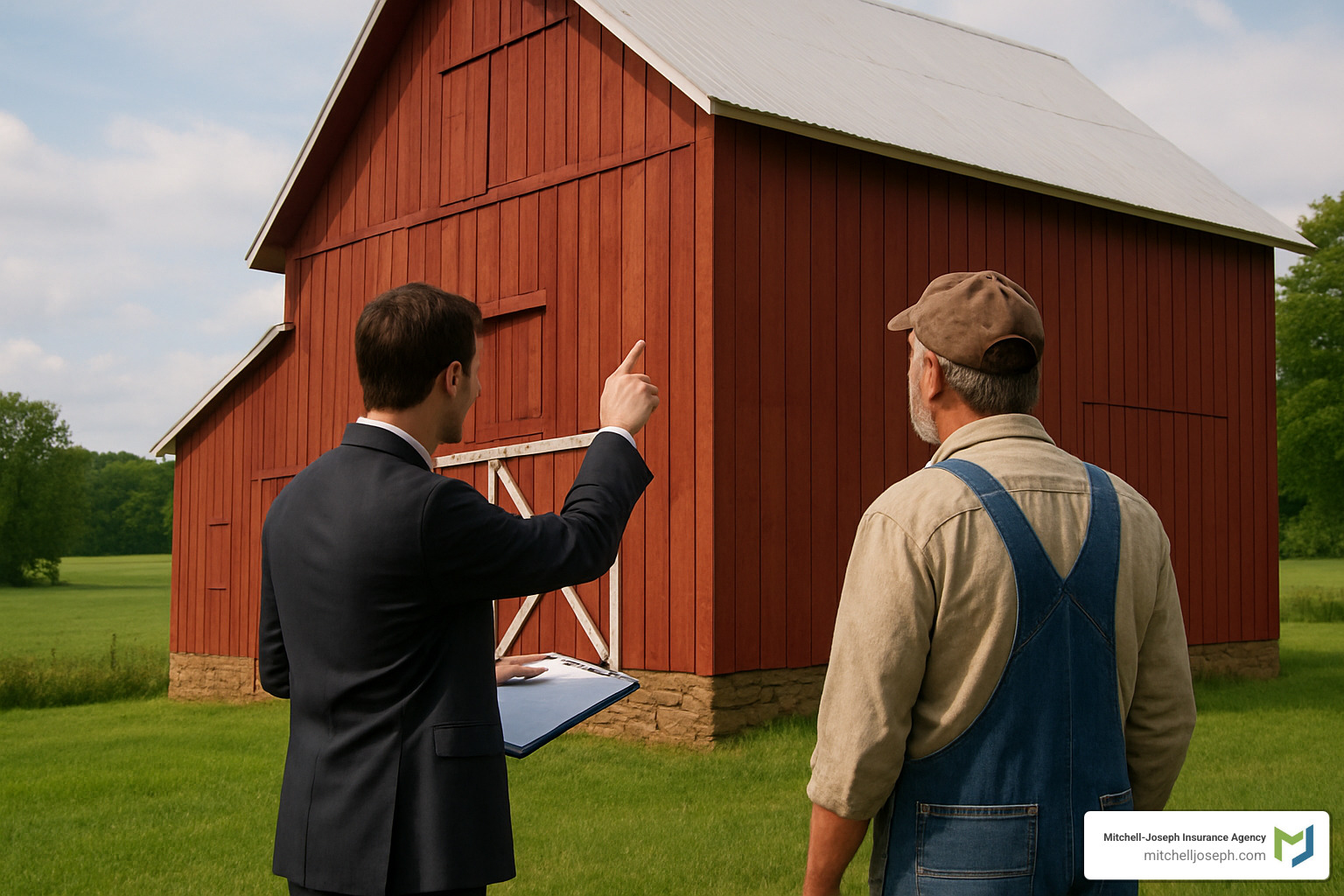
Finding the right insurance partner for your farm isn’t like shopping for car insurance. When it comes to commercial farm insurance NY, you need someone who speaks your language – someone who knows the difference between a heifer and a Holstein, understands seasonal risks, and recognizes the unique challenges New York farmers face.
“My agent actually showed up during harvest when we had equipment damage,” shares one of our grain farming clients. “He didn’t just take photos – he helped us figure out how to keep operating while waiting for repairs. That’s the kind of partnership that matters.”
When you’re selecting an insurance advisor, look beyond the premium quote. Does the agent take time to walk your property? Do they ask detailed questions about your operation? The best farm insurance partners bring agricultural expertise to the table, understanding that farming isn’t just a business – it’s a way of life with unique seasonal pressures and time-sensitive needs.
Carrier selection matters tremendously too. Some insurance companies specialize in dairy operations, while others excel at covering orchards or vegetable farms. A knowledgeable independent agency like Mitchell-Joseph Insurance can match your operation with the right carrier, rather than trying to force your square-peg farm into the round hole of a one-company solution.
For farms welcoming visitors through agritourism, your insurance partner should help ensure you’re meeting all requirements under the Safety in Agritourism Act. This includes proper signage, visitor waivers, and safety protocols that not only protect your visitors but also strengthen your liability defense if accidents occur.
Similarly, produce operations increasingly need guidance on Food Safety Modernization Act (FSMA) certification requirements. The right insurance partner will help you understand how compliance affects both your insurability and your premium costs.
Need answers to common business insurance questions? Our Business Insurance FAQ page offers helpful insights.
Choosing the right partner for your Commercial farm insurance NY needs
Finding your ideal insurance match involves more than just price shopping. The right partnership can make all the difference when storms hit, equipment fails, or liability issues arise.
Experience with similar operations is crucial. An agent who regularly works with dairy farms will better understand milk contamination risks, while someone familiar with vineyards will recognize the unique exposures of tasting rooms. At Mitchell-Joseph Insurance, we’ve worked with virtually every type of agricultural operation in the Finger Lakes region since 1984.
Carrier access provides options custom to your specific operation. Independent agencies like ours can shop multiple companies to find the best fit for your farm, rather than trying to make your operation fit a single company’s appetite.
Service culture becomes apparent in how questions are handled and how accessible your agent is during busy seasons. Can you reach someone when you need them? Will they respond quickly during planting or harvest when time is precious?
Claims advocacy might be the most valuable service a good agent provides. When disaster strikes, having someone who knows your operation and can speak on your behalf with adjusters can mean the difference between a fair settlement and a frustrating experience.
Local presence matters because farming varies dramatically by region. Our multiple locations throughout the Finger Lakes region mean we understand the soil, weather patterns, and agricultural practices specific to your area of New York.
“We switched to Mitchell-Joseph after a disappointing claim experience with our previous carrier,” one orchard owner told us. “The difference was night and day – they actually understood the time-sensitive nature of our business and expedited everything to minimize our loss.”
Step-by-step claim roadmap for NY commercial farms
When disaster strikes your farm, knowing how to steer the claims process can save precious time and ensure you receive fair compensation. Here’s your roadmap:
First, document everything before cleanup begins. Your smartphone is your best first responder – take photos and videos of all damage from multiple angles. This visual evidence becomes invaluable if questions arise later about the extent of the loss.
Next, take reasonable steps to prevent additional damage. This might mean covering broken windows, moving undamaged equipment to shelter, or temporarily patching a roof. Your policy actually requires these reasonable measures, and the costs are typically reimbursable.
Report promptly to your agent or insurance company. Many farm policies have time limits for reporting claims, and delays can complicate the process. At Mitchell-Joseph Insurance, we make this easy with multiple reporting options, including after-hours emergency contacts.
Before the adjuster visits, gather your documentation. This includes inventory lists of damaged property, purchase receipts, and maintenance records. For crop losses, have your production history and records ready. For business interruption claims, be prepared to show financial records demonstrating typical income.
Throughout the process, track all expenses related to the loss. Keep receipts for emergency repairs, equipment rentals, or additional labor needed because of the incident. These expenses may be covered under your policy’s “Extra Expense” provision.
When you receive the settlement offer, review it carefully before accepting. Does it accurately reflect current replacement costs? Does it account for all aspects of your loss? If something seems missing or undervalued, speak up.
If you disagree with the settlement, work with your agent to appeal. A good agent becomes your advocate, helping explain the unique aspects of your operation that might not be obvious to an adjuster unfamiliar with agriculture.
“The adjuster initially missed the seasonal impact of our equipment loss,” recalls a vegetable farmer client. “Our agent helped explain that a tractor breaking down in April has a much bigger financial impact than the same breakdown in November. That conversation added $12,000 to our business interruption settlement.”
Farm claims often involve specialized knowledge. From understanding the true replacement cost of a custom-built manure handling system to recognizing the downstream impacts of a feed storage loss, the right insurance partner makes all the difference in achieving a fair outcome.
For claim emergencies outside business hours, keep your policy numbers and emergency contact information easily accessible. Most farm insurers offer 24/7 reporting options, and at Mitchell-Joseph Insurance, we pride ourselves on being responsive when our farm clients need us most.
Frequently Asked Questions about Commercial Farm Insurance NY
What does Commercial Farm Insurance NY usually cost?
When farmers ask me about the cost of commercial farm insurance NY, I always tell them it’s like asking “how long is a piece of string?” The price varies tremendously based on your specific operation.
For small hobby farms, coverage might start around $1,500 per year – about what you’d pay for a decent used tractor tire. Mid-sized operations typically see annual premiums between $5,000 and $15,000, while large commercial farms with substantial assets might invest $20,000 or more in their protection.
Your specific premium depends on several factors that tell your farm’s unique story: the size of your operation, what you’re growing or raising, your equipment value, whether you welcome visitors, your claims history, and the coverage limits you select.
Here at Mitchell-Joseph Insurance Agency, we’re fortunate to work with 24 different insurance companies. This gives us the flexibility to shop around and find competitive rates for everything from small organic vegetable farms to large dairy operations across New York State.
Is crop insurance included or purchased separately?
Crop insurance typically stands separate from your main farm policy – they’re cousins rather than siblings in the insurance family.
Most commercial farm insurance NY policies focus on protecting your physical assets – buildings, equipment, and sometimes livestock – along with liability protection. Your crops, however, need their own specialized coverage through the Federal Crop Insurance Corporation (FCIC) program.
This arrangement actually works in your favor. The FCIC operates as a public-private partnership, with policies sold through approved private insurance agencies (like us) but backed by federal support. This structure helps make premiums more affordable through government subsidies while ensuring standardized coverage terms.
For New York farmers, several crop insurance options exist to match your specific needs:
– Multi-Peril Crop Insurance for specific commodities
– Whole-Farm Revenue Protection that’s ideal for diversified operations
– Yield Protection focusing on production losses
– Revenue Protection that combines both yield and price coverage
We often help farmers coordinate both their general farm policy and appropriate crop insurance to create a seamless safety net without costly overlaps or dangerous gaps in protection.
How soon must I secure workers’ compensation after hiring help?
The clock starts ticking on workers’ compensation requirements when your farm’s cash wages exceed $1,200 in a calendar year. Once you cross that threshold, New York State requires coverage beginning April 1 of the following year.
I’ve seen this catch many farmers by surprise, especially when they’re growing their operations. It’s worth noting that family members working on unincorporated farms may be exempt, but this family exemption disappears if your farm is organized as an LLC or corporation.
“We always recommend securing coverage proactively if you’re approaching that threshold,” as our compliance specialist often tells clients. “The penalties for being uninsured can be devastating – far more expensive than the policy itself.”
Even those well-intentioned farm apprentices and interns should be covered, regardless of whether they’re paid. I’ve worked with several farms that didn’t realize this until they faced a compliance review.
At Mitchell-Joseph, we help farmers monitor their payroll relative to the threshold and implement coverage at just the right time – not too early (when it’s an unnecessary expense) and certainly not too late (when it creates legal exposure).
Conclusion

When you’re working the land that’s been in your family for generations, or building a new agricultural dream from scratch, the right commercial farm insurance NY does more than just protect buildings and equipment—it safeguards your legacy.
Throughout the seasons of farm life, from spring planting to winter planning, your operation faces challenges unique to New York agriculture. The freezing temperatures that threaten your apple orchards, the liability concerns when hosting fall agritourism events, the equipment that must function perfectly during narrow harvest windows—these realities demand specialized protection.
“Insurance isn’t just about recovering from disaster,” shares one of our long-time dairy clients. “It’s about knowing my children and grandchildren can continue this way of life even if something unexpected happens.”
This perspective on succession planning speaks to why comprehensive coverage matters. When properly structured, your farm policy creates a single, seamless safety net that eliminates dangerous gaps while avoiding costly overlaps in coverage. This efficiency not only saves money but provides the peace of mind that comes from knowing your entire operation is protected under one carefully crafted plan.
The agricultural landscape continues to evolve rapidly. Climate patterns shift, regulatory requirements increase, and consumer expectations change. At Mitchell-Joseph Insurance Agency, we believe your protection should evolve too. Our farm-certified advisors make regular visits to client operations, not just when it’s time to renew, but to spot emerging risks and opportunities throughout the year.
We’re deeply rooted in the communities we serve across the Finger Lakes region. When you work with us, you’re partnering with people who understand that a freeze warning in Naples means something different than one in Avon, and that the equipment needs of a Victor vegetable grower differ from those of a Canandaigua dairy farm.
With access to 24 different insurance companies, we can customize commercial farm insurance NY solutions for:
- Family farms transitioning to the next generation
- Expanding operations adding new ventures or acreage
- Specialty producers with unique equipment or products
- Farms incorporating agritourism or direct marketing
Beyond just selling policies, we provide ongoing risk management consultation, claims advocacy when losses occur, and regular policy reviews to ensure your coverage grows alongside your farm. This approach has helped hundreds of New York farm families protect what matters most since 1984.
For more information about how we can help protect your agricultural legacy, visit our Insurance-coverage farm insurance page or reach out to any of our locations throughout the region.
Your farm deserves protection from people who understand New York agriculture—not just as an industry, but as a way of life. That’s exactly what we provide at Mitchell-Joseph Insurance Agency.

