

Why New York Homeowners Need Affordable Insurance Protection
Understanding Homeowners Insurance Costs in New York
Here’s something that might surprise you: despite New York’s reputation for high costs, cheap homeowners insurance New York is actually more accessible than in most other states. While our property values might make your wallet nervous, our insurance premiums are refreshingly reasonable.
The numbers tell a great story for New York homeowners. Our state consistently ranks among the most affordable for homeowners insurance, with rates that are significantly lower than what homeowners pay in states like Florida, Texas, or Louisiana.
Average Premiums Across the State
New York homeowners are catching a break when it comes to insurance costs. The average annual premium ranges from $1,114 to $1,740 for standard coverage, which puts us well below the national average of $1,754 to $2,110 annually.
Breaking this down to monthly payments, most New York homeowners pay between $90 and $145 for their coverage. That’s roughly 10-39% lower than the national average, depending on which industry report you’re reading.
These favorable rates exist despite some unique challenges we face here in the Empire State. Our harsh winters can cause frozen pipes and ice dams, coastal areas deal with hurricane risks, and urban areas have their own concerns. Yet New York’s strong building codes, excellent fire departments, and competitive insurance market help keep our rates manageable.
Of course, inflation hasn’t skipped over New York entirely. Home insurance premiums increased about 11% from May 2022 to May 2023, driven by rising construction costs, labor shortages, and more frequent severe weather events. But even with these increases, we’re still in better shape than most states.
How Costs Vary by City
Where you live within New York makes a huge difference in your insurance costs. The variation can be dramatic – sometimes doubling between different cities and regions.
New York City commands the highest premiums in the state, with Manhattan averaging around $2,295 annually, Brooklyn at $1,945, and the Bronx at $2,050. Westchester County isn’t far behind, with cities like Mount Vernon, New Rochelle, and Yonkers averaging around $1,485.
On the flip side, upstate areas offer much more affordable rates. Rochester (where we’re based!) averages just $1,125 annually, making it one of the most affordable areas in the state. Buffalo comes in at $1,200, Syracuse at $1,215, and Poughkeepsie at $1,150.
Albany falls in the middle range at $1,305, with Schenectady at $1,225 and Utica at $1,295.
These differences aren’t random – they reflect real factors that affect your risk. Local crime rates play a significant role, as does your proximity to fire services. Areas with quick fire department response times see lower rates. Weather risks matter too – coastal areas face hurricane exposure, while inland areas might deal more with winter storm damage.
The good news is that wherever you live in New York, you’re likely paying less for homeowners insurance than you would in many other states. And with the right approach to shopping and comparing coverage, you can find even better deals within your area.
What Determines Your Home Insurance Rates in New York?

When insurance companies calculate your premium, they’re essentially playing detective – gathering clues about risk from your home, your personal profile, and your coverage choices. Understanding this process is your key to finding cheap homeowners insurance New York that doesn’t sacrifice protection.
Think of it like this: every detail tells a story about how likely you are to file a claim and how expensive that claim might be. The good news? Once you know what insurers are looking for, you can often influence these factors to work in your favor.
Your Home’s Characteristics
Your house is the star of the show when it comes to rate determination. Every brick, shingle, and pipe plays a role in your premium calculation.
Replacement cost is where many homeowners get tripped up. Your home’s market value and its replacement cost are completely different numbers. If your Rochester home is worth $250,000 but would cost $300,000 to rebuild from scratch, you need coverage based on that higher replacement cost. Trying to save money by under-insuring often backfires spectacularly when disaster strikes.
Home age matters more than you might think. Newer homes – especially those built within the last 10 years – often qualify for new construction discounts that can significantly reduce your premium. Meanwhile, older homes built before 1950 may face higher rates due to outdated electrical systems, aging plumbing, and heating systems that weren’t built to modern safety standards.
Construction materials also influence your rates. Frame construction typically costs more to insure than masonry or brick construction. Your roof deserves special attention here – roofs over 20 years old may trigger higher premiums, while recent roof replacements often earn discounts. The material matters too: while asphalt shingles are standard, slate or tile roofing may qualify for additional savings.
High-risk features can bump up your liability exposure. Swimming pools, trampolines, tree houses, and hot tubs all increase the chance of accidents on your property. This doesn’t mean you can’t have these features – just be aware they’ll likely affect your premium.
Your Personal Profile
Your personal characteristics paint a picture of risk that insurers take very seriously.
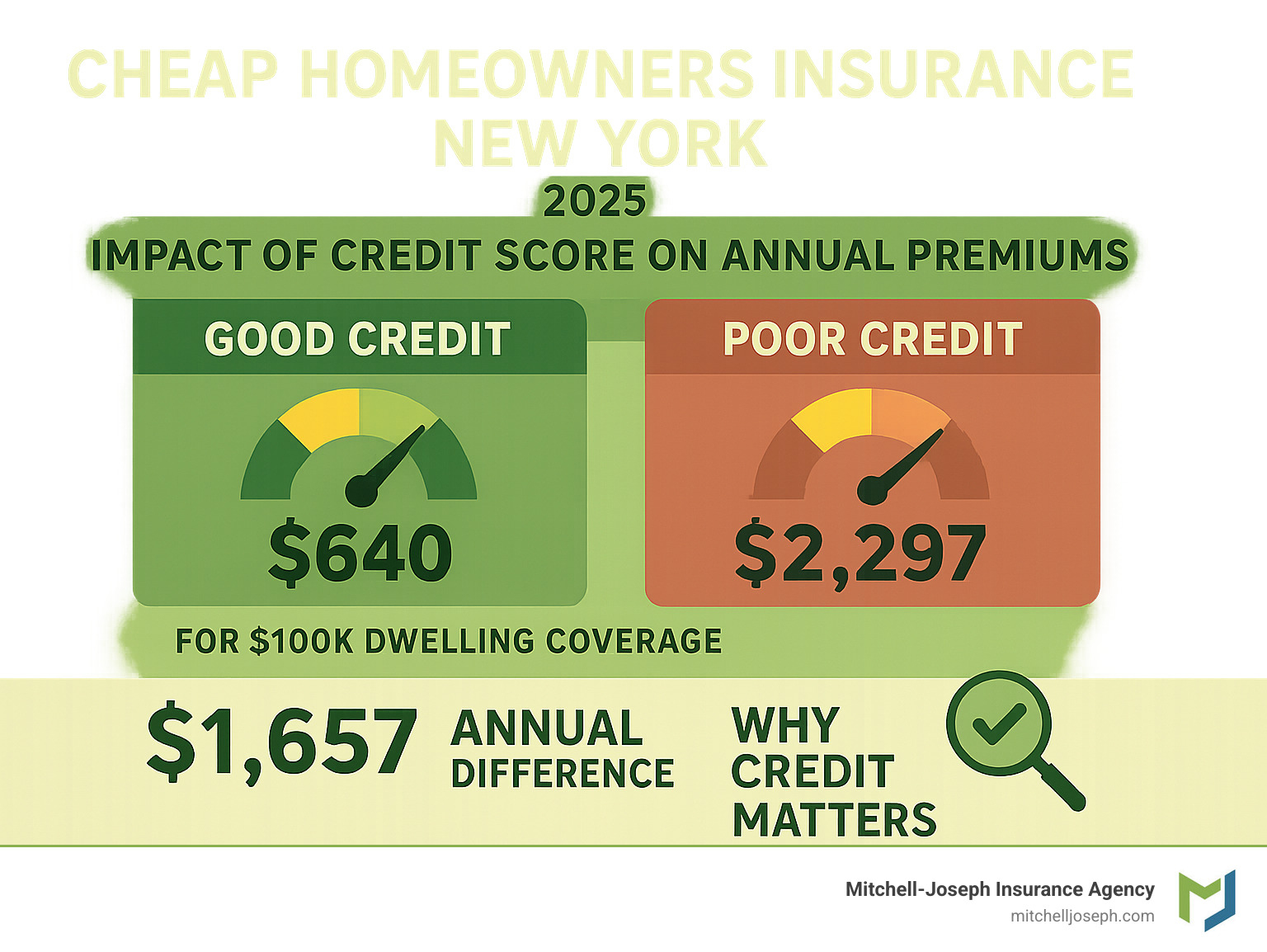
Your credit-based insurance score is probably the most shocking factor for many homeowners. In New York, the difference between good and poor credit can mean paying $1,657 more per year for the same coverage. That’s not a typo – homeowners with poor credit pay an average of $2,297 annually for $100K dwelling coverage, while those with good credit pay just $640.
Claims history follows you wherever you go. Having two claims in the last five years can raise your average premium by $272 annually compared to having no claims. This is why we often recommend handling small repairs out-of-pocket rather than filing claims for every minor issue.
Geographic location within New York creates significant variations in rates. Your proximity to fire hydrants and fire stations, local crime statistics, and flood zone designations all factor into your premium. If you’re in a coastal area, your exposure to windstorm damage becomes a consideration too.
For homeowners in areas with potential flooding concerns, I always recommend checking your flood risk at the FEMA Flood Map Service Center. Standard homeowners insurance doesn’t cover flood damage, so knowing your risk level is crucial.
Your Chosen Coverage and Deductible
The coverage limits and deductible you select give you direct control over your premium costs.
Your dwelling coverage amount should equal your home’s full replacement cost, not its market value. This protects you from violating the 80% rule and ensures you won’t be left paying out-of-pocket for rebuilding costs.
Liability limits determine how much protection you have if someone gets injured on your property. While higher limits increase your premium, the extra cost is usually minimal compared to the additional protection.
Your deductible amount offers one of the easiest ways to control costs. Here’s how adjusting your deductible can impact your annual premium:
| Deductible Amount | Average Annual Premium | Annual Savings |
|---|---|---|
| $500 | $488 | Baseline |
| $1,000 | $439 | $49 |
| $1,500 | $412 | $76 |
| $2,000 | $395 | $93 |
Higher deductible savings can be substantial – increasing from $500 to $2,000 saves nearly $100 annually. Just make sure you can comfortably afford the higher out-of-pocket cost if you need to file a claim. There’s no point in saving $93 per year if you can’t afford a $2,000 deductible when disaster strikes.
How to Find Cheap Homeowners Insurance New York

After helping thousands of New York homeowners save money on their insurance over the years, I’ve learned that finding cheap homeowners insurance New York isn’t about cutting corners – it’s about being smart with your choices. The best savings come from understanding what insurers reward and taking advantage of every opportunity to reduce your risk profile.
The Power of Bundling and Discounts
The easiest way to slash your insurance costs is through bundling. When you combine your home and auto insurance with the same company, you’re not just getting a small discount – you’re often looking at savings of up to 25% on both policies. Add an umbrella policy to the mix, and those savings can jump to 35%.
I’ve seen clients save over $800 annually just by bundling their policies. It’s such a reliable money-saver that it’s usually the first thing we explore when someone calls looking for lower rates.
But bundling is just the beginning. Insurance companies offer a surprising number of discounts that many homeowners never think to ask about. Installing smoke detectors and burglar alarms can save you 5-15% on your premium. If your home is less than 10 years old, you’ll likely qualify for a new home discount of 5-15%.
Going five years without filing a claim? That claim-free discount can save you up to 10%. Been with the same insurer for years? Many companies offer loyalty discounts to long-term customers. Some insurers even offer discounts for working from home (about 5%) or having a green, energy-efficient home.
Certain professions like teaching or engineering may qualify for professional discounts. The key is asking – many of these discounts aren’t automatically applied, but they can add up to significant savings when combined.
For a complete breakdown of available discounts, check out our Homeowners Insurance Discounts page.
Finding the Right Coverage Limits
Here’s where many homeowners get tripped up: they either over-insure and waste money, or under-insure and face financial disaster when they need to file a claim. Finding that sweet spot requires understanding what you actually need to protect.
Avoiding over-insurance starts with getting an accurate replacement cost estimate. Your home’s market value and its replacement cost are often very different numbers. A $300,000 home might only cost $250,000 to rebuild, or it might cost $350,000 – it depends on construction costs in your area and your home’s specific features.
We help our clients conduct accurate replacement cost calculations and review them annually. Construction costs change, and so do your belongings. What made sense five years ago might not make sense today.
The 80% rule is crucial to understand here. New York requires you to insure your home for at least 80% of its replacement cost to avoid coinsurance penalties. Fall short of this threshold, and you’ll pay part of every claim out of your own pocket – even small claims that are well below your coverage limit.
Comparing Quotes Effectively
Shopping around for insurance can feel overwhelming, but it’s absolutely worth the effort. I’ve seen identical coverage vary by hundreds of dollars between companies. The same protection that costs $450 with one insurer might cost $1,200 with another.
Working with an independent agent like us gives you a huge advantage here. Instead of calling company after company yourself, we can compare rates from 24 different insurance companies in one conversation. We see the whole market, not just one company’s offerings.
When you’re comparing quotes, make sure you’re looking at identical coverage limits, deductibles, and policy features. A lower premium might mean you’re getting less coverage, which could cost you thousands if you need to file a claim.
The details matter. Two quotes might look similar on the surface, but one might have a higher deductible, lower liability limits, or exclude certain types of coverage. We help our clients understand exactly what they’re comparing so they can make informed decisions about their cheap homeowners insurance New York options.
What Does a Standard New York Home Insurance Policy Cover?

When you’re shopping for cheap homeowners insurance New York, understanding what’s actually covered helps you make smart decisions about your protection. Think of your policy as a safety net with six main components working together to protect your home, belongings, and financial well-being.
Core Coverages in a Standard Policy
Dwelling Protection is the foundation of your policy. This covers your home’s structure – everything from the walls and roof to your built-in appliances and attached garage. If a covered peril like fire or windstorm damages your home, this coverage pays to rebuild or repair it.
Other Structures protection extends beyond your main house to cover detached buildings on your property. Your shed, detached garage, fence, or that gazebo you built last summer are all protected under this coverage. It’s typically set at 10% of your dwelling coverage, but you can increase it if you have expensive outbuildings.
Personal Property coverage protects your belongings inside your home. Your furniture, clothing, electronics, and even items temporarily away from home are covered. However, expensive items like jewelry or artwork often have coverage limits, so you might need additional protection for valuable possessions.
Loss of Use coverage becomes your lifeline if your home becomes uninhabitable after a covered loss. It pays for hotel stays, restaurant meals, pet boarding, and other additional living expenses while your home is being repaired. This coverage has saved many of our clients from financial hardship during extended repairs.
Personal Liability protection shields you if someone gets injured on your property or you accidentally damage someone else’s property. Whether it’s a slip-and-fall accident on your icy sidewalk or your child accidentally breaking a neighbor’s window, this coverage handles legal defense costs and damages up to your policy limits.
Medical Payments to Others covers small medical bills for injuries on your property, regardless of who’s at fault. If your mail carrier trips on your front steps, this coverage pays their immediate medical expenses without requiring a lawsuit. It’s designed to handle minor incidents before they become major liability claims.
For detailed information about how these coverages work together, visit our Home Insurance Coverage Types page.
Essential Considerations for New Yorkers
Living in New York brings unique insurance considerations that other states don’t face. Windstorm coverage is particularly important for coastal homeowners. While standard policies cover wind damage, properties near the coast often have separate wind and hail deductibles that can be 1-5% of your dwelling coverage. During hurricane season, these deductibles may be even higher.
Water backup coverage has become increasingly valuable as New York’s infrastructure ages and severe weather becomes more frequent. This add-on coverage protects against sewer backup damage and sump pump failures – problems that can cause thousands of dollars in damage but aren’t covered under standard policies. For just $50-$100 annually, this coverage often pays for itself with a single claim.
Flood insurance isn’t included in standard homeowners policies. Given New York’s extensive coastline and river systems, flood insurance is often essential even in areas outside designated flood zones. We’ve seen too many homeowners find this gap in coverage after it’s too late.
For regulatory information and consumer resources about insurance requirements and protections in New York, visit the New York State Department of Financial Services.
Frequently Asked Questions about Cheap Homeowners Insurance New York
Is homeowners insurance required by law in New York?
Here’s something that surprises many of our clients: New York State doesn’t legally require homeowners insurance. You won’t get a ticket or face legal penalties for going without coverage.
However, if you have a mortgage – and most homeowners do – your lender will absolutely require it. They’re protecting their investment, and frankly, you should be too. Even if you own your home outright, skipping insurance is a massive financial gamble.
I always tell clients to think about it this way: would you drive around in a $300,000 car without insurance? Your home is likely worth even more and faces constant risks from fire, theft, severe weather, and liability claims. Cheap homeowners insurance New York provides a crucial financial safety net that protects what’s probably your largest asset.
What is the 80% rule in homeowners insurance?
The 80% rule trips up more homeowners than almost any other insurance concept, but it’s actually straightforward once you understand it. You need to insure your home for at least 80% of its replacement cost to avoid a coinsurance penalty.
Here’s where it gets tricky: we’re talking about replacement cost, not market value. If your home would cost $400,000 to rebuild but you only carry $250,000 in coverage, you’re underinsured and will face penalties on every claim.
Let’s say you have that $50,000 kitchen fire. With $250,000 coverage on a home that needs $320,000 in coverage (80% of $400,000 replacement cost), you’ll only receive about $39,000. You’ll pay nearly $11,000 out of your own pocket, even though your claim is well below your coverage limit.
This is why we always recommend insuring for the full replacement cost, not just the minimum 80%. It’s better to pay a bit more in premiums than face a coinsurance penalty when you need your coverage most.
How does my credit score affect my ability to get cheap homeowners insurance in New York?
Your credit score has a huge impact on your homeowners insurance rates – probably much bigger than you realize. The difference between good and poor credit can cost you over $1,600 per year for the exact same coverage.
The numbers are staggering: homeowners with good credit pay an average of $640 annually for $100,000 in dwelling coverage, while those with poor credit pay $2,297 for identical protection. That’s a difference of $1,657 every single year.
Insurance companies use what’s called a credit-based insurance score as a statistical predictor of how likely you are to file claims. Decades of data show that people with higher credit scores tend to file fewer claims, so insurers reward them with lower rates.
The good news? Improving your credit score is one of the most effective ways to lower your premiums. Focus on paying bills on time, keeping credit card balances low, and avoiding closing old credit accounts. Check your credit report for errors – we’ve seen clients save hundreds by correcting simple mistakes.
Be patient though. Credit improvement takes time, but the savings on your insurance premiums alone make it worth the effort. Combined with other strategies like bundling policies and adjusting deductibles, credit improvement can dramatically reduce your insurance costs.
Conclusion
Finding cheap homeowners insurance New York doesn’t mean you have to compromise on protecting what matters most to you. After helping thousands of New York homeowners over the past 25 years, I’ve seen how the right approach can save families hundreds or even thousands of dollars annually while maintaining excellent coverage.
The beauty of New York’s insurance market is that we already have below-average costs compared to the rest of the country. When you combine that advantage with smart shopping strategies, the savings really add up. Shopping around remains the most powerful tool in your arsenal – we regularly see rate differences of $500 or more between companies for identical coverage.
Bundling your policies consistently delivers some of the biggest savings, often reducing your total insurance costs by 25-35%. It’s one of those rare win-win situations where you save money and simplify your life at the same time. Adjusting your deductibles might seem small, but that extra $100 you save annually adds up to $1,000 over a decade.
Here’s what surprises many homeowners: maintaining good credit has a bigger impact on your rates than almost anything else. The difference between good and poor credit can mean paying $1,600 more each year for the exact same coverage. That’s a mortgage payment for many families.
Taking advantage of available discounts – from safety devices to new construction benefits – and right-sizing your coverage ensures you’re not leaving money on the table or paying for protection you don’t need.
As an independent agency here in Honeoye Falls, we have something most insurance shoppers don’t: access to 24 different insurance companies under one roof. This means we can do the heavy lifting of comparing rates and coverage options for you. We’re not tied to any single company, so our recommendations are based purely on what works best for your situation and budget.
Whether you’re protecting a Rochester ranch, a Syracuse colonial, or a Buffalo bungalow, our goal is simple: find you the perfect balance of comprehensive coverage and affordable premiums. The cheapest policy isn’t always the best value, but the right coverage at the right price? That’s what we help you achieve.
Ready to see how much you can save on your homeowners insurance? Get a quote for the cheapest home insurance in New York and let our experienced team show you what’s possible. With over 200 years of combined experience, we know how to steer New York’s insurance landscape to your advantage.
Your home is likely your largest investment. Protecting it shouldn’t break the bank, and with the right guidance, it won’t.

