

What Is a Business Owners Policy and Why Does Your Business Need One?
A business owners policy (BOP) is an insurance package that combines property insurance, liability protection, and business interruption coverage into one convenient policy designed specifically for small to medium-sized businesses.
Business Owners Policy at a Glance:
– Definition: A bundled insurance policy combining property, liability, and business interruption coverage
– Ideal for: Businesses with fewer than 100 employees and under $5 million in revenue
– Average cost: $85-118 per month (national average)
– Core coverage:
* Property insurance (buildings, equipment, inventory)
* General liability (third-party injuries, property damage)
* Business interruption (lost income during covered shutdowns)
– What’s not included: Workers’ compensation, auto insurance, professional liability, cyber liability (though these can be added as endorsements)
Think of a BOP as a cost-effective insurance bundle that protects what you’ve worked hard to build. Rather than purchasing separate policies for different risks, a business owners policy packages essential coverages together, typically at a lower premium than buying each separately.
Most small businesses with physical locations, valuable equipment, or regular customer interaction should consider a BOP as their foundation for risk management. The policy acts as a safety net against common risks like property damage from fire or storms, customer injuries on your premises, and income loss if you need to temporarily close after a covered event.
I’m Jeffrey Joseph, and as the owner of Mitchell-Joseph Insurance Agency, I’ve helped hundreds of small businesses find the right business owners policy protection since 1999, tailoring coverage to match each client’s unique risk profile and budget constraints.

Common business owners policy vocab:
– general liability insurance for businesses
– general liability policy
Business Owners Policy (BOP) Fundamentals
Ever wonder how successful small businesses protect themselves without breaking the bank? The answer often lies in a business owners policy. This insurance solution was created specifically for small to medium-sized businesses—bundling essential coverages into one package that’s both comprehensive and affordable.
At its heart, a business owners policy is all about efficiency. Insurance companies recognized that many small businesses face similar risks and created these bundled policies to provide streamlined protection. By packaging property, liability, and business interruption coverage together, insurers can offer you significantly better rates than if you purchased each coverage separately—typically saving you 10% or more on premiums.
Not every business qualifies for a BOP. Generally, you’ll need to:
- Have fewer than 100 employees
- Generate annual revenue under $5 million
- Operate from a relatively small commercial space
- Run a business in a low to moderate risk industry
Most standard business owners policies offer coverage limits of up to $5 million for business income, though some insurers will extend that to $8.5 million in gross sales per location for qualifying businesses.
When it comes to property protection, you’ll typically have two options: named-peril coverage, which protects against specific listed risks like fire and theft, or special form coverage, which covers all risks except those specifically excluded in your policy.
For many small business owners in Honeoye Falls and beyond, a BOP forms the foundation of their entire insurance program, with additional policies added only as needed.
Scientific research on business owners policy
Business Owners Policy Explained
Think of a business owners policy as your business’s insurance Swiss Army knife—one tool with multiple essential functions bundled together. This package policy combines three critical protections:
First, commercial property insurance safeguards your physical assets—the building itself (if you own it), your equipment, inventory, furniture, and fixtures—against covered perils like fire, theft, and certain water damage incidents.
Second, general liability coverage protects you when a customer slips and falls in your shop, when your work accidentally damages someone else’s property, or when your advertising unintentionally infringes on someone’s copyright.
Third, business interruption insurance (sometimes called business income coverage) can be a lifesaver if disaster strikes. If a covered event forces you to temporarily close, this coverage helps replace lost income and covers ongoing expenses like rent and payroll while you recover.
The real magic of a business owners policy isn’t just what it covers—it’s the simplicity it brings. Instead of juggling multiple policies with different renewal dates and separate bills, you have one comprehensive policy addressing your most common risks.
Most BOPs include valuable features like worldwide liability coverage, equipment breakdown protection, and coverage for business personal property. Many even include extras like protection for newly acquired property, outdoor fixtures, and seasonal increases for inventory—perfect for retailers who stock up for holiday rushes.
Business Owners Policy vs General Liability vs CPP
When comparing a business owners policy to standalone general liability insurance, the difference is substantial. While general liability only protects against third-party claims (like customer injuries or property damage), a BOP gives you that same liability protection PLUS property insurance AND business interruption coverage.
Now, how does a business owners policy stack up against a Commercial Package Policy (CPP)? Both combine multiple coverages, but they serve different business needs. A BOP comes pre-packaged with standard coverages designed specifically for small businesses, while a CPP offers more flexibility for larger or more complex operations.
| Feature | Business Owners Policy (BOP) | Commercial Package Policy (CPP) |
|---|---|---|
| Business Size | Small to medium (typically <100 employees) | Medium to large businesses |
| Revenue Limit | Usually under $5 million | No specific limit |
| Customization | Limited, with standard coverages | Highly customizable |
| Pricing | More affordable, bundled discount | Generally higher premium |
| Property Coverage | Included by default | Can be custom specifically |
| Liability Coverage | Included by default | Can be custom specifically |
| Business Interruption | Included by default | Optional addition |
A business owners policy makes the most sense if you’re a small business with straightforward coverage needs and want an affordable, bundled solution. Opt for standalone general liability only if you have minimal or no business property to insure. Consider a CPP if your business has outgrown BOP eligibility limits or requires specialized coverages.
What a BOP Covers — and What It Doesn’t
Let’s pull back the curtain on what a business owners policy actually protects—and just as importantly, where it leaves gaps in your coverage.
Coverage Components Inside a Business Owners Policy
Think of your business owners policy as a three-layer shield protecting your business from common risks.
The first layer is property insurance, which safeguards the physical assets that keep your business running. If you own your building, the policy covers the structure itself, including permanently installed fixtures and equipment. Even if you rent, your BOP still protects your business personal property—from office furniture and inventory to computers and equipment.
I once worked with a small bakery owner who thought her landlord’s insurance would cover everything after a pipe burst. She was relieved to learn her business owners policy covered not just her damaged ovens and display cases, but also her custom cabinetry and specialized equipment.
The second layer, general liability insurance, protects you when things go wrong with customers or visitors. If someone slips on your freshly mopped floor and breaks an arm, your policy covers their medical bills and your legal defense if they sue. It also helps if you accidentally damage someone else’s property or face claims of libel, slander, or copyright infringement.
The third vital layer is business interruption insurance—something many business owners don’t fully appreciate until they need it. This coverage becomes your financial lifeline if disaster forces you to temporarily close. It replaces lost income and covers ongoing expenses like rent, loan payments, and payroll during the shutdown.
Many BOPs also include equipment breakdown coverage, which kicks in when mechanical or electrical failures occur—like when your restaurant’s walk-in freezer suddenly dies or your office HVAC system fails.

More info about Business Interruption
Major Exclusions & Optional Endorsements
While a business owners policy offers robust protection, it’s not all-encompassing. Knowing its limitations is just as important as understanding its strengths.
Your BOP won’t cover professional mistakes or bad advice—that requires professional liability insurance. It also doesn’t cover vehicles (you’ll need commercial auto for that) or work-related injuries (that’s what workers’ compensation is for). Floods and earthquakes need separate policies, and intentional acts or damages aren’t covered either.
I remember helping a local retail shop owner after a major flood. She was devastated to learn her business owners policy didn’t cover flood damage—a common misconception that can lead to serious financial hardship.
Fortunately, you can fill many coverage gaps with optional endorsements. Cyber liability coverage has become increasingly essential, protecting against the potentially devastating costs of data breaches. If you provide professional services, adding professional liability coverage shields you from claims of errors or negligence.
Other valuable add-ons include employment practices liability (protecting against claims of wrongful termination or discrimination), crime insurance (for employee theft or fraud), and spoilage coverage (particularly important for food-based businesses).
For businesses serving alcohol, liquor liability is a must-have addition. And if you’re looking for extra peace of mind, an umbrella liability policy provides additional coverage beyond your BOP’s limits—often at a surprisingly affordable rate.
At Mitchell-Joseph Insurance Agency, we’ve seen how the right business owners policy with carefully selected endorsements can be the difference between a business recovering from disaster or closing its doors permanently.
More info about Business Interruption
Eligibility, Customization & Cost Factors
Wondering if your business qualifies for a business owners policy and what you might pay? Let’s break it down simply.
Not every business can get a BOP, and the price varies depending on your specific situation. Understanding what insurance companies look at helps you know if this coverage is right for your business.
Eligibility Factors
Insurance companies created the business owners policy with smaller operations in mind. To qualify, your business typically needs to:
- Have fewer than 100 employees
- Generate less than $5 million in annual revenue
- Fall into a low or moderate risk category
- Operate from premises that meet certain size requirements
- Maintain a reasonable claims history
The good news is that many local businesses in the Honeoye Falls area fit perfectly into these parameters. If you run a retail shop, a small office, a service business, an apartment building, or you’re a contractor with a handful of employees, you’re likely an ideal candidate for a BOP.
Businesses that often don’t qualify include those in high-risk industries (like demolition), large manufacturing operations, companies with unique liability concerns, or businesses that have outgrown the revenue thresholds.
Cost Factors
If you’re budgeting for a business owners policy, you can expect to pay around $1,019 annually – about $85 per month on average. In 2024, new customers are typically paying a median of $67 monthly, though the average hovers around $118 per month.
Your premium depends on several key factors: Your industry plays a huge role – a quiet bookstore presents fewer risks than a busy restaurant with hot cooking equipment. Your location matters too, as insurance costs vary by state and even neighborhood based on local crime rates and weather patterns.
The building itself influences your rate – newer construction with modern safety features often costs less to insure than older buildings. Your coverage limits and deductible choices directly impact your premium too. Previous claims, years in business, and even your credit score can all affect what you pay.
Scientific research on Business Owner Policy
Who Needs a Business Owners Policy?
While not mandatory, a business owners policy makes perfect sense for many small businesses. Here’s who should consider this coverage:
If you run a retail store or food establishment, you’re dealing with valuable inventory, equipment that can break down, and a constant stream of customers who could potentially get injured. The combination of property and liability risks makes a BOP particularly valuable.
Service businesses like salons, dry cleaners, and repair shops rely heavily on specialized equipment and also have regular customer interaction. For you, a BOP protects both your tools of the trade and shields you from liability claims.
Even office-based businesses like accounting firms, real estate agencies, and consulting practices need protection for their equipment, furniture, and potential liability exposures.
Small contractors – whether you’re an electrician, plumber, or painter – need coverage for your tools and equipment, plus liability protection for accidents at job sites. A business owners policy can be customized to meet these specific needs.
Property owners and landlords benefit from BOPs that protect both their buildings and provide liability coverage for common areas where tenants or visitors might be injured.
Tailoring Your BOP
The beauty of a business owners policy is that it’s not one-size-fits-all. Think of it as a solid foundation that you can build upon to create protection that perfectly fits your business.
Start by ensuring your coverage limits accurately reflect your business reality. Your property limits should cover the full replacement cost of everything you’d need to replace after a total loss. For liability, while $1 million per occurrence is standard, consider whether your business activities might warrant higher limits.
Different industries benefit from specific endorsements. Restaurants might add spoilage coverage, retailers might want peak season coverage for holiday inventory, and contractors should consider tools and equipment coverage that extends protection to multiple job sites.
Some add-ons make sense for almost any business today. Cyber liability coverage has become increasingly important as even the smallest businesses collect customer data. If you have employees, employment practices liability protects against claims of discrimination or harassment.
More info about business insurance
Buying, Claims & Policy Management
Let’s be honest – insurance paperwork isn’t anyone’s idea of fun. But getting the right business owners policy in place is one of the smartest moves you can make as a business owner. At Mitchell-Joseph Insurance Agency, we make the process as painless as possible, guiding you from that first quote through to helping you if you ever need to file a claim.
Purchasing Process Step-by-Step
Before shopping for coverage, take a moment to think about what your business needs protection for. Make a quick inventory of your equipment, inventory, and areas where you might be liable if something goes wrong. How long would it take your business to recover after a serious loss?
When you’re ready for quotes, we’ll need basic information about your business – things like your address, how long you’ve been operating, what industry you’re in, and how many employees you have. We’ll also want to know about your annual revenue, details about your building (if you own it), and the value of your business property.
As you compare quotes, look beyond just the premium to examine coverage limits, deductibles, and what’s excluded. The financial strength of the insurer matters too – you want a company that will be there when you need them.

Working with your agent, you can customize your business owners policy to fit your specific needs. We’ll help you adjust property and liability limits, select appropriate deductibles, and add necessary endorsements. We can even help you bundle your BOP with other policies you might need, like workers’ comp or commercial auto.
Once you’ve found the right fit, binding coverage is straightforward – complete the application, pay your premium (many insurers offer payment plans), and you’ll receive your policy documents. If your landlord or clients require proof of insurance, we can provide certificates right away.
More info about Business Insurance FAQ
Navigating a Claim & Real-World Examples
Even with the best prevention measures, sometimes things go wrong. When they do, knowing how to handle your claim can make all the difference.
Report any loss to your insurance company as soon as possible. Most business owners policies require prompt reporting, and delays can sometimes jeopardize your coverage. Document everything with photos and videos, keep receipts for emergency repairs, and maintain a detailed timeline of events.
Your policy requires you to take reasonable steps to prevent additional damage. This might mean boarding up broken windows after a break-in or shutting off water after a pipe bursts. Your claims adjuster will guide you through the process, evaluating the loss and determining coverage.
Let me share a few real-world examples that show how a business owners policy works in practice:
Imagine a small bakery where a fire damages the kitchen, destroying equipment and making the space unusable for six weeks. Their BOP property coverage paid $75,000 to replace damaged equipment and repair the kitchen. Meanwhile, business interruption coverage provided $30,000 for lost income during the closure, and extra expense coverage paid $5,000 for a temporary kitchen rental.
In another case, a customer slipped on a wet floor in a retail store, breaking their wrist. The store’s BOP immediately paid $5,000 for initial medical bills through medical payments coverage. When the customer sued, liability coverage paid $15,000 for legal defense, and when the claim settled for $100,000, the liability portion of the BOP covered it.
For a small accounting firm that experienced a data breach, their business owners policy with a cyber endorsement paid $30,000 for forensic IT services, $25,000 for client notification and credit monitoring, $40,000 for legal defense, and $10,000 for public relations services to manage reputational damage.
Frequently Asked Questions about Business Owners Policy
What is the main difference between a Business Owners Policy and general liability insurance?
When business owners ask me this question, I explain it this way: think of general liability as a single puzzle piece, while a business owners policy gives you the complete picture.
The fundamental difference comes down to what each covers. General liability insurance stands alone, protecting you only against third-party claims—like if a customer slips and falls in your shop, or you accidentally damage someone else’s property while working.
A business owners policy, on the other hand, bundles multiple essential coverages together. You get that same general liability protection PLUS property insurance to cover your building, equipment and inventory, AND business interruption coverage that helps keep you afloat if you need to temporarily close after a covered event.
For most small businesses in Honeoye Falls and beyond, a BOP simply makes more sense. Unless you’re running an extremely minimal operation, the comprehensive protection a business owners policy provides delivers much better value, often at a price not significantly higher than standalone liability coverage.
Can a Business Owners Policy be customized after purchase?
Absolutely! Your business owners policy should grow and change right alongside your business. In fact, one of the things our clients appreciate most is how flexible these policies are.
Common modifications we help clients with include:
– Increasing property limits after purchasing expensive new equipment
– Adding new business locations as you expand
– Including endorsements for new risks (like adding cyber coverage when you launch an online store)
– Adding landlords or clients as additional insureds when contracts require it
– Adjusting business interruption coverage as your revenue grows
The process is refreshingly simple. Just give us a call with details about what’s changed, and we’ll handle the paperwork. Most straightforward changes can be completed the same day you request them.
One important reminder: while you can add coverage anytime, you can’t add protection for something that’s already happened. That’s why regular policy reviews are so crucial.
How often should I review or update my Business Owners Policy?
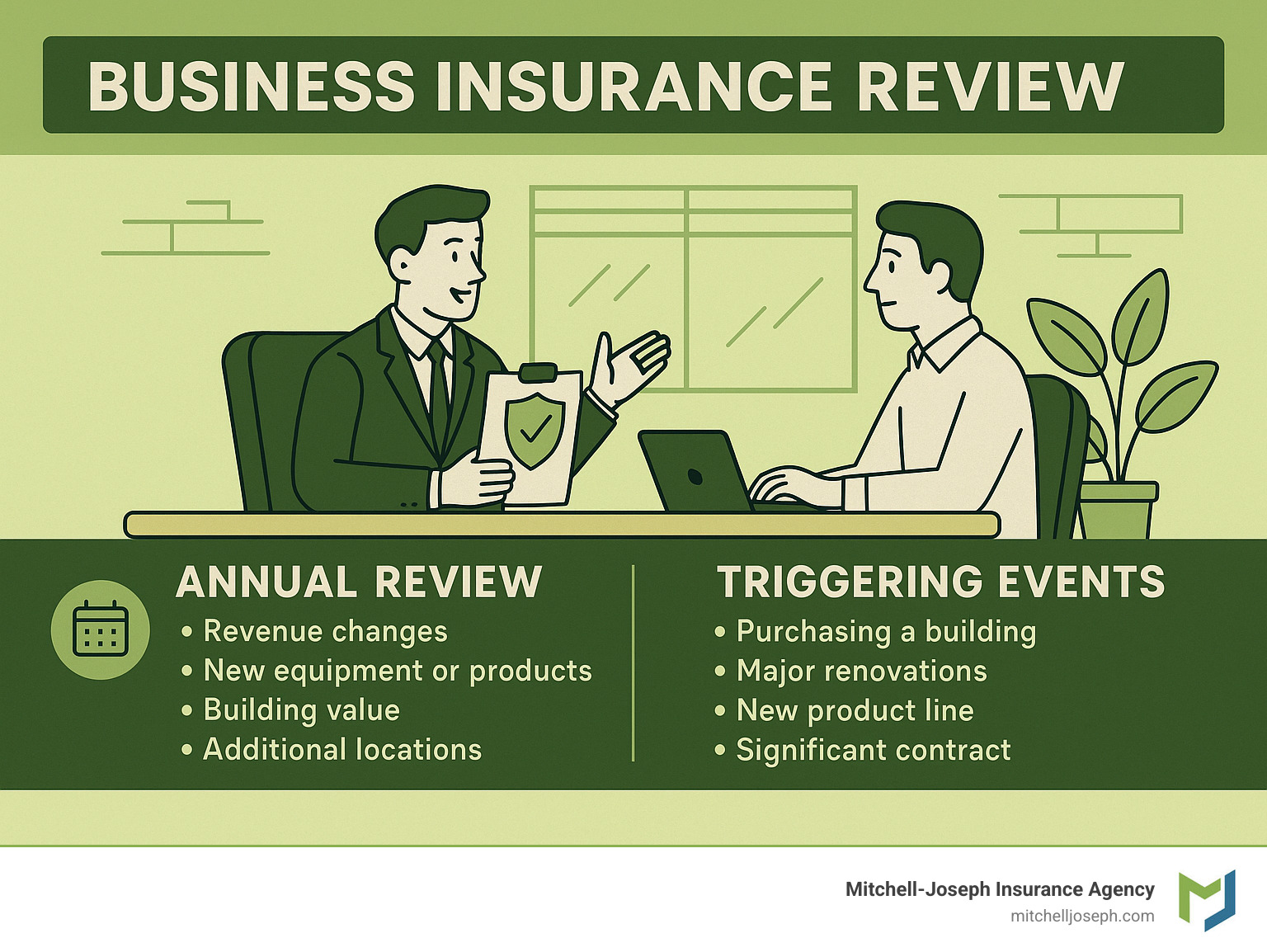
I always tell my clients: at minimum, give your business owners policy a thorough review once a year at renewal time. But certain business changes should prompt an immediate conversation with your agent.
Your annual review is the perfect time to consider the bigger picture of your business protection. Has your revenue significantly changed? Have you purchased new equipment? Added employees? Expanded your services? Changed locations? Each of these factors can affect your coverage needs.
But don’t wait for renewal if you experience major changes like:
- Buying or selling a building
- Completing significant renovations
- Making major equipment purchases
- Opening a new location
- Adding new product lines or services
- Taking on contracts with specific insurance requirements
- Significantly increasing your inventory beyond normal seasonal fluctuations
- Launching online sales if you were previously brick-and-mortar only
At Mitchell-Joseph Insurance Agency, we’ve found that a formal review at renewal plus a mid-year check-in works well for most businesses.
Conclusion
A business owners policy is like a well-designed Swiss Army knife for small business protection—compact, efficient, and surprisingly powerful. By bundling property, liability, and business interruption coverage into one neat package, a BOP delivers comprehensive protection without the premium price tag. Most businesses save around 10% compared to purchasing these essential coverages separately.
Throughout this guide, we’ve explored how a business owners policy works as your business’s financial safety net. It protects the physical assets you’ve invested in, shields you from costly liability claims, and helps keep income flowing even when disaster strikes. This three-in-one approach not only saves you money but also simplifies your life with one policy, one renewal date, and one premium to manage.
For most small businesses here in Honeoye Falls and across western New York, a thoughtfully structured BOP forms the foundation of a solid risk management strategy. While you might need additional policies like workers’ compensation or commercial auto insurance depending on your operations, your business owners policy handles many of the most common risks your business faces daily.
The true beauty of a BOP lies in its flexibility. With the right endorsements, your policy grows and adapts alongside your business, addressing industry-specific risks and changing needs. Whether you’re a restaurant owner worried about food spoilage or a retailer concerned about seasonal inventory fluctuations, your policy can be customized to fit like a glove.
At Mitchell-Joseph Insurance Agency, we understand that your business is as unique as your fingerprint. Our team brings over 200 years of combined experience and relationships with more than 24 insurance companies to find you the right coverage at competitive rates. We’re not just insurance agents—we’re your neighbors, deeply rooted in the communities we serve and committed to protecting what you’ve worked so hard to build.
Whether you’re shopping for your first business owners policy or reviewing existing coverage, I invite you to reach out for a friendly, no-pressure conversation about your needs. As an independent agency, we work for you, not the insurance companies, ensuring recommendations that truly serve your best interests.
Ready to take the next step in protecting your business? Give our Honeoye Falls office a call, or reach out to any of our locations throughout western New York.

