Why Your Business Needs Protection from Unexpected Lawsuits
A business liability insurance policy keeps an unexpected accident or lawsuit from turning into a financial disaster. When third parties say your company caused bodily injury, property damage, or reputational harm, the policy pays for your legal defense, settlements, and court-awarded judgments.
Key components of business liability coverage:
- Bodily injury protection – covers medical costs if customers or visitors are hurt on your premises
- Property damage coverage – pays for damage your business causes to someone else’s property
- Personal and advertising injury – protects against libel, slander, and copyright claims
- Legal defense costs – attorney fees and court expenses are paid even if allegations are groundless
- Medical payments – quick, no-fault payment for minor injuries to help disputes stay small
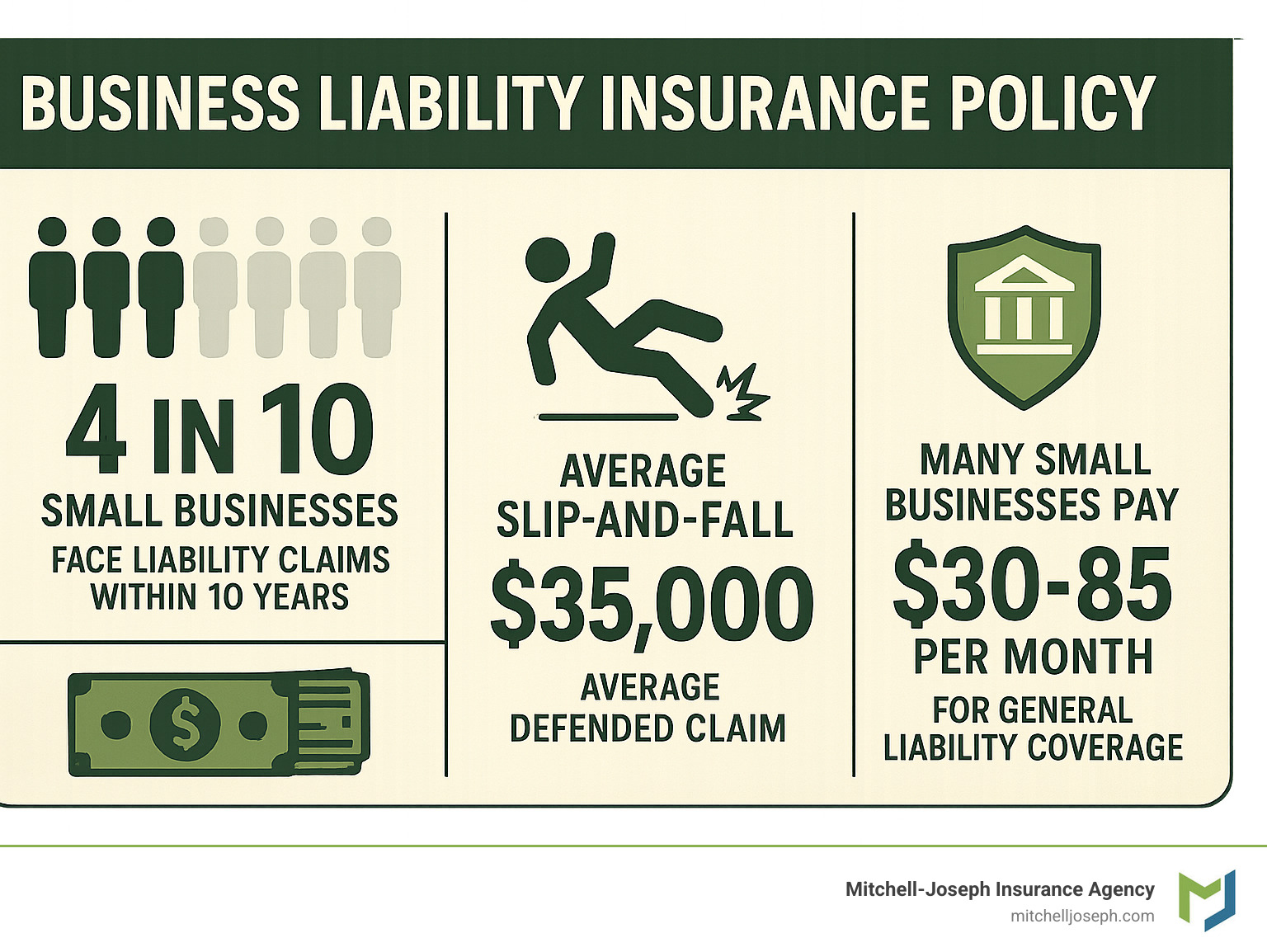
The numbers are eye-opening: 4 in 10 small businesses will face a liability claim within the next decade. A typical slip-and-fall averages $35,000 and can top $75,000 once attorneys get involved. Few businesses keep that kind of cash on hand just in case.
I’m Jeffrey Joseph of Mitchell-Joseph Insurance Agency. For more than 20 years I’ve helped Finger Lakes businesses choose liability coverage that fits their risks and budgets. I’ve seen first-hand how the right policy can turn a potential catastrophe into a manageable inconvenience.
Basic business liability insurance policy terms:
– business owners policy
– general liability insurance for businesses
What Is a Business Liability Insurance Policy?
Think of a business liability insurance policy as your financial safety net when someone claims your business caused them harm. It’s a contract with an insurance company that steps in to protect your business assets when customers, vendors, or visitors say you’re responsible for their injuries or property damage.
Here’s what makes this coverage so valuable: even if a claim against your business is completely bogus, you still need to defend yourself in court. That’s where your policy becomes your best friend, covering both the legal costs and any settlements or judgments.
Most business liability insurance policies work on what we call an “occurrence basis.” This means if something happens while your policy is active, you’re covered – even if the lawsuit doesn’t show up until years later.
Understanding your coverage limits is crucial. Every policy has two main numbers you need to know. The per-occurrence limit is the maximum your insurer will pay for a single incident. The aggregate limit is the total they’ll pay for all claims during your policy year. So if you have a $1 million per-occurrence limit and a $2 million aggregate limit, you’re protected up to $1 million for any single claim, but no more than $2 million total for the year.
What really sets business liability apart is its legal defense coverage. These costs are covered in addition to your policy limits, not carved out of them. If you face $50,000 in attorney fees with a $1 million policy, you still have that full million available for any settlement or judgment.
The policy specifically focuses on third-party claims – meaning people who aren’t your employees. This includes everyone from customers browsing your shop to delivery drivers making pickups at your warehouse.
Key Protections of a Business Liability Insurance Policy
Slip-and-fall incidents are hands-down the most common claims I see across our Rochester and Finger Lakes region. Whether it’s a customer who catches their heel on a loose floorboard in your Canandaigua store or someone who slips on ice outside your Victor office, these accidents happen more often than you’d think.
Your business liability insurance policy covers the medical bills, lost wages, and pain-and-suffering claims that follow these incidents. The coverage extends beyond just your main business location too – it follows you to trade shows, client meetings, and any temporary locations where you’re conducting business.
Reputational harm protection has become increasingly important in our social media world. Your policy includes personal and advertising injury coverage that protects you when someone claims you’ve damaged their reputation through libel, slander, or even copyright infringement.
If you’re renting your business space – and most of our clients in Pittsford and Honeoye Falls do – rented premises coverage protects you when you accidentally damage the property. Fire damage from equipment malfunction or water damage from a burst pipe could otherwise cost you thousands out of pocket.
Medical payments coverage is like a peace offering that helps maintain good customer relationships. It provides immediate payment for minor injuries without anyone having to prove fault. Usually ranging from $5,000 to $10,000 per person, it’s designed to handle small bumps and bruises quickly before they turn into bigger problems.
What a Business Liability Insurance Policy Doesn’t Cover
Knowing what your business liability insurance policy excludes helps you understand where you might need additional coverage. These gaps exist for good reasons – mainly to prevent overlapping coverage that would drive up your premiums unnecessarily.
Commercial auto incidents need their own coverage. If your employee causes an accident while driving for business – whether in a company vehicle or their personal car – your general liability policy won’t respond. You’ll need separate commercial auto insurance for these situations.
Employee injuries fall under workers’ compensation insurance, not your liability policy. In New York, most businesses with employees must carry workers’ comp coverage anyway, so this exclusion rarely creates problems.
Professional mistakes require professional liability coverage, also called errors and omissions insurance. If you’re a consultant, architect, or other professional service provider, claims about mistakes in your professional work need specialized coverage.
Cyber incidents like data breaches and ransomware attacks need cyber liability insurance. Your general liability policy wasn’t designed for our digital world’s unique risks, so these exposures require their own specialized coverage.
Types of Business Liability Coverage You Might Need
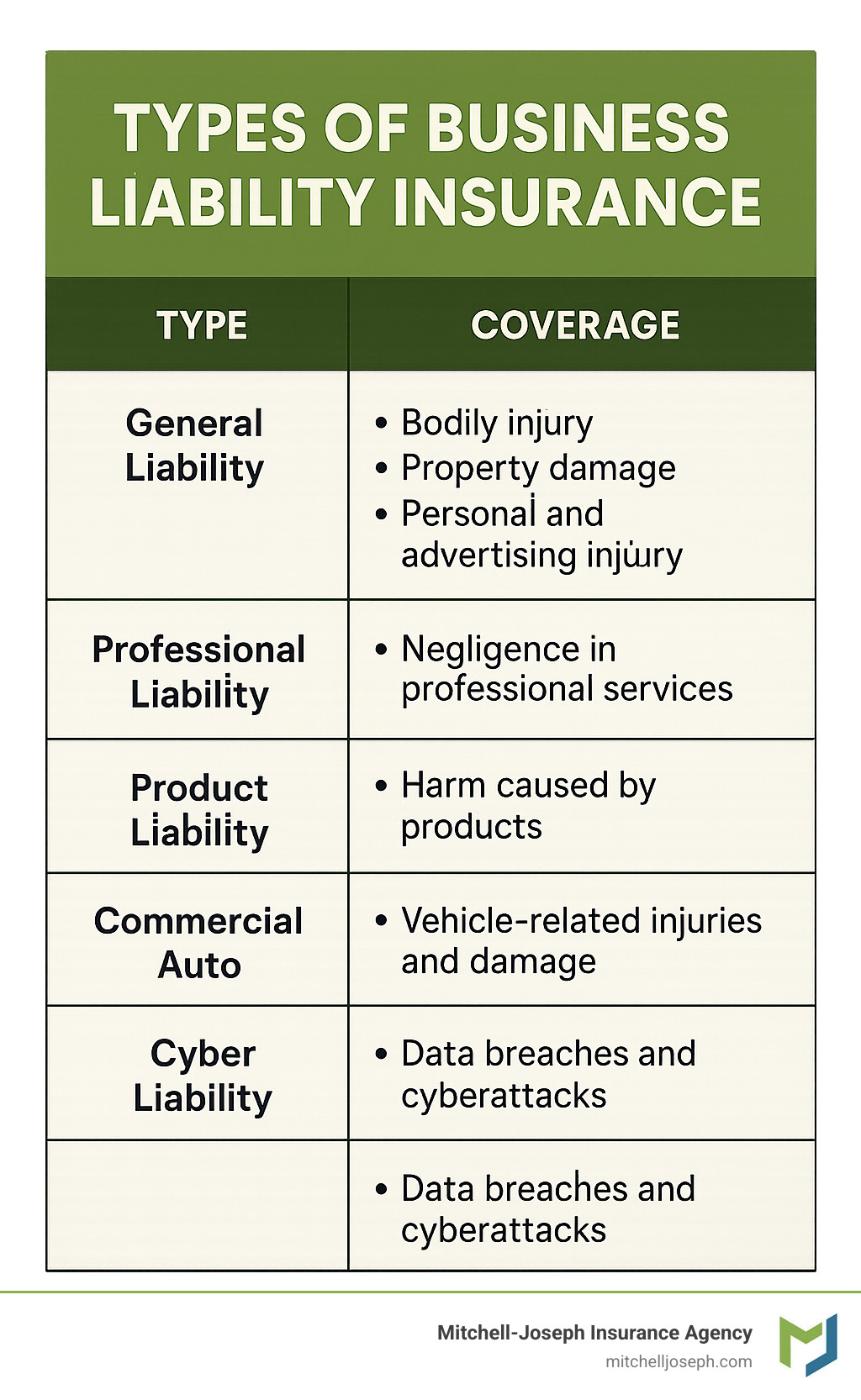
Every operation has its own exposures, so the perfect business liability insurance policy for a Pittsford consultant won’t look the same as one for a Canandaigua manufacturer. As an independent agency we quote coverage with 24 insurers, letting us mix and match until the puzzle fits.
• General liability insurance – foundational coverage for slip-and-fall injuries, property damage, and advertising injury claims.
• Professional liability (E&O) – critical for firms that give advice or design solutions. It covers allegations that your service or guidance caused financial loss.
• Product liability – protects makers, distributors, and retailers when a product you touch harms someone or damages property.
• Directors & officers (D&O) – shields personal assets of corporate or nonprofit leadership when they’re sued over management decisions.
• Cyber liability – handles the fallout from data breaches, ransomware, and privacy violations.
• Umbrella insurance – inexpensive extra limits that sit on top of several primary policies.
Business structure matters too. An LLC protects the owner’s personal assets, but the LLC itself still needs insurance. Sole proprietors have no legal separation, so liability coverage is even more important.
General Liability Basics
More info about General Liability Policy
General liability covers injuries on your premises, damage caused by your work after it’s completed, and the legal costs of defending those claims. Clients often ask to be named additional insured on your policy; we issue certificates and endorsements quickly so jobs aren’t delayed.
Specialized & Optional Policies
Some operations need more than standard liability protection:
- Employment practices liability (EPLI) – covers discrimination, harassment, and wrongful-termination suits.
- Liquor liability – required if you sell or serve alcohol.
- Pollution liability – for businesses with environmental exposures such as fuel storage or chemical use.
Your independent agent will help decide which add-ons truly matter, so you’re not paying for coverage you’ll never need.
Cost of Coverage & Factors That Influence Premiums
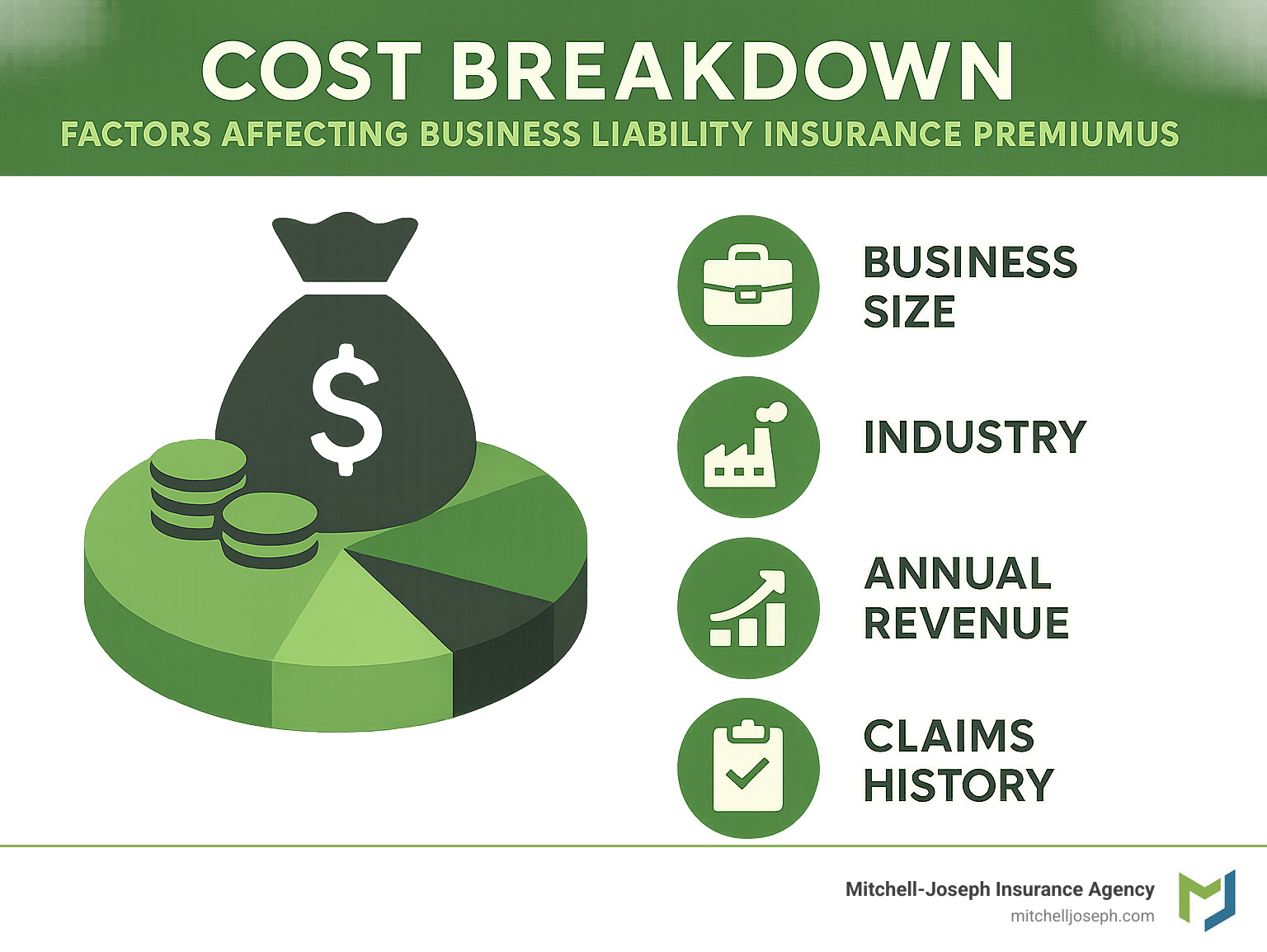
Premiums for a business liability insurance policy vary, but they always come down to the same core factors:
- Industry classification – a low-risk accounting office may pay $300-500 a year, while a roofing contractor could pay ten times that.
- Annual revenue – more sales generally equal more interactions with the public and more potential claims.
- Payroll and headcount – the more employees, the more chances for mistakes or accidents.
- Claims history – clean records earn preferred pricing; frequent losses push rates up.
- Location – busy downtown Rochester storefronts cost a bit more than quieter Stanley shops.
Higher limits are surprisingly affordable: doubling coverage from $1 million to $2 million often raises premium only 15-20%. Most Finger Lakes businesses land between $30 and $85 per month for general liability.
Your premiums are normally tax-deductible as an ordinary business expense. See IRS Publication 535 for details.
Estimating Your Budget
Start with your industry’s baseline, then adjust for revenue, payroll, and loss history. A two-person consulting firm in Pittsford with $200,000 of revenue might budget $400-800 per year. Bundling liability with property coverage in a Business Owner’s Policy (BOP), choosing higher deductibles you can afford, and maintaining strong safety practices all keep costs in check.
How to Choose, Purchase, and Maintain the Right Policy

Choosing liability coverage is easier when you follow a simple roadmap:
- Identify risks – walk through your workspace and list what could realistically go wrong.
- Work with an independent agent – we shop 24 insurers so you don’t have to.
- Match contract requirements – many landlords and clients specify exact limits or endorsements.
- Review annually – revenue, headcount, and services change, so coverage should too.
More info about Business Insurance FAQ
Getting a Quote & Proof of Insurance
We can start a quote with just your business description, annual revenue, employee count, and recent claims. Accuracy is important—under-stating risk may leave gaps when a claim hits.
Certificate requests come fast once you’re in business. We handle them quickly so projects keep moving.
Filing a Claim & Keeping Coverage Current
Document incidents immediately, contact us promptly, and cooperate with the adjuster. At renewal we’ll verify that limits, exposures, and deductibles still make sense so your business liability insurance policy grows with your company.
Frequently Asked Questions about Business Liability Insurance Policies
Over the years, we’ve answered thousands of questions about business liability coverage from our clients throughout the Finger Lakes region. Here are the three questions we hear most often:
Is a business liability insurance policy required by law?
Here’s the short answer: business liability insurance policy coverage isn’t required by New York state law or federal regulations. But before you breathe a sigh of relief, let me explain why most businesses end up needing it anyway.
Your commercial lease probably requires it. Most landlords in Rochester, Victor, and throughout our area won’t rent to businesses without liability coverage. They’ll want you to name them as an additional insured too, which protects them if someone gets hurt on the property and decides to sue everyone involved.
Your clients almost certainly require it. Whether you’re doing work for other businesses or selling to consumers, contracts typically specify minimum liability coverage amounts. We regularly help clients meet requirements ranging from $500,000 to $2 million in coverage.
Some professional licenses require proof of insurance. Depending on your industry, you might need to show coverage before you can operate legally in New York.
The real question isn’t whether it’s legally required – it’s whether you can afford to operate without it. One slip-and-fall claim or property damage incident could wipe out years of hard work. The peace of mind alone makes the modest cost worthwhile.
How often should I review or update my coverage?
We sit down with our clients every year at renewal time to review their business liability insurance policy, but don’t wait a full year if your business changes significantly.
Revenue growth is a big trigger for coverage updates. If your Canandaigua consulting firm started the year expecting $100,000 in revenue but you’re on track for $300,000, your liability exposure has grown too. We need to adjust your coverage to match.
New employees change your risk profile. More people working means more potential for accidents and claims. We’ll need to update your payroll information and possibly adjust your premiums.
Adding services or products can create new liability exposures. If you started as a web designer but now you’re also doing photography, your insurance needs have evolved. Some services require specialized professional liability coverage.
Moving locations definitely requires a policy update. Different areas have different risk factors, and your premium might change based on your new address.
After any incident – even minor ones that don’t result in claims – give us a call. We can review what happened and make sure your coverage would respond appropriately to similar situations in the future.
Can premiums be deducted on my business taxes?
Yes, and this is one of the easier tax questions we get! Business liability insurance policy premiums qualify as ordinary and necessary business expenses, which means they’re generally fully deductible.
The IRS considers liability insurance essential for protecting your business assets, so they allow the deduction. Whether you’re a sole proprietor in Honeoye Falls or running a corporation in Pittsford, you can typically deduct your premiums.
This deduction can make your effective cost of coverage even lower. If you’re in a 25% tax bracket and pay $1,000 annually for liability insurance, your after-tax cost is really only $750.
Keep good records of your premium payments throughout the year. We provide detailed invoices that make it easy for your accountant to claim the deduction properly.
Tax laws do change, and every business situation is unique. We always recommend checking with your tax professional to make sure you’re handling deductions correctly and taking advantage of all available tax benefits.
Conclusion
When you think about everything that could go wrong in business, lawsuits probably aren’t at the top of your worry list. But here’s the thing – they should be near it. A business liability insurance policy isn’t just another expense on your books. It’s your financial safety net when the unexpected happens.
I’ve seen too many business owners learn this lesson the hard way. One slip-and-fall incident, one angry customer’s lawsuit, or one mistake that damages someone else’s property can wipe out years of hard work. The difference between businesses that survive these challenges and those that don’t often comes down to having the right insurance coverage in place.
At Mitchell-Joseph Insurance Agency, we’ve been protecting Finger Lakes businesses for decades because we understand something important: your business is personal. Whether you’re running a small shop in Honeoye Falls or managing a growing company in Victor, you’ve poured your heart and resources into building something meaningful.
That’s why we don’t believe in one-size-fits-all insurance solutions. Our independent status means we can shop around with 24 different insurance companies to find coverage that actually makes sense for your specific situation and budget. We’re not trying to sell you the most expensive policy – we’re trying to find the right one.
The peace of mind that comes with proper liability coverage is hard to put a price on. When you know your business assets are protected, you can focus on what you do best: growing your business and serving your customers. You can say yes to new opportunities without constantly worrying about what might go wrong.
Don’t wait until you’re dealing with a lawsuit to think about protection. The best time to secure your business liability insurance policy is before you need it. Contact us today – we’d love to sit down and talk about how we can help protect what you’ve worked so hard to build.