

Protecting Your Digital Expertise: Why IT Consultants Need Insurance
In today’s digital landscape, your expertise as an IT consultant is invaluable to clients who depend on your tech savvy. But with great knowledge comes great responsibility—and risk. That’s where business insurance for IT consultants becomes not just a safety net, but a crucial business asset.
When you’re deep in code or configuring complex systems, the last thing you want to worry about is what might happen if something goes wrong. As someone who’s helped IT professionals steer insurance needs for over two decades, I’ve seen how proper coverage provides both protection and peace of mind.
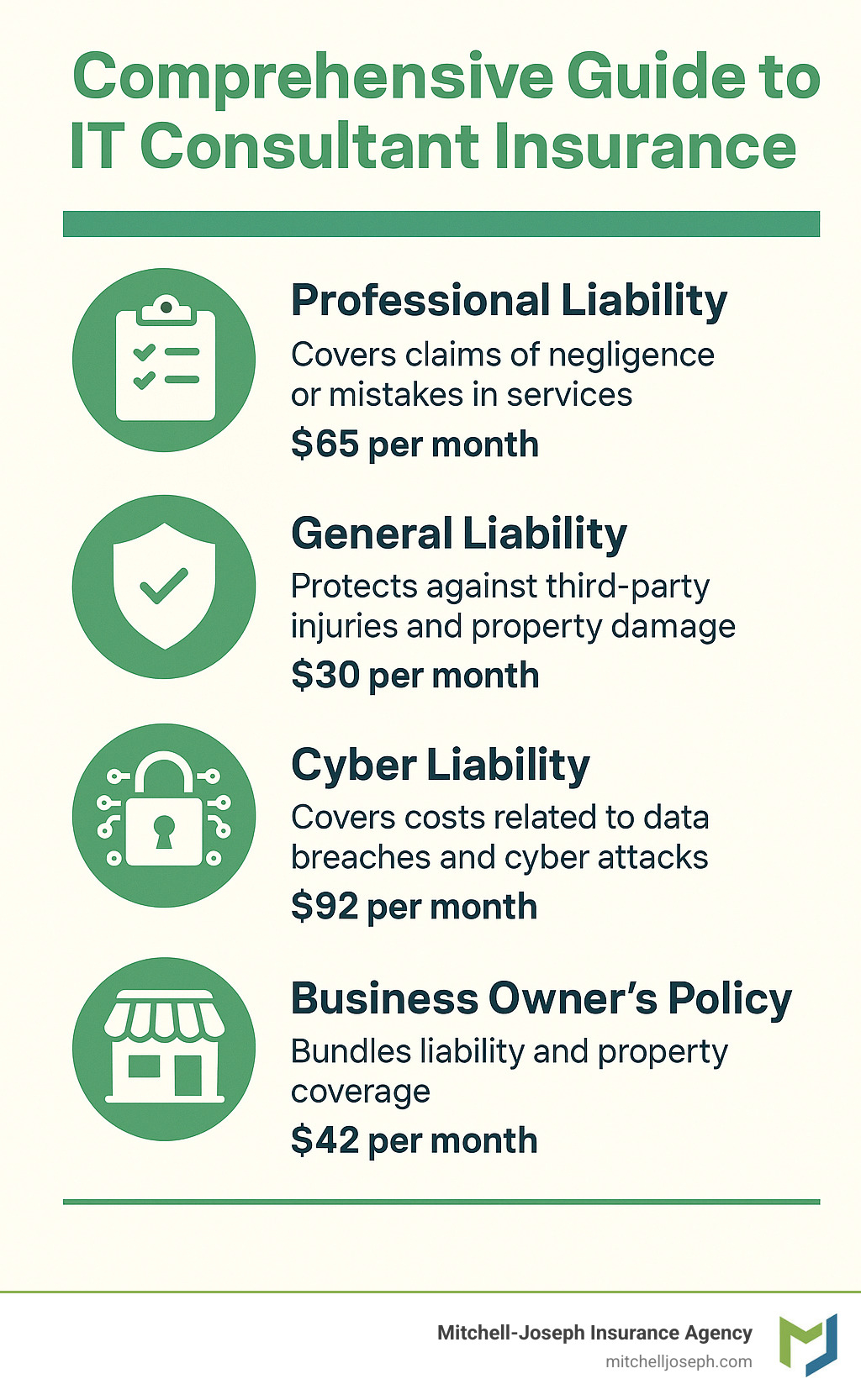
The tech consulting world comes with unique challenges—from client lawsuits over project delays to potential data breaches affecting sensitive information. Most IT consultants need a combination of coverages to fully protect their business:
Professional Liability Insurance (also called E&O) averages about $65 monthly and protects you when clients claim your advice or work caused them financial harm. Whether it’s a missed deadline or a configuration error, this coverage handles your defense costs and potential settlements.
General Liability Insurance typically costs around $30 monthly and covers those “real-world” risks—like a client tripping over your laptop bag during an on-site visit or accidentally damaging client property while installing hardware.
Cyber Liability Insurance, averaging $92 monthly, has become essential in our interconnected world. It helps with recovery costs if client data is compromised through your systems or while in your care.
Many consultants find value in a Business Owner’s Policy (BOP) at about $42 monthly, which bundles general liability with property coverage to protect your equipment and office space at a better rate than purchasing separately.
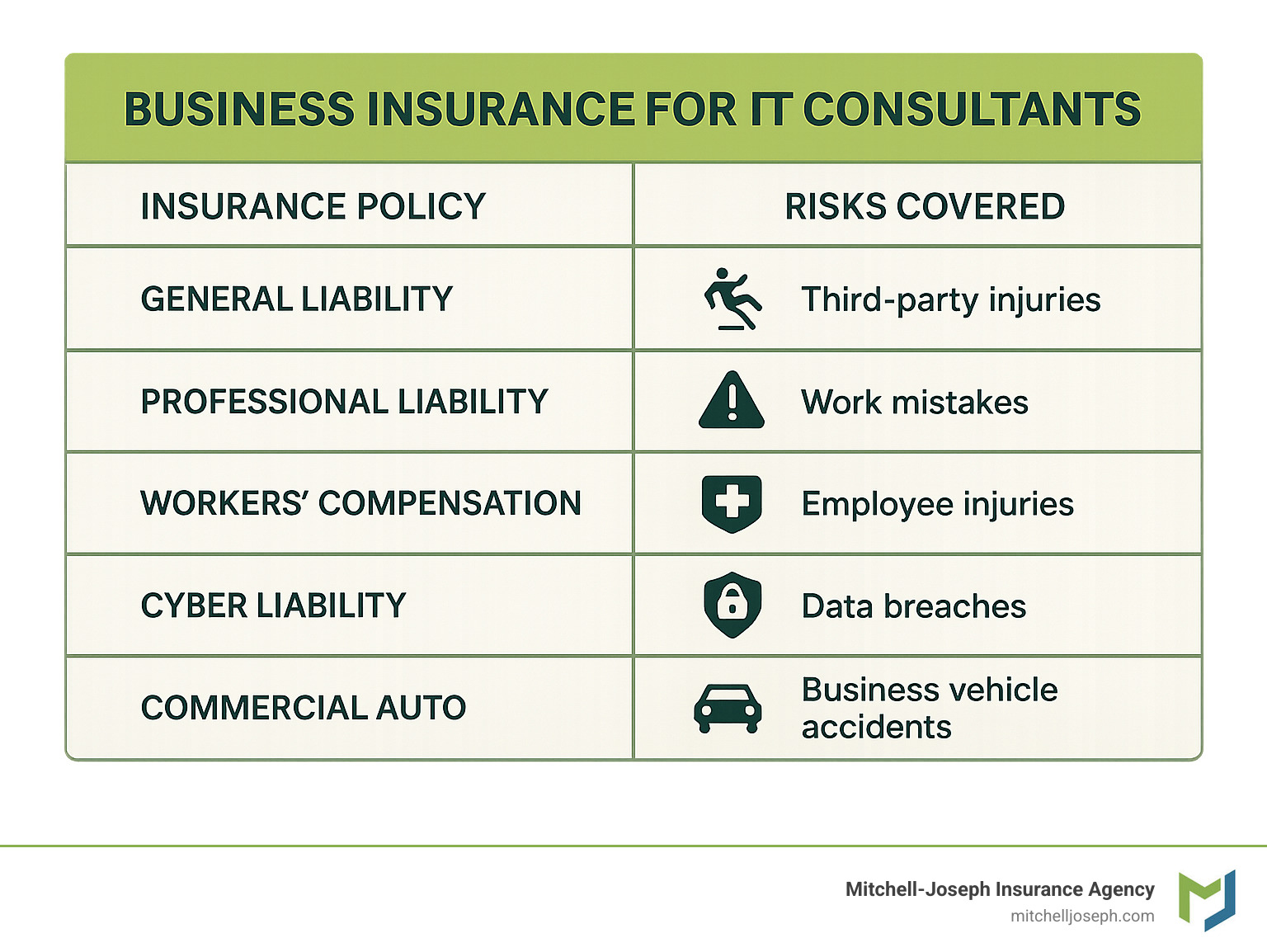
And if you have employees, Workers’ Compensation (around $40 monthly) isn’t just smart—it’s required by law in most states.
I’m Jeffrey Joseph, owner of Mitchell-Joseph Insurance Agency, and I’ve spent over 20 years helping IT consultants across upstate New York find the right protection for their digital expertise. I’ve noticed an increasing trend: clients now often require proof of insurance before signing contracts. Having the right coverage isn’t just about protection—it’s about winning business and projecting professionalism.
Even the most careful IT consultants face hidden risks. Scope creep can turn a straightforward project into a liability nightmare. Missed milestones might trigger penalty clauses in contracts. And system downtime can result in significant losses for clients—losses they may expect you to cover.
With proper business insurance for IT consultants, you can focus on what you do best: providing exceptional technical expertise to your clients. Your reputation—and your business future—deserve nothing less than comprehensive protection.
For more specific coverage information, check out our resources on Business insurance for software developers, learn about the Importance of business insurance, or browse our business insurance FAQ.
Why IT Consultants Need Insurance
In today’s digital-first world, IT consultants face unique challenges that make proper insurance coverage not just recommended, but essential. As someone who’s worked with tech professionals for over two decades, I’ve seen how the right protection can make all the difference when things go sideways.
Client Lawsuits Are More Common Than You Think
The truth is, technology consulting carries significant liability risk. A recent industry report highlighted that “a claim that your advice caused a financial loss could devastate a small technology consulting company.” Even when you’ve done everything by the book, clients might still pursue legal action if they believe your recommendations resulted in problems like system downtime, data corruption, security vulnerabilities, missed deadlines, or failed implementations.
Take one of our Rochester clients, for example. Despite following industry best practices during a system update, they faced a $75,000 lawsuit when their client’s network went down for 48 hours. The client demanded compensation for lost business revenue. Fortunately, their professional liability policy covered both legal defense costs and the eventual settlement, preventing a potential financial disaster.
Contract Requirements Make Insurance Mandatory
These days, having proper business insurance for IT consultants isn’t optional if you want to land lucrative contracts. Many clients—particularly government agencies, financial institutions, healthcare organizations, and enterprise corporations—require specific coverage before they’ll even consider signing an agreement with you. Typically, they’ll ask for:
- Professional liability/E&O insurance (often $1-2 million in coverage)
- General liability insurance
- Cyber liability coverage
- Workers’ compensation (if you employ others)
Without these policies in place, you might watch valuable opportunities go to competitors who made the investment in proper coverage.
Reputation Protection
In the competitive IT consulting field, your professional reputation is your most valuable asset. One uninsured incident can cause lasting damage to your brand and credibility. The right insurance not only covers financial losses but also provides resources for reputation management after an incident occurs, helping you rebuild trust with clients and the marketplace.
Hidden Risks of Unmanaged Projects
IT consulting projects come with unique challenges that can unexpectedly increase your liability exposure:
Scope Creep
We’ve all been there—a project starts with clear boundaries, but gradually, clients add “just one more thing” beyond the original agreement. This common scenario increases your risk of missed deadlines, budget overruns, and client dissatisfaction, often leading to disputes and claims of professional negligence.
Missed Milestones
One Rochester consultant shared this cautionary tale: “My client’s productivity dropped 15% after I missed a critical implementation milestone. Though it wasn’t entirely my fault, they sued for the lost revenue. My E&O insurance covered the $45,000 settlement.” Without coverage, that consultant might have faced bankruptcy from a single project gone wrong.
Downtime Losses
System downtime can be incredibly costly—some businesses lose thousands of dollars per minute when critical systems are unavailable. If your consulting work leads to unexpected downtime, clients won’t hesitate to seek compensation for these losses, putting your business at significant financial risk without proper insurance protection.

Essential Coverage Types for IT Consultants
Not all insurance policies are created equal. IT consultants need specialized coverage custom to their unique risks. Let’s break down the essential policies you should have in your protection toolkit:
Professional Liability (Errors & Omissions)
Professional liability insurance, also known as errors and omissions (E&O) insurance, is the cornerstone of protection for IT consultants. This policy has your back when clients claim your work caused them financial harm.
Think of it as your safety net for those “uh-oh” moments that can happen even to the most careful consultants. When a client believes your advice led them astray or your work didn’t deliver as promised, this coverage steps in.
Professional liability covers negligence claims, advice that missed the mark, project delays, service delivery failures, contract breaches, and—perhaps most importantly—the often astronomical legal defense costs that come with these situations.
I recently worked with an IT consultant from Rochester who implemented a new CRM system for a client. Despite careful planning, the client finded the system wasn’t compatible with their existing accounting software—a requirement clearly stated in their contract. The resulting lawsuit claimed $125,000 in damages for the failed implementation and business disruption. Thankfully, their E&O policy covered the entire claim.
For technology-specific consulting, look for Technology E&O coverage, which addresses the unique risks IT professionals face, including intellectual property protection. At around $65 per month, this insurance is surprisingly affordable considering the protection it provides.
More info about Business Insurance
General Liability Protection
While you might think business insurance for IT consultants should focus only on technical errors, general liability insurance is equally important. This coverage protects against everyday physical risks—like someone tripping over your laptop cord during a client meeting.
General liability insurance covers bodily injuries that happen at your office or while you’re at a client’s location. It also protects you if you accidentally damage client property (imagine spilling coffee on an expensive server) or face claims of slander, libel, or copyright infringement in your marketing materials.
An IT consultant from Victor, NY shared this story with me: “A client tripped over my laptop charger during a training session and broke their wrist. They sued for medical expenses and lost income. My general liability policy covered the entire $35,000 claim—without it, my small business might not have survived.”
At approximately $30 per month, general liability insurance is not only affordable but often required by commercial property leases, client contracts, and even conference venues if you present at industry events.
NY General Liability Insurance
Cyber Liability Safeguards
As an IT consultant with access to clients’ sensitive data and systems, cyber liability insurance isn’t optional—it’s essential. This coverage protects you from the potentially devastating costs of data breaches, ransomware attacks, and other cyber incidents.
Cyber liability comes in two important flavors:
First-party coverage protects your business directly, covering costs like data recovery after an attack, business interruption losses, ransomware payments, breach notification expenses, credit monitoring for affected parties, and public relations support to repair your reputation.
Third-party coverage kicks in when clients sue you over a data breach, covering legal defense costs, settlements, judgments, and regulatory fines.
In today’s digital landscape, these incidents happen with alarming frequency. One IT consultant I work with had their laptop hacked during a network optimization project, exposing client data. They needed to notify affected individuals, provide credit monitoring, and hire PR professionals to manage the fallout. Two clients also sued over the breach. Their comprehensive cyber liability policy covered both first-party costs ($75,000) and third-party legal expenses ($120,000).
At around $92 per month, cyber liability insurance might seem expensive, but considering the average data breach now costs small businesses over $200,000, it’s actually one of the best investments you can make.
Business Owner’s Policy Bundles
A Business Owner’s Policy (BOP) is like buying in bulk—you get general liability insurance and commercial property coverage bundled together at a lower cost than purchasing them separately.
This policy protects your physical business assets like office space, equipment, and furniture, while also covering income losses during temporary closures. For IT consultants with expensive equipment, this coverage is particularly valuable.
I recently helped an IT consultant whose office experienced water damage from a burst pipe. Their servers, computers, and other equipment were destroyed, forcing them to close for two weeks during repairs. Their BOP covered $25,000 for damaged equipment, $10,000 for lost income, and $5,000 for temporary office space—all for a premium of about $42 per month.
BOPs are typically available to businesses with fewer than 100 employees, revenues under $1 million, small office spaces, and relatively low-risk operations—making them perfect for many IT consulting firms.
Business Interruption Insurance NY
Workers’ Compensation & Employee Safety
If you have employees, workers’ compensation insurance isn’t just a good idea—it’s required by law in most states. This coverage helps employees who suffer work-related injuries or illnesses by covering medical expenses and lost wages.
In the IT consulting world, the most common claims aren’t from dramatic accidents but from everyday hazards: repetitive strain injuries like carpal tunnel syndrome, back and neck problems from long hours at desks, stress-related conditions, and ordinary trips and falls.
One consultant I work with developed severe carpal tunnel syndrome after years of intensive computer work. Their workers’ compensation policy covered $15,000 in medical treatments, $10,000 in lost wages during recovery, and $5,000 for ergonomic workplace modifications.
At approximately $40 per month per employee, workers’ compensation is a modest investment that provides critical protection. Even if you’re a sole proprietor without employees, I recommend considering this coverage for yourself, as regular health insurance often excludes work-related injuries.
Additional Policies to Consider
Depending on your specific business operations, you might need these supplemental coverages to round out your protection:
Commercial Auto Insurance is essential if you use vehicles for business purposes, like visiting clients or transporting equipment. Personal auto policies typically exclude business use, leaving you exposed to significant risk. This coverage averages about $146 per month.
Portable Equipment Coverage protects your laptops, tablets, smartphones, and other equipment when used outside your office—crucial for consultants who work on-site with clients.
Fidelity Bonds provide protection against employee theft or dishonesty—particularly important if your team members have access to client systems or sensitive data. These typically cost around $110 per month.
Umbrella Insurance provides additional liability coverage beyond the limits of your existing policies, typically in $1 million increments. Think of it as an extra layer of protection for those worst-case scenarios.
Cost of Business Insurance for IT Consultants
Understanding the financial investment required for proper insurance coverage helps you budget appropriately and recognize the value these policies provide.

How much does Business insurance for IT consultants cost?
When IT consultants ask me about insurance costs, I always share real numbers based on our experience working with hundreds of technology professionals across New York State. The truth is, business insurance for IT consultants is often more affordable than most expect.
Here’s what you’ll typically pay each month:
- General Liability: $30 per month ($363 annually)
- Professional Liability/E&O: $65 per month ($785 annually)
- Cyber Liability: $92 per month ($1,964 annually)
- Business Owner’s Policy: $42 per month ($546 annually)
- Workers’ Compensation: $40 per month per employee ($480 annually)
- Commercial Auto: $146 per month ($1,752 annually)
- Fidelity Bonds: $110 per month ($1,316 annually)
We use median figures rather than averages because they paint a more accurate picture. Averages can be skewed by those rare, extremely high or low premiums that don’t represent what most consultants actually pay.
You’ll be happy to know there are several ways to trim these costs. Bundling policies through one insurer often shaves off 10-15% from your premium. Many of our IT consultant clients opt for slightly higher deductibles to lower their monthly payments. And here’s a simple tip that surprises many: paying annually instead of monthly typically earns you a nice discount with most insurers.
Smart risk management pays off too. Implementing strong security protocols and documenting your risk management practices can lead to significantly lower premiums, especially for cyber insurance.
At Mitchell-Joseph, we compare quotes from 24 different insurance companies to find you the best coverage at competitive rates. We’re not tied to any single provider, so we can truly shop the market for you.
Factors that influence your premium
The cost of business insurance for IT consultants isn’t one-size-fits-all. Several key factors will determine your specific rates:
Services Offered
I’ve noticed significant premium variations based on what type of IT consulting you provide. System implementation specialists typically pay more due to the potential downtime risks involved. Strategic consultants fall in the middle range. Training specialists often enjoy lower rates since their work rarely disrupts critical systems.
Custom software developers face higher premiums because of intellectual property concerns, while cybersecurity consultants also pay more due to the sensitive nature of their work. One of our clients switched from general IT support to specialized security consulting and saw a 15% premium increase despite maintaining the same revenue.
Business Size and Revenue
As your consulting practice grows, expect your insurance costs to increase accordingly. This isn’t just because insurers want to charge bigger companies more. Larger businesses typically have more assets to protect, work with larger clients (potentially leading to larger claims), and employ more people (increasing workers’ compensation costs).
A solo consultant making $80,000 annually might pay half what a 10-person firm making $1.2 million would pay for similar coverage types.
Claims History
Your track record matters enormously. A clean claims history demonstrates lower risk to insurers, resulting in lower premiums. I’ve seen this with clients who’ve maintained claim-free records for years – they consistently enjoy some of our best rates.
Conversely, even one significant claim can raise your premiums for several years. This is why investing in preventative measures and quality control processes makes financial sense in the long run.
Policy Limits and Deductibles
The coverage amounts you select directly impact your costs. For example, a $1 million E&O policy might cost $65 monthly, while doubling your coverage to $2 million might only increase your premium to $95 monthly. That’s a lot more protection for a relatively modest increase.
Your deductible choice creates another opportunity for customization. Increasing your deductible from $1,000 to $5,000 could reduce your premiums by 10-15%. Just be sure you keep enough cash reserves to cover that higher deductible if needed.
Geographic Location
Where you operate significantly affects your insurance costs. Different states have different regulations, litigation environments, and cost-of-living factors that influence claim amounts.
For IT consultants in upstate New York, I’ve found that premiums tend to be slightly lower than the national average, particularly in areas like Honeoye Falls, Canandaigua, and Victor. This regional advantage is one reason why many of our local consultants have been pleasantly surprised by their quotes.
How to Secure Coverage Quickly and Meet Contract Requirements
When you need insurance coverage—whether for a new contract opportunity or to protect your growing business—time is often of the essence. Here’s how to get covered efficiently:
Business insurance for IT consultants and client confidence
Having the right insurance coverage doesn’t just protect you from financial losses—it also signals professionalism and reliability to potential clients.
Properly insured IT consultants win more bids because many RFPs (Requests for Proposals) require specific insurance coverage. Without it, your bid may be automatically disqualified, regardless of how brilliant your technical expertise or competitive your pricing might be.
One of our clients from Canandaigua shared this eye-opening experience with us: “After losing three potential contracts because I lacked proper insurance, I contacted Mitchell-Joseph Insurance. Within 24 hours, I had the coverage I needed and was able to successfully bid on my next opportunity. That contract alone paid for several years of insurance premiums.”
Insurance helps you build client trust in ways that technical credentials alone cannot. When clients know you’re properly insured, they feel more confident in your services. Your coverage demonstrates that you take your business seriously, have financial backing if something goes wrong, and are prepared for contingencies.
Many clients won’t even consider working with uninsured consultants. Their contracts typically specify minimum coverage amounts (often $1-2 million), specific policy types like E&O, general liability, and cyber liability, additional insured status for the client, and waiver of subrogation clauses. Having these coverages ready before contract negotiations can expedite the process and prevent delays in project start dates.
Steps to get covered in 24 hours
At Mitchell-Joseph Insurance Agency, we’ve streamlined the process to get IT consultants covered quickly. We understand that when opportunity knocks, you can’t afford to wait weeks for insurance paperwork.
First, gather your basic business information including your business name and structure, years in operation, employee count, annual revenue, services offered, any prior claims, and your desired coverage limits. Having this information ready saves valuable time during the application process.
Next, request quotes by reaching out to us via phone, visiting our website, or stopping by one of our offices in Honeoye Falls, Pittsford, Naples, Rushville, or other locations across upstate NY. We’ll immediately begin working on your behalf.
When we present your options, we don’t just show you premiums. We explain coverage differences, deductible options, payment plans, and the financial strength ratings of each insurer. We believe an informed decision is always better than simply choosing the cheapest option.
After you’ve selected your coverage, most of the application process happens online with e-signatures, making it convenient regardless of your location or schedule. Once you’ve completed the application and made your initial payment, you’ll have immediate access to your Certificate of Insurance through our client portal.
One IT Security Consultant from Rochester told us: “I needed proof of insurance for a government bid by the next morning. Mitchell-Joseph had me covered within hours. I was able to download my certificate and share it with the potential client before the deadline. We won the contract, which more than paid for the insurance.”
With business insurance for IT consultants in place, you’ll have both protection and the professional credibility needed to win more business. And unlike some agencies that represent just one or two insurance companies, we compare quotes from 24 different insurers to find you the best coverage at competitive rates.
Frequently Asked Questions about Business insurance for IT consultants
Let’s tackle some of the questions I hear most often when helping IT consultants find the right insurance coverage. These are the concerns that keep many technology professionals up at night—and rightfully so!
Do IT consultants legally need workers’ compensation?
In New York State, the rules are pretty straightforward: if you have employees (even part-timers), workers’ compensation isn’t optional—it’s the law.
Solo practitioners and partnerships without employees generally don’t need to worry about this requirement. However, if you’ve structured your business as an LLC or corporation, you might still need coverage depending on your ownership percentage—even if you’re the only person working there.
I often tell my clients that workers’ comp makes sense even when it’s not legally required. Why? Because your regular health insurance typically won’t cover work-related injuries. For IT folks, we’re talking about things like carpal tunnel syndrome from all that typing, back problems from those marathon coding sessions in uncomfortable chairs, and even stress-related conditions that come with tight project deadlines.
One of our Rochester-based IT consultants initially skipped workers’ comp to save money. After developing severe wrist pain that required surgery, he finded his health insurance wouldn’t cover it because it was deemed work-related. That $12,000 medical bill would have been fully covered under a workers’ comp policy that would have cost about $480 annually.
What is the difference between first-party and third-party cyber liability?
Think of first-party cyber liability as protection for your own business. It covers direct costs you’ll face after a cyber incident, including:
- Getting your data back after it’s been compromised
- Income losses while your systems are down
- Paying that ransomware demand when you have no other choice
- Notifying clients their data may have been exposed
- Providing credit monitoring for affected individuals
- Hiring PR experts to repair your reputation
Third-party cyber liability, on the other hand, kicks in when others come after you. This includes:
- Legal defense when clients sue you over a data breach
- Settlements and judgments if you’re found liable
- Regulatory fines and penalties imposed by government agencies
As an IT consultant with privileged access to client systems and sensitive data, you’re in a unique position of trust. That’s why I typically recommend carrying both types of coverage. Most quality insurers offer these protections in a single comprehensive cyber liability policy, making it easier to ensure you’re fully protected.
When is a Business Owner’s Policy recommended?
A Business Owner’s Policy (BOP) is like the Swiss Army knife of small business insurance—it bundles multiple coverages together at a better price than buying them separately.
I recommend a BOP for IT consultants who:
- Work from an actual office (not just your dining room table)
- Have invested in valuable equipment like high-end computers and servers
- Run a smaller operation (fewer than 100 employees)
- Generate under $1 million in annual revenue
- Need both liability and property protection
The beauty of a BOP is the savings—typically 10-15% less than purchasing general liability and property insurance as separate policies. Even for home-based consultants, a BOP offers important protection that your homeowner’s policy simply doesn’t. Most home insurance provides minimal coverage for business equipment and zero liability protection for your professional activities.
I remember helping a four-person IT consulting firm in Victor that was paying separately for general liability and property coverage. By switching to a BOP, they saved nearly $500 annually while actually gaining additional protection for business interruption. When a three-day power outage left them unable to access their systems, that business interruption coverage was the difference between a minor inconvenience and a major financial setback.
Business insurance for IT consultants doesn’t need to be complicated, but it does need to be comprehensive. At Mitchell-Joseph Insurance Agency, we’re always happy to explain these concepts in plain English and help you find exactly the right coverage for your specific situation.
Conclusion
Protecting your IT consulting business doesn’t have to be complicated, but it does need to be comprehensive. As we’ve explored throughout this guide, business insurance for IT consultants provides the safety net you need in an increasingly complex digital landscape.
At Mitchell-Joseph Insurance Agency, we understand the unique challenges you face. Our family-owned business brings over 200 years of combined experience to the table, helping IT consultants just like you across upstate New York find coverage that truly fits their needs—not too much, not too little, but just right.
When you work with us, you’re not just getting an insurance policy. You’re gaining a partner who will take the time to understand your business and recommend protection that makes sense for your specific situation. Whether you’re a solo consultant working from home or managing a growing team with multiple client projects, we’ve got your back.
What makes our approach different? For starters, we can compare quotes from 24 different insurance companies to find you the best value. More importantly, we provide the personalized attention that national chains simply can’t match. Our local presence—with offices in Honeoye Falls, Pittsford, Naples, Rushville, Avon, and throughout the region—means we understand the unique business environment you’re operating in.
The digital world isn’t getting any simpler. New threats emerge daily, from sophisticated ransomware attacks to evolving client expectations. But with the right insurance coverage in place, you can focus on what you do best—delivering exceptional IT services—while knowing you’re protected against the unexpected.
Don’t wait for a crisis to find gaps in your coverage. Don’t lose that next big contract because you couldn’t provide proof of insurance quickly enough. Reach out to us today through our website, and let’s make sure your business has the protection it deserves. A quick conversation now could save you countless headaches (and dollars) down the road.
After all, the best time to get insurance is always before you need it.

