

Why Auto Insurance for Students Costs More (But Doesn’t Have to Break the Bank)
Auto insurance for students is significantly more expensive than coverage for older drivers, but understanding your options can help you find affordable protection. Here’s what you need to know:
Key Facts About Student Auto Insurance:
- Students under 25 pay 142% more than average drivers
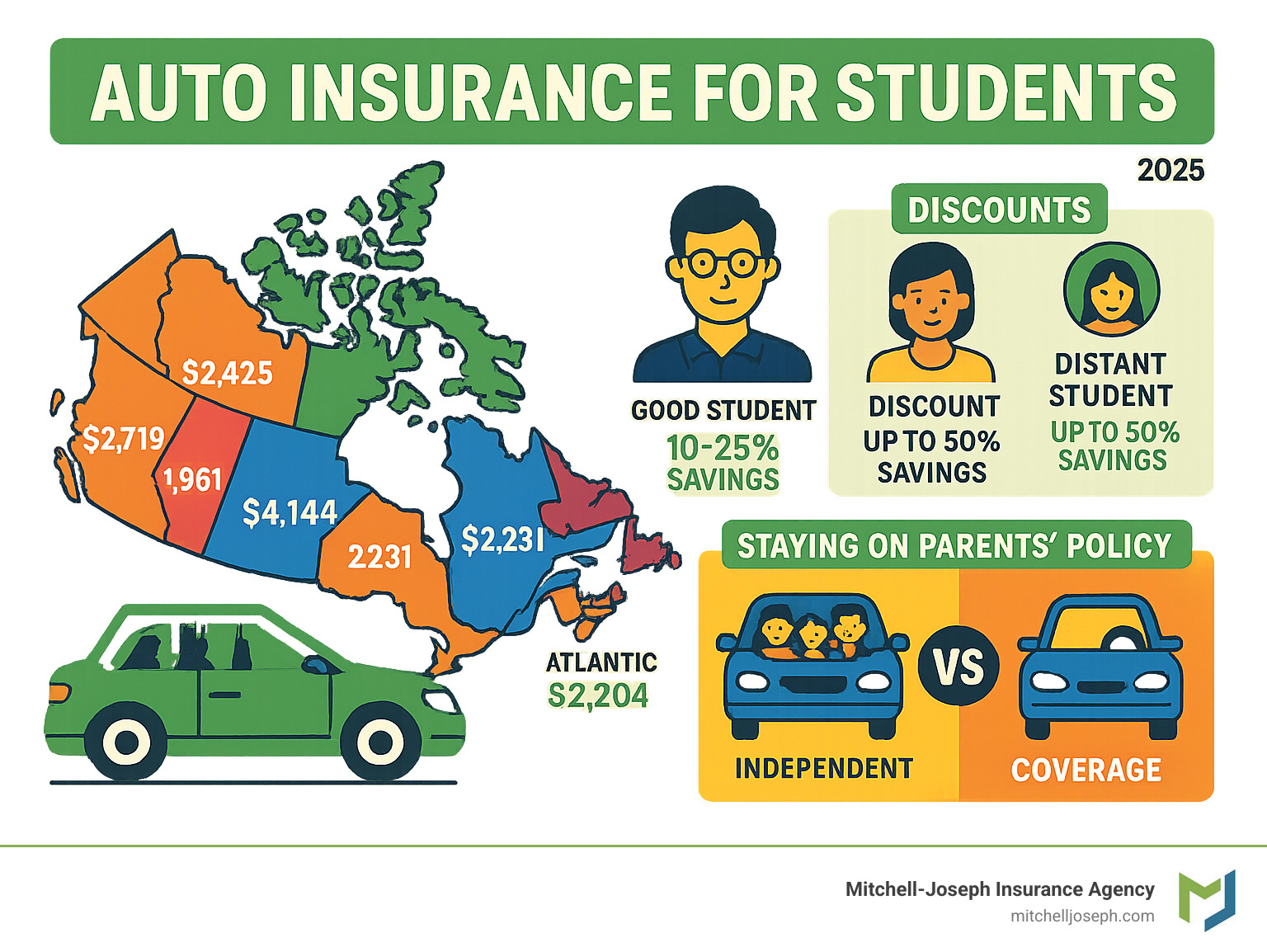
- Ontario students average $4,144 per year vs. provincial average of $1,505
- Good student discounts can save 10-25% with 80%+ grades
- Distant student discounts offer up to 50% savings when living 100km+ from home
- Students can stay on parents’ policies as secondary drivers for lower rates
Being a college or university student is both exciting and a little confusing. You’ll experience many firsts, like living on your own and managing day-to-day affairs – including figuring out car insurance that won’t drain your budget.
The statistics tell a clear story: drivers under 25 face the highest insurance premiums of any age group. In 2022, Transport Canada reported 9,897 injuries among drivers aged 15-19, and the fatal collision rate for 16-19 year olds was 6.5 per 100,000 licensed drivers. These numbers explain why insurers charge more – but they don’t mean you’re stuck paying sky-high rates.
Smart students have options. Whether you’re commuting from home, living on campus, or studying out-of-province, there are proven strategies to cut your insurance costs while maintaining proper coverage.
I’m Jeffrey Joseph, and I’ve been helping families in the Finger Lakes region steer auto insurance for students since 1999 at Mitchell-Joseph Insurance Agency. I’ve seen how the right coverage strategy can save student drivers hundreds or even thousands of dollars annually. Let me show you exactly how to protect yourself on the road without breaking your budget.
Student Car Insurance 101: What Makes It Different?
Auto insurance for students operates on the same basic principles as regular car insurance, but the pricing structure reflects the reality that young drivers face higher risks. Understanding these differences is crucial for making informed decisions about your coverage.
The fundamental reason student insurance costs more is risk-based pricing. Insurance companies analyze decades of data showing that drivers under 25 are statistically more likely to be involved in accidents. This isn’t a judgment on your driving ability – it’s simply a reflection of inexperience behind the wheel and the learning curve that comes with developing safe driving habits.
Canada’s graduated licensing system recognizes this reality. Whether you’re working through your G1 learner’s permit or have recently earned your full G license, you’re still building the experience base that insurance companies use to assess risk. In most provinces, the minimum driving age is 16, though Alberta and New Brunswick allow learners at 14.
Transport Canada’s data reinforces why insurers charge more for young drivers. Beyond the injury statistics mentioned earlier, the fatal collision rate for 16-19 year olds increased by 5% in 2021, highlighting the ongoing safety challenges in this age group. For more detailed information about auto insurance basics, check out our Auto Insurance FAQs.
Auto insurance for students vs regular policies
The coverage options available to students are identical to those offered to any driver – auto insurance for students doesn’t mean you get a different type of policy. What changes is the pricing structure and the discount opportunities available to you.
Students typically face higher premiums due to three main factors:
-
Limited driving history – Even if you’ve had your license for a few years, you haven’t built up the long-term claims-free record that insurers reward with lower rates.
-
Age-based risk factors – Statistical models show higher claim frequencies for drivers under 25, regardless of individual driving ability.
-
Vehicle usage patterns – Students often drive in high-risk scenarios like late-night social activities or unfamiliar areas around campus.
However, students also have access to unique discount opportunities that can significantly offset these higher base rates. Good student discounts, distant student discounts, and driver education credits can combine to create substantial savings.
Primary vs secondary/occasional driver status
One of the most impactful decisions for auto insurance for students is whether to be listed as a primary or secondary driver. This classification can literally save you thousands of dollars annually.
As a secondary or occasional driver on your parents’ policy, you’re covered to drive the family vehicle but aren’t considered its primary user. The key requirement is that you use the car less than 50% of the time. This arrangement offers several advantages:
- Lower premiums – You benefit from your parents’ driving experience and claims history
- Multi-car discounts – Your parents may qualify for additional savings by having multiple vehicles on one policy
- Distant student discount – If you’re attending school more than 100km from home, you could see premium reductions of up to 50%
The distant student discount is particularly valuable. When you’re away at school and only driving during breaks or occasional visits home, insurance companies recognize that your actual driving exposure is significantly reduced. This can result in dramatic premium savings while maintaining full coverage.
At Mitchell-Joseph Insurance Agency, we often recommend this approach for students who don’t need daily access to a vehicle at school. You maintain continuous coverage (important for your insurance history), benefit from lower rates, and can easily adjust your status if your driving needs change.
Coverage Checklist: Mandatory & Optional Protections
Understanding what coverage you need – and what you can skip – is essential for managing your auto insurance for students budget effectively. Let’s break down the mandatory requirements and optional protections that make sense for student drivers.
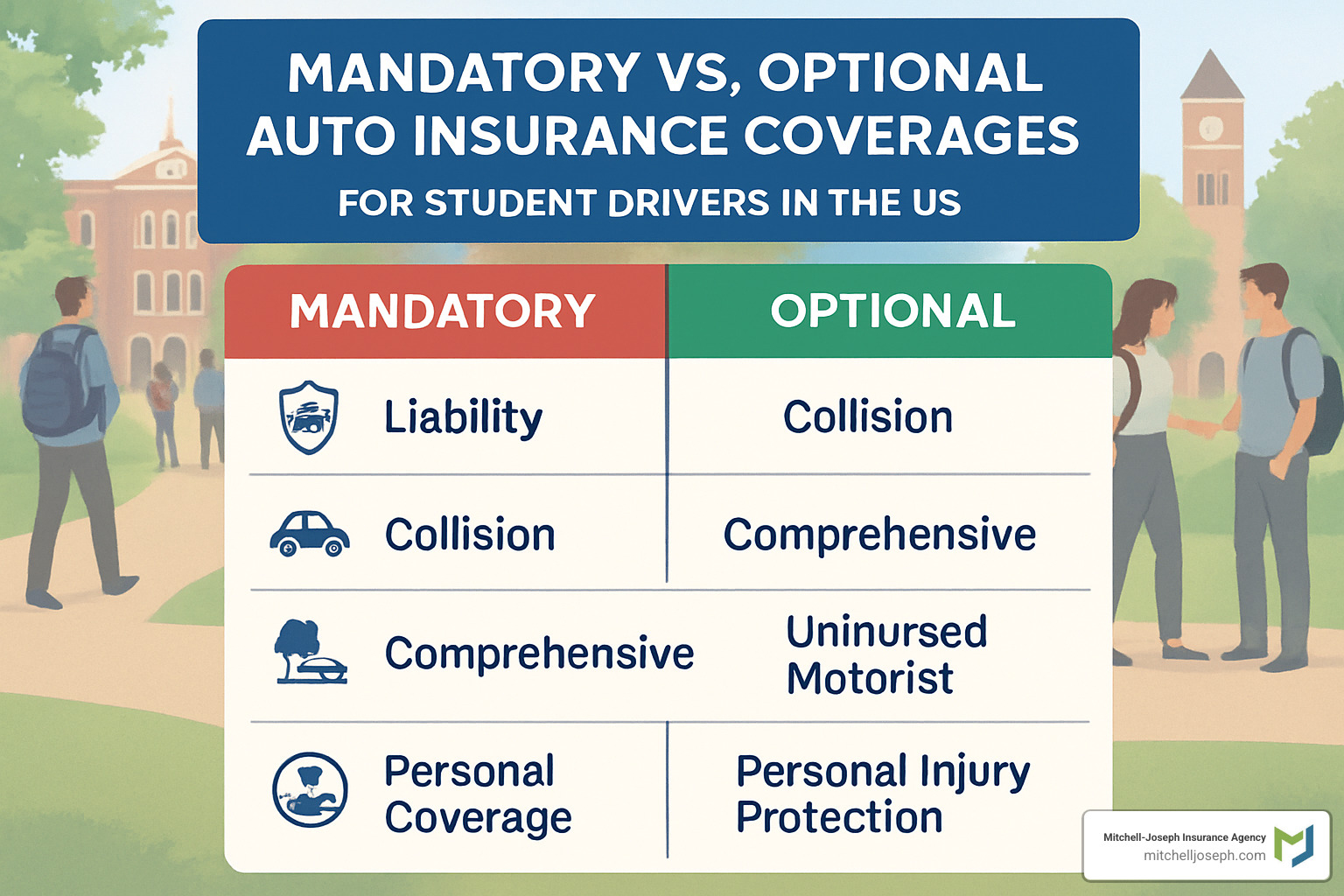
Mandatory Coverage Requirements:
All Canadian provinces require minimum coverage that includes:
-
Third-party liability – Covers injury and property damage you cause to others. Minimum limits vary by province but typically start at $200,000. We recommend higher limits given the potential costs of serious accidents.
-
Accident benefits – Provides medical coverage and income replacement if you’re injured in an accident, regardless of fault.
-
Uninsured motorist coverage – Protects you if you’re hit by an uninsured driver or in a hit-and-run situation.
-
Direct Compensation Property Damage (DCPD) – In no-fault provinces, this covers damage to your vehicle when another driver is at fault.
Optional Coverage Worth Considering:
- Collision coverage – Pays for damage to your vehicle in an accident, regardless of fault
- Comprehensive coverage – Covers theft, vandalism, weather damage, and other non-collision losses
- Roadside assistance – Provides towing, battery boosts, and emergency services
- Rental car coverage – Pays for a rental vehicle while yours is being repaired
For a visual guide to choosing the right coverage levels, reference this Choosing coverage guide.
Optional extras worth considering
Several optional coverages can provide excellent value for student drivers:
Accident Forgiveness – This coverage protects you from rate increases after your first at-fault accident. For new drivers who are still developing their skills, this can provide valuable financial protection and peace of mind.
Usage-based insurance (telematics) – These programs use mobile apps or devices to monitor your driving habits. Safe drivers can earn discounts of up to 30% by demonstrating good habits like smooth braking, appropriate speeds, and avoiding late-night driving.
Replacement cost coverage (FPQ5) – If you have a newer vehicle, this coverage pays the original purchase price if your car is deemed a total loss, rather than the depreciated value.
Tenant insurance bundling – If you’re renting an apartment or living in residence, bundling your auto and tenant insurance can result in significant multi-policy discounts. This is especially valuable since many students need tenant insurance anyway to protect their belongings.
For families looking at comprehensive coverage strategies, our Auto Insurance for Families guide provides additional insights on coordinating coverage across multiple family members.
Auto Insurance for Students: Costs, Discounts & How to Shop Smart
The reality of auto insurance for students costs can be sobering, but understanding the factors that drive these costs – and the discounts available to offset them – puts you in control of your insurance budget.
Cost Reality Check:
Student drivers face some of the highest insurance premiums in Canada. The average increase for student car insurance compared to the general population is 142%, with provincial variations ranging from 126% to 210%. Here’s how the numbers break down:
- Ontario: Standard rate $1,505 vs. student rate $4,144
- Alberta: Standard rate $1,316 vs. student rate $3,120
- Quebec: Standard rate $717 vs. student rate $2,114
- New Brunswick: Standard rate $867 vs. student rate $1,867
Gender also plays a role, with male student drivers typically paying 40% more than female students, though this varies by location and driving record.
Available Discounts:
The good news is that multiple discount opportunities can significantly reduce these high base rates:
- Good student discount: 10-25% savings for maintaining an 80%+ average
- Driver training discount: Completing an approved course can save enough to cover the course cost in the first year
- Distant student discount: Up to 50% savings when living 100km+ from home
- Winter tire discount: 5% mandatory discount in Ontario
- Telematics programs: Up to 30% savings for safe driving habits
- Multi-policy bundling: Up to 25% when combining auto and tenant insurance
For more detailed information about managing rising insurance costs, visit our guide on noticing higher auto insurance costs. You can also find additional money-saving strategies in this latest research on saving.
Auto insurance for students cost factors
Beyond age and experience, several specific factors influence your auto insurance for students premiums:
Vehicle Type and Safety Features – The car you drive significantly impacts your rates. Vehicles with advanced safety features like automatic emergency braking, lane departure warnings, and blind spot monitoring can qualify for safety discounts. Conversely, high-performance vehicles or cars with poor safety ratings will increase your premiums.
Annual Mileage – How much you drive matters. Students who only drive occasionally or have low annual mileage may qualify for low-mileage discounts or usage-based insurance programs.
Postal Code – Where you park your car overnight affects your rates. Urban areas with higher crime rates and accident frequencies typically result in higher premiums than rural locations.
Claims History – Even as a new driver, any at-fault accidents or comprehensive claims will impact your rates. Maintaining a clean record is one of the most effective ways to keep costs down over time.
Money-saving hacks for auto insurance for students
Smart students can employ several strategies to minimize their auto insurance for students costs:
Maximize Academic Performance – That good student discount isn’t just a nice bonus – it’s a substantial financial incentive. Maintaining a B average or 3.0 GPA can save you hundreds of dollars annually. Keep your transcripts handy when shopping for insurance.
Strategic School Selection – If you’re choosing between schools, consider the insurance implications. Students attending school more than 100km from home qualify for distant student discounts, while those in provinces with government-run insurance (BC, Manitoba, Saskatchewan) may face different rate structures.
Leverage Graduated Licensing Programs – Some provinces offer grid rating programs that automatically reduce rates for new drivers as they progress through the licensing system. Take advantage of these programs by completing each licensing stage promptly.
Optimize Your Deductible – Choosing a higher deductible can significantly reduce your premiums. If you can afford to pay $1,000 or $1,500 out of pocket in the event of a claim, the annual savings on your premium often justify the increased deductible.
Park Smart – Where you park your vehicle matters. Secure parking in a garage or monitored lot can qualify for discounts, while street parking in high-crime areas increases your risk and rates.
Consider Pay-Per-Mile Insurance – If you’re a low-mileage driver, usage-based insurance programs can offer substantial savings. These programs typically charge a base rate plus a per-mile fee, making them ideal for students who drive infrequently.
How to compare quotes and choose a policy
Shopping for auto insurance for students requires a strategic approach to ensure you’re comparing apples to apples and getting the best value for your coverage needs.
Shop Annually – Insurance rates change frequently, and loyalty doesn’t always pay. Even if you’re happy with your current insurer, getting quotes annually ensures you’re not missing out on better rates elsewhere.
Align Coverage Limits – When comparing quotes, make sure you’re using identical coverage limits and deductibles. A quote that looks cheaper might have lower liability limits or higher deductibles that could cost you more in the long run.
Read the Fine Print – Pay attention to endorsements and exclusions. Some policies might exclude coverage for certain activities or have restrictions that could affect your coverage when you need it most.
Consider the Total Package – The cheapest quote isn’t always the best value. Consider factors like customer service reputation, claims handling, and the financial stability of the insurance company.
At Mitchell-Joseph Insurance Agency, we can provide you with quotes from 24 different insurance companies, allowing you to compare options and find the best combination of coverage and price for your specific situation. For students in the Rochester area, check out our Auto Insurance Quotes Rochester NY service for personalized quotes.
Special Situations & FAQs
Auto insurance for students becomes more complex when you factor in the mobility that comes with student life. Whether you’re moving away for school, studying internationally, or just trying to understand what’s covered, these special situations require specific attention.

Moving 100 km+ or out-of-province
One of the most significant factors affecting auto insurance for students is geographic mobility. Moving for school can actually work in your favor financially, but it requires proper planning and communication with your insurer.
The 100km Rule – Students who move more than 100km from home for school can qualify for substantial discounts. This distant student discount recognizes that you’re not driving the family vehicle daily, reducing your risk exposure. Some students see their premiums drop by up to 50% when properly classified as occasional drivers living away from home.
Address Updates – You must notify your insurer of any address changes. Insurance companies use postal codes for territory rating, which affects your premiums based on local accident rates, crime statistics, and other risk factors. Failing to update your address could void your coverage or result in claim denials.
Out-of-Province Moves – If you’re attending school in a different province, the situation becomes more complex. You’ll need to inform your insurer about the change, and you may need to switch to a policy that meets the new province’s regulatory requirements. Some provinces have government-run insurance systems that don’t allow out-of-province policies.
License Conversion – When moving provinces, you typically have 60-90 days to convert your driver’s license. This timeline varies by province, so check the specific requirements for your new location.
International students & foreign licences
International students face unique challenges when securing auto insurance for students in Canada, but there are pathways to coverage and potential savings.
Proof of Experience – If you have driving experience in your home country, gather documentation of your driving history and any insurance claims. Some insurers will recognize this experience and offer better rates than they would to a completely new driver.
Temporary Coverage – Most provinces allow you to drive on a foreign license for 60-90 days, but you should obtain Canadian coverage immediately. Your home country’s insurance likely won’t provide adequate coverage for Canadian requirements.
Public Insurance Considerations – In provinces with government-run insurance (BC, Manitoba, Saskatchewan), international students must purchase coverage through the provincial system. Private insurance isn’t available for basic coverage in these provinces.
Rental Options – If you don’t own a vehicle but occasionally need to drive, make sure you understand the insurance implications of rental cars or borrowing vehicles from friends.
Are your belongings covered while away?
This is one of the most common questions we get about auto insurance for students, and the answer depends on your specific situation and coverage.
Homeowner’s Policy Extension – If your parents have homeowner’s insurance, your personal belongings may be covered while you’re temporarily away at school. This typically includes items in your dorm room, apartment, or even your vehicle. However, coverage is usually subject to the policy’s deductible, which might be $1,000 or more.
Tenant Insurance – Many students need separate tenant insurance to adequately protect their belongings. This is especially important if you’re living off-campus or have valuable items like electronics, musical instruments, or expensive textbooks.
Proof for Landlords – Some landlords or residence halls require proof of insurance. Your parents’ homeowner’s policy or your own tenant policy can provide this documentation.
Deductible Considerations – Even if your belongings are covered under a parent’s policy, you’ll need to pay the deductible for any claims. For smaller losses, this might not be cost-effective.
Driving outside Canada or in the US
Auto insurance for students becomes more complicated when you’re driving outside Canada, whether for spring break, visiting family, or studying abroad.
US Travel – Most Canadian auto insurance policies provide coverage in the United States, but the liability limits might not meet US requirements. Some insurers can extend coverage for up to one year for students studying in the US, while others limit coverage to six months.
Liability Limits – US liability requirements can be higher than Canadian minimums. Make sure your policy provides adequate coverage for the states you’ll be visiting or living in.
Proof of Insurance – Always carry a valid insurance card when driving in the US. Some states require specific documentation, and you may need to provide proof of insurance if stopped by police or involved in an accident.
Extended Stays – If you’re studying in the US for an extended period, you may need to purchase local insurance after your Canadian coverage expires.
Top quick FAQs on auto insurance for students
Do rates automatically drop at age 25? – While rates typically decrease as you age, the change isn’t automatic. Your rates will gradually improve as you build experience and maintain a clean driving record. The most significant drops usually occur around ages 21 and 25.
Can I pause my insurance while away at school? – You cannot completely pause your insurance, but you can adjust your coverage. If you’re leaving your car at home, you might be able to remove collision coverage while maintaining comprehensive and liability coverage.
What happens if I drive without coverage? – Driving without insurance is illegal in all Canadian provinces and territories. Penalties can include fines, license suspension, vehicle impoundment, and classification as a high-risk driver, which will make future insurance much more expensive.
Will my parents’ rates increase if I’m added to their policy? – Yes, adding a young driver will increase the premium, but it’s usually much less expensive than getting your own policy. The increase depends on your age, driving experience, and the coverage levels chosen.
Can I get temporary insurance? – Most insurers don’t offer true temporary policies to students. Instead, you can be added to a parent’s policy as needed or adjust your coverage levels seasonally.
Conclusion
Auto insurance for students doesn’t have to break your budget. While the statistics show that young drivers pay significantly more than older, more experienced drivers, smart strategies can help you minimize these costs while maintaining proper protection.
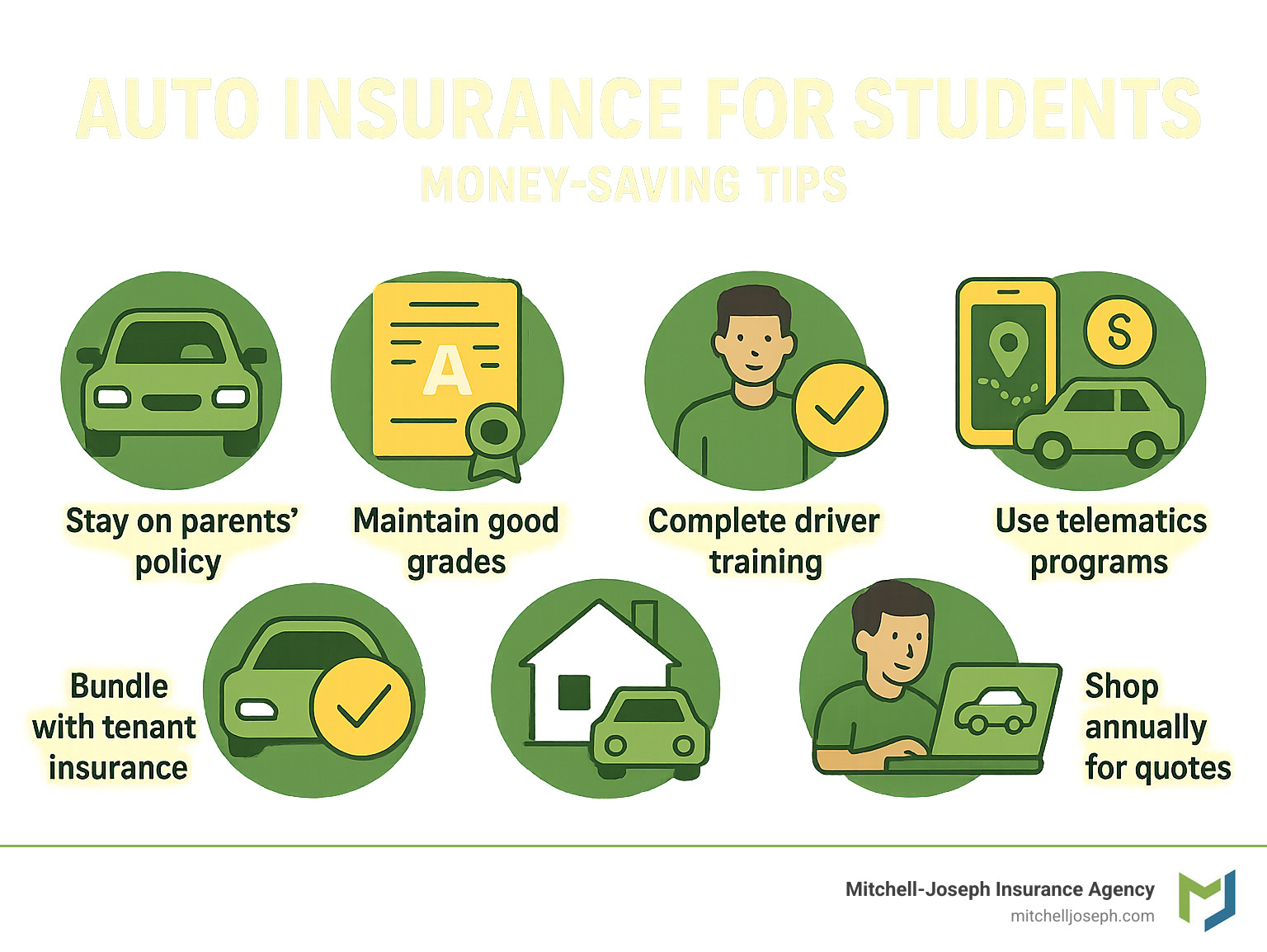
The key takeaways for managing your student auto insurance costs:
- Stay on your parents’ policy as a secondary driver when possible – this single decision can save you thousands annually
- Maintain good grades to qualify for substantial good student discounts
- Take advantage of distance – if you’re more than 100km from home, make sure you’re getting the distant student discount
- Complete driver training – the upfront cost often pays for itself in the first year through insurance savings
- Use technology – telematics programs can provide significant discounts for safe driving habits
- Bundle wisely – combining auto and tenant insurance often results in meaningful savings
- Shop annually – insurance rates change, and loyalty doesn’t always pay
At Mitchell-Joseph Insurance Agency, we understand that every student’s situation is unique. Whether you’re commuting from home in Rochester, studying at a SUNY campus, or attending school out of state, we can help you find the right coverage at the right price. With access to 24 different insurance companies and over 200 years of combined experience, we’re equipped to find solutions that fit your specific needs and budget.
Our locations throughout the Finger Lakes region – from Honeoye Falls to Canandaigua to Victor – mean we’re familiar with the local factors that affect your insurance rates. We know which insurers offer the best student discounts, which companies are most flexible with distant student situations, and how to structure your coverage for maximum savings.
Don’t let high insurance costs keep you off the road. Contact Mitchell-Joseph Insurance Agency today for a personalized quote that takes advantage of all available discounts and coverage options. Your education is an investment in your future – your auto insurance should be too.
Ready to start saving? Visit our Auto Insurance page or call us directly to discuss your specific situation. We’re here to help you hit the road with confidence, not hit your wallet with unnecessary costs.

