

Why Auto Insurance for Families is Essential for Your Household
Auto insurance for families provides comprehensive coverage for multiple drivers and vehicles under one policy, typically offering significant savings compared to separate individual policies. Family auto insurance plans can save households 10% to 25% through multi-car discounts, with some insurers like State Farm offering up to 20% savings on combined policies.
Key Benefits of Family Auto Insurance:
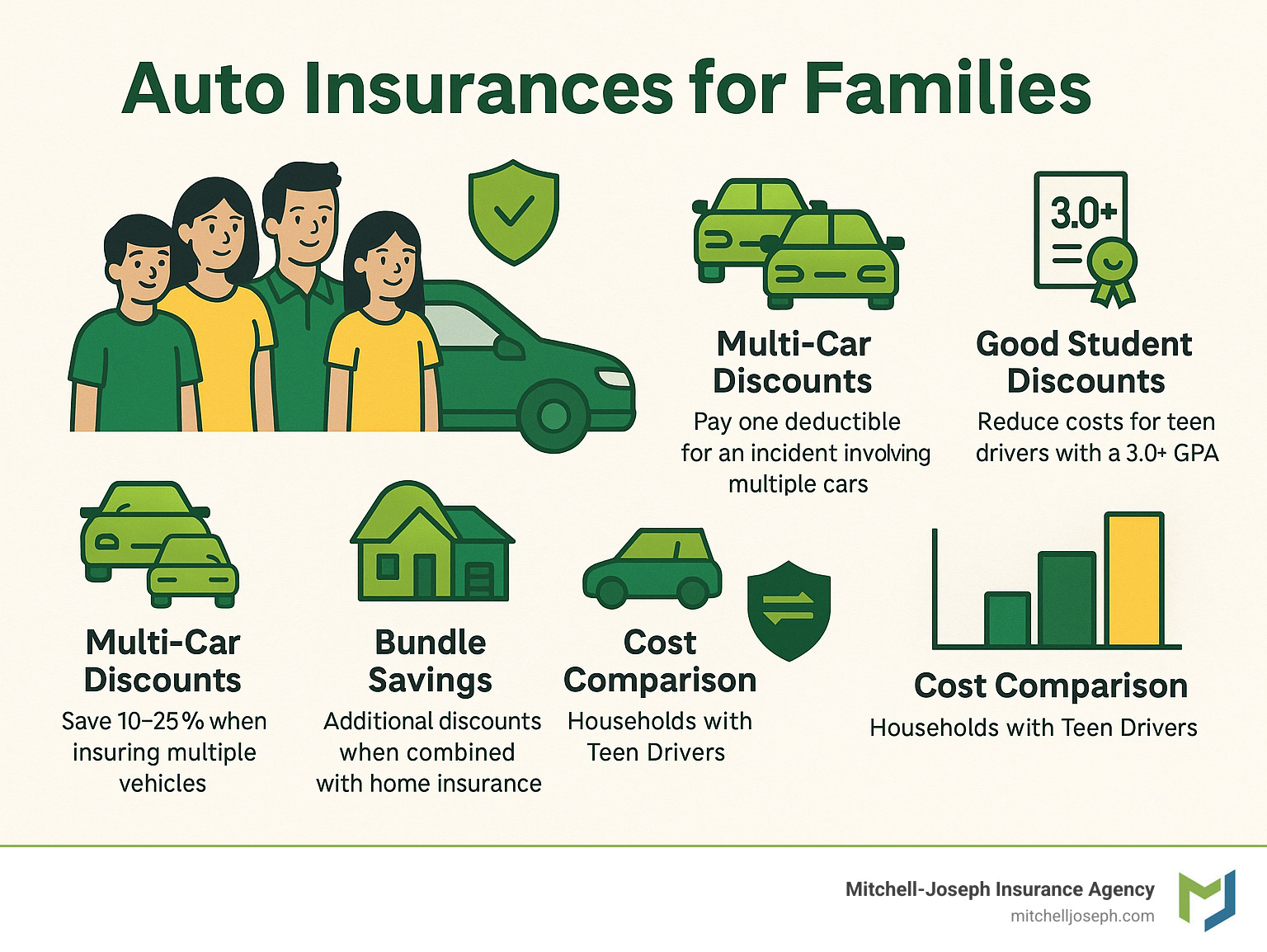
– Multi-car discounts – Save 10-25% when insuring multiple vehicles
– Single deductible – Pay only one deductible if multiple cars are damaged in the same incident
– Combined coverage limits – Pool coverage across vehicles for larger claims
– Simplified billing – One payment date and contact point for all vehicles
– Good student discounts – Reduce teen driver costs with 3.0+ GPA requirements
– Bundle savings – Additional discounts when combining with home insurance
The numbers tell the story clearly. Adding a 16-year-old driver to your family policy can triple your rates, but keeping them on the family plan still costs less than separate coverage. According to recent data, full coverage for a married couple with one teen averages $537-682 monthly, while families can offset these higher costs through strategic discounts and proper vehicle assignments.
When your child gets their license, the best way to save is to add them to your policy – and while it’s still going to be expensive, family policies make it manageable. The key lies in understanding how to structure your coverage, maximize available discounts, and choose the right vehicles for different drivers.
I’m Jeffrey Joseph, and I’ve been helping families in the Finger Lakes region steer auto insurance decisions since 1999 at Mitchell-Joseph Insurance Agency. Through decades of experience with auto insurance for families, I’ve seen how the right policy structure can save thousands while providing better protection than multiple individual policies.
Auto insurance for families terms at a glance:
– auto insurance for business owners
– auto insurance rochester
Auto Insurance for Families: How It Works
Think of auto insurance for families as your household’s safety net on wheels. It’s a multi-car policy that brings all your vehicles and drivers together under one comprehensive plan, creating a unified approach to protecting everyone who matters most to you.
Here’s the beautiful simplicity of it: Instead of juggling separate policies for each family member, everyone shares one master policy with customized coverage for each vehicle. All the drivers in your household get listed on the policy, and each car gets its own coverage selections – whether that’s basic liability to meet state requirements or full comprehensive and collision protection.
The policy covers all the standard bases you’d expect. Liability coverage handles the damages and injuries you might cause to others (and it’s required in most states). Comprehensive coverage steps in when life throws curveballs like theft, vandalism, or that surprise hailstorm. Collision coverage takes care of repairs when you have an unfortunate meeting with another vehicle or that sneaky mailbox.
What makes family policies truly special is something called permissive use. This means any family member can hop in any covered vehicle and still be protected. Your teenager can borrow your car for a school event, or you can drive your spouse’s vehicle to work – everyone stays covered.
At Mitchell-Joseph Insurance Agency, we’ve been helping families structure these policies since 1999. With access to 24 different insurance companies and over 200 years of combined experience, we know how to find that sweet spot between savings and protection for your household’s unique needs. More info about auto insurance services
Why Auto Insurance for Families Beats Single-Car Policies
The math alone makes auto insurance for families a smart choice – most families save 10-25% compared to buying separate policies. But the real advantages go way beyond the numbers.
Picture this scenario: A hailstorm hits your neighborhood and damages three cars sitting in your driveway. With individual policies, you’d pay three separate deductibles. With a family policy, you pay just one deductible for the entire incident. That single benefit can save you hundreds or even thousands of dollars when Mother Nature decides to throw a tantrum.
The billing simplicity is honestly a game-changer for busy families. No more juggling multiple due dates, payment methods, or policy numbers. You get one monthly bill and one point of contact for all your vehicles. It’s like having a personal assistant for your insurance needs – everything stays organized and manageable.
Some states even allow combined coverage limits within family policies. If one vehicle needs expensive repairs that exceed its individual limits, you might be able to pool coverage from other vehicles on the policy. It’s like having a family emergency fund built right into your insurance.
Coverage Options Every Household Should Consider
Let’s be honest – state minimum coverage might look tempting when you’re trying to keep costs down, but it’s often like bringing a butter knife to a sword fight. Most state minimums only cover $25,000-50,000 in property damage and bodily injury, amounts that disappear faster than ice cream on a hot summer day in today’s expensive repair and medical world.
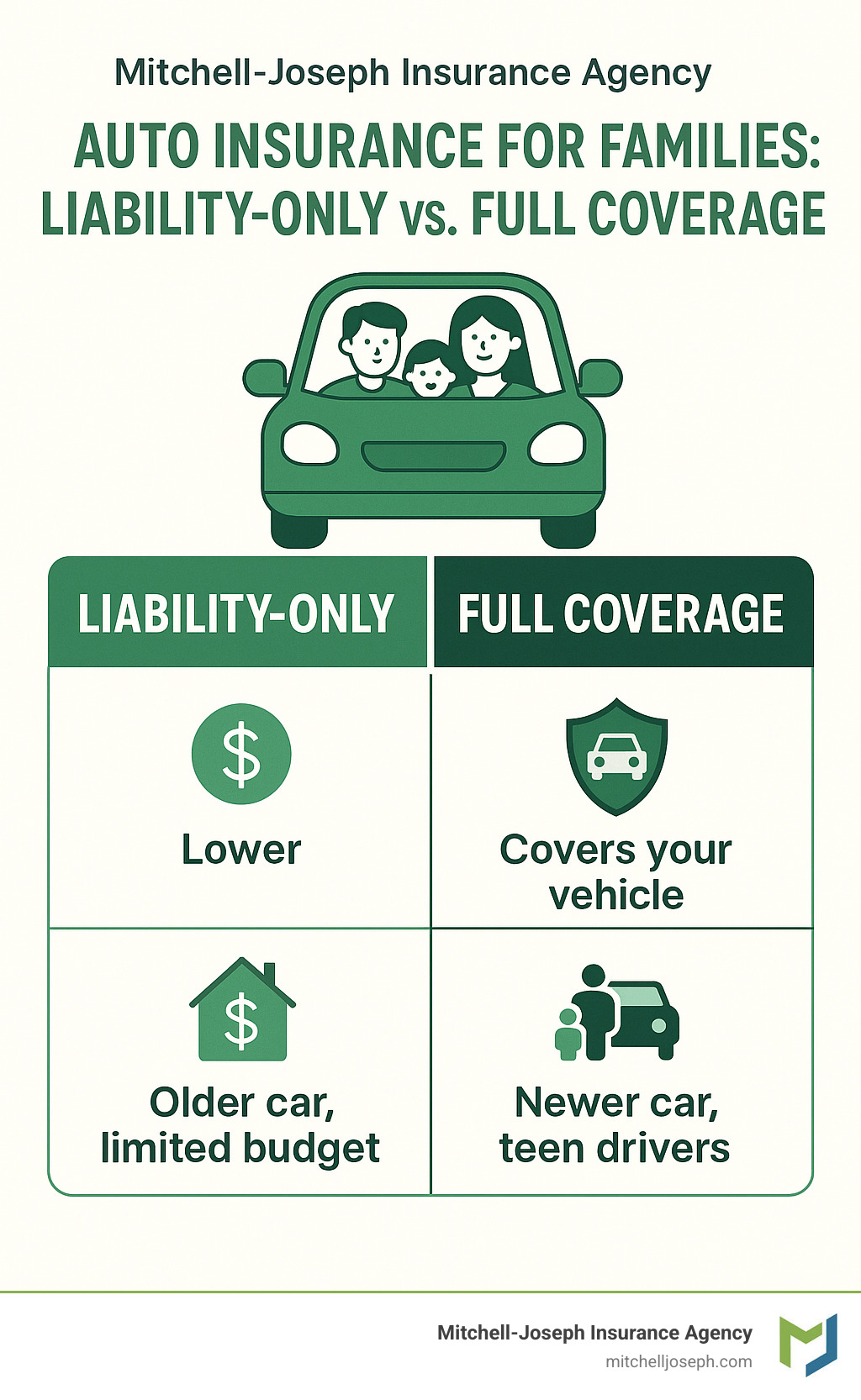
Full coverage is where families find real peace of mind. This includes comprehensive and collision protection for your own vehicles against damage, theft, and total loss. If you’re financing or leasing any vehicles, your lender will require this coverage anyway – they want to protect their investment just as much as you do.
Uninsured motorist coverage is absolutely crucial for families. With roughly 13% of drivers nationwide cruising around without insurance, this coverage fills a critical gap when the at-fault driver can’t pay for the damage they cause. Think of it as your backup plan for someone else’s poor planning.
Don’t overlook the smaller add-ons that can make a big difference. Roadside assistance covers emergency towing and jump-starts when you’re stranded. Rental reimbursement keeps your family mobile while your vehicle is being repaired. These relatively inexpensive options can save significant out-of-pocket costs during already stressful situations. More info about rental reimbursement
Benefits, Discounts & Bundling Strategies

The beauty of auto insurance for families lies in the layering of savings opportunities. Think of it like a financial puzzle where each piece – from multi-car discounts to good student rewards – fits together to create substantial savings.
Your multi-car discount is the foundation, typically saving 10-25% right off the bat. But that’s just where the savings begin. If you have a teen driver who maintains a 3.0 GPA or higher, you’ll open up good student discounts that can significantly offset those higher young driver premiums.
Safe driver discounts reward your family’s clean driving records, while telematics programs take this a step further. These smartphone apps or plug-in devices track your actual driving habits – things like smooth braking, gentle acceleration, and avoiding late-night drives. The safest drivers can save up to 30% through these programs.
Here’s something many families don’t realize: your homeowner status actually affects your auto insurance rates. Homeowners typically pay about 2% less than renters because insurance companies have found they tend to be more stable and file fewer claims.
Even your marriage status matters. Married drivers pay roughly 5-6% less than single drivers – about $134 monthly versus $147 for singles. Insurance companies have decades of data showing married folks tend to drive more cautiously.
The real magic happens when you bundle your home and auto insurance. This combination can save up to 25% on both policies combined, often adding up to over $950 annually for many families. Adding life insurance to the mix can open up even more savings. Scientific research confirms that customers who bundle multiple products report higher satisfaction with their overall insurance experience.
Stretching Your Budget with Bundles
Smart bundling goes way beyond just putting your cars together on one policy. When you combine your home and auto insurance, you’re tapping into some of the biggest savings available in the insurance world.
The numbers are compelling. Many families save over $950 annually through auto-home bundles, and the convenience factor is huge too. One bill, one agent, one phone call when you need help.
Don’t overlook umbrella policies if you have significant assets to protect or teen drivers in the house. These provide extra liability coverage above your regular auto and home limits, and they often come with bundle discounts when added to existing policies. It’s like having a financial safety net that actually pays you back through discounts.
Even if you’re renting, you can still play the bundling game. Renters insurance combined with auto coverage delivers meaningful savings, plus you get that simplified combined billing that makes managing your budget so much easier.
At Mitchell-Joseph Insurance Agency, we’ve been helping families in the Rochester area and throughout the Finger Lakes region find the perfect bundle combinations since 1999. Being independent means we can shop your bundle across 24 different insurance companies to find the sweet spot between savings and coverage. More info about auto insurance in Rochester
Stacking Teen and Young-Driver Discounts
Let’s be honest – adding a teen driver to your policy feels like financial whiplash. But here’s the thing: you can fight back with strategic discount stacking. The key is combining multiple discounts instead of hoping one discount will solve everything.
Start with the good student discount. Most insurers require a 3.0 GPA or higher, and this discount can make a real dent in those sky-high teen premiums. It’s also a great motivator for keeping grades up – suddenly that B+ in chemistry has real-world value.
Defensive driving courses often provide additional discounts and teach skills that actually make your teen safer on the road. Some insurers even require these courses for young drivers, so you might as well get the discount while building better driving habits.
If your teen is heading to college more than 100 miles from home, the away-at-school discount can provide meaningful relief. Since they won’t have regular access to the family cars, the risk – and the premium – goes down.
Telematics apps can be particularly powerful for responsible teen drivers. These programs monitor driving behavior and reward safe habits with premium reductions that can reach 30% for the safest drivers. Yes, your teen might grumble about being monitored, but the savings speak louder than complaints.
The crucial thing to remember is that even one traffic violation can wipe out years of good-driver discounts. That’s why investing in proper driver education and emphasizing safe driving habits isn’t just about safety – it’s about protecting your family’s financial future too.
Cost Factors & Premium-Lowering Tips
When it comes to auto insurance for families, understanding what drives your costs is like having a roadmap to savings. Some factors you can control, others you can’t – but knowing the difference helps you make smarter decisions about your coverage.
Driver age hits hardest on family budgets. A teen driver can cost $5,840 annually to insure, while that same coverage would only run $2,373 for a 45-year-old parent with good credit and a clean driving record. It’s a tough pill to swallow, but there are ways to soften the blow.
Your credit score affects premiums in most states – better credit means lower rates. It might seem unfair, but insurance companies have found strong correlations between credit responsibility and driving responsibility. The good news? Improving your credit helps both your insurance rates and your overall financial health.
Vehicle type makes a huge difference too. That flashy sports car might look great in the driveway, but it’ll look expensive on your insurance bill. Sports cars and luxury vehicles cost more to insure because they’re pricier to repair and more attractive to thieves. A practical sedan or SUV keeps both repair costs and premiums more manageable.
Annual mileage is another factor you can control. Drive less, pay less – it’s that simple. Many insurers offer low-mileage discounts for drivers who stay under certain annual limits.
Your ZIP code plays a bigger role than you might expect. Urban areas typically see higher rates due to increased risks of accidents, theft, and vandalism. While you probably won’t move just for cheaper insurance, it’s worth knowing how location affects your rates.
Here’s something many families don’t consider: your claim history follows you for years. Sometimes it’s smarter to pay for minor repairs out-of-pocket rather than file a claim. That claims-free discount you’ve built up over years might be worth more than the immediate payout from a small claim.
At Mitchell-Joseph Insurance Agency, we’ve spent decades helping families steer these cost factors. Our experience serving communities throughout Victor, Canandaigua, Pittsford, and the surrounding Finger Lakes region gives us insight into local factors that affect your rates. More info about premium factors
How Adding a Teen Driver Affects Rates
Let’s be honest – adding a teen driver to your auto insurance for families policy is going to hurt your wallet. Adding a 16-year-old with their own car can triple your rates. If you’re adding a second teen driver, expect rates to jump by around 47%. But don’t panic – there are smart ways to manage this financial hit.
Vehicle assignment is your secret weapon. Pair your teen with an older, less expensive car, and you’ll save significantly on both collision and comprehensive coverage. A teen driving a 10-year-old sedan costs far less to insure than one behind the wheel of a new SUV. Plus, if they dent the older car learning to parallel park, you won’t lose sleep over it.
Many insurers offer teen driver practice programs or graduated licensing discounts that reward completing driver education courses. These programs don’t just improve safety – they can provide premium reductions that help offset those sky-high teen rates.
Timing matters too. Some families benefit from adding their teen to the policy when they get their learner’s permit. This allows them to gain experience under the family policy’s protection while potentially qualifying for early enrollment discounts. It’s like getting a head start on building their insurance history.
The key is thinking strategically about how to structure your coverage. Yes, teen drivers are expensive to insure, but keeping them on the family policy is still much cheaper than separate coverage.
Should Young Adults Stay on the Family Policy?
This question keeps many parents up at night, especially when their college graduate moves back home or starts their first job. The answer usually depends on age, living situation, and marital status.
For college students, staying on the family policy almost always makes financial sense. The away-at-school discount can provide meaningful savings, and students can maintain coverage even while living in dorms or apartments near campus. They just need to list their parents’ home as their permanent address.
Young adults in their early twenties typically benefit from staying on the family policy too. Even though their individual rates start dropping, losing the multi-car discount and bundling benefits often makes separate coverage more expensive. The math usually favors the family policy until the mid-twenties.
The break-even point typically hits somewhere in the mid-twenties, when individual rates drop enough to compete with family policy benefits. But this varies significantly based on driving record, location, and vehicle type.
Marriage changes everything. When young adults get married, they can start their own family policy and begin building their own multi-car and bundling discounts. At this point, separate coverage often makes more sense both financially and practically – plus, they’re starting their own family insurance journey.
We help families work through these decisions regularly. Every situation is unique, and what works for one family might not work for another. The key is running the numbers and considering both current costs and future savings opportunities.
Shopping, Comparing & Switching Family Policies
Shopping for auto insurance for families feels overwhelming at first – you’re juggling information for multiple drivers, several vehicles, and trying to compare coverage options that seem to change with every quote. But here’s the thing: a little preparation upfront can save you hundreds (or even thousands) of dollars annually.
The key difference between shopping for individual coverage and family policies is the complexity. You’re not just getting a quote for yourself and your car anymore. You’re coordinating coverage for everyone in your household, from your spouse to that teenager who just got their license and makes your heart skip a beat every time they drive away.
Online quoting has come a long way, and many insurers can now handle comprehensive family quotes through their websites. But honestly, complex family situations often benefit from the human touch. When you’re dealing with teen drivers, multiple vehicles, or unique coverage needs, an experienced agent can explain the nuances that online forms just can’t capture.
At Mitchell-Joseph Insurance Agency, we’ve seen how our independent status makes a real difference for families. With access to 24 different insurance companies, we can find combinations of coverage and pricing that single-company agents simply can’t offer. Scientific research confirms what we’ve experienced – customers working with knowledgeable agents report higher satisfaction with their insurance experience. More info about auto insurance quotes
Information You Need for a Family Quote
Getting accurate quotes means having your ducks in a row before you start calling or clicking. Trust me, there’s nothing more frustrating than getting halfway through a quote and realizing you need to hunt down your teenager’s driver’s license number.
Start with the basics: full names and dates of birth for every household driver. This includes that 15-year-old who’s counting down the days until they can get their learner’s permit – many insurers want to know about them too, even if they’re not driving yet.
Driving records are crucial, and insurers typically look back five years for tickets, accidents, or violations. Some look back even further for serious issues like DUIs. If you’re not sure about someone’s driving record, most states let you request a copy online for a small fee.
Vehicle information needs to be precise. The VIN (vehicle identification number) is the gold standard – it tells insurers exactly what they’re covering, including safety features that might qualify for discounts. You’ll also need the exact make, model, and year, plus current mileage.
Don’t forget about annual mileage estimates for each vehicle. That car your college student drives only on weekends costs less to insure than your daily commuter vehicle. The difference between 5,000 miles per year and 15,000 miles can be significant.
The garaging address where vehicles are primarily kept affects your rates more than you might expect. Even if family members are temporarily living elsewhere (like college students), the primary location where the car “sleeps” determines much of the rate calculation.
Auto Insurance for Families: Smart Comparison Checklist
Here’s where many families make a costly mistake: they compare quotes without ensuring they’re truly comparing apples to apples. A quote that looks cheaper might have higher deductibles, lower coverage limits, or missing coverages that could leave you exposed.
Make sure every quote includes identical coverage limits and deductibles. If one quote has $100,000 in liability coverage and another has $300,000, you’re not making a fair comparison. The same goes for comprehensive and collision deductibles – a $500 deductible will cost more than a $1,000 deductible, but you’ll pay less out-of-pocket if you need to file a claim.
Financial strength ratings matter more than most people realize. Look for companies with A.M. Best ratings of A- or higher. These ratings indicate the company’s ability to pay claims reliably. A slightly higher premium with a financially stable company beats a bargain rate from a company that might struggle to pay claims when you need them most.
Claims service reputation becomes especially important for auto insurance for families because, statistically, you’re more likely to file claims with multiple drivers and vehicles. Research customer satisfaction ratings and read reviews about how companies handle claims. Do they make the process smooth, or do they make you jump through hoops?
Consider the availability of local service. While online account management is convenient for routine tasks, complex claims or coverage questions often benefit from talking to a real person who understands your situation.
Finally, think about payment flexibility. Some families prefer paying annually to avoid monthly fees, while others need the budget predictability of monthly payments. Some insurers offer discounts for automatic payments, while others charge fees for monthly billing.
Conclusion
Finding the right auto insurance for families can feel overwhelming at first, but it’s one of the smartest financial moves you can make for your household. The savings opportunities are real – from those 10-25% multi-car discounts to the strategic bundling options that can save you nearly $1,000 annually.
What matters most is getting personalized advice that fits your family’s unique situation. Every household is different, whether you’re dealing with your first teen driver, managing multiple vehicles, or trying to balance comprehensive coverage with a tight budget.
At Mitchell-Joseph Insurance Agency, we’ve been helping families in the Rochester area and throughout the Finger Lakes region make these important decisions since 1999. Our family-owned business understands that insurance isn’t just about policies and premiums – it’s about protecting the people you care about most.
With access to 24 different insurance companies and over 200 years of combined experience on our team, we can compare options that many families never even know exist. We’re not tied to just one company’s products, which means we can truly shop around to find your best deal.
The insurance world keeps changing, with new discount programs and coverage options appearing regularly. Telematics programs that reward safe driving, improved bundling opportunities, and improved digital tools all create new ways to save money while getting better protection.
But here’s what hasn’t changed: the value of working with people who know the business inside and out. We take the time to explain your options, answer your questions, and make sure you understand exactly what you’re buying. No insurance jargon, no pressure – just honest advice from neighbors who’ve been doing this work for decades.
Your family deserves both great protection and fair prices. Whether you’re in Victor, Canandaigua, Pittsford, or anywhere else in our service area, we’re here to help you find that perfect balance.
Ready to see what auto insurance for families can do for your household? Give us a call or stop by our office in Honeoye Falls. Let’s review your current coverage and explore how the right policy structure can improve both your peace of mind and your budget. More info about auto insurance in Rochester
After all, your family’s safety and financial security are too important to leave to chance.

