

Finding Your Perfect Travel Companion Without Breaking the Bank
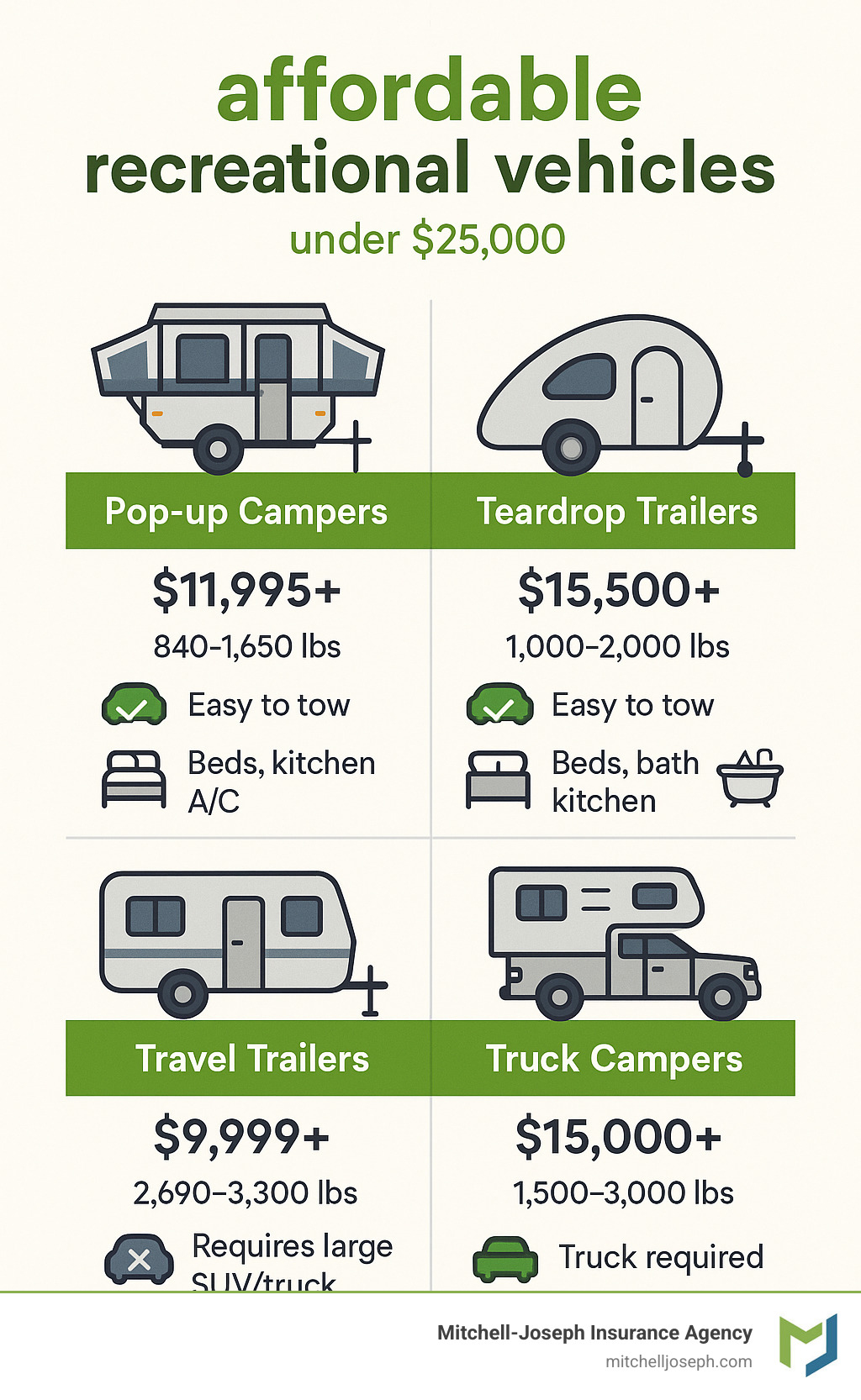
Affordable recreational vehicles are now more accessible than ever, with many quality options available under $25,000. If you’re looking for budget-friendly RVs that still offer comfort and functionality, here’s what you need to know:
| RV Type | Starting Price | Weight Range | Best For |
|---|---|---|---|
| Pop-up Campers | $11,995+ | 840-1,650 lbs | Easy towing, beginners |
| Teardrop Trailers | $15,500+ | 1,000-2,000 lbs | Solo/couples, off-road |
| Travel Trailers | $9,999+ | 2,690-3,300 lbs | Families, weekend trips |
| Truck Campers | $15,000+ | 1,500-3,000 lbs | Versatility, off-grid |
The RV camping lifestyle doesn’t have to cost a fortune. Many manufacturers now offer feature-rich models with surprisingly affordable price tags. The 2025 Keystone Coleman 13B, for example, retails for just $9,999 and includes a bathroom, kitchen, and sleeping space – proving you don’t need to sacrifice comfort for affordability.
Today’s budget-friendly RVs come with impressive standard features that were once considered premium upgrades. Many models under $16,000 include:
- Functional kitchens with two-burner stoves
- Onboard bathrooms (dry or wet)
- Comfortable sleeping areas for 3-7 people
- Solar-ready electrical systems
- Lightweight designs towable by SUVs
The best part? Many dealers offer significant discounts from MSRP. That Keystone Springdale 1400RE with an $18,804 sticker price? Savvy shoppers can often negotiate it down to around $11,000.
I’m Jeffrey Joseph from Mitchell-Joseph Insurance Agency, and I’ve spent over two decades helping RV enthusiasts find the right coverage for their affordable recreational vehicles while providing guidance on minimizing ownership costs and maximizing protection.
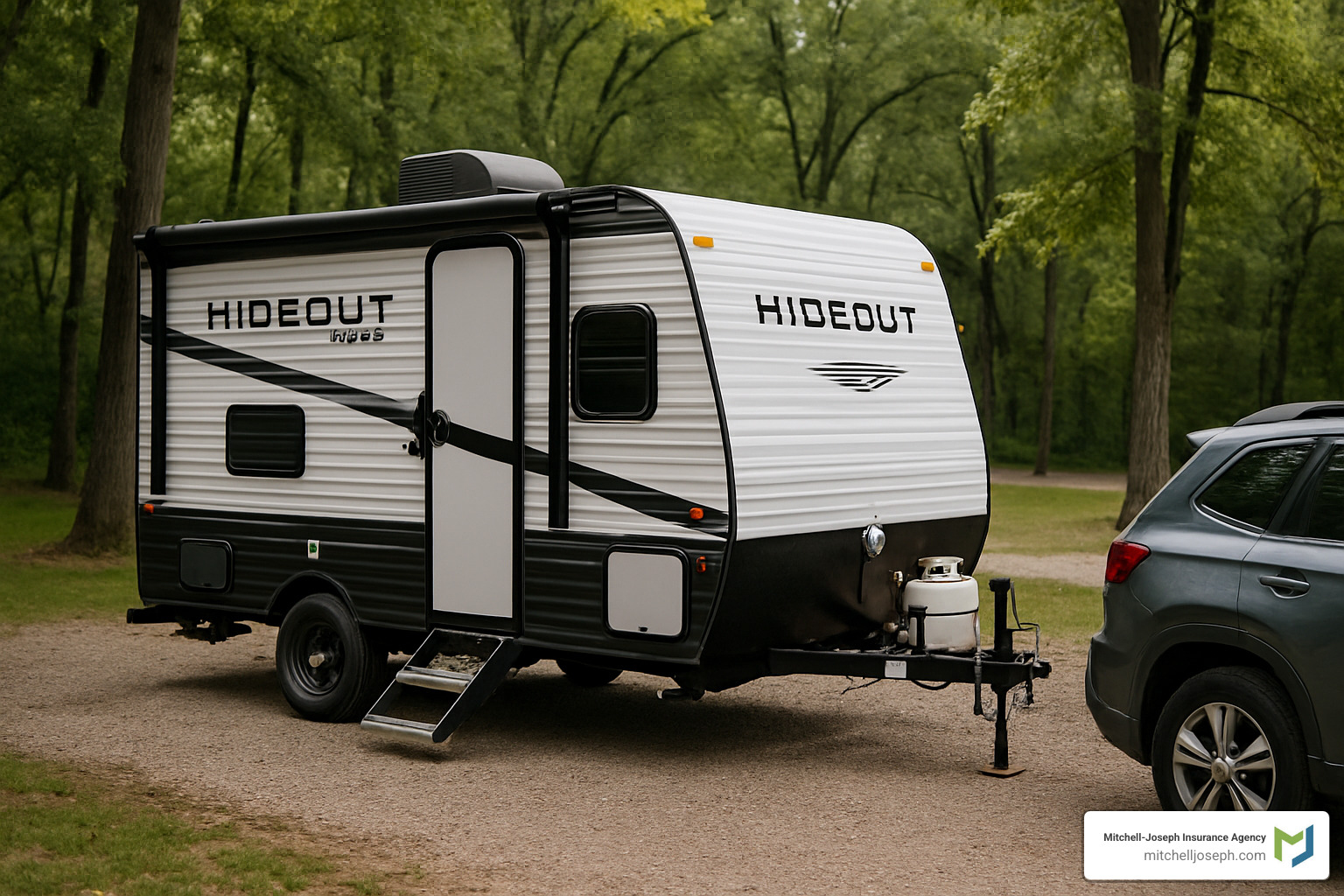
Keystone Hideout Sport Single-Axle
If you’re dipping your toes into the camping lifestyle, the Keystone Hideout Sport Single-Axle might just be your perfect match. This little gem starts at around $17,025 – making it one of the most affordable recreational vehicles that doesn’t skimp on comfort or functionality.
What makes the Hideout Sport so special? For starters, it’s incredibly practical for first-timers. Weighing in at just 3,300 pounds dry, you won’t need to trade in your family SUV for a heavy-duty truck – most mid-size vehicles can handle this lightweight trailer with ease.
The popular 175BH floorplan feels surprisingly spacious despite its compact footprint. Up front, you’ll find a cozy queen bed where you can actually stretch out after a day of trip. The kids (or your friends) will love the bunk beds, and altogether, this little trailer can sleep up to 6 people comfortably. The two-burner galley kitchen might not be chef-grade, but it’s perfect for whipping up pancakes or heating soup after a hike.
“We never thought camping could be this comfortable without spending a fortune,” shares Emma from Rochester. “Our Hideout has transformed our family weekends – we’ve used it more in six months than we expected to in two years!”
Don’t let the budget-friendly price fool you – Keystone doesn’t cut corners where it matters. The stick-built frame with corrugated metal siding offers surprising durability for the price point. While it’s not the luxury model with all the bells and whistles, proper care will keep this trailer creating memories for many seasons to come.
I especially appreciate the thoughtful touches that come standard: a 13,500 BTU air conditioner for those sticky summer nights, a reliable gas/electric water heater, and a power awning that transforms your campsite into an outdoor living room. Many models now come solar-ready too – perfect if you’re dreaming of more remote trips down the road.
For new RVers still nervous about backing into campsites (we’ve all been there!), the single-axle design is actually a blessing in disguise. It makes the trailer more responsive and easier to maneuver into those tricky spots that seem designed to test your patience and marriage simultaneously.
Want to learn more about how these trailers hold up over time? Keystone’s research on RV durability offers fascinating insights into how they’re built to last, even at this accessible price point.
Jayco Jay Flight SLX 170BH
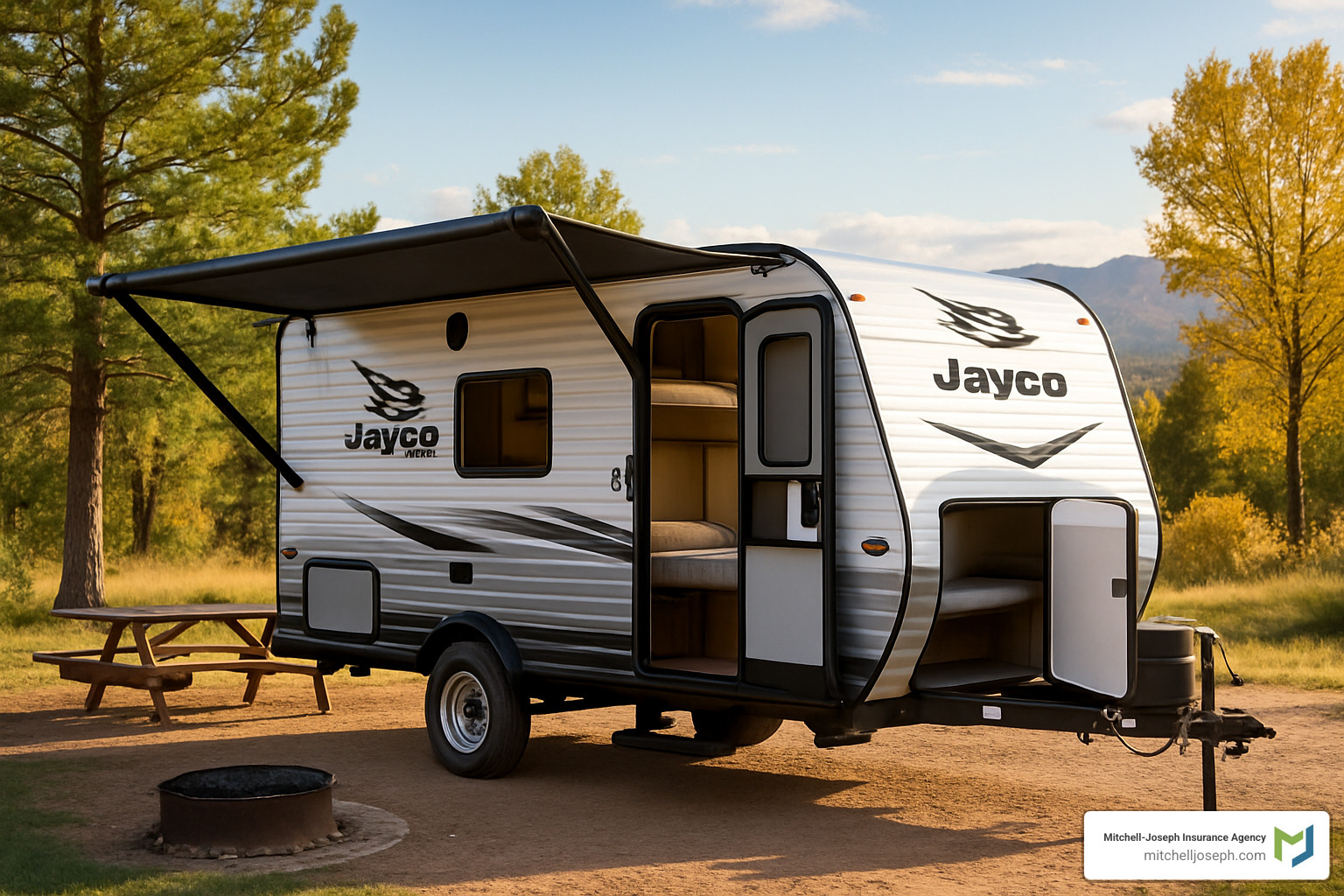
If you’re searching for affordable recreational vehicles that don’t skimp on quality, the Jayco Jay Flight SLX 170BH deserves your attention. Starting at $24,309, this lightweight marvel packs impressive features into a budget-friendly package that won’t leave you feeling like you’ve compromised.
At just 2,690 pounds unloaded (UVW), this nimble trailer can be towed by many family SUVs and crossovers – no heavy-duty truck required! This accessibility makes the Jay Flight SLX a perfect entry point for families new to RVing or those looking to downsize from bulkier rigs.
Families particularly love the thoughtful 170BH floorplan. The comfortable queen bed up front gives parents their own space, while the bunk beds provide kids with a sleeping area they can call their own. The surprisingly roomy galley kitchen features a two-burner cooktop that handles everything from morning pancakes to evening pasta dishes. And parents everywhere appreciate the full bathroom with tub/shower combo – making cleanup after adventurous days much easier!
What truly sets the Jay Flight apart from other trailers in this price range is Jayco’s commitment to quality construction. While other manufacturers might cut corners, Jayco uses screwed (not stapled) cabinetry that stands up to road vibrations. Their fully integrated A-frame and Magnum Truss Roof System can support up to 4,500 pounds – a testament to durability that exceeds what you’d expect at this price point.
“After comparing several models under $25,000, the Jay Flight’s build quality stood out immediately,” shares Sarah Miller, a camping enthusiast from Victor, NY. “Two years and dozens of trips later, everything still works perfectly – no rattles, leaks, or issues that often plague budget trailers.”
The standard 5,000 BTU air conditioner keeps things comfortable on warm summer nights, while the solar-ready design on all 2024 models makes it easy to add panels for off-grid trips. This forward-thinking feature means you can gradually upgrade your camping setup without complicated electrical modifications.
Perhaps most reassuring for new RV owners is Jayco’s industry-leading 2-year limited warranty – twice the coverage most manufacturers offer in this price range. This warranty covers manufacturer defects and workmanship issues, reflecting Jayco’s confidence in their product and providing valuable peace of mind for new owners.
For families balancing camping dreams with budget realities, the Jay Flight SLX 170BH delivers exceptional value that grows even more apparent the longer you own it. Its thoughtful design, quality construction, and family-friendly features make it one of the smartest investments in today’s affordable recreational vehicles market.
Scientific research on ultra-light trailers confirms that properly constructed lightweight models like the Jay Flight can offer durability comparable to heavier units when built with quality materials and engineering principles.
Coachmen Viking Pop-Up Camper
If you’re looking for truly affordable recreational vehicles that won’t empty your wallet, the Coachmen Viking Pop-Up Camper deserves a special place on your shopping list. Starting at just $11,995, these clever fold-out campers offer one of the most budget-friendly entries into the RV lifestyle without forcing you to leave the comforts of home behind.
What makes the Viking truly special is its incredible portability. With a dry weight of around 1,650 pounds, these nimble pop-ups can be towed by most family vehicles – your SUV, crossover, or even some sedans can handle the job. This means no expensive new tow vehicle purchase, saving first-time RV owners thousands right from the start.
The Viking’s ingenious design transforms from a compact, low-profile trailer during travel into a surprisingly spacious living area once you reach your destination. The tent-like expandable sections create generous headroom and comfortable sleeping spaces while keeping weight and wind resistance minimal – good news for your vehicle’s fuel economy too!
“We love how easy our Viking is to tow and set up,” shares James Thompson from Mendon, NY. “My wife and I can be fully set up in about 15 minutes. For weekend getaways, it’s perfect – we have all the comforts we need without the expense and hassle of a larger trailer.”
Despite its affordable price tag, the Viking doesn’t skimp on quality. Coachmen builds these campers with a sturdy steel frame, marine-grade tent material, and a one-piece roof to ensure durability and protection from the elements. The torsion axle suspension delivers a smoother towing experience than you might expect from a budget-friendly camper.
I’ve been particularly impressed with the Viking’s clever indoor/outdoor cooktop, which gives you flexibility in meal preparation regardless of weather. Nothing beats cooking breakfast outside on a beautiful morning, but when rain threatens, you can quickly move operations indoors.
The Viking comfortably sleeps 4-6 people depending on the model, making it perfect for small families or couples who occasionally bring along friends. The canvas sides feature zippered windows and screens that provide excellent ventilation on warm nights while keeping bugs at bay.
Storage is another area where the Viking shines. When folded for travel, its low profile allows it to fit in most standard garages – eliminating costly RV storage fees during the off-season. This practicality extends to the campsite, where thoughtful storage compartments help keep your gear organized despite the compact footprint.
For budget-conscious campers wanting to experience the RV lifestyle without a major financial commitment, the Coachmen Viking Pop-Up Camper represents exceptional value. It strikes that perfect balance between affordability, comfort, and ease of use that makes weekend trips accessible to almost anyone.
Timberleaf Pika Teardrop
There’s something undeniably charming about the Timberleaf Pika Teardrop that sets it apart from other affordable recreational vehicles. Starting at just $15,500, this little beauty combines artisanal craftsmanship with genuine off-road capability – all in a package you can tow with practically any vehicle.
Unlike the mass-produced options that dominate the market, each Pika is lovingly handcrafted with attention to detail you rarely find in this price range. The off-road chassis isn’t just for show, either. With independent suspension, rugged all-terrain tires, and extra ground clearance, this mighty mini trailer can follow your Subaru or Jeep to those secret camping spots where conventional RVs fear to tread.
Inside the cozy cabin, you’ll find a surprisingly comfortable queen-sized mattress that transforms the entire interior into your personal sleeping sanctuary. My favorite feature has to be the panoramic skylight – there’s nothing quite like drifting off to sleep while stargazing through crystal-clear plexiglass. The custom woodwork throughout the interior adds a touch of warmth and craftsmanship that makes the Pika feel more like a tiny cabin than a budget trailer.
When morning comes and it’s time for breakfast, the rear galley hatch swings up to reveal a cleverly designed outdoor kitchen area. Protected from the elements, this space typically offers storage for your cooking gear, a solid countertop for meal prep, and room for optional add-ons like a cooler or portable stove.
“We’ve taken our Pika places I never imagined possible with an RV,” shares Michael Chen, an outdoor enthusiast from Rochester. “Our Subaru Outback tows it effortlessly, even on steep mountain roads, and the craftsmanship is truly exceptional.”
What makes the Timberleaf Pika particularly special is how it combines handmade quality with genuine affordability. While $15,500 gets you the base model, most builds stay comfortably under $20,000 even with popular options added – remarkable value for something built with such care. And with its aircraft-grade aluminum frame, you can count on this little trailer to be your trip companion for many years to come.
The lightweight design – typically under 1,000 pounds – means virtually any vehicle with a hitch can tow a Pika. This accessibility makes it perfect for solo travelers or couples who want to explore the back roads without investing in a bigger tow vehicle. And with its tidy 5′ × 8′ footprint, you won’t struggle to find storage space during the off-season.
For those who value quality craftsmanship, off-road capability, and minimalist design, the Timberleaf Pika offers a compelling alternative to conventional RVs. It focuses on the essentials without unnecessary complications, resulting in a reliable, low-maintenance camping solution that brings joy to every trip.
SylvanSport GO
If you’re looking for an affordable recreational vehicle that truly breaks the mold, the SylvanSport GO deserves your attention. Starting at just $14,995, this remarkable 840-pound wonder is what would happen if a Swiss Army knife became a camping trailer – it transforms to meet almost any outdoor need you might have.
The GO isn’t just a camper; it’s a chameleon on wheels. I’ve watched owners’ faces light up as they demonstrate how their GO shifts from a sleek, low-profile trailer into a surprisingly spacious tent camper that comfortably sleeps four adults. The next day, that same trailer might be hauling kayaks to the lake or an ATV for trail trips.
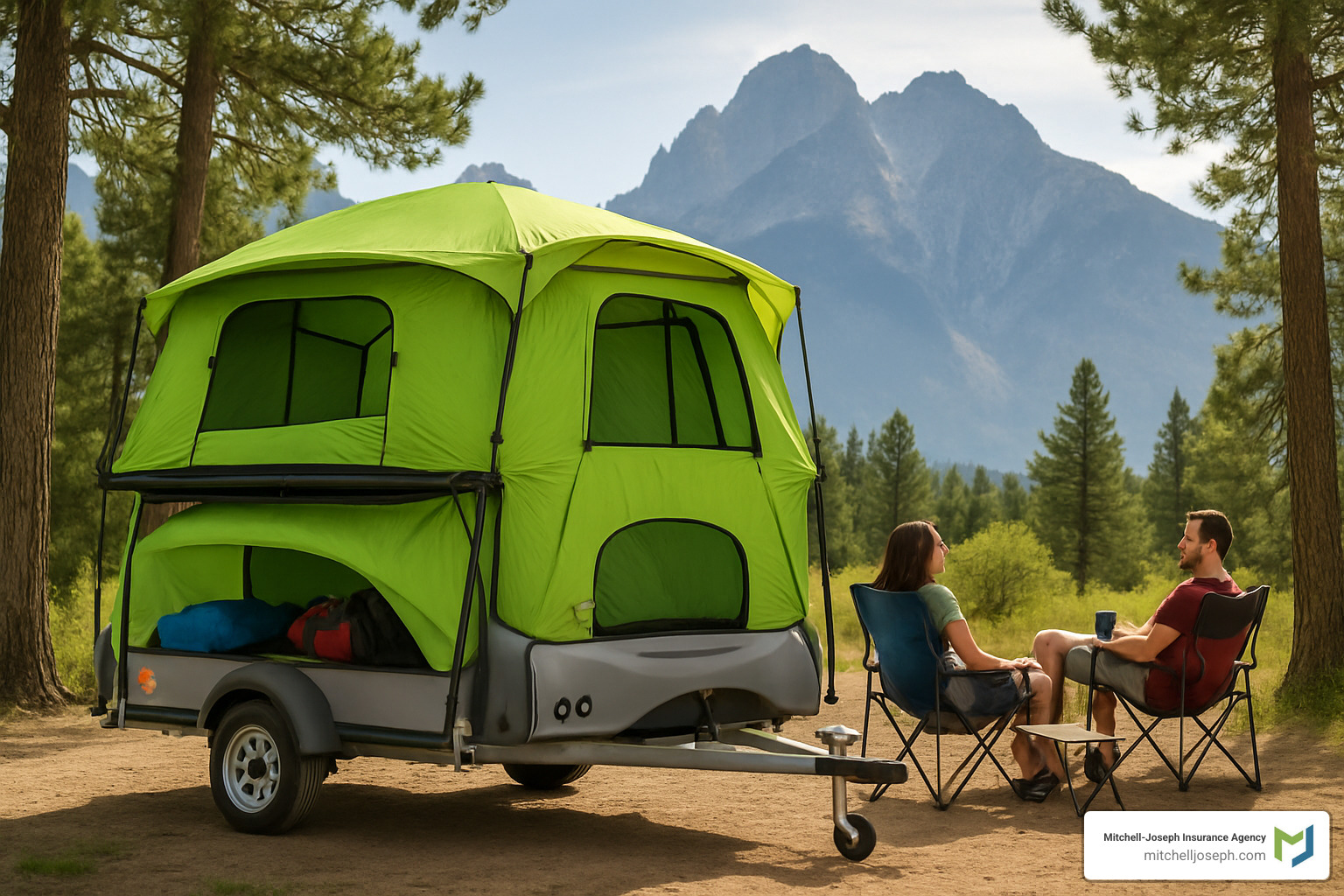
What makes the GO particularly special is its thoughtful engineering. The lightweight aluminum frame supports a tent system made from the same waterproof, ripstop materials you’d find in premium backpacking gear. When you arrive at your campsite, the platforms that secured your gear during transit convert into comfortable sleeping areas, with the main tent offering full standing height – no hunching required!
“We initially bought our GO to haul our mountain bikes and camping gear,” shared Lisa Donovan from Naples, NY, who I met at a recent camping expo. “But we’ve ended up using it for everything – furniture moving, kayak transport, and of course, camping trips. The versatility is incredible for the price.”
The quality of construction consistently exceeds what you’d expect at this price point. The anodized aluminum frame doesn’t just look good – it stands up to years of use and weather exposure. Many owners I’ve spoken with report excellent durability even when frequently switching between the unit’s various configurations.
For families with limited storage space, the GO offers another significant advantage. When folded down, its compact dimensions (approximately 11′ × 6′ × 4′) allow it to fit in most standard garages. This eliminates the need for separate RV storage fees – a hidden cost that can add hundreds to your annual camping budget.
Perhaps most impressively, the GO can be towed by virtually any vehicle with a hitch. I’ve seen them pulled by everything from compact cars to motorcycles. This accessibility means you won’t need to upgrade your family vehicle to enjoy weekend trips – another substantial cost savings that makes the GO an even better value.
For active outdoor enthusiasts who need their gear to be as adaptable as their lifestyle, the SylvanSport GO represents one of the most innovative and versatile solutions in the affordable recreational vehicles market today.
How to Score Affordable Recreational Vehicles & Keep Costs Down
Finding your perfect RV without emptying your bank account takes a bit of strategy – but don’t worry, I’ve got you covered! After helping hundreds of campers find their dream rigs, I’ve learned a few tricks about scoring affordable recreational vehicles and keeping ownership costs manageable.
Dealership Strategies
Timing can make all the difference when hunting for budget-friendly RVs. Fall in love with camping in July? Consider waiting until September or October when dealers are desperate to clear inventory. Those end-of-season clearance sales often feature discounts of 20-30% off MSRP as dealers make room for next year’s models.
RV shows are another goldmine for bargain hunters. I attended the Northeast RV Show last year and watched a family save nearly $4,000 on a Jayco trailer because three competing dealers were all trying to make sales targets. The natural competition creates a buyer’s market!
Don’t be shy about negotiation, either. Unlike car dealerships, RV prices typically include substantial markup. I’ve seen customers knock $7,000-8,000 off a $25,000 travel trailer simply by starting with a confident (but reasonable) offer. And those previous model year units? They’re practically identical to the newest versions but often sell for thousands less.
Alternative Purchase Channels
While dealerships are the most obvious place to shop, savvy buyers know to explore other options. Online marketplaces like RVTrader and Facebook Marketplace connect you directly with private sellers who typically offer better prices than dealerships – no middleman means more savings for you!
Auction sites can yield some incredible deals, though they do require cash purchases and offer limited inspection opportunities. Just last month, a client found a nearly-new Coachmen Viking at an online auction for 40% below retail value. The previous owner had used it exactly twice!
Rental fleet sales from companies like Cruise America offer well-maintained units at competitive prices. Yes, they’ll have higher mileage, but they’ve also received regular professional maintenance – a fair trade-off for the substantial savings.
Pre-Purchase Considerations
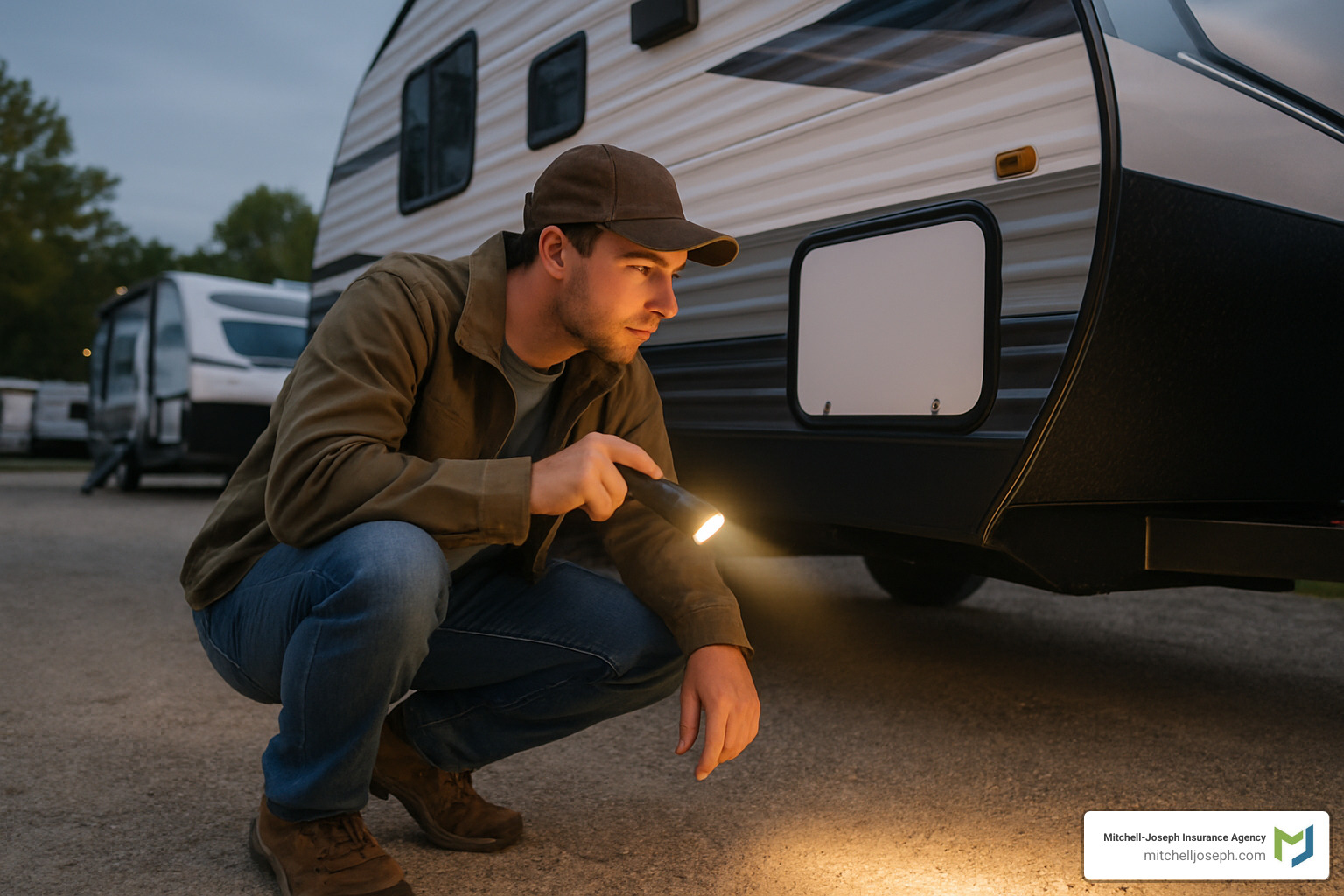
Before you sign on the dotted line, take a moment to ensure you’re making a smart purchase. The most common mistake I see? Buyers falling in love with trailers that exceed their vehicle’s towing capacity. This leads to unsafe driving conditions and often expensive vehicle upgrades that could have been avoided with proper planning.
For used units, consider investing $300-500 in a professional RV inspection. It might seem like an unnecessary expense, but I’ve seen inspectors catch potential $3,000 roof repairs that weren’t visible to the untrained eye. For new units, insist on a detailed Pre-Delivery Inspection with the dealer – this is your chance to catch issues before they become your problem.
Take time to research common problems with your chosen model. Every RV has its quirks, and online forums and owner groups can provide invaluable insights. A quick search might reveal that the model you’re considering tends to develop plumbing leaks near the bathroom – information you can use to negotiate a better price or guide your inspection.
Ownership Cost Management
Finding a great deal is only half the battle – keeping costs down after purchase is equally important. Learning basic DIY maintenance like sealant inspection, winterizing, and appliance servicing can save you hundreds each year. My neighbor taught himself to do his own RV winterization and now saves $200 annually on professional services.
If your neighborhood allows it, storing your RV at home eliminates monthly storage fees that typically range from $50-200. That’s potential savings of up to $2,400 per year just by parking in your own driveway!
Insurance optimization is another area where thoughtful choices make a big difference. At Mitchell-Joseph Insurance Agency, we help clients find the perfect balance of coverage and cost. Many RV owners don’t realize they qualify for multi-policy discounts or that their storage location and usage patterns can significantly impact their premiums. We’ve helped families save hundreds annually just by structuring their policies more efficiently.
For frequent campers, membership programs like Passport America and Harvest Hosts can reduce overnight camping costs by 50% or more. One family I worked with saved over $1,200 last summer using these discount programs across a dozen weekend trips.
Budget‐Friendly Upgrades for affordable recreational vehicles
You don’t need expensive modifications to improve your camping experience. Simple, cost-effective upgrades can transform your comfort level and functionality without breaking the bank.
Basic 100W solar kits now start around $200 and can keep batteries charged during day trips or weekend camping. This small investment expands your camping options by reducing your dependence on electrical hookups – perfect for those seeking more remote experiences!
Converting to LED lighting costs just $30-50 for most small RVs and reduces power consumption by up to 90%. This means longer operation on battery power and less generator noise disrupting your peaceful campsite. It’s a win-win!
RV mattresses in budget models are notoriously uncomfortable (I’ve heard them compared to “sleeping on a cutting board”). A quality 2-3″ memory foam topper for $80-150 can make all the difference between waking refreshed or with an aching back.
Power protection is perhaps the most important investment you can make. A basic surge protector ($50-100) prevents costly electrical system damage from inconsistent campground power. This small device can prevent repairs costing thousands – I’ve seen RVs with fried control boards because of power surges that a simple protector would have prevented.
Thermal curtains, water pressure regulators, and Bluetooth thermostats are other affordable upgrades that solve specific problems rather than just adding features. As renovation specialist Amanda Torres wisely advises, “Identify what aspects of your camping experience need improvement, then target those areas first for the best return on investment.”
Hidden Costs to Watch on affordable recreational vehicles
When budgeting for your new trip machine, be aware of these often-overlooked expenses that can catch new owners by surprise.
Those dealer preparation fees ($400-900) and document processing charges ($100-500) aren’t set in stone. While some preparation is legitimate, these fees are often inflated and negotiable. Don’t be afraid to question these charges – I’ve seen buyers get them reduced or even eliminated entirely.
Extended warranties are among the most aggressively pushed add-ons, often with 100%+ markup. If you want extended coverage (which can be valuable), research third-party options that typically cost 40-60% less than dealer offerings. The coverage is often identical or even better!
Financing terms deserve careful scrutiny. Dealer financing often carries higher interest rates than credit unions or banks. A seemingly small 2% rate difference on a $20,000 RV loan over 10 years represents nearly $2,000 in additional interest – money better spent on campground fees and trips!
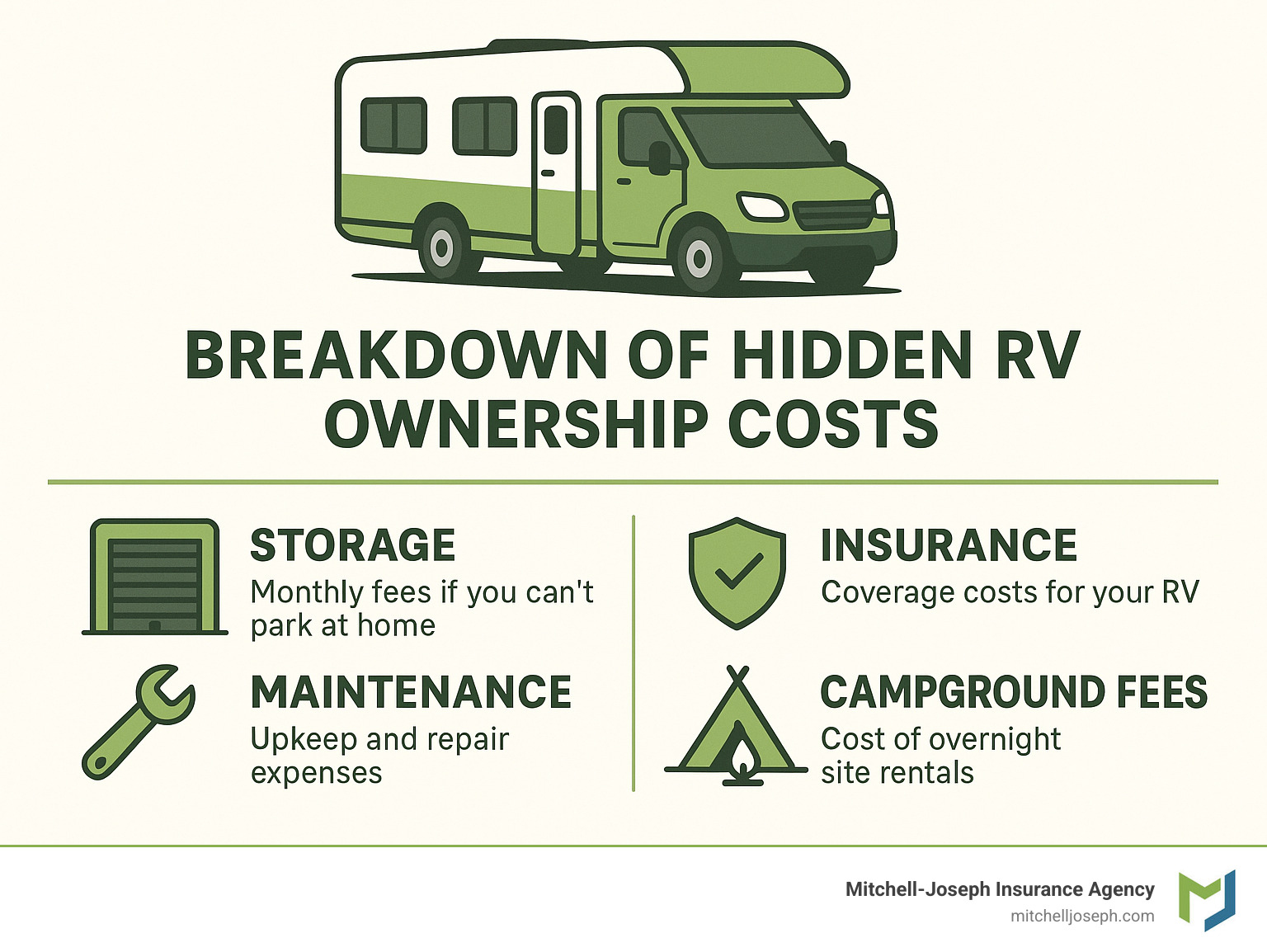
Storage costs can add up quickly if you can’t park at home. Indoor climate-controlled storage in premium areas can reach $250 monthly – that’s $3,000 annually just to park your RV! Insurance is another ongoing expense, with basic coverage starting around $300 annually for small trailers.
At Mitchell-Joseph Insurance Agency, we recommend comprehensive coverage that includes full replacement cost protection, emergency expense coverage, personal effects coverage, and roadside assistance. This comprehensive approach might cost a bit more upfront but provides invaluable peace of mind when you’re miles from home.
Regular maintenance requires budgeting 2-3% of your RV’s value annually. For a $20,000 trailer, that’s $400-600 yearly for regular service. Campground rates have increased dramatically in recent years, with popular destinations now charging $50-100 per night during peak season.
Don’t forget the impact on your vehicle’s fuel efficiency. Towing typically reduces MPG by 30-50%, substantially increasing travel costs. A vehicle that normally gets 25 MPG might drop to 12-17 MPG when towing – something to consider when planning trip budgets.
“Many first-time RV buyers focus exclusively on the purchase price without accounting for ongoing costs,” explains financial planner Robert Johnson. “The most financially successful RV owners are those who thoroughly research and budget for these hidden expenses before buying.”
By anticipating these costs and incorporating them into your planning, you can avoid unwelcome surprises and ensure your RV trip remains affordable for years to come. After all, the best camping memories come from enjoying the journey – not worrying about unexpected expenses!
More info about auto insurance services
Frequently Asked Questions About Budget RV Shopping
What defines an “affordable” RV today?
When people ask me about affordable recreational vehicles, I usually tell them that today’s sweet spot is generally under $25,000. But honestly, affordability varies quite a bit depending on what type of RV you’re considering.
For pop-up campers, you’re looking at roughly $8,000-15,000 for something nice that won’t break the bank. Teardrop trailers typically run $12,000-20,000 in the affordable range, while travel trailers and truck campers both fall into the $15,000-25,000 bracket. If you’re interested in a motorized option, used Class B or C motorhomes can sometimes be found in the $50,000-85,000 range – though that’s pushing the definition of “affordable” for many families.
The good news is that manufacturers have really stepped up their game in recent years. I’ve been helping RV owners find insurance for over two decades, and the value proposition has improved dramatically. The $20,000 travel trailer you can buy today often includes features that were only available in much pricier models just a few years ago.
Most budget-friendly RVs now come standard with power awnings, LED lighting throughout, solar pre-wiring, Bluetooth speakers, USB charging ports, and better mattresses than we used to see. Manufacturers typically save money by using more affordable materials – think laminate countertops instead of solid surface, vinyl flooring instead of tile, and aluminum framing rather than steel – but the functionality remains impressive.
New vs. used—what’s the smarter buy under $25k?
This is probably the question I hear most often at Mitchell-Joseph Insurance Agency. The truth is, both options have their merits when shopping for affordable recreational vehicles.
With new RVs, you’ll enjoy that full manufacturer warranty (typically 1-2 years), the latest features and floor plans, and the peace of mind knowing there’s no hidden damage lurking. Financing terms are usually more favorable, and if you order directly, you might even have some customization options.
On the flip side, used RVs offer significantly more bang for your buck – often 30-40% more RV for the same money. The steepest depreciation has already occurred (typically 20-30% in those first few years), and sometimes the previous owner has added valuable upgrades. I’ve seen clients find premium brand RVs at budget prices simply by shopping the used market carefully.
“The sweet spot for used RVs is typically 3-5 years old,” as my friend Thomas Reynolds, an RV appraiser, always says. These units have taken their biggest depreciation hit but are still modern enough to include the features most people want.
When I’m helping friends shop for used RVs, I always tell them to prioritize evidence of regular maintenance, carefully check for water damage (the absolute worst issue you can encounter), verify that all systems work properly, examine the condition of tires, batteries and seals, and confirm the title is clean with no accident history.
For new RVs, focus instead on build quality, warranty terms, how well the floor plan works for your specific needs, weight considerations for your tow vehicle, and which features come standard versus optional.
From what I’ve seen helping hundreds of RV owners with their insurance needs, well-maintained used RVs purchased from caring private sellers often represent the absolute best value in the market.
How do I estimate towing and fuel efficiency before I buy?
Understanding the real-world towing requirements and fuel impacts of affordable recreational vehicles is absolutely crucial if you want to avoid budget surprises down the road.
First, let’s talk towing capacity. The most important thing is to know your actual numbers – not just what a salesperson tells you. Find your vehicle’s specific towing capacity in your owner’s manual or on the door jamb sticker. Vehicle options can significantly impact these ratings, so don’t rely on general information about your model.
You’ll need to understand a few key terms. Dry Weight is what the RV weighs without fluids or cargo. GVWR (Gross Vehicle Weight Rating) represents the maximum allowed weight when fully loaded. Tongue Weight is the downward force on your hitch, typically 10-15% of the trailer’s total weight.
To calculate your real-world capacity, subtract passenger and cargo weight in your tow vehicle from its rated capacity. If your SUV is rated for 5,000 pounds but you’re carrying 800 pounds of people and gear, your effective capacity is only 4,200 pounds.
Here’s a tip I share with all my clients at Mitchell-Joseph Insurance: follow the 80% rule. For safety and performance, stay below 80% of your maximum capacity. With that 5,000-pound rating, you should aim for trailers under 4,000 pounds dry weight.
As for fuel efficiency, be prepared for a significant impact. Most vehicles experience a 30-50% reduction in fuel economy when towing. If you normally get 20 MPG, expect 10-14 MPG with a trailer behind you. Trailer aerodynamics make a difference too – teardrop trailers and pop-ups create less drag than tall travel trailers, resulting in better fuel economy.
When planning trips, I always suggest calculating fuel costs using the lower MPG figure and adding 10% for adverse conditions like mountains or headwinds. And remember that your speed makes a huge difference – towing at 55-60 MPH versus 70+ MPH can improve fuel economy by 15-20%.
“The most common mistake new RV owners make is underestimating towing impacts,” as my engineer friend Michael often reminds me. A midsize SUV rated for 5,000 pounds can technically tow a 4,500-pound trailer, but the experience will be stressful and potentially unsafe, especially in challenging conditions.
For the best experience with your affordable RV, choose a tow vehicle with capacity at least 20% above your fully loaded trailer weight, install a weight-distribution hitch for trailers over 3,000 pounds, consider adding a brake controller, and always monitor tire pressure in both vehicles.
And before you hit the road, give us a call at Mitchell-Joseph Insurance Agency to review your coverage. Many standard auto policies don’t fully address the unique risks of towing, and we want to make sure you’re properly protected for your trips.
Conclusion
The world of affordable recreational vehicles offers more exciting possibilities today than ever before. From the ingeniously lightweight SylvanSport GO at just 840 pounds to the impressively well-built Jayco Jay Flight SLX, budget-conscious triprs can find remarkable options under $25,000 that don’t compromise on the camping experience.
Throughout our exploration of budget-friendly RVs, we’ve finded that finding your perfect match involves balancing several key considerations. You’ll want to ensure your tow vehicle can comfortably handle your RV’s weight – not just on paper, but in real-world conditions like mountain passes and windy days. You’ll need to honestly assess which features truly matter for your camping style rather than paying for amenities that sound nice but rarely get used.
Beyond the sticker price, understanding the true cost of RV ownership makes all the difference in long-term satisfaction. From storage fees to maintenance requirements, being prepared for these ongoing expenses prevents unwelcome surprises down the road.
“I tell all my first-time buyers that research before purchase and maintenance after purchase are the twin pillars of RV satisfaction,” says RV technician Robert Williams. “An affordable recreational vehicle that receives proper care can deliver 15+ years of reliable service and countless family memories.”
The good news for today’s buyers is that manufacturing quality has improved dramatically in the budget segment. Many affordable models now use the same fundamental construction techniques as their premium counterparts. The differences typically appear in finishing materials and convenience features rather than structural elements that affect durability.
At Mitchell-Joseph Insurance Agency, we’ve helped hundreds of families across Honeoye Falls, Pittsford, Canandaigua and throughout the Rochester area protect their RV investments with thoughtfully designed insurance coverage. Our team understands that RVs aren’t just vehicles – they’re gateways to trip and family bonding time that deserve proper protection.
The most satisfied RV owners we work with share one common trait: they matched their purchase to their actual camping habits rather than aspirational ones. By focusing on how you’ll really use your RV instead of imagining unlikely scenarios, you can find an affordable option that brings years of enjoyment without unnecessary expense.
The open road beckons, and with today’s affordable recreational vehicles, trip is more accessible than ever. Whether you’re drawn to a nimble pop-up for weekend escapes or a comfortable travel trailer for extended journeys, there’s a budget-friendly option waiting to become your home away from home.
For more information about protecting your RV investment with appropriate insurance coverage, visit our auto insurance services page or contact our office in Honeoye Falls, NY. We’d be happy to help you find the perfect balance of protection and affordability for your new travel companion.

